
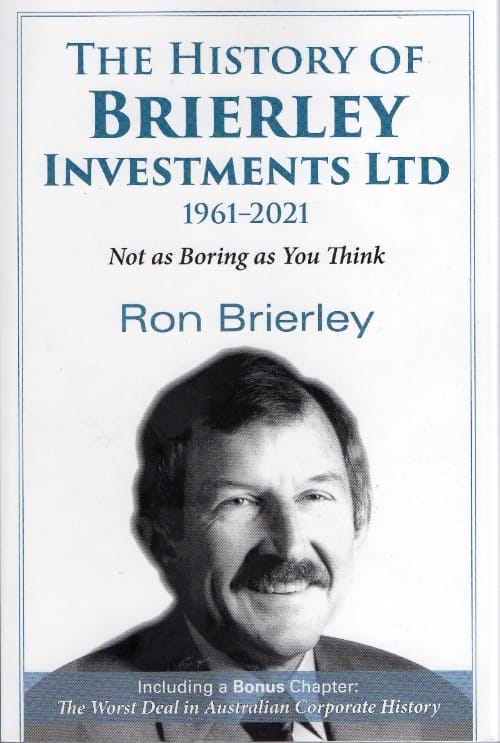
The History of Brierley Investments Ltd 1961-2021
Financial markets predator Ron Brierley emerges from his own book as a social animal. Hitherto considered an uber quant who only ventured into society under duress.
This we can assume is the reason that The History of Brierley Investments Ltd 1961-2021 is weirdly yet intuitively subtitled consumer warning style “Not as Boring as You Think.”
Yet here we find him a familiar figure in the drawing rooms of household names in the celebrity circuit internationally.
He was routinely entertained for example by Ron and Nancy Reagan and in one illustration we find him in a family lineup beside Margaret Thatcher.
He was no stranger to aristocracy or even Royalty as commemorated in the trademark greetings lineup photograph with the late Queen, only one of several such regal encounters.
He joked with the Duke of Wellington at Apsley House that he would learn Spanish as director of the Duke's South American railway.
Cricket celebrities abound. Donald Bradman, Keith Miller, and an on-the-wagon cross over figure Michael Parkinson who resents Ron's too candid appraisal of the Parkinson family choice of wine.
Politicians are on Ron's social beat too. Notably John Major who invites Ron to socials at both Numbers 11 and 10 Downing Street, and Chequers.
Back in Sydney he consorts routinely with the Packer and Fairfax dynasties during the city's not so distant gilded age.
The stock picker in this story reveals that actually he always understood that business is people.
He intentionally or unintentionally implies this as an additional principle to the three foundation ones in his initial prospectus:-
- Some companies are worth more dead than alive.
- Australia and New Zealand comprise a single market
- Money itself is an undervalued commodity.
It is the first of these principles all restated at the outset of this book that indelibly identified Ron as an austere numbers man combing through ledgers seeking out listed companies whose casheable assets were greater than the value of their aquirable shares.
This impression was enhanced by a notion that he had to be dragged away from his balance sheets in order to participate in life as lived by everyone else.
In turn this priestley existence was embellished by the presence of a well-publicised praetorian guard of acolytes who interfaced between Ron and the outside world.
In the event his own story reveals that he moved easily between the elite and the everyday population.
The ascetic figure cum party goer in this slim volume frequently refers to himself participating jauntily here and there in consuming a convivial “glass,” in addition to an early role as a corporate wine investor.
Bearing in mind his image as a ferocious cost cutter it is salutary to learn that BIL maintained three fully crewed aircraft.
In his parallel everyman persona we find him in the middle of one of his several epochal stock exchange shake-ups “cooking a pie” composed of Fray Bentos, and one of “good value at $6.”
There is the occasional flash of humour. In an early foray into newspapers Ron finds himself in Britain horse trading chez Rupert Murdoch. How was he getting back to London? Asks Murdoch. By cab replies Ron. Murdoch directs his own driver to take Ron “wherever he wants.”
Ron muses that he might take the cab to John O'Groats. But settles for Knightsbridge.
Luck played a certain part. Or was it planning? The author reveals that he was never the victim of duelling dates. Throughout his long career annual general meetings never clashed. He never had to explain to shareholders for any disappointing absence.
As the 1990s drew to a close there began to descend upon BIL, as Brierley Investments Ltd was known, an aura to the effect that its magic was waning. It had shrugged off the 1987 Crash, yet now its touch seemed less than sure.
The value of this monograph to investment practitioners on any scale is that it describes a few disasters along with the triumphs.
One of these was the self-confessed “disaster” in 1997 of a 25 percent interest in Central North Island Forest Partnership for $160 million. “Two years later it was a total write-off.”
The crunch of this blended with other misadventures came a year later in 1998. Confesses Brierley.: “when the full year result was announced it was a shocker- a real shocker. A loss of $904 million...”
The episode was indicative. BIL was losing its way. Literally.
Now comes the most interesting revelation in the book.
The normally reticent Brierely lashes out at his lieutenants, the members of his own secular priesthood popularly deemed to share his infallibility.
They had been drawn to Asia “like the moth to the flame.” The result was an “unmitigated disaster.”
It was “the very antithesis of the strategy and practice which had been so successful for BIL for more than 30 years”
Like Kipling's soldier Ron Brierley's operatives had 'eard the East a -callin' and there was no turning them back.
As BIL's glory days drew to a close in the dying days of the last century it combined with an unspoken suspicion in the Australasian market. It was that BIL faltered in managing in an operational way its own acquisitions.
Why exactly was the BIL formula enduring speed wobble in the 1990s?
Especially when it had so successfully absorbed the punishment of the later 1980s with Ron Brierley even appointed as chairman of the Bank of New Zealand emblematically the jewel in the crown of the nation's now extinct role in global finance.
Brierley himself is not above gloating that the 1987 Crash washed away the numerous “clones” of he and fellow New Zealand knight Bob Jones
Bob Jones writes Brierley “was undoubtedly the most remarkable person I have ever met......
“He fully expected to outlive me and apparently seemed in excellent health when lunching with my publisher Henry Newrick in early 2025. Three months later he was dead.”
The History of Brierley Investments Ltd is subtitled 1961-2021. But few can doubt that it was the last century that counted and that it was under the momentum of these years that the outfit drifted on under different names and different boards in different places.
An appendix of the book is a clipping album of BIL's headlines over the decades. They reveal an unquestioning appraisal of BIL's maneouvering. Ron lists Australian journalists deserving of his recognition. New Zealand financial journalists may or may not mourn that they are omitted from this particular list.
Down from the highest mountain from mythology to demonology the de-ennobled troubled and beleagured tycoon is denied a serene dotage.
Purged from any society access or influence he now delivers a level and first person insider picture of a pivotal operator's stock markets maneouvering within living investor memory.
He presents us too with the evidence that contrary to a widespread impression he was an assiduous networker. Even a social lion when and where it, well, counted.
