
Founded by Max Farndale 1947 - 2018

Adjudicator wants new angle on proposed merger filed by March 2017 deadline
Just as everyone else including the proprietors themselves were giving up on newspapers the Commerce Commission has seized the print cause with a vigour and enthusiasm absent for many years now from the industry itself.
The Commission which arbitrates on New Zealand’s mergers and acquisitions from the competitive point of view has fastened upon newspaper diversity as their reason for vetoing the merger of the nation’s two newspaper publishing chains, the locally owned NZME and the Australian owned Fairfax.
As if mirroring the newspaper editorial quest for a new angle on something familiar, the Commerce Commission instead of fastening upon the mechanical aspect of the consolidation especially in regard to printing instead focused on the loss of editorial independence attendant upon such a merger.
Giving this point a big headline the Commission observed that such a single-owner concentration of publishing would put New Zealand only one place behind China with its single party ownership of the media.
The result of the first round of the merger application by the two chains has thus come as a surprise to the applicants.
The feeling had been that any objections to the fusion would be related to print production economies and thus the loss of jobs ensuing from the telescoping of the two chains comparatively numerous printing works.
One reason for this is that the two applicants in their joint submission outlined a surprisingly small joint saving from centralised mechanical production.
In effect the Commission in the manner of a stern but fair editor has told the two operators to come back to them. Next time with a better story. The deadline for filing is March next year.
The meaning of the Commission’s intent is in fact spelled out in its emphasis on what it describes as the need “for a well-established liberal democracy".
This it made clear was not attainable with “one organisation controlling nearly 90 per cent of the country's print media market.”
The Commission’s confidence in the economic future of print media will in a curious way re-invigorate the two supplicant chains as they seek to define a winning formula to compete with the free model in which social networks of one description or another have taken over the subscriber system once symbolised by print dailies.
It is obvious that neither of the chains foresaw the Commission adopting this editorial content diversity angle. The Commission in a curious way has revealed the emphasis that certain sectors of society still place on news as news.
From the MSCNewsWire reporters'desk Tuesday 8 November 2016

New Zealand Party’s forecast based on own pre-election analysis
New Zealand’s ACT Party predicts without qualification that Donald Trump will be the next president of the United States. The political party’s newsletter Free Press states flatly that “Clinton is bombing out.”
The party simultaneously forecasts that the “fallout” from Mr Trump’s election “will be like Brexit.” It will be “terrifying the day before and unnoticed the day after.”
The party’s Trump prediction is based on its own pre-election soundings in the lead up to New Zealand’s own general elections. The party does not amplify this demographic or statistical analysis.
But their prediction is taken to be a comparative one based on a broadly similar anglo-saxon English speaking and ethnic mix.
ACT New Zealand is a free market political party in New Zealand founded in 1993 by Roger Douglas the former finance minister generally credited with converting the economy from a regulated command one to its current enterprise status.
In spite of its Trump prediction the party is pessimistic about his actual effect and value of Trump in office. The party it says has long watched “neophyte” MPs and Ministers,” no matter how successful in their previous lives”, get thoroughly “gazumped” by bureaucrats with "30-40 years’" experience in their area.
This bureaucratic inertia quotient is cited as the reason the party believes that the Trump presidency will in the event be a “fizzer.”. .
From the MSCNewsWire reporters desk - Monday 7 November 2016

Bank officials proclaim themselves “stoked” by disappearance of depositor protection.
In a remarkable display of modern financial marketing presentation techniques the cancellation of Kiwbank’s deposit guarantee is being portrayed as an advantage for........Kiwibank’s depositors.
The 14 year old deposit insurance scheme will disappear on February 28 next year.
The deposit guarantee was always an important selling proposition for Kiwibank. The reason is that other New Zealand bank deposits are not guaranteed by anyone and certainly not the government.
Kiwibank marketeers are slickly presenting the pending disappearance of the bank deposit guarantee as an example of the bank maturing and generally coming of age.“This reflects how far Kiwibank has come.......We are now a successful and profitable bank...so a guarantee to give customers confidence in a brand new bank is no longer needed.”
The grounds for seeking to convert what is in customer terms is a negative into giving the appearance of a full-fledged advantage attribute is based on the investment in the bank by the New Zealand Super Fund and Accident Compensation Corporation.
“It means the profits Kiwibank delivers will continue to stay in New Zealand directly benefitting all Kiwis.”
Exulting in this somewhat nebulous benefit the letter to depositors (pictured) devolves into street-language in order to express the full measure of its own enthusiasm for the disappearance of the deposit guarantee scheme. “....So we are absolutely stoked,” declares in his letter to depositors Mark Wilkshire the Kiwibank marketing head.
In the event the investment in the publicly-owned bank has merely diversified. The underpinning is now spread around additional public bodies in the form of the Super Fund and Accident Compensation.
It is not immediately apparent how this public risk-spread will reinforce the retention of profits within New Zealand.
The deftly presented transformation of a marketing drawback, the withdrawal of the guarantee, into a customer benefit underlines though the continuing and misplaced belief that all bank deposits in New Zealand are somehow guaranteed. This continues in spite of assertions, notably from the Reserve Bank, that no guarantee exists.
However the government-sponsored and multi-faceted and attenuated bailing out of the BNZ after the 1987 bust greatly contributed to reinforcing this misapprehension to the effect that all banks, notably the trading banks are covered by a guarantee.
In the event, the publicly-owned Kiwibank was the exception in that its deposits were, and until February 28 will continue to be, underwritten by the state.
From the MSCNewsWire reporters desk - Monday 7 November 2016
Questions Float about IPO ticket-clip -
The mooted litigation-funded class action against the Wynyard Group faces an immediate two-fold problem. This is exactly what entities are in the firing line of this proposed action, and how will any desired reparations be extracted from these entities?
Are we looking here, for example, at Britain’s Skipton Building Society? This financial services organisation is usually cited as controlling the Jade computer services organisation from which the Wynyard Group originated.
There are several problems here.One is that the Skipton Building Society–Jade organisation’s association with Wynyard Group is rather more tenuous than is widely supposed. For example, instead of seeding its new offspring with funding, the British organisation appropriated for itself a very large part of the original investment from the NZX flotation. The exact benefit of this to the fledgling offspring, the Wynyard Group and its shareholders has been complex to define and similarly with the labyrinthine ensuing cross-over obligations between the two companies.
If the Wynyard class action group has in its sights any other investors and/or promoters in Jade then there is the problem now of their being domiciled outside the Westminster jurisdiction. This especially applies to Jade investors in the United States.
In so many ways the Wynyard Group flotation represented New Zealand equities investors at their finest and most patriotic in their willingness to put their money behind the home team. You have to live in Christchurch to understand the intensity of this willingness to back the local side which Jade once was, and so, much more recently, was its Wynyard offshoot.
In the event Jade began in the desert, the Saudi Arabian one, where two New Zealand programmers were working as IT specialists for a Saudi distributor of United States earthmoving equipment. A problem in the 1970s that hit the engineering and construction equipment and stock holding business everywhere was the arrival of double digit inflation. The danger to engineering suppliers in this was selling parts and even full scale pieces of equipment at below their replacement cost.
It was now that the two programmers, with time on their hands, set out to solve this problem. They did so by devising a real time and online (ie instantaneous) system which meant that price increases from suppliers rippled out to all warehouse and outlet supply depots across the planet and as they occurred. This was a colossal breakthrough by any standard and became more so as the two programmers now proceeded to package it and market it
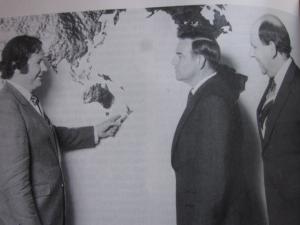
Burroughs, then a major force in world computing, ranking only just behind IBM, recognised the value of this discovery and in a remarkably short space time branded it as LINC (for logic and information network compiler) and put it in the very top shelf of their worldwide marketing. Our photograph shows Gil Simpson (at left) with his co-developer Peter Hoskin. In the middle is Robert Holmes the Burroughs top sider who oversaw the deal.
It was now that Jade made Christchurch in the 1980s one of the world hubs of network computing science. It really was a “centre of excellence.” The Linc compiler with its rapid implementation automated programming was the unique selling proposition, the secret. While the Linc project never actually became fourth generation (as was widely claimed for it) the product in that era got as close as any other system did to replicating the wave or multi-processing operation of the human brain.
All the rest followed. The Jade Stadium, Sir Gil Simpson Drive, and of course Sir Gil himself. Peter Hoskin, the co-developer, faded out of direct involvement and in recusing himself became the New Zealand version of those other early self-sidelined co-developers Paul Allen and Steve Wozniak.
Time moved on, and it was now that as so often in the IT sector, time from being an ally now manifested itself as a problem, especially at Burroughs, which by now had re-named itself Unisys. It was still a big-iron, mainframe manufacturer of centralised computers. It was now besieged by the personal computer manufacturers.
Even as Burroughs – Unisys became distracted, it was still able to use its muscle in its stronghold of mainframes to insert the Jade Linc system into the financial sector notably in the United Kingdom. It was now that started the supplier-client relationship of Jade with the Skipton Building Society.
Exactly why, and how Skipton became anchor investor in Jade remains largely unclear. There are though grounds for believing that Skipton needed to protect its own investment in its own Jade systems and did so by investing in the supporting supplier.
Even so, Jade was careful always to diversify its own market and took up a strong footprint in logistics, a natural growth sector deriving from its original inventory management expertise.
It was as part of this sector application diversification scheme that Jade sought out still newer fields in which to apply its compiler expertise. Law enforcement/risk management made sense.
Jade was by now encountering the problem of companies outside the United States to the effect that no matter how effective their products, no matter how much they tuned and re-tuned their underpinning quantum mechanics not to mention their marketing, they still seemed the poor relation to Silicon Valley. Especially in its ability to launch torrential new products on a marketplace that had become attuned, if not addicted to fast-rotating product issue frequency.
Canada’s Research in Motion with its Blackberry and Finland’s Nokia are two examples of seemingly invulnerable companies that succumbed to this kind of Silicon Valley rolling release.
Wynyard for example walked into this kind of Silicon Valley deep-pocket storm when it found itself confronted with sometime New Zealand resident and Tolkien buff Peter Thiel’s Palantir crime product.
Wynyard because of its Anglo-United States lineage had about it from the start an aura of the gilt edge. This halo was emphasised by its role as New Zealand’s first heavy-end departmental-capability IT main board listing. As is the IT custom everywhere the claims and forecasts made on its behalf contained a show-business extravagance and the executives seemed more photogenic than in other industries. The explanation for this multiplier is that if you win big in IT you win bigger than you do in other industries.
In the event, and as we can all see now, it was highly speculative and depended for its success on an early investment take up. One ideally in the form of a mainstream merger or acquisition that would have given Wynyard scale and the global distribution and sales and support channels that it always needed.
It does now all seems so unfair. Jade in its day took automated programming, meaning fast setup, further than any other technology outfit anywhere. It survived the 1987 bust, the dot com bubble, and the Great Financial Crisis.
But now its offshoot and which carries its pedigree is left to fade unfinished into the history of New Zealand ultra-advanced technology.
From the MSCNewsWire reporters' desk - Wednesday 2 November 2016

Sudden disappearance of New Zealand civil engineering institution led to standards decline claims correspondent
The rush to bury the reality and the memory of the old New Zealand Ministry of Works had a singular and tangible outcome. This was the standards vacuum. The subsequent leaky building problem and the modern buildings which collapsed due to earthquakes in Christchurch are the result of this. This state of affairs was referred to, but not at the length it deserved by your original correspondent who correctly described the New Zealand “way” in which entities once believed to be of value are suddenly swept away and in this process are deemed in every way to be bad. This is an impression that as your original correspondent observed then proceeds to compound on itself over the years.The Ministry of Works’ meticulously enforced quality standards should have been carefully preserved. Instead what happened was that the dissolution of the old Ministry of Works introduced a facet of the law of unintended consequence. This took the form of the disappearance of New Zealand’s high level construction standards which if not actually enforced by the Ministry served as a yardstick for the entire sector whether Ministry or not.
It was now that was created the standards vacuum situation which I have just described. Now allow me to take a step backwards. A problem in New Zealand construction has long been for people to represent themselves as doing work that they are not in fact institutionally qualified to do. This is unavoidable in a new country and one in which the demand for construction people will often outweigh the supply of them. These “chancers” as we used to call them are often valuable just because they are self-taught and often work hard to overcome their lack of officially sanctioned training. The problem starts though when such people assume professional roles in which test and measurement qualifications of an institutional type are by definition essential.In the aftermath of the disappearance of the old Ministry of Works so there began also to disappear the inspectorates and their cadres of highly qualified people who themselves had been tested practically and theoretically. The gnawing away of the old Ministry standards was by now well under way and has been compounded by the failure of the professional societies to claim responsibility for the demonstrable failure of their own authorised practitioners.Yours faithfullyAlan GrimbleAuckland

US-made First Alert extinguisher had undisclosed additional safety catch trigger
A US-made fire extinguisher on sale in New Zealand features an undisclosed second-tier safety trip which is in addition to the standard pull-pin release mechanism.
The second tier safety device on the extinguisher is comprised of a barely visible plastic filament. This must be pressed simultaneously with the white trigger at the top.
No indication is given on the instructions of the existence of this additional filament-press detonation mechanism. The three part operating instruction only states to Pull Pin/Aim/Press Lever.
Absolutely no mention is made of the barely visible filament device which also needs to be pressed in order to detonate the extinguisher.. Neither is this secondary device pictured on the extinguisher.A reader has presented the now-used extinguisher (pictured) to MSC-Newswire in order to draw attention to the need to for factories and workshops to test operationally one example of each of their fire extinguisher brands and model types in order for this type of problem to be identified prior to a fire instead of afterward.
The pictured extinguisher was thought to be faulty and valuable moments were lost in fighting a real-life fire. In the event hoses were required to put out a fire which could have been instantly extinguished had the pictured device been brought to bear at the start of the fire.
A problem with New Zealand’s imported extinguishers is that just because they are made for other jurisdictions with other national safety regulations so there will be differing levels of operating procedures and these, as in the instance of this US extinguisher, may not be pictured or described on the device itself.
All factory and works safety officials should test under operational conditions one sample of every brand and series model type of its extinguishers urged our informant. They noted that factory fires were volatile just because of the works environment. Every split second was crucial in suppressing them. Secondary, and in the instance of the pictured extinguisher, disguised activation steps must be factored in. Something that could only be achieved by practical and applied type-testing
“We want others to learn from our experience with this problem which itself seems to be hidden from sight.”
From the MESCNewsWire reporters' desk
Sports Medicine Growth Keeps Medicos Mum.
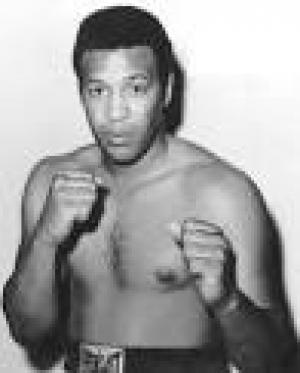
When Muhammad Ali came to the Hutt Valley in 1979 a member of his entourage was a stooped man who passed unnoticed even to boxing aficionados. It was in fact Jimmy Ellis, former World Heavyweight champion, and the author of Ali’s favourite tag line, Float Like a Butterfly/Sting Like a Bee.
At that time all those years ago the late Jimmy Ellis (pictured) we now know was in the grip of dementia pugilistica.
The stilling of all official condemnation of boxing remains one of the weirdest silences in today’s age of officially imposed urban safety and ultra-caution. Voices are equally stilled about injuries sustained at rugby football, notably at its high end (“just concussion- he’ll be right.”)
In boxing the debate like a deflected punch centres around the safety and security of the boxing gloves in absorbing the immediate kinetic energy of the blow.
In the event there is a school of thought that holds that boxing would be safer if blows were delivered unsheathed, the numerous bones of the hand being anatomically the most delicate.
Until quite recent times there was a belief that the deliberate attempt to concuss an opponent, the KO, would cause boxing to fade away under the feminisation of society inherent in the women’s movement. In the event the movement instead swerved toward boxing on the grounds that women could do it, with the result that female boxing now appears as a mainstream sporting code co-equal to the male version .
The medical profession has steered a cautious path around the issue, if only because so many of its members are actively involved in the sports medicine category.
Bare-knuckle boxing is the original form of boxing and involves individuals fighting without boxing gloves or other padding on their hands. Bare-knuckle boxing was sidelined with the arrival in 1867 of Queensbury Rules and gloved bouts.
In recent years bare knuckle has staged a comeback if not in name then as a component of martial jousts.
Ali meanwhile following his visit to NewwZealand was never to regain the fitness he displayed on that tour. Many mark his downward spiral from events soon after when in order to raise funds for the Black Muslims he embarked upon a career of Thai kick boxing. In doing so many believe he took blows to his neck which detonated his early Parkinsons Disease.
From the MSCNewsWire reporters' desk - Friday 30 September 2016
 Dollar Control of Trade Underpins Pacific Pact
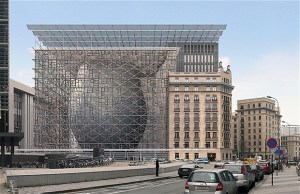 This time the feeling is mutual
The EU is actively wooing New Zealand in the matter of the mooted NZ/EU Free Trade Agreement.


Tapie Affair Opens Door of Opportunity for Kiwi
A door of opportunity has unexpectedly opened to enable New Zealand prime Minister John Key tomaintain his upward trajectory in the form of becoming managing director of the International Monetary Fund.
The present managing director of the IMF Christine Lagarde (pictured) has become inextricably enmeshed in France’s Tapie Affair and has been ordered to stand trial for her alleged part in it.This coincides with a move to place a non-European official at the helm of the IMF. This originally came about in order to position someone from a BRICs nation at the helm. But nobody has been forthcoming from these nations, possibly because of their objective of becoming independent of it.
Step forward Mr Key who also has the essential background in Wall Street international finance.Earlier Christine Lagarde had been expected in mid 2016 to renew her mandate with the IMF. However she has now become the latest in a long line of high level French officials to have become rolled up in the Tapie Affair.This centres on Bernard Tapie a onetime member of the Mitterand government, a celebrated sportsman and entrepreneur, who had gamed Adidas eventually though having to hand it over to a consortium which included Credit Lyonnais.In the event this group made a substantial profit on the deal, which Tapie now claimed. Amazingly he was successful.The problem was that Credit Lyonnais was now back in public hands. So Mr Tapie’s payout which approximates to $500 million was derived from the pockets of French taxpayers.The other enduring problem in the 20 year affair was that instead of the matter being referred to the courts, it was placed in the hands of private arbitrators.Christine Lagarde was minister of finance at the time and is thus being accused of signing off on the arrangement.Mr Tapie has now been ordered to pay back the money.The IMF stems from Bretton Woods, as does the World Bank. Curiously the IMF acts as a bank. The World Bank, as a fund.The World Bank is traditionally under United States direction. The IMF under European, as a counter balance.Nobody doubts though that White House approval is required for the leadership of both organisations.Mr Key has the required money market experience. He has run a country. He has backed President Obama’s showpiece international thrusts, the TPPA, and the Paris Climate.He is known to be on personal terms with President Obama who will have the ultimate sign-off on the IMF leadership.Politically Mr Key leads a centrist party and long-running government and above all one which features favourably at the top of all the internationally “transparency” tables.
From the MSCNewsWire reporters' desk

Palace of the Alhambra, Spain
By: Charles Nathaniel Worsley (1862-1923)
From the collection of Sir Heaton Rhodes
Oil on canvas - 118cm x 162cm
Valued $12,000 - $18,000
Offers invited over $9,000
Contact: Henry Newrick – (+64 ) 27 471 2242
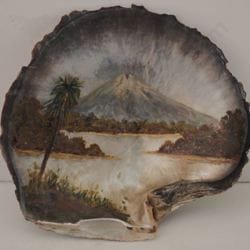
Mount Egmont with Lake
By: John Philemon Backhouse (1845-1908)
Oil on Sea Shell - 13cm x 14cm
Valued $2,000-$3,000
Offers invited over $1,500
Contact: Henry Newrick – (+64 ) 27 471 2242

|
|