Te Aute spirit of excellence through individualism swamped in Reverse Discrimination policies
A political emphasis on retribalizing now focuses on New Zealand’s gangs in a country with more enrolled gang members than members of its military.
The nation’s gangs are accorded immense social license and are handled with velvet gloves by officialdom. Yet it wasn’t always like that. The problem was originally foreseen as long ago as 1854.
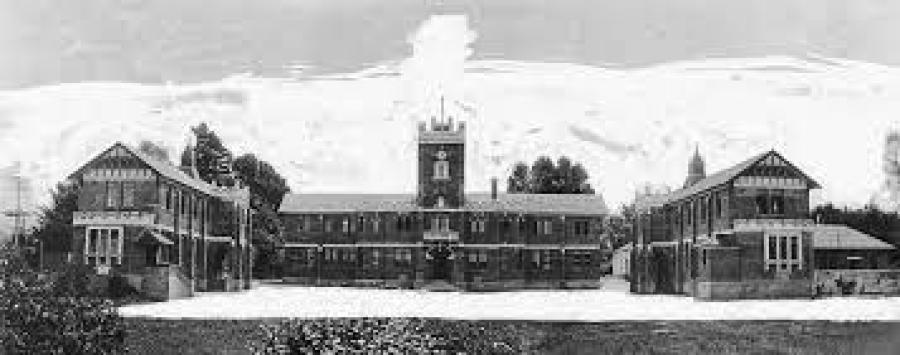
Te Aute College (pictured in early days) opened that year with the express purpose of ensuring that there would always be in existence a Maori professional class comprised of medical doctors, lawyers, and clergy.
In 1883 a government native schools inspector confirmed in their report that Te Aute was meeting this objective and noted its accomplishments in mathematics and science specifically.
Among the first to comprehend how seriously off-course this strategy had drifted away from this was the head of the Maori Council, the late Sir Graham Latimer, a farmer. In the 1970s he sought to re-capture this Te Aute approach which in today’s terms would be described as one of excellence by example.
He instituted now a scheme in which accomplishment was showcased in every walk of life, and notably in the enterprise sector. Today, this would be known as putting forward avatars, winners.
This strenuous scheme was now copied by the government which launched its own programme and which had the effect of accelerating the exact drift that Sir Graham Latimer sought to stem. This was to stop the government becoming the catch-all job provider.
Sir Graham understood as did the founders of Te Aute College that the future of his people standing tall in relation to Europeans was to ensure a strong representation in the great professions, and as the 1970s dawned in free enterprise business leadership too.
Sir Graham we can see now was the last authority figure with the clout, the mana, to seek to adjust the Maori way of life to the European one.
After this, there would be dominating an academic-departmental move to do the opposite.
It was to adjust the European modus operandi to appease the separatists.
The emergence of the gang system, predominantly Maori, but not entirely, is the ever-present testimony to the failure of good intentions. Official measures now fed the flames of tribalism.
Some measures were accidental such as the decision to replace the nation’s highway patrol motor bikes with models made in Japan which gave the gangs easy access to their preferred hardware. This was in the form of the now discarded British Norton 650s which flooding the market overnight transitioned from being instruments of law enforcement to symbols of law flouting.
Politically the gangs enjoy a constant resonance covered by the much enunciated doctrines of inclusion, diversity, and of course multiculturalism.
In their more threatening anti-social manifestations gangs draw forth from authority figures vows to draft laws designed to put them out of business. The laws have long existed. But the gangs by experience believe themselves exempt.
A seemingly matter-of-fact series of recent edicts by the Labour government to placate the gangs has had the surprising effect of drawing instead of anticipated if muted approval quite the opposite reaction.
These followed the revelation that unworldly if well-intentioned officialdom in the race relations industry were in the habit of depositing symbolic cash gifts when they attended in the course of their duties the various gang convocations.
First off the launching ramp was a scheme to give enterprises demonstrating Maori involvement preferential access to government contracts.
Now came the announcement of direct government payments to gangs running their own anti drug addiction and health collectives.
Complexions often obliterated by tattoos, clad in emblazoned villainous regalia and astride their unsilenced heavy capacity bikes the blokes-only gangs know they project a volatile mix of menace, unpredictability, and instability.
During the 1950s there developed a mood that time would diminish any tribal hostility and in practical terms would be accomplished by inter-marriage, a concept much illustrated at the time by two merging circles, demonstrating the convergence of the bloodlines.
What also happened was that far from accomplishing “assimilation” the word used in this optimistic era to describe this process, more and more routinely identified as themselves as Maori, and thus came under government head start policies designed for the indigenous.
Sir Graham Latimer and his lieutenant of that era Maori Council secretary Kereana Anihana also foresaw the problem so evident today of a media cushioning with a coating of romanticism of the reality of the gangs.
A visitor to the Maori Council secretary’s office in the 1970s was surprised to find Mr Anihana with his head in his hands.
“I can’t bear to see the television cameras doing so much damage to my people,” he explained to his visitor.