
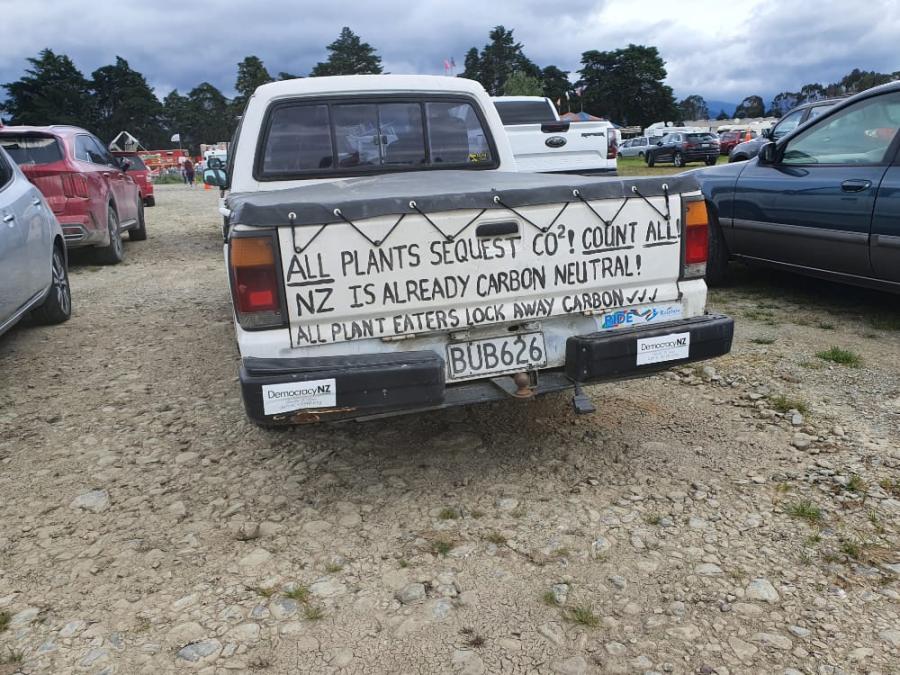
Liability becomes Credit with Statistical Reclassifying
A categorisation overhaul in which the pasture-economy nation’s vast grasslands are included in the emissions equation would see New Zealand classified as carbon dioxide positive instead of carbon dioxide negative.
The agricultural nation until quite recently had an entire government agency known as Grasslands which existed to refine and define the role of the herb as the central factor in the export economy.
The absence of the Grasslands organisation and the subsequent dispersal of its official responsibility and emphasis meant that its role has been left open to any number of different interpretations especially political ones.
Unlike trees grasslands store most of their carbon underground in their roots and the soil. Which makes them more reliable “carbon sinks” than forests, according to a 2018 University of California study.
These factors are recognised for example in the United States where large scale grassland proprietors receive substantial offset incentives. Ranchers are rewarded for using their grasslands to retain carbon dioxide in the ground rather than in the atmosphere.
Also through photosynthesis grass absorbs sunlight to produce energy. Grass plants will take in the heat of the sun during the day and release it slowly at night, helping to moderate temperatures
In New Zealand the pressure is on farmers to eliminate grass, the basis of the nation’s pastoral export industry, in favour of pine forestry.
This carbon farming procedure is becoming dominated by foreign interests and when the carbon credits are eventually cashed they will simply be repatriated overseas. It is these credits earned in the earlier life of the tree that contain the value.
Politicians still want to believe that there resides in the internal transaction of this financial process of carbon “farming” an export-type benefit to the nation.
These offsetting deals are becoming increasingly complex.
This is especially in regard to leasing contract structures.
This means that they benefit the non-productive if highly rewarded service sectors of the economy such as legal.
Also the burgeoning carbon “farming” consultant industry taking advantage of the curious circumstance in which secondary farmland offers similar returns to the best pasture.
This sector internationally is also aware that New Zealand’s emissions trading program is the only one in the world that allows companies to offset 100 percent of their emissions through forestry.
In this flourishing category we may also include politicians and their captive officials who always say that all this is obligatory simply because of the nation’s carbon dioxide contribution is on a “per head” basis.
This oft-uttered belief is never challenged.
This is surprising given that New Zealand has one of the lowest populations per landmass ratios of any developed nation anywhere.
It is underpopulated, in other words.
In the past era of the global population explosion forecast emergency in the late 1960s carbon dioxide was said to be an offset to the widely predicted starvation anticipated for the world to endure around current times. The era we live in now.
Carbon dioxide remains at a tiny fraction of one percent of the world’s atmosphere.
It was seen at the time of this particular postulated catastrophe as increasing in life-giving significance as the compensating minor gas vital to plant growth and thus food.
In effect it was seen as an offsetting factor to the calamity prophesy, the global starvation one, of that time.
New Zealand’s contribution to international carbon dioxide levels is barely measureable.
A reorganisation of the statistical basis of this official calculation would transform it from a debit into a credit.
Also generating the negative rather than positive impression is officially statistically generated confusion in that emissions from the different greenhouse gases are shown in carbon dioxide equivalents officially under the formula framed (CO2-e) units.
The disestablishment in quite recent times of the Department of Scientific and Industrial Research along with its Grasslands Division we can see now ushered in the predominance of those other scientists, the practitioners of the social and political versions whose sway over the productive economy grows daily.