
Founded by Max Farndale 1947 - 2018
1. Prime Minister of New Zealand the Right Honourable Bill English and Prime Minister of Japan His Excellency Shinzo Abe held a productive meeting in Tokyo on 17th May 2017. The two leaders reiterated the Strategic Cooperative Partnership between New Zealand and Japan founded on common values, such as freedom, democracy, rule of law and human rights, as well as a strong commitment to peace and security, free trade and investment, and sustainable development.
2. The two leaders acknowledged the success and maturity of New Zealand –Japan relationship at all levels, reflecting strong cooperation over many years.
3. The two leaders reiterated their firm commitment to the Trans-Pacific Partnership (TPP). Prime Minister Abe welcomed New Zealand’s recent ratification of the TPP Agreement, alongside Japan. The two leaders appreciated the value of the TPP in enhancing high-standard regional trade rules and architecture, and contributing to growth, competition, innovation, and productivity that creates jobs and lower costs to consumers, as well as its strategic benefits. The two leaders affirmed the importance of close cooperation in realising TPP’s strategic and economic benefits and remain committed to maintaining the unity among the signatories and early entry into force of the TPP Agreement, whilst bearing in mind opportunities for other economies to join if they accept the high standards of the TPP. They also confirmed that New Zealand and Japan continue to work together on the Regional Comprehensive Economic Partnership (RCEP) Agreement negotiations to achieve a high-quality agreement, covering trade in goods, trade in services, and investment as well as rules such as trade facilitation, rules of origin, e-commerce, intellectual property and government procurement, reaffirming the RCEP Guiding Principles and the Joint Statements by RCEP Leaders. They shared the view that ambitious, comprehensive, balanced, and high-standard TPP and RCEP outcomes would contribute positively to the shared goal of regional economic integration.
4. The two leaders condemned in the strongest terms North Korea’s nuclear tests, repeated ballistic missile launches and proliferation activities. They strongly urged North Korea to cease its destabilising and provocative actions immediately and to fully comply with its international obligations and commitments, including those under relevant United Nations (UN) Security Council resolutions. The two leaders welcomed the unanimous adoption of UN Security Council resolution 2321 and emphasised the importance of enhancing pressure on North Korea through full, thorough and sustained implementation by Member States of all relevant UN Security Council resolutions, including Resolutions 2270 and 2321. The two leaders strongly urged North Korea to resolve the abductions issue at the earliest time.
5. The two leaders underlined the importance of ensuring a stable, free and open rules-based order and of enhancing connectivity in our region and beyond. They confirmed that New Zealand and Japan will continue to work proactively in this regard, together with other like-minded partners. Prime Minister English appreciated the briefing by Prime Minister Abe on Japan’s “Free and Open Indo-Pacific Strategy” and welcomed Japan’s greater engagement in the region.
6. The two leaders also re-emphasised the importance of upholding the rules-based regional and international order in the maritime domain, and called on all states to respect freedom of navigation and overflight, and unimpeded trade. They reaffirmed that any issues in the maritime domain should be resolved peacefully and in accordance with international law and expressed their strong opposition to any use of force or actions that could increase tensions.
7. In this regard, the two leaders expressed concern over the situation in the South China Sea and called on the parties to settle disputes by peaceful means in accordance with United NationsConventions on the Law of the Sea (UNCLOS) and in light of the award rendered by the Arbitral Tribunal on 12 July 2016. They called on all parties to uphold freedom of navigation and overflight and ensure unimpeded trade while avoiding provocative actions that could increase tensions and erode regional trust and confidence, including land reclamation, building of outposts, construction and militarisation.
8. The two leaders encouraged early finalisation of an effective Code of Conduct in the South China Sea (COC) and full implementation of the Declaration on the Conduct of Parties in the South China Sea (DOC) in its entirety.
9. The two leaders welcomed the contribution of the East Asia Summit (EAS) and Asia-Pacific Economic Cooperation (APEC) as important elements of regional architecture that promote stability and prosperity and advance regional economic integration. Japan welcomed New Zealand’s hosting of APEC in 2021.
10. Recognising the unique and complex challenges in the Pacific region, the two leaders emphasised the importance of cooperation between Japan, New Zealand, and the Pacific island countries to build economic and environmental resilience and maintain regional peace and stability. The two leaders committed to continue practical cooperation and policy consultation.
11. The two leaders acknowledged the commitment to develop the security and defence relationship following the signing of a Memorandum of Intent on Defence Cooperation in 2013. They welcomed recent concrete progress on the unit-to-unit exchanges and underscored the importance to seek further exchange and cooperation opportunities. They encouraged their officials to continue work on a possible acquisition and cross-servicing agreement (ACSA) between the two countries.
12. The two leaders encouraged stronger business linkages between Japan and New Zealand in areas of complementary strengths. They reaffirmed the importance of strengthening the partnership in food and agriculture between the two countries, and a shared commitment to food quality and safety. They welcomed the recent growth in research and commercialisation partnerships in functional food, elderly care technologies, agri-business, and geothermal energy. The two leaders welcomed the ongoing discussion between their officials to explore a Japan-New Zealand partnership on renewable energy. Prime Minister English welcomed Japan’s upcoming role as Chair of the Global Research Alliance on Agricultural Greenhouse Gases (GRA). The two leaders instructed their officials to resume Joint Economic Consultations.
13. The two leaders welcomed enhanced bilateral cooperation in sport, culture and people-to- people linkages. They stated their intention to cooperate for the success of the Rugby World Cup 2019, the Tokyo 2020 Olympic and Paralympic Games and the World Masters Games 2021 to be hosted by Japan. They appreciated both initiatives; “Sport for Tomorrow” and “Game on English”. They also welcomed the signing of the bilateral Memorandum of Cooperation between the Japan Sports Agency and the Sport New Zealand. The two leaders reaffirmed the importance of sister city exchanges for promoting mutual understanding especially among young people.
14. With their past experiences of natural disasters in both countries, including great earthquakes, the two leaders shared the intention that both sides will seek further opportunities to work together to enhance recovery and resilience in the region.
15. The two leaders reaffirmed that Japan and New Zealand would continue to work closely together on global issues such as security, disarmament and non-proliferation, human rights, the 2030 Agenda for Sustainable Development, climate change, the UN Security Council reform, based on their shared commitment to common democratic values, peace and security, free trade and investment, and international law. "The information contained in this email message is intended only for the addressee and is not necessarily the official view or communication of the Ministry. It may be legally privileged. If you are not the intended recipient you must not use, disclose, copy or distribute this message or the information in it as this may be unlawful. If you have received this message in error, please email or telephone the sender immediately."
Bill EnglishPrime Minister
| A Beehive rrelease || May 18, 2017 |||
Ξ NZManufacturer May 2017 Issue
Ξ Cadbury expands Hobart factory
Ξ Multiple complaints against engineering firm
Ξ Rakon full-year loss widens on 16% sales drop, impairment of Indian JV
Ξ Ngati Whatua wants to buy Ports of Auckland
Ξ Joyce's rocket: taxpayers should be allowed to see what they paid for
KiwiRail has moved to secure the future of the Cook Strait link by purchasing the Interislander ferry Kaitaki, the largest domestic passenger ferry operating in New Zealand. The ship had previously been leased.
“The Interislander fleet is the extension of SH1 across Cook Strait. Our ships are vital for tourism, and an important piece of the integrated transport network for freight, with road and rail working together to help drive New Zealand’s growth,” KiwiRail Chief Executive Peter Reidy says.
“We make up to 4000 sailings a year.
“Last financial year KiwiRail’s Interislander ferries carried more than 1 million net tonnes of freight, 83,000 commercial vehicles and 800,000 passengers.
“The ability to move large numbers of passengers across the strait is critical for KiwiRail’s tourism business, and for New Zealand’s tourism industry, which is the country’s largest earner of overseas funds.
“Nearly 190,000 people are directly employed in the tourism sector.
“Ensuring visitors are able to travel between the North Island and the South Island easily makes sure that the benefits – and the jobs – are spread through the country.
“The Kaitaki can carry up to 1350 passengers, more than the Aratere and the Kaiarahi combined.
“The ship had been leased from Irish Ferries, based in Dublin, but with the lease due to run out in 2020 there was no certainty that the ship would be available after that.
“There is a world-wide shortage of suitable secondhand ferries and heavy competition for those ships that are available, so the best option was to take up the opportunity to purchase the ferry.
“Interislander leased the Kaitaki in 2005, and it has proved itself on what can be a challenging route.
“KiwiRail has been working with the port companies to look at long-term plans for ships and terminals and this decision means that we have the time to make sure we get the best possible solution. Getting this right is important for both KiwiRail and New Zealand.
“Passengers and freight customers will not notice any change as a result of the purchase. The only difference is that the ship will be registered in New Zealand instead of Portsmouth.
“The Interislander team is dedicated to providing the very best of service both to our passengers and to those shipping freight across the strait. This purchase is an important part of doing that,” says Mr Reidy.
| A KIWI Rail release || May 17,2017 |||
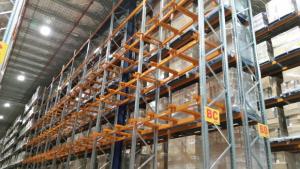
Dematic has launched a new product in its ColbyRACK range that increases safety for forklift operators removing pallets from high storage levels in warehouses and distribution centres.
The new Retrofit Pallet Guide was designed by Dematic’s structural engineering specialists after calls from its customers, including a major retailer and 3PL, for a tool that would minimise incidents where pallets and cartons fall from heights.
The product is primarily intended for retrofitting pallet guides to single deep selective racking. While the use of pallet guides is common in double deep racking, they have rarely been used in single deep racking. However, their potential safety benefits are starting to be recognised, because pallet guides provide a visual cue that encourages forklift operators to slow down and align pallets more accurately.
The new Colby Retrofit Pallet Guide can be installed onto existing selective racking beams, avoiding the expense and inconvenience of changing over to new, cleated beams. The pallet guides are also a simple option for storing European pallets on Australian racking, and can be relocated within a warehouse as storage needs change.
“Worker safety is becoming more important for Australian businesses, particularly those that operate busy facilities with pickers and forklifts in close proximity,” said Dr Paul Berry, senior structural engineer at Dematic.
| A Dematic release || May 17,2017 |||
Qantas Freight has entered into a one year agreement with Sai Cheng Logistics International (Sai Cheng) to fly airmail weekly out of China to the United States.
Sai Cheng is a joint venture company between Australia Post and China Post, which provides an integrated logistics solution for Chinese customers to overseas markets including Australia, New Zealand, Asia, the US, Europe and South America. The new agreement builds on the longstanding Australia Post and Qantas relationship, which includes contracts for the transport of Australianinternational outbound mail as well as a dedicated domestic air freighter network.
The airmail from China Post will be airlifted from China Post’s hubs of Shanghai and Hong Kong to various points in the United States by Qantas Freight using our Boeing 747-400 freighter network from Shanghai and our belly capacity out of Hong Kong via Australia. Qantas Freight currently operates four freighter services per week from Shanghai to the USA, including stops in Los Angeles, New York City, Chicago and Dallas Fort Worth.
Executive Manager Qantas Freight, Catering and Australia Airports, Alison Webster said the airline was excited to be working with Sai Cheng.
“We’ve been flying freight between China and the US for the past 14 years with a triangular freighter route that operates four times per week between Australia – China – the US – Australia.
“The variety of freight we carry on this freighter network is extensive – including medical equipment, fresh produce, online shopping, mining equipment, racehorses and even the occasional helicopter.
“The uplift of China Post airmail is a welcome addition to our network and reinforces that the routing we operate is aligned to our customer needs,” said Ms Webster.
General Manager of Sai Cheng Jonathan Qiao said he was really pleased to be partnering with Qantas Freight.
“We collect more than fifty tonnes of airmail each week across China bound for the US. Our customers seek a fast and reliable service and Qantas’ service frequency and freight network to the US allows us to deliver just that.
“With thirteen warehouses spread across eight cities in China, this partnership will strengthen our growing network, connecting Chinese consumers with the world.”
| A Cargo Trends release || May 17, 2017 |||

Chemistry has allowed humans to create a myriad of new inventions and improve on innumerable existing ones. Through research, we've created synthetic materials that are stronger than the metals we've used for centuries. One synthetic fiber invented in the last several decades is being implemented into many protective gear and vehicles because of its sheer strength and durability. Militaries, law enforcement and civilian industries are using the synthetic fiber called Dyneema to protect lives and equipment.
Dyneema is a high-strength synthetic fiber that is capable of protecting an individual or vehicle from threats like an improvised explosive device (IED) or shots from an AK47 [source: Dyneema ]. If you took a block of Dyneema and block of steel, on a weight-for-weight basis the block of Dyneema would be 15 times stronger than the steel block [source: Dyneema]. The lightweight fiber is strong and moldable, yet it can withstand significant explosions and extreme weather conditions. There are other synthetic fibers similar in characteristics, like Kevlar, but only Dyneema is trademarked as the world's strongest fiber [source: Dyneema].
By 2018, high-performance carbon-fiber bike builders will be useing Dyneema to build revolutionary frames that are stronger, lighter, and more impact resistant than ever before. The applications are limitless for a product that has Green attached to it's name.
| A How Stuff Works release || May 17,2017 |||

Entries for the inaugural ExportNZ ASB Wellington Export Awards close this Friday, May 19.
Entrants must have a minimum of $100,000 in export revenue and be based in the Wellington region, which includes Horowhenua, Manawatu, Tararua, and Wairarapa down to Wellington.
Companies can enter any of four categories: Marsh Innovation in Export Award, MFAT Most Sustainable in Export Award, Wellington Airport Emerging Exporter Award, CentrePort Excellence in Export Services Award. Entrants will be required to describe their company and its achievements in export.
The judges will visit shortlisted companies during the week of 29 May – 2 June, at which time their submissions will be discussed. The finalists will be announced on 6 June, and the winners of each category will contest the supreme award, the ASB Exporter of the Year, which will be announced at a gala dinner on the waterfront at Te Wharewaka on 21 June.
The judges are three experts in the area of trade: Mike Atkins, Head of Trade Finance at ASB; Charles Finny, Government Relations Consultant, Saunders Unsworth; Rachel Baxter, customer managers team leader, NZ Trade and Enterprise.
Chamber Chief Executive John Milford says the purpose of the awards is to celebrate businesses making it in the export market.
"Exporters are the lifeblood of our country and we need to acknowledge their contribution.
"ExportNZ awards are held throughout the country and the time is right for Wellington to celebrate those companies that contribute so much in the form of export receipts and jobs to both the national and local economy by way of their skill and innovation.
"We're not just talking about physical exports such as manufactured and agriculture goods that go through CentrePort and the airport, but also those from our booming service and IT sectors.
"These awards are a great chance for export businesses to expand their business horizons and get inspired."
Entry forms, criteria details, and registration forms are available on the Chamber of Commerce website: www.wecc.org.nz
ExportNZ Wellington is overseen by Wellington Chamber of Commerce.
About the judges:
Mike Atkins is Head of Trade Finance at ASB and has more than 30 years' experience in the field of International Trade.
Charles Finny is a Government Relations Consultant at Saunders Unsworth. His areas of expertise include China, US politics and trade policy, Australia, Asia and international trade.
Rachel Baxter leads a team of customer managers at NZTE, working to grow companies internationally - bigger, better, faster - for the benefit of New Zealand. The team works with 130 exporting companies based in the upper South Island (Nelson/Marlborough) and lower North Island. Rachel's background is in strategy, economics and policy.
| A WECC release || May 17, 2017 |||

On 1 November, The Langham Auckland, one of New Zealand’s leading hotels will be rebranded as Cordis, Auckland. Cordis Hotels and Resorts is a new generation of selected upper upscale modern hotels by Langham Hospitality Group that is devoted to the guests’ needs and well-being, catering to both business and leisure travelers.
“Our hotel in Auckland fits the Cordis brand perfectly,” says Robert Warman, chief executive officer of Langham Hospitality Group. “It is well located in the vibrant part of the city, a top-of-mind venue for meetings and events, a favourite for special occasions amongst the locals, and we have experienced colleagues who provide warm and friendly service from the heart.”
“The addition of Cordis, Auckland to our portfolio is a significant milestone for the group as it will be the first Cordis hotel in the Pacific. Our plan is to introduce and grow the Cordis brand in this region, which is seeing increasing numbers of leisure and corporate travellers year on year. Each Cordis is individual in style, architecture and design, all of which will be reflective of its location, local culture and is tailored to the requirements of our guests, from corporate travelers, honeymooners and families,” adds Warman.
Franz Mascarenhas, managing director of The Langham, Auckland says “I am confident Cordis, Auckland will succeed and continue to be the social centre of Auckland, hosting major events, conferences, international delegations and the city’s most glamourous weddings. We look forward to the continued support of the local community.
” Cordis derives its name from the Latin term meaning “heart”. The brand’s concept focuses on the core pillars of innovation in hospitality, genuine service, elegance in design and captivation of the senses.
Following the recent renovation of the banquet venues and the hotel’s Eight restaurant, The Langham Auckland will undergo refurbishment from 11 July for all 411 rooms and suites, lobby lounge and the exclusive Club Lounge. The refurbishment will ensure the hotel continues to provide the best facilities for guests in the market. The facelift is scheduled to be completed by Feb 2018.
To ensure there will be minimal disruption, the room renovations will be carried out in phases where guest floors will be closed off entirely and refurbishment works will be isolated to the designated areas only. Guests staying in the rooms or attending events at The Langham, Auckland will not be inconvenienced at any time during the refurbishment period.
In terms of design, guests may expect contemporary rooms and spaces that are reflective of the Cordis brand and local culture. The award-winning New Zealand based design firm, Space Studio, is the appointed interior designer for this refurbishment project.
In addition, to Cordis, Auckland, other Cordis properties in the brand’s portfolio are in Hong Kong, Shanghai (Hongqiao), Ningbo, Dongqian Lake (2018), Shanghai, East Bund (2019), Hangzhou (2019) and Bali (2018). Read more at http://www.etbtravelnews.global
| An ETB Travel Update || May 17,, 2017 |||

Given Air NZ’s CEO Christopher Luxon thinks the airline is the best in the world, it probably doesn’t hurt to listen when he says travel agents are important.
Speaking to Travel Weekly at the 2017 TRENZ conference in Auckland recently, Luxon said travel agents are an absolutely essential part of the travel industry.
“For us the channels haven’t changed tremendously. Yes, over the last 15 years there’s been a drive to more direct channels through our own direct services or through OTAs, but the reality is, there’s always going to be a need for travel agents,” he said.
“And for a business like ours that want to understand customer needs better, the high-touch people like travel agents are fantastic.
“It’s just about education, I think travel agents can better serve their customers with more knowledge, and with that ‘high-touch’ that many customers are prepared to pay for; to be able to have that anxiety removed and to have the expertise of a travel agent to help them.”
Travel agents are a key focus area for their educational campaigns, which also hope to inform Aussies of the routes Air NZ flies beyond the Tasman.
“It’s really about educating Australians, because while they think we’re that really cool airline that flies between the Tasman and maybe domestically in NZ, seven out of 10 have no idea we fly beyond NZ into North America, South America, China, Southeast Asia, and all across the place,” Luxon explained.
“So if you want to get to America and you live in Adelaide, why not come through Auckland and it’s very easy to transfer onto services going to Houston, Buenos Aires?
“In fact 40 per cent of our traffic going into Buenos Aires is Australian now.”
Aussies recently voted Air NZ the number one for Corporate Reputation in Australia, beating out the homegrown carriers of Qantas and Virgin Australia.
On this honour, Luxon told TW, “It’s just awesome that Australians think so highly of us.
“We’ve been flying to Australia for 77 years, that’s how our company started, flying from Auckland into Rose Bay, and really it’s been a continuation of that journey.”

Air New Zealand is giving travellers a sneak peek into what the future of inflight service could look like.
The airline has been working with information technology service provider Dimension Data on unique software for Microsoft’s augmented reality (AR) viewer HoloLens that could support cabin crew as they carry out their inflight duties by aggregating and displaying key customer information directly in front of them.
Data such as a customer’s preferred meal and drinks choice, onward travel and loyalty membership details could be displayed. The programme is even sophisticated enough to detect the emotion of the customer by picking up on visual and audio cues.
Air New Zealand Chief Digital Officer Avi Golan says the airline has fostered a strong culture of experimentation with new and emerging technologies such as the HoloLens.
“This software is a great example of us collaborating with other partners and exploring how technology could enhance the way our people work as well as the experience they deliver to our customers through greater personalisation,” says Mr Golan.
The technology could also allow the airline’s cabin crew to move to a paperless inflight system presenting added environmental benefits.
Air New Zealand has developed a global reputation for innovation having worked with a range of technology partners and introduced a number of customer innovations to enhance the customer experience in recent times. These include auto bag drops to speed up the check-in process with face-to-passport recognition and Airband™, a wristband for children travelling unaccompanied embedded with technology that allows parents and guardians to track each step of their young ones’ journey. Airband™ was named Innovation of the Year at the 2016 CAPA Asia Pacific Aviation Awards.
Click here or on the image below to download video of Air New Zealand trialling the Microsoft HoloLens.


Palace of the Alhambra, Spain
By: Charles Nathaniel Worsley (1862-1923)
From the collection of Sir Heaton Rhodes
Oil on canvas - 118cm x 162cm
Valued $12,000 - $18,000
Offers invited over $9,000
Contact: Henry Newrick – (+64 ) 27 471 2242
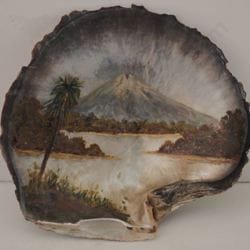
Mount Egmont with Lake
By: John Philemon Backhouse (1845-1908)
Oil on Sea Shell - 13cm x 14cm
Valued $2,000-$3,000
Offers invited over $1,500
Contact: Henry Newrick – (+64 ) 27 471 2242

|
|