
Founded by Max Farndale 1947 - 2018

Dec 20, 2017 - For anyone who has marveled at the richly colored layers in a cafe latte, you're not alone. Princeton researchers, likewise intrigued, have now revealed how this tiered structure develops when espresso is poured into hot milk.
"The structure formation in a latte is surprising because it evolves from the chaotic, initial pouring and mixing of fluids into a very organized, distinct arrangement of layers," said Nan Xue, lead author of a paper describing the findings in Nature Communications, and a graduate student in the lab of Howard Stone, professor of mechanical and aerospace engineering at Princeton.
Honing techniques for yielding sought-after layers by flowing liquids into each other could reduce costs and complexity in a range of applications.
"From a manufacturing perspective, a single pouring process is much simpler than the traditional sequential stacking of layers in a stratified product," said Stone. "In one application of this study, we are exploring the physics behind making a whole layered structure with one step, rather than one-by-one stacking of the layers."
The inspiration for the research project came from an unsolicited, emailed picture of a layered coffee drink sent to Stone. With Xue looking for a project to take on as he started his graduate work, he initially investigated the concept by preparing lattes in the lab, using store-bought coffee and milk.
After several tries, it became clear to Xue that staying within only certain parameters, such as temperatures and pour rates, allowed for a characteristic café latte. These efforts hinted at the underlying, quantifiable physics that had to be involved in its liquid structure formation.
To control their model of latte layering with more precision, Xue and colleagues opted for a stand-in recipe that would make a barista shudder: dyed water substituting for the hot coffee, and salty, denser water for the warm milk.
A panel of light-emitting diodes and a camera then illuminated and captured the movement of fluids within the concoction. The researchers seeded the mixture with tracer particles, which scattered light from a green laser beam, to further track the faux-latte's internal dynamics, a technique called particle image velocimetry. Finally, numerical simulations were run to compare the collected data with various models of the evolving system of intermixing liquids.
The overall analysis showed that the primary mechanism behind the layering is a phenomenon known as double-diffusive convection. It occurs when stacked-up fluids of different densities, impelled by gravity to mix their contents, exchange heat through the movement of their constituent materials. Within a given mixture, denser, cooler liquids sink, while lighter, hotter liquids rise. This sinking and rising stops, however, when the local density in a region within a latte approaches an equilibrium. As a result, the fluid there has to flow horizontally, rather than vertically, creating distinct bands, or layers.
Through their experiments, the researchers examined how the velocity of the fluid injection of the warm milk matters as well. If poured too slowly, the denser fluid will mix too evenly as it flows into the less-dense fluid. A faster pour rate causes the former to punch through the latter and trigger the rapid movements that culminate in the desired layering when density equilibria are established.
Additional work needs to be done to characterize the layering effect demonstrated in lattes to extend control of it to other leveled liquids and semi-solids. But the preliminary findings from Xue and his colleagues already have shown how the activity within a common beverage could lead to uncommon insights. The same can be said for this engineering project focusing on cheese."This result shows the beauty of fluid mechanics and is very significant," said Detlef Lohse, a professor of fluid mechanics at the University of Twente in the Netherlands who was not involved with the study. "I think it will have bearing on various industrial flows and mixing procedures in so-called process technology, in which mixing of fluids with different densities by the injection of one into the other is omnipresent."
Lohse further pointed out how the Princeton research could help in better explaining heat- and salinity-dependent flows of water in Earth's vast oceans, a phenomenon that has key implications in climatology and ecology. "The most awesome finding may be that there is perfect analogy between the layering in a cafe latte," said Lohse, "and the known and extremely relevant layering of water with different temperatures and salt concentrations in the ocean."
For more coffee-related engineering, check out Adding Up the Perfect Cup.
Source: The Engineer Princeton University || December 14, 2017 |||
Dec 20, 2017 - New Zealand’s trade relationship with India has been strong and growing rapidly. As at Year ended June 2017, India was the Seventh largest export destination and 11th largest import source for New Zealand’s total exports and imports of goods and services respectively.
India was the fifth largest destination for New Zealand’s commercial services exports after China, Australia, EU and US, and the Ninth largest import source for its commercial services imports.
Table 1 suggests that, as at year-end June 2017, India was New Zealand’s 11th largest trading partner based on total trade in goods and services, with a two-way total trade valued at $ 2.6 billion, out of which exports were worth $ 1.7 billion.
The Export Sector
New Zealand’s exports to India have been heavily concentrated in a few product categories. The top five goods exported from New Zealand to India as at Year-end June 2017 constituted 78.5% of New Zealand’s total exports to India.
The top commodity item of exports was Logs and Forestry products ($271 million), followed by Confidential items ($154 million), Wood Pulp ($45 million), Wool ($39 million), and Edible Fruit and Nuts ($34 million) (Table 2).
In terms of change in value of exports to India as at year-end March 2016, the largest increases were noted in Confidential Items (up by $70 million from a year ago); followed by Wood Pulp (up by $12 million) and Logs and Sugar & Sugar confectionery (both up by $2 million).
The largest decreases in export values during this period were noted in exports of Machinery Equipment and parts (down by $15 million), followed by Dairy Produce (down by $11 million compared to a year ago) and Metal Scraps including Iron and Steel ingots (down by $ 9 million).
Continue here to read the full article on Indian Newslink || December 17, 2017 |||
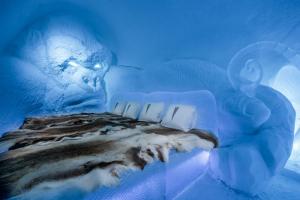
Dec 21,2017 - The town of Jukkasjärvi in northern Sweden is home to an annual hotel made from snow and ice. Now in its 28th edition, the Icehotel features 15 rooms boasting impressive frozen sculptures. Highlights include a space-themed room and another dominated by a strange ice queen.
Constructing the Icehotel involved harvesting thousands of ice blocks from a nearby frozen river. A 30,000 cubic meter (1,059,440 cubic ft) mixture of snow and ice was used to create the hotel. It includes warm rooms, sub-zero ice rooms, an ice bar, as well as a ceremony hall suitable for weddings and the like.
That said, it's the 15 rooms with the ice carvings that are naturally the main draw. These are kept at a temperature of -5° C (23 degrees Fahrenheit) and guests sleep atop reindeer skins in sleeping bags. The sculptures were created by 36 artists hailing from 17 different countries, and range from abstract scenes to lifelike animals.
The artists are very skilled and the rooms are worth checking out in full, in the gallery.Guests who opt to brave the cold are woken with a hot drink, plus a sauna, hot shower and roaring fire are available too. Activities include a northern lights tour on snowmobile, a half-day tour with dog sled, ice sculpting, and yoga.
The Icehotel opened its doors December 15 and is running until April 15, after which time it will begin to melt away. Pricing starts at 2,250 SEK (around US$267) for a single night in a warm hotel room, but the ice sculpture suites cost considerably more. The solar-powered Icehotel 365 is also installed on the same site and is open year-round.
Source: New Atlas Icehotel For more images || December 21, 2017 |||

Dec 21, 2017 - TL;DR–an item that represents the work that someone invested is a representation of value. This has been true throughout history and it is true now.
The origin for this post is a bit unusual….the Old Testament.
I was reading a story about Joseph when he was viceroy of Egypt and how his brothers came down from Canaan to buy food during the famine. The text says that they brought “money” with them (in the form of silver coins).
The question that I had then was: Why would believe that the ruler of a foreign land would accept their silver coins in payment for something of “actual” value, in this case, food?
Physical Proof of WorkThroughout history, some metals have achieved the status of “precious” and been used as a form of money.
As we talked about the other day, money needs to have a few characteristics to make it work.
It needs to be durable, transportable, and relatively scarce, among other things.
One possible reason that a silver (or gold) coin works as money is that it actually is a physical representation of the fact that someone put their labor (which is value) into the mining, refining, smelting, forging, etc. of the coin.
So, the coin in your hand is a “proof of work.”
That proof, then, represents value and it can be transferred from one person to the next.
That’s the physical world.
Digital Proof of WorkThe reason why (some) blockchains have value is because of the “proof of work” algorithm.
In this case, the miners invest work (computing power and electricity) to verify transactions and add blocks to the chain. When they do, they get new Bitcoins which are the digital representations of the fact that they did the work.
The more I think about it, the more I realize Satoshi’s genius in outlining the terms for the Bitcoin blockchain as he did.
When you can prove that work was done to create something, that thing has some inherent value.
The Problem with FiatWhich brings us to fiat currency.
When the US dollar was backed by gold (until 1971), we just had an easier, more transportable way of representing the proof-of-work that went into creating the gold.
When Nixon took the US off that standard, however, it became free floating.
Ironically, it is the US dollar that isn’t really backed by anything (except for the government’s ability to coerce you to use it when paying your taxes and jail you if you don’t).
For 46 years, we’ve had the inertia of the value of a US dollar because everyone else accepts the dollar for payment. It’s a big magic trick we all play on each other.
But here’s the challenge.In order to create new dollars, there is no “work” that needs to be done. Someone pushes a button and POOF…money is created.
Argentinians, Zimbabweans, Turks, Cypriots and others have seen firsthand what happens when this is taken to its extreme. That is the danger of being able to create money without any actual work behind it.
What’s Old is NewSo, the reason why the ancient Near East accepted gold or silver coins is the same reason why more and more people are accepting cryptocurrencies. It represents a proof of work.
All of us know that our labor has value.
By having an incorruptible proof of our labor (a gold coin or a blockchain-based coin), we can give others greater confidence that they can accept the proof in exchange for their assets.
Source: Jeremy Epstein for Never Stop Marketing || December 21, 2017 |||
Manchester with Cathay Pacific
Price: From $1,609 return
Class: Economy
Departs: Auckland
Arrives: Manchester
Airline: Cathay Pacific
Travel Dates: Tuesday 16th of January 2018 until Friday 30th of November 2018
Description: Fly to Manchester from $1609* return - ex Auckland with Cathay Pacific.
Sales Until: 27 Feb 18.
Travel Dates: 16 Jan - 30 Jun 18, 1 Sep - 30 Nov 18.
Closeout and blackout periods apply over school holidays and peak holiday periods & availability of seats is likely to be very limited over this time.
Conditions: * It is our policy to present the cost of our flights & holidays inclusive of all airport and government charges. Please accept however that these charges are not within our control, therefore we reserve the right to pass on any increase. Travel agent professional service fees where charged, will be additional to the advertised prices.
This email address is being protected from spambots. You need JavaScript enabled to view it.
Paris with Air China
Price: From $1,329 returnClass: Economy
Departs: Auckland
Arrives: Paris
Airline: Air China
Travel Dates: Sunday 4th of March 2018 until Sunday 25th of November 2018
Description: Fly to Paris from $1329* return - ex Auckland with Air China.
Sales Until: 19 Jan 18.
Travel Dates: 4 Mar - 31 May 18, 18 Oct - 25 Nov 18.
Closeout and blackout periods apply over school holidays and peak holiday periods & availability of seats is likely to be very limited over this time.
Conditions: * It is our policy to present the cost of our flights & holidays inclusive of all airport and government charges. Please accept however that these charges are not within our control, therefore we reserve the right to pass on any increase. Travel agent professional service fees where charged, will be additional to the advertised prices.
This email address is being protected from spambots. You need JavaScript enabled to view it.
London with American Airlines
Price: From $1,715 return
Class: Economy
Departs: Auckland
Arrives: London
Airline: American Airlines
Travel Dates: Monday 15th of January 2018 until Saturday 24th of March 2018
Description: Fly to London from $1715* return - ex Auckland with American Airlines.
Sales Until: 31 Jan 18.
Travel Dates: 15 Jan - 24 Mar 18
Closeout and blackout periods apply over school holidays and peak holiday periods & availability of seats is likely to be very limited over this time.
Conditions: * It is our policy to present the cost of our flights & holidays inclusive of all airport and government charges. Please accept however that these charges are not within our control, therefore we reserve the right to pass on any increase. Travel agent professional service fees where charged, will be additional to the advertised prices.
This email address is being protected from spambots. You need JavaScript enabled to view it.

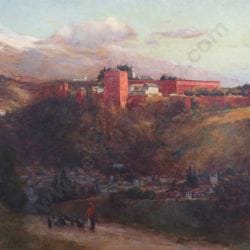
Palace of the Alhambra, Spain
By: Charles Nathaniel Worsley (1862-1923)
From the collection of Sir Heaton Rhodes
Oil on canvas - 118cm x 162cm
Valued $12,000 - $18,000
Offers invited over $9,000
Contact: Henry Newrick – (+64 ) 27 471 2242
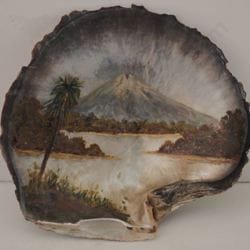
Mount Egmont with Lake
By: John Philemon Backhouse (1845-1908)
Oil on Sea Shell - 13cm x 14cm
Valued $2,000-$3,000
Offers invited over $1,500
Contact: Henry Newrick – (+64 ) 27 471 2242

|
|