
Founded by Max Farndale 1947 - 2018
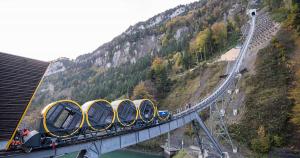
Dec 19, 2017 - The world’s steepest funicular line - which can climb a 110% gradient - has opened to the public at the Alpine resort of Stoos in central Switzerland. Swiss President Doris Leuthard officially opened CHF52 million ($53 million) project running from Schywz to the mountain village of Stoosexternal link, which lies 1,300 meters above sea level, on Friday evening. The public got their first taste on Sunday. Saturday was reserved for the locals.
Continue here for a look at what can be seen when in the funicular.
The funicular opened two years later than planned due to engineering and money problems. But this was forgotten as Leuthard cut the red ribbon. In her speech, she praised the project’s organisers for their courage. Many funiculars are not profitable. “But the board, canton and the region believe in the future. I am convinced that this will pay off,” she said.
Leuthard, who also head the transport ministry, said that the funicular would also serve locals as well as tourists. “This is what characterises Switzerland, that we offer a service that everyone can use.”
Flexible carriages
The barrel-shaped carriages adjust their floors so passengers can still stand upright while they climb towards the Alpine plateau at inclines of up to 110%.
The train follows a 1,720-metre track, climbing or descending 743 metres. It reaches speeds of up to ten metres per second. The whole trip lasts around four minutes.
The railway replaces an older one that has been in operation since 1933. “After 14 years of planning and building, everyone is very proud of this train,” said Ivan Steiner, spokesman for the railway.
+ Find out more about the different types of mountain railways in Switzerland here
| A SwissInfo release || December 19, 2017 |||

Dec 19, 2017 - In the world of aerospace engineering the race to build the first new civilian supersonic aircraft is certainly heating up. With several major players currently working on supersonic passenger jets, Aerion and Lockheed Martin are targeting those for whom even first class commercial air travel is substandard. The pair has just announced a partnership to develop the world's first supersonic business jet.
Aerion has been chugging away developing its AS2 supersonic business jet for several years now, first collaborating with Airbus on the aerodynamics and structural design before working with GE Aviation on the development of a supersonic engine. This latest announcement is a Memorandum of Understanding (MOU) with Lockheed Martin to work together on all the future phases of development on the supersonic business jet from engineering to production.
"Following our initial review of Aerion's aerodynamic technology, our conclusion is that the Aerion AS2 concept warrants the further investment of our time and resources," says Orlando Carvalho, Executive Vice President for Lockheed Martin. "We are committed to remaining on the cutting edge of aerospace technology and are excited to examine the contribution we might make to working with Aerion on making aviation history."
Aerion has been subtly improving its supersonic jet engine design over the years after announcing a new three-engine configuration back in 2014. The latest design pulls the two outboard engines forward, under the wings, while leaving the third engine in the tail.
Aerion currently estimates the AS2 will be ready for its first flight by 2023 but several other companies are racing to be the first supersonic player in the new millennium. Earlier this year, Spike Aerospace took to the skies with a flight test of an unmanned SX-1.2 prototype demonstrator that is a subscale version of its planned S-512 supersonic passenger plane. The successful tests come ahead of a projected flight date for a full-scale S-512 in 2021.The new three-engine configuration
NASA is also working on its own designs for a a supersonic passenger plane, which is also aiming for first flight tests in 2021, with Lockheed Martin again helping with the engineering and design challenges.
Lockheed Martin's skill and experience with supersonic engineering seems to be a strong validation of Aerion's designs. The company is known for its supersonic combat aircraft so if any company has the know-how to move the technology into a civil or commercial application then it is Lockheed Martin.
The next few years promise to be exciting for fans of supersonic aviation.
Source: Lockheed Martin and New Atlas || December 19, 2017 |||
Dec 19, 2017 - Legendary antipodean actors Bryan Brown and Sam Neill have reunited on-screen as the distinctive voices behind the latest instalment of Air New Zealand’s Better Way to Fly campaign to convince more Australians to fly the Kiwi airline across the Tasman and beyond. Bryan Brown is currently the voice behind Air New Zealand’s lovable CGI character Dave the goose who demonstrates all the reasons why the airline is a great choice for Australians flying to North and South America. Now he’s joining forces with acting mate Sam Neill as the voice of an adorable new CGI character, Pete the Kiwi. Together Dave and Pete are reminding Australians that Air New Zealand is the best way to spread their wings across the Tasman. Air New Zealand Chief Revenue Officer Cam Wallace says, “Not only do we have more flights between Australia and New Zealand than anyone else, we’re a premium carrier offering customers a whole range of choices from lie flat Business Premier™ beds through to an award winning Premium Economy™ cabin, a full service Economy experience or just a Seat and carry-on bag. “Wherever customers choose to sit, they can enjoy Air New Zealand’s world class food, top New Zealand wines and free access to inflight entertainment.” After a relaxing trans-Tasman flight into Auckland, Wellington, Christchurch or Queenstown, customers can then connect seamlessly with Air New Zealand’s network of 21 domestic destinations. Air New Zealand’s alliance relationship with Virgin Australia means Australians can also choose to earn Virgin Velocity points for their trip. Air New Zealand’s General Manager of Global Brand and Content Marketing Jodi Williams says, “Aussies have already grown to love Bryan’s performance as Dave the goose and when the long-standing friends got together again in the recording studio to debut Sam’s version of Pete the Kiwi, their shared sense of humour produced some great comic moments.” Click here to view the behind the scenes video with Bryan and SamAustralians can fly direct to New Zealand from Sydney, Melbourne, Brisbane, Perth, Adelaide, Gold Coast, Sunshine Coast and Cairns. The latest instalment of A Better Way to Fly featuring Bryan Brown and Sam Neill is available for download here.
| An air New Zealand release || December 19, 2017 |||

Dec 19, 2017 - The challenges of high pressure have kept metal 3D printing from gaining widespread application in hydraulics technology, but we may begin seeing 3D-printed components in specialized applications.
One advantage of hydraulics technology is its high power density. Hydraulic pumps are typically a small fraction the size of the electric motors that drive them, and the size and weight differential between pumps and gas or diesel engines is even more pronounced. An even bigger advantage is with actuators. Hydraulic cylinders only a few inches in diameter can generate forces to lift thousands of pounds, crush rock and concrete, or form high-strength steel into rugged components.
Of course, another advantage of hydraulics is its ability to control direction, speed, torque, and force using anything from simple manually operated valves to sophisticated electronic controls to command valves automatically. And even though electronic control of hydraulic valves continues to advance, processes improvements for manufacturing the valves themselves have not been as dramatic. But that has started to change.
Where We Are and May Be Going
Cartridge valve technology is widely used to integrate several control functions into a single manifold. Centrally locating multiple valves within a manifold can dramatically reduce
Continue here to read the full article written by Alan Hitchcox for Hydraulics & Pneumatics Hydraulics & Pneumatics || December 14, 2017 |||
Dec 19, 2017 - The Coalition Government must be deeply worried about maintaining internal discipline within their own Caucuses given they are attempting to ride rough shod over our democratic processes by preventing individual MPs from standing up for the voters that elect them, National’s Justice Spokesperson Amy Adams says.
“Last week the Coalition introduced what is colloquially known as ‘Waka Jumping’ legislation. It might be more accurately called the ‘Winston Peters Self Preservation Bill’ as it was clearly his bottom line for entry into the Coalition.
“The Bill would effectively prevent individual Members of Parliament from speaking out on points of principle and policy, and ensuring the voices of their communities are heard. Worse still, it would enable party leaders to advise the Speaker that a Caucus member isn’t acting as the leader would want and then move to force that member out of Parliament.
“This makes individual MPs more answerable to their party leader than to the voters that elected them. Allowing party leaders to overrule the wishes of voters is fundamentally wrong,” Ms Adams says.
“This is about ensuring the factions within New Zealand First, Labour and the Greens are kept from raising objections to the direction of the Government or threatening the leadership of their respective parties.
“The reason the Coalition Government wants to push this piece of legislation through as one of their first bills is to ensure unhappy MPs don’t jump ship. From going soft on crime and immigration to removing benefit sanctions to pushing up taxes on New Zealand families, New Zealand First are having to swallow a whole lot of dead rats which their voters just do not support.
“Overriding democracy to entrench your own political position is an abuse of power of the worst kind.”
| A national Party release || December 18, 2017 |||
Dec 19, 2017 - The coalition Government has 29 new fiscal time-bombs waiting to go off according to the half-yearly economic and fiscal update, National Party Finance Spokesperson Steven Joyce says. “Treasury has identified an unprecedented number of new fiscal risks that are caused by the arrival of the new Government,” Mr Joyce says.
“These cover a huge range of election commitments that are yet to be included in the Government accounts.
“Major policies like the Provincial Growth Fund, extra DOC funding, their justice policies, their primary health care policy, new rail links in Auckland and Wellington, and the effect on government of increasing the minimum wage, are all not included in the accounts in this update.
“Bearing in mind that the threshold for Treasury to note a specific risk is $100 million, across the 29 new risks that’s billions of extra spending that isn’t quantified so far.
“The Government’s allowances for new spending are already very tight because of their pre-election health and education commitments, and their distaste for PPPs to fund infrastructure.
“They haven’t even included an estimate for the America’s Cup - despite the urgency of that decision.
“The new Government may have convinced themselves they will be fiscally responsible but they clearly haven’t yet convinced the Treasury.
“Despite assurances that the coalition Government’s policy programme would be fully costed and released before Christmas, the HYEFU only contained policy items in the 100 day plan. It’s clear that the public has only been given a small taste of the new Government’s spending appetite in the half-year update.
“As Grant Robertson has become fond of saying, this update is truly just a starting point.”
| A national Party release || December 19, 2017 |||
Dec 19, 2017 - The Minister for Trade and Export Growth needs to put New Zealand exporters ahead of coalition politics and get the TPP deal done, National Party Trade Spokesperson Todd McClay says. “The Trade Minister’s statement following last week’s WTO Ministerial Conference reveals more for what it doesn’t say and demonstrates rising trade tensions within the Government.
“Today’s statement was completely silent on the TPP, showing that Labour are starting to bow to pressure from their junior Coalition partner - New Zealand First.
“New Zealand First, Labour and the Greens have all previously voted against TPP legislation. The revised TPP very closely mirrors the original agreement signed in Auckland last year and includes an investor-state dispute mechanism, a provision that the Greens and New Zealand First have previously protested against.
“It is clear that New Zealand First’s ongoing opposition to the TPP is jeopardising the process.
“The lack of information or progress on this is especially concerning given that all of the TPP Ministers attended the WTO conference.
“National has guaranteed its parliamentary support for a revised TPP. The Government must make this agreement its number one trade priority.
“It is time for the Labour Government to step up and deliver for New Zealanders. They are at risk of squandering the opportunity to secure a fairer deal for kiwi exporters because of coalition politics.”
| A National party release || December 18, 2017 |||

Dec 19, 2017 - New Zealand’s education system for providing trained tech graduates is insufficient and the country is over reliant on importing advanced digital skills, a leading Kiwi tech expert says. NZTech chief executive Graeme Muller says while the geo-political situation is currently working to New Zealand’s advantage - making it attractive for digital talent to consider a role in New Zealand - it will be risky to continue to rely on immigration for the bulk of the talent pool. He was commenting today about key insights from the digital skills report released by the New Zealand Digital Skills Forum, which is a collaborative group of leading tech industry and government agencies working together to address digital skills shortages. The report is designed to help government, industries and tertiary institutions tweak their systems to meet the substantial tech demand.
Muller says every advanced economy is facing similar demand for digital skills and global competition means that if it isn’t already, it will become a financial drain on our businesses to rely too heavily on immigration for digital skills. “Consequently, we should lift efforts to increase the number and type of students throughout New Zealand that are learning advanced digital skills. Overall numbers need to increase, as do the number of females, Maori and Pacific youth,” he says. “We must also ensure that as we work to increase numbers, they are learning digital skills that are in demand. Analysis of which skills are in demand and short to medium term forecasted needs should be completed on a regular basis to inform the education system. “The critical question is: are we producing the right students? With the demand for software developers so high, if most domestic students are not gaining these skills then this will create a noticeable skills shortage. “Immigration is critical for the development of the New Zealand digital skills profile. Not only does it help to fill the gap between the digital jobs created and the locally educated digital workers, it also provides valuable access to unique skills, experiences and diversity. “Alongside the direct to employment immigration pathway, the international education pathway also provides an excellent opportunity. Last year there were 4,248 international tech students studying in New Zealand, which accounted for just under 30 percent of all tech students. “As global demand keeps building for digital talent, New Zealand will still need to compete internationally and import people. However, in the long term, we need to better balance our reliance on immigration and develop additional pathways to increase the flow of local skills into the market. “Not all tech employees have tertiary qualifications, or even need them. The range of possible digital technology roles across the economy is vast, as are the variety of pathways into tech roles.” To better prepare students for a digital world, the Ministry of Education is from next year introducing a new digital technologies curriculum for students from year one to year thirteen. The ministry aims to have all schools teaching digital technologies across all year groups by 2020. Currently, there are only a small number of students learning computer sciences or information technology at secondary school and this needs to change, and change fast, Muller says.
| A MakeLemonade release || December 19, 2017 |||
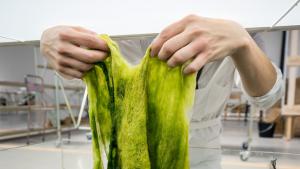
Dec 19, 2017 - A new bioplastic made from algae could replace oil-based plastic completely according to its inventors, potentially turning the manufacturing industry from a source of CO2 into a destroyer of the greenhouse gas writes Jesus Diaz for Fast Company. The designers behind the material imagine a world in which shops can locally produce all kinds of objects on demand, from plates to furniture, using 3D printers and the bioplastic. To demonstrate their material’s qualities, they’re producing it in small batches and using it to print designer products.
The Dutch designers Eric Klarenbeek and Maartje Dros spent three years creating their biopolymer, trying to find a solution to the problems of synthetic plastic. The latter contributes heavily to global warming and, worse, it depends on a limited, non-renewable resource as its raw material. In addition to that, plastic products get ferried from large factories all over the world into distribution centers and, eventually, retail shops, further increasing their carbon footprint.
So Klarenbeek and Dros asked themselves: What if we could invent a material using locally-grown raw materials–and use it to enable a manufacturing and distribution process that remained local from start to finish?
Algae are highly effective biomass generators. They’re also easy to grow and they’re great CO2 processing machines–they take this gas out of the atmosphere and the sea and turn carbon molecules into starch through photosynthesis, releasing oxygen molecules into the atmosphere as a byproduct.
Continue here to read the full article || December 19, 2017 |||

Palace of the Alhambra, Spain
By: Charles Nathaniel Worsley (1862-1923)
From the collection of Sir Heaton Rhodes
Oil on canvas - 118cm x 162cm
Valued $12,000 - $18,000
Offers invited over $9,000
Contact: Henry Newrick – (+64 ) 27 471 2242

Mount Egmont with Lake
By: John Philemon Backhouse (1845-1908)
Oil on Sea Shell - 13cm x 14cm
Valued $2,000-$3,000
Offers invited over $1,500
Contact: Henry Newrick – (+64 ) 27 471 2242

|
|