
Founded by Max Farndale 1947 - 2018
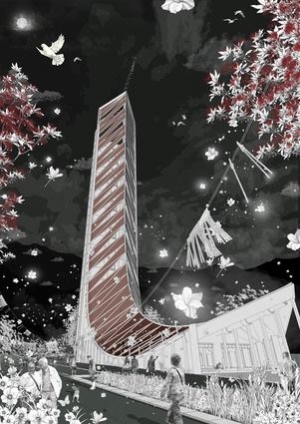
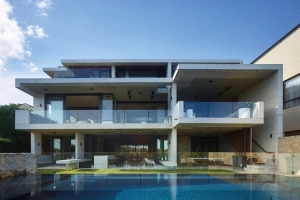

Dec 18, 2017 - The Government is making it easier for people to understand and apply best practice when designing and constructing buildings. By launching a new building system search engine and sponsoring five commonly used building standards and a handbook, we hope to see improved compliance with the Building Code, and even more importantly, safer homes and buildings, says Minister for Building and Construction Jenny Salesa.
“The online search engine, Building CodeHub helps people locate the latest building rules and guidance information for designing and constructing buildings,” says Ms Salesa. “It’s the definitive source of up-to-date rules and guidance from a range of sources.”
“New Zealand’s building regulator the Ministry of Business, Innovation and Employment (MBIE), has sponsored some of the most commonly-used standards, making them freely available to all users,” says Ms Salesa.
“We anticipate that providing free access to these standards, will make it easier for consumers to understand the building code requirements and apply best practice methods when undertaking home building projects.”
The sponsored standards and handbook, which can be accessed from the Standards New Zealand website, are:
“MBIE will continue to make the building system more accessible with further enhancements to Building CodeHub and considering ways to improve access to more design and construction building standards,” says Ms Salesa.
https://codehub.building.govt.nz/
https://www.standards.govt.nz/
| A Beehive release || December 18, 2017 |||
Dec 18, 2017 - The Whangaparaoa Community Recycling Centre has found a way to harness the power of the sun as it gears up for the busy festive season. The recycling centre recently began using a solar-powered wheelie bin lifter for glass recycling after being granted $11,000 by the Glass Packaging Forum (GPF). The machine, which was custom made by Simpro Engineering, lifts bins filled with colour-sorted container glass and tips it into a storage container at the small site.
The glass can then be transported to New Zealand’s only glass manufacturers O-I New Zealand to be remade into new 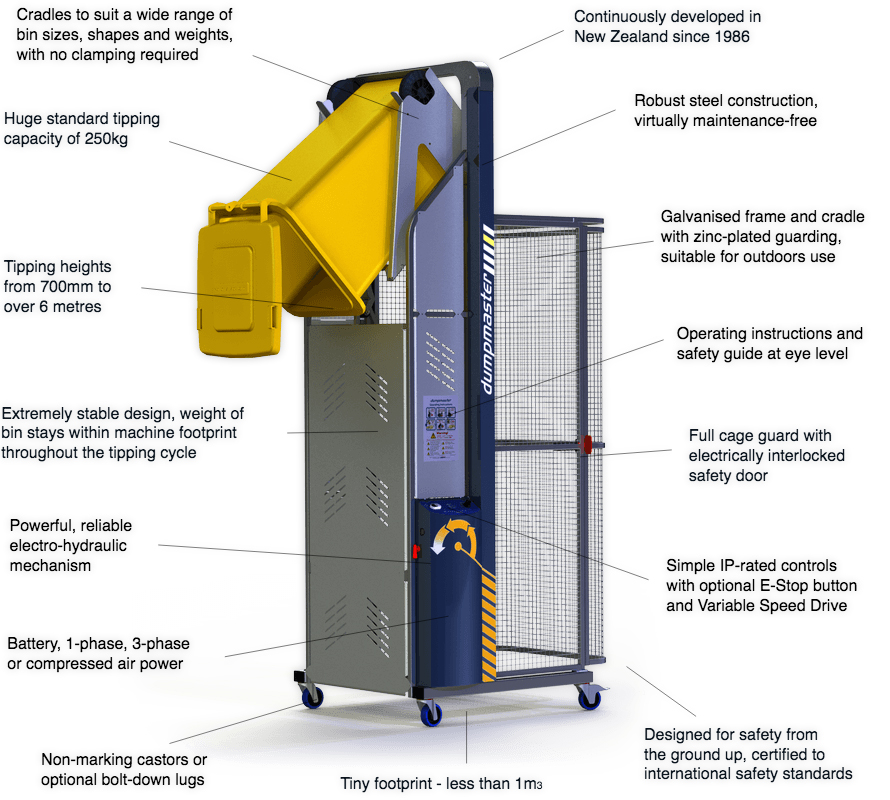 glass bottles and jars. The previous system saw workers manually pull the bins up a ramp and tip the glass out.
Sustainable North Trust trustee Betsy Kettle says the bin lifter is a great addition to the operation. “The workers love it because it eliminates the manual strain on their backs and frees up the space taken by the rusty old glass ramp.
“Having the extra space also means that the glass collection truck doesn’t have to shift the bins in the parking lot across the street, making the Whangaparaoa Road safer, too,” she says.
The recycling centre is once again expecting a busy festive season as the number of recycled glass bottles and jars increases over the summer. The new bin lifter gives them the capacity to deal with the extra load, Kettle says.
The site does not have a power supply, meaning it is essential the bin lifter be solar-powered. It also powers the center’s eftpos machine and can recharge the staff cell phones, she says.
The Sustainable North Trust and Community Business and Environment Centre (CBEC) jointly run the recycling centre under contract to Auckland Council. The recycling centre handles around seven tonnes of glass a month.
The GPF promotes the environmental benefits of glass packaging and manages the accredited GPF Product Stewardship Scheme. It allocated grants to fund infrastructure, research, events and public place recycling to increase the volume of recycled glass going back to the furnace at O-I, or for alternative uses for recycled glass.
| A Glass Recycling Forum release || December 18, 2017 |||
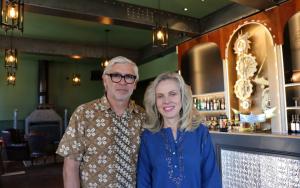
Dec 18, 2017 - Kiwiana, heritage, steam punk and luxury have merged at one of Featherston’s most loved historic buildings, which is reopening this week writes Hayley Gastmeier in the Wairarapa Times Age.
In all its glory, The Royal Hotel will be back in business from Wednesday, after an extensive two-year makeover.
Owners Rob Allen and Janelle Harrington bought the prominent Revans St building when it came up for sale in 2015.
The couple has put in considerable effort to ensure the hotel reflects both its own roots, and the history of the town.
Inspired by the town’s rail history, the hotel has tapped into the steam punk genre, while also embracing the coming together of Maori and Pakeha, as well as the town’s military history.
The hotel’s 12 upstairs bedrooms each have its own “personality”, themed on a unique character.
Most have elegant ensuites, in which the basins have been cleverly crafted with vintage sewing machine bases.
The largest room “belongs” to King Tawhiao, who was leader of the Waikato tribes and was the second Maori King.
Other rooms are themed after Victorian writers, such as Jules Verne (author of 20,000 Leagues Under the Sea), classic children’s books, and inspiring people of the past, such as Meri Te Tai Mangakahia, a campaigner for women’s suffrage in New Zealand.
Continue here to read the full article
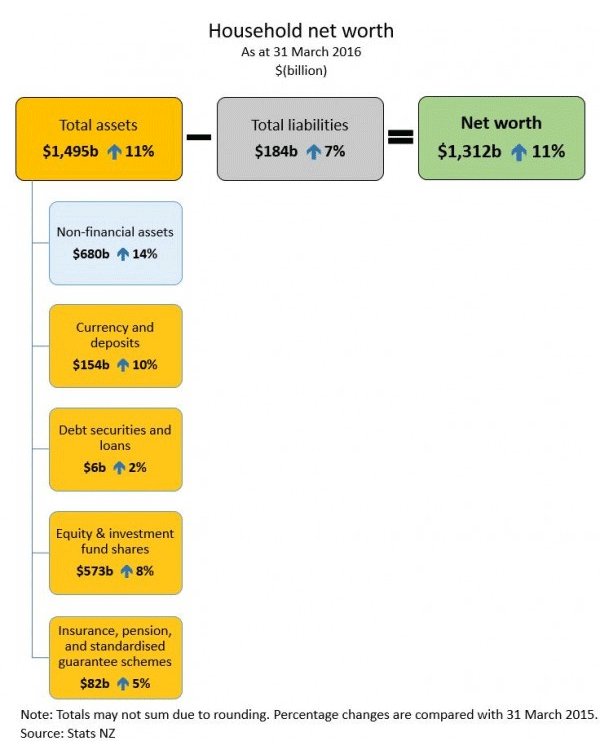
Dec 18, 2017 - New Zealanders’ wealth rose at its fastest pace in a decade, mainly driven by rising property values, Stats NZ said today. New Zealanders’ net worth rose $136 billion to $1.5 trillion in the year to 31 March 2016. The total net worth is equal to about $330,000 per person, mainly reflecting the value of property ownership.
“Net worth is the balance of what New Zealanders own over what they owe, and this is the biggest increase experienced in the last 10 years,” national accounts senior manager Gary Dunnet said.
Data used in this release comes from a range of sources, some of which is only available up to 2016. Therefore, the integrated data presented is up to the March 2016 year.
Household net worth increased 11 percent (or $134 billion). This was largely driven by rises of $84 billion in property values and $14 billion in currency and deposits, offset somewhat by additional loans of $12 billion.
Households own property worth $680 billion, about 45 percent of total household assets of $1,495 billion. The other main household assets are shares and other equity (38 percent), currency and deposits (10 percent), and insurance and pension funds (nearly 6 percent of total household assets).
From March 2015 to 2016, household deposits increased 10 percent to $154 billion, and provided an increased share of banking funding.
Financial assets, including bank deposits and shares, held by New Zealanders rose from $1,780 billion in 2007 to $2,575 billion in 2016 (up 45 percent). Most financial assets are held in equity ($1,045 billion) and loans ($769 billion).
Similarly, non-financial assets, including property, are $1,697 billion at March 2016, up 44 percent from $1,182 billion in 2007.
Dec 18, 2017 - Air New Zealand will fly nearly 6000 extra seats on its seasonal service between Christchurch and Fiji in 2018, an increase of more than 40 percent. The airline currently operates two services per week from Christchurch to Nadi International Airport between July and October, increasing to three services per week at peak times. Next year Air New Zealand’s Christchurch-Fiji service will start five weeks earlier on 26 May, with up to four services per week in the busy school holiday period. Air New Zealand Chief Revenue Officer Cam Wallace says the airline has tripled capacity between Christchurch and Fiji over the past five years. “Fiji is a clear favourite for Kiwi holidaymakers. We’re pleased these extra flights will offer South Island travellers greater flexibility for their holiday plans.” The new flights will be operated by the airline’s A320 aircraft and are available for purchase at www.airnewzealand.co.nz
| An Air New Zealand release || December 18, 2017 |||

Palace of the Alhambra, Spain
By: Charles Nathaniel Worsley (1862-1923)
From the collection of Sir Heaton Rhodes
Oil on canvas - 118cm x 162cm
Valued $12,000 - $18,000
Offers invited over $9,000
Contact: Henry Newrick – (+64 ) 27 471 2242
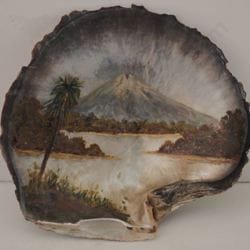
Mount Egmont with Lake
By: John Philemon Backhouse (1845-1908)
Oil on Sea Shell - 13cm x 14cm
Valued $2,000-$3,000
Offers invited over $1,500
Contact: Henry Newrick – (+64 ) 27 471 2242

|
|