
Founded by Max Farndale 1947 - 2018
Dec 14, 2017 - Air New Zealand and Virgin Australia have today announced changes to one of their key alliance routes driven by an improved demand outlook. The two airlines are set to provide customers with an expanded schedule of flights on the Auckland-Brisbane route, with up to five extra flights per week delivering an additional 38,000 seats between April and October 2018. This means customers will now be able to choose from up to 34 return services per week. In addition, Virgin Australia will be re-timing its weekday Auckland-Brisbane service to provide a better evening schedule proposition for the alliance, with the choice of departure times of 4:00pm, 6:00pm and 7:30pm allowing for more flexibility for customers. Air New Zealand Chief Revenue Officer Cam Wallace says the new services are timed for seamless connections to domestic ports at both ends of the route. “Demand for trans-Tasman travel continues to be strong and it’s a market we’re focused on growing. Together with Virgin Australia, we’ll offer up to six daily return flights between Brisbane and Auckland next winter - a capacity boost of more than 10 percent compared with the same period this year.” Group Executive for Virgin Australia Airlines Rob Sharp welcomed these changes, saying that the alliance will continue to look for opportunities to offer better connections and flight frequencies between Australia and New Zealand for its customers. “Virgin Australia is pleased to see the growth in demand for these services and these network changes. Our alliance with Air New Zealand is committed to providing customers with flexible travel options to and from New Zealand and the updates to the flight schedule reflect this.” Flights will be available to be purchase shortly at www.airnewzealand.co.nz and www.virginaustralia.com.
| An Air New Zealand release || December 14, 2017 |||
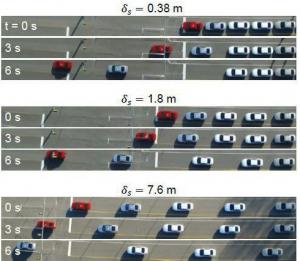
Dec 13, 2017 - When pulling up to a traffic light, most drivers get pretty close to the car in front of them, leaving just several feet of space between their bumper and the next. The practice of packing tightly at traffic lights is widely accepted. Traditional thinking says the closer a car is to a traffic light, the more likely that car will be to pass through the intersection before the light turns red again.
Thanks to new research by Virginia Tech College of Engineering professors and students, drivers now have a good reason to dismiss this faulty line of roadway intuition. The results could be useful in Ethiopia, where traffic management is a serious engineering project.
The study, published this month in the New Journal of Physics, used video cameras attached to drone helicopters to capture footage of cars accelerating through a traffic light on the Virginia Tech Transportation Institute's Smart Road. By systematically controlling the packing density of the cars, the researchers discovered that any decrease in distance to the light was completely offset by the time it took for cars to regain a comfortable spacing before drivers could accelerate.
Drivers who pack tightly at intersections do not increase their chances of making it through the light, and tailgating at traffic lights can also lead to more rear-end collisions.
"We varied the bumper-to-bumper spacing between cars by a factor of 20 and saw virtually no change in how much time it took for the cars to pass through the intersection when the light turned green," said Jonathan Boreyko, assistant professor in the department of biomedical engineering and mechanics. "The results mean there's no point in getting closer to the car in front of you when traffic comes to a stop," he said.
The inspiration for the research first came to Boreyko when he was sitting in traffic one day. Noticing that cars had to wait for the car in front of them to regain a safe spacing before they could start moving again, he hypothesized that, contrary to popular opinion, it might actually be better for cars to stop farther apart from each other when idling at a traffic light.
He teamed up with Farzad Ahmadi, a fourth-year Ph.D. student in Virginia Tech's engineering mechanics program and the study's lead author, to investigate.Using 10 volunteer drivers in identical vehicles, the researchers staged a series of experiments at the traffic light on the Virginia Tech Transportation Institute's Smart Road. Drivers systematically lined up at the light in a set of distances ranging from 1.25 to 50 feet, and a drone helicopter hovering overhead captured controlled bird's-eye-view footage of the traffic as drivers accelerated through the light.
Analysis showed that the time required for all cars to pass through remained relatively fixed, give or take about one second, for spacing distances up to 25 feet.
The two researchers used the thermodynamic concept of latent heat, the energy that a system loses during melting or evaporation, to describe what happens to cars stopped at a traffic light. Vehicles are jammed into a "solid phase" at a light and must waste energy "melting" back into a "liquid phase" before they can actually move through the intersection.
Boreyko and Ahmadi wondered if latent heat would have such a dramatic effect on other systems, such as slow-moving pedestrian traffic. Should people waiting in lines space themselves closer together or farther apart in order to move through more quickly?
The researchers set up a second round of experiments in The Cube at Virginia Tech's Moss Arts Center, a highly adaptable theater and laboratory equipped with synchronized cameras. Undergraduate students added a few conditions to their senior design experiments on human crowds to test Boreyko and Ahmadi's hypothesis.
"Latent heat had almost no effect for a line of pedestrians," said Boreyko. "The closer people got to each other, the faster they could empty the line. We realized that people move very slowly, but can accelerate very quickly, which minimizes the lag effect we saw with the cars at the traffic light."
The study's findings suggest that both pedestrians and drivers alike could see considerable benefits when taking a mindful approach to packing density in lines.
"Pedestrians waiting in a line should get as close to each other as possible if it's important for the line to empty quickly," said Boreyko. "But when you encounter a traffic jam or stop at a light, keep a safe and comfortable distance. You can just maintain whatever spacing you had when you were driving at full speed. You won't lose any time, but you'll reduce the odds of an accidental rear-end collision."Ahmadi agreed with Boryeko's conclusion.
"When my father was teaching me how to drive, he told me that to prevent an accident, you should stop so you can easily see the rear bumper of the car in front of you at a traffic light," said Ahmadi. "I've never done that until I analyzed the data of this experiment."
For more traffic management, find out how these machine learning techniques aim to reduce traffic.
| An engineering.com release || December 13, 2017 |||
Dec 14, 2017 - The European Union (EU) and Japan have concluded negotiations on a free trade deal to create the world’s largest open economic area, signalling their rejection of the protectionist stance of US president Donald Trump.
The two parties, who agreed in principle the outlines of the deal in July, said negotiators had now finished a legal text that would open up trade for economies generating about 30% of global GDP.
In a joint statement, Japanese prime minister Shinzo Abe and European Commission president Jean-Claude Juncker said the deal had “considerable economic value” and “strategic importance”.
“With the finalisation of the negotiations, the path is now clear to complete the internal procedures leading to the signature, ratification and full implementation of the agreement,” they said.
They added that the deal demonstrated their commitment to “keeping the world economy working on the basis of free open and fair markets with clear and transparent rules”.
The deal, the Economic Partnership Agreement, combining the 28-nation bloc and world’s third largest economy, will remove EU tariffs of 10% on Japanese cars and the 3% rate typically applied to parts.
For the EU, it will scrap Japanese duties of 30% on EU cheese and 15% on wines, as well as allowing it to increase its beef and pork exports and gain access to large public tenders in Japan.
Cecilia Malmstrom, EU trade chief, said amid widening protectionist movements the deal demonstrates to the world the flag of free trade would keep waving.
“This is biggest trade agreement we have ever negotiated for the EU. It sends a powerful message in defence of open trade based on global rules,” she said.
In the past five months negotiators worked on stabilising tariffs in services, regulatory cooperation and the means to protect food and drink categories, including only naming sparkling wines from a specific Italian region prosecco.
However, Malmstrom said that discussions are set to continue on the contentious issue of investor protection.
Japan has been reluctant to adopt the investment court system the EU has devised in answer to criticism of traditional dispute settlement arrangements intended to protect investors.
Campaigners argue the system, known as ISDS, hands companies the power to undermine social and economic rules. Brussels responded by devising an alternative system of investment courts but has so far not convinced Tokyo to back it.
Malmstrom said negotiations would continue separately on this issue outside the scope of the main deal, helping smooth the path towards ratification.
“This needs further discussion at the beginning of next year but the rest of the agreement is there,” she said.
The absence of investor protection from the deal means that the EU can ratify the agreement through the European Parliament and Council of Brussels, rather than through lengthy national ratification procedures.
She added that the EU is also hoping to seal free trade agreements with Mexico and the Mercosur bloc of Argentina, Brazil, Paraguay and Uruguay.
“The fact that we managed to finalise this today when we and Japan go to Buenos Aires, sends a powerful signal that we can make good trade agreements that are win-win,” she said.
| A Supply Management release || December 13, 2017 |||



INDIA - MAKE IT YOUR SPIRITUAL EXPERIENCE Rich in holy places, traditions and rituals, India offers

Dec 13, 2017 - Earlier this year, we committed to placing 55 billion XRP in a cryptographically-secured escrow account to create certainty of XRP supply at any given time. As promised, today we completed the lockup. By securing the lion’s share of XRP in escrow, people can now mathematically verify the maximum supply that can enter the market. While Ripple has proved to be a responsible steward of XRP supply for almost five years – and has clearly demonstrated a tremendous track record of investing in and supporting the XRP ecosystem – this lockup eliminates any concern that Ripple could flood the market, which we’ve pointed out before is a scenario that would be bad for Ripple!
This move underscores Ripple’s commitment to building XRP liquidity and a healthy and trusted market. Long term, the value of digital assets will be determined by their utility. XRP has emerged as the only digital asset with a clear institutional use case designed to solve a multi-trillion dollar problem – the global payment and liquidity challenges that banks, payment providers and corporates face.
Unlike other digital assets purely driven by unexplained speculation, real institutional customers are already using and finding value in XRP, and governments, regulators and central banks are increasingly recognizing the role it could play in the global system.
XRP goes beyond what Bitcoin does well — a store of value — and delivers transaction speed and throughput that is orders of magnitude faster than BTC or ETH. While other digital assets continue to bump against their transaction limits, XRP remains the fastest, most efficient and most scalable digital asset in the world – making it the best digital asset for payments. It’s no surprise that institutions are looking to XRP to provide much-needed on-demand liquidity for cross-border payments.
Game changer for $XRP! 55 billion XRP now in escrow Tweet This
Here’s how the escrow works:
The Escrow feature in the XRP Ledger allows parties to secure XRP for an allotted amount of time or until specific conditions are met. For example, Escrow allows a sender of XRP to put conditions on exactly when a payment can be completed, so the payment remains cryptographically locked until the due date.
We use Escrow to establish 55 contracts of 1 billion XRP each that will expire on the first day of every month from months 0 to 54. As each contract expires, the XRP will become available for Ripple’s use. You can expect us to continue to use XRP for incentives to market makers who offer tighter spreads for payments and selling XRP to institutional investors.
We’ll then return whatever is unused at the end of each month to the back of the escrow rotation. For example, if 500M XRP remain unspent at the end of the first month, those 500M XRP will be placed into a new escrow account set to expire in month 55. For comparison, Ripple has sold on average 300M XRP per month for the past 18 months.
Ripple’s vision remains the same – to enable the Internet of Value in which money moves like information moves today – and XRP is at the heart.
To learn more, please visit ripple.com/xrp.
| A Ripple release || December 7, 2017 |||

Palace of the Alhambra, Spain
By: Charles Nathaniel Worsley (1862-1923)
From the collection of Sir Heaton Rhodes
Oil on canvas - 118cm x 162cm
Valued $12,000 - $18,000
Offers invited over $9,000
Contact: Henry Newrick – (+64 ) 27 471 2242

Mount Egmont with Lake
By: John Philemon Backhouse (1845-1908)
Oil on Sea Shell - 13cm x 14cm
Valued $2,000-$3,000
Offers invited over $1,500
Contact: Henry Newrick – (+64 ) 27 471 2242

|
|