
Founded by Max Farndale 1947 - 2018



Dec 8, 2017 - Higher sales volumes for chemicals and plastics producers helped lift manufacturing in the September 2017 quarter, Stats NZ said today.
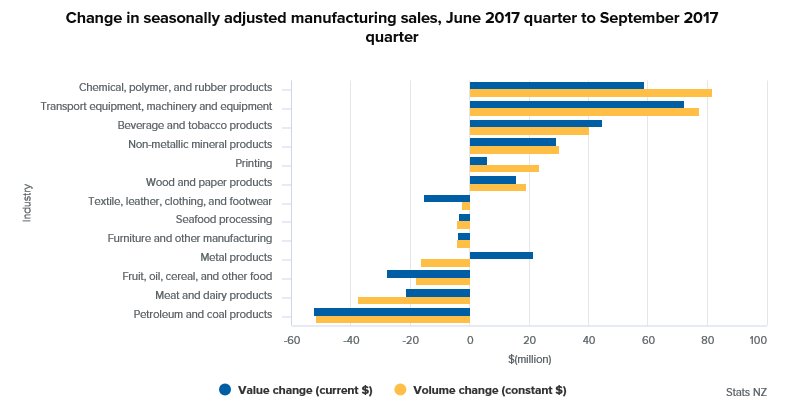
The total volume of manufacturing sales rose 0.3 percent in the September 2017 quarter compared with the June 2017 quarter, when adjusted for seasonal effects. This follows a 1.0 percent increase in the June 2017 quarter.
Six of the 13 manufacturing industries saw sales rise in the September 2017 quarter. The largest movements were chemical, polymer, and rubber product manufacturing, up 3.7 percent, and transport equipment, machinery and equipment manufacturing, up 2.8 percent.
“The September quarter’s rise in chemical, polymer, and rubber product manufacturing sales followed a sizeable 8.5 percent fall in the June 2017 quarter,” manufacturing manager Sue Chapman said. “This industry includes the manufacturing of fertiliser, plastics, and rubber products.”
Meat and dairy product manufacturing sales seasonally fall in the September quarter, with sales volumes down 0.5 percent. This followed an 8.0 percent rise in the June 2017 quarter.
 The actual volume of total manufacturing sales was unchanged from the previous September quarter. When price changes are included, the value of manufacturing sales was $25.3 billion in the September 2017 quarter, up $2.0 billion from the September 2016 quarter.
| A STATSNZ release || December 8, 2017 |||

Dec 8, 2017 - Over its long history, Canada’s banking industry has absorbed a range of adjacent players in the sprawling world of financial services: trust companies, investment dealers, property and casualty insurers, and wealth advisors. Many of these structural mergers involved both extensive regulatory reform as well as significant cultural shifts within the industry. Yet as Canada’s banks consolidated and expanded into these other verticals, they tended to impose their cautious ways rather than adopt the more free-wheeling ethic of the smaller players they had raced to acquire.
The fintech revolution, however, will demand a complete reboot of this well-established dynamic. As these ambitious startups evolve from giant-killing disrupters into innovation-minded partners for the banking sector, both sides are struggling to figure out how to live with one another.
Fintech firms offer entrepreneurial energy, innovative technologies and highly flexible consumer engagement techniques. But they also bring a healthy dose of impatience to a famously staid industry that was widely congratulated, almost a decade ago, for the corporate caution and regulatory prudence that allowed Canada’s banks to ride out the 2008 credit crisis.
Banks, for their part, are awakening to the realization that younger consumers want to do most of their banking on their mobile devices, which is also how they shop and consume news. The American Banking Association even published a tip sheet for its members on how to “make friends” with fintech.
It’s a tall order. The sluggish pace of in-branch or web-based banking and lending, hard-wired into the banking industry’s culture, is anathema to the fintech industry’s sense of urgency and opportunity, and reveals, to many of these startups, a reluctance to take chances on new mobile and data technologies.
Fintech firms offer entrepreneurial energy, innovative technologies and highly flexible consumer engagement techniques. But they also bring a healthy dose of impatience to a famously staid industry
As a former banking consultant who now helps raise capital for fintech startups, I can see both sides.
If it hopes to survive, the banking industry needs to find new ways of partnering with these nimble newcomers. Yet the learning has to happen in the other direction as well: if they want to succeed and grow, impatient fintech entrepreneurs must find ways to work with these large, closely regulated institutions.
Let’s start with the source of the chafing. Various fintech players with serious ambitions have told me they often feel worn down by bank clients’ insistence on historical performance data for innovations with no past, the dearth of seasoned innovation champions within these huge organizations, the lasting effects of legacy technologies, and frustratingly diffuse decision-making processes.
Risk aversion runs deep in the banking sector, and, in many cases, it seems to be a point of pride. As some fintech founders report, they’re often told by bank partners that every feature of a new service must work perfectly, while potential downsides are scrutinized to the point of exhaustion. And though fintech founders are acutely aware of the fast pace of their own industry, many come away from these encounters sensing that their banking partners have little sense of urgency.
Today, some banks are starting to see that there may be risks associated with their institutional inertia. Most have established innovation labs or are backing proof-of-concept projects with fintech partners. While some fintech startups express skepticism about these ventures, others offer up useful advice for their bank partners on how to make such forays succeed:
— resist the analysis-paralysis instinct and give your innovation teams sufficient scope to dive into proof-of-concept partnerships, knowing that some will fail
— ensure that there’s a business sponsor behind such pilot projects, as well as a path that leads to a possible deal, and
— be prepared to pay fintech partners for the value they create through successful initiatives that generate new service offerings and improved customer engagement.
But it’s a two-way street. Fintechs need the support of banks to help overcome one of their main challenges: getting to scale and ultimately putting products in front of customers. This can entail something of a Catch-22, however, because banks often seem to be more receptive to partnerships with fintech firms that have already created a compelling brand promise, have a consumer track record and bring their own investors or sponsors to the table.
Fintech options ease the pain points of financing for entrepreneurs ‘There’s no silver bullet here’: Global financial firms still grappling with fintech challenge, report finds
So, what does a successful partnership look like? These pairings, fintech firms say, will increase addressable market segments; demonstrate how an improved user experience leads to increased adoption; expand the lifetime value of a customer relationship; and focus on service offerings that minimize competitive tensions.
To work with fintech firms, banks also need to reconcile themselves to some unfamiliar practices, such as associating their brands with products and services they don’t necessarily own. And both parties have to find common ground on technical issues such as customer data sharing, anti-money-laundering/know-your-client compliance and which key performance indicators will be employed to measure success, given that at least initially, the new fintech partnerships are unlikely to make a dent in the top line.
As this difficult pairing game proceeds, it may be useful to look beyond the banking industry for learnings. My own suggestion: IBM in the early 1990s, when then-CEO Lou Gerstner, a former consumer packaged goods executive, radically shook up the sleepy culture of a massive tech manufacturer. Recognizing the mortal threats facing his company from both the hardware and software sides of the computer industry, Gerstner forced IBM’s tens of thousands of employees to begin thinking about creating business solutions that actually responded to its customers’ needs. The end result? During Gerstner’s tenure, among many other changes, he shut down unprofitable businesses and added valuable service offerings to the commoditized hardware business, increasing the market cap of IBM to US$168 billion from US$29 billion.
Simply put, fintechs are to the banking sector as Gerstner was to IBM: crucial change agents, pushing these giants to confront the uncertain future taking shape outside the walls of a fortified industry that’s far more exposed than Canada’s bankers may realize.
Change, as we know, is hard. Not changing, however, would be worse.
Roy Kao is senior advisor, Finance & Commerce, MaRS Discovery District. This article first appeared in the Ivey Business Journal.
| A Financial Post release || December 8, 2017 |||
Dec 8, 2017 - Tomorrow (Saturday) will mark 150 years since the opening of the Lyttelton Rail Tunnel, an engineering marvel which remains a key part of the KiwiRail network and important contributor to the local economy. When the Lyttelton Rail Tunnel opened on December 9, 1867, it was the first rail tunnel in New Zealand, and the first in the world to be drilled through the side of an extinct volcano.
Before the opening of the tunnel, it was difficult to transport Canterbury’s goods, such as wool, throughout the world. To reach Lyttelton Port, people and goods would need to travel over the Bridle Path or take long and complicated routes involving river and sea crossings.
With the support of Superintendent William Sefton Moorhouse (known as ‘Railway Billy’), it was decided a direct rail tunnel between Christchurch and Lyttelton was the best option.
The tunnel presented unprecedented challenges to the engineers involved, such as how to drill through hard volcanic rock, and was one of the country’s first great engineering works.
It has stood strong for 150 years, and while passengers no longer travel through the tunnel, it remains a vitally important transport route for exports from the region.
“Every year, our services carry 1.1 million tonnes of coal, 300,000 tonnes of logs and around 30,000 tonnes of general freight through the Lyttelton Rail Tunnel,” says KiwiRail Network Services Group General Manager Todd Moyle.
“The tunnel is essential to KiwiRail’s operations, those of Lyttelton Port Company and to the people of Canterbury, who rely on our services to export their goods to the world.
“Volumes are increasing into and out of LPC, which last year opened its Inland Port in Rolleston to help service increasing productivity from the Canterbury plains, making the tunnel as important as ever.
“We’re grateful to the engineers and officials who, more than 150 years ago, had the foresight and perseverance to design and build what has become a significant part of KiwiRail’s network and of New Zealand’s history.”
| A KiwiRail release ||| December 8, 2017 |||

Dec 8, 2017 - Switzerland’s national pursuit cycling team will make its debut at the 2018 New Zealand Cycle Classic held in the Wairarapa next January. While some of the riders have competed in New Zealand before, this will be the first time the team has competed in the iconic race, the only Union Cycliste Internationale (UCI) 2.2 accredited tour staged in New Zealand which has been an annual sporting fixture for the past 30 years. The team will be led by experienced rider Thery Schir, who competed at the 2016 Olympic Games, finished fourth in the Madison at the 2016 World Champs and recorded strong results in the international tour of Portugal and Fleche Du Sud in the Netherlands. The Swiss team will use the NZ Cycle Classic as an important part of their preparation for the 2018 World Track championships, held in Holland in March. Schir is looking forward to visiting and competing in the Wairarapa from January 17th – 21st 2018.
“I am looking forward to exploring a new part of the world with the New Zealand Cycle Classic and hoping to sample some famous Martinborough wine after the tour,” said Schir.
The Swiss team features a who’s who of experienced riders including seasoned professional track and road rider Cyrylle Thiery, who finished fifth in the Tour of Hokkaido in Japan in 2016 and third in the sprints classification. He is the most experienced rider in the team with top places in this year’s tour of Colombia, South Bohemia Tour in the Czech Republic and the Tour of Greece.
Stefan Bissegger is the third member of the team and the 2016 winner of the Driedaagse Van Axel tour and sprints classification in the Netherlands. He is tipped to be an exciting rider to watch during the NZ Cycle Classic’s bunch stage finishes.
The rest of the team are Claudio Imhof, Frank Pasche and Gael Suter, all experienced riders in stage races around Europe.
Swiss team manager and national coach, Ross Machejefski, who is a New Zealander, chose to start the team’s year during a Kiwi summer to prepare his riders for the world championships later in March.
“This tour fits into a one month training block in New Zealand for the team to avoid the harsh Swiss winter! The riders are really looking forward to racing in the New Zealand summer and alongside some of Australasia's best road riders” Machejefski said.
New Zealand Cycle Classic race director Jorge Sandoval is thrilled to have the quality Swiss team make its debut in his event.
“Swiss riders are highly regarded all over the world, to have them here for the first time is a privilege for our event - they may be the Swiss “Track” team but I know how experienced they are in stage races, having seen their results and participation over the last few years in many stages races around the globe, they are coming here to do well and should be a strong team to beat,” said Sandoval.
The New Zealand Cycle Classic is recognised as the premier international road cycling event in this country and has developed a reputation for unearthing new talent, with many of the riders having gone on to win stages in the Tour de France, the Tour of Italy and world championship titles. In 2018 it will be held in the Wairarapa from January 17th – 21st with more riders coming from around the world. These teams will be announced in the coming weeks as will confirmation about whether 2017 Tour winner Joseph Cooper will defend his title.
The five-stage tour features two new routes that weave through Wairarapa’s rolling country side and will also see the team’s presentation held in a festive evening setting on Tuesday, 16th January in Masterton.
Being held simultaneously, is Huri Huri a series of community based cycling events designed to celebrate the Wairarapa’s bike-friendly roads, tracks and trails; the people that ride on them and the bikes they ride.
These include: an opportunity to explore the historic Castlepoint Station by bike along three different coastal tracks on Saturday, 20th January and a fun, family friendly evening at Mitre 10 Mega Masterton on Tuesday, 16th February. This promotional evening will include a freestyle BMX display; fun cycle obstacle course for children; a free barbecue and a promotional circuit ride for club riders. The elite teams will also ride the same Criterium circuit enabling spectators to get a taste of what exciting, international racing will unfold in the coming days.
DETAILS FOR THE 2018 NEW ZEALAND CYCLE CLASSIC
Teams Official Presentation & Promotional Criterium: Tuesday, 16th January 2018
Mitre 10 Mega Masterton, eveningIncludes teams presentation, Criterium, Huri Huri BMX display, family BBQ
Stage One. Wednesday 17th January 2018122.5kmMasterton – Alfredton - MastertonStage Two. Thursday, 18th January 2018120kmMasterton – Gladstone Circuit – Masterton
Stage Three. Friday, 19th January 2018136kmMasterton - Martinborough
Stage Four. Saturday, 20th January 2018147kmMasterton – Te Wharau – Admiral Hill
Huri Huri eventExplore Castlepoint Station by bike, 20th January 2018
Stage Five. Sunday, 21st January 2018120kmMasterton. Riders complete 12 laps of a 10km circuit.
| A Destination Wairarapa release || December 8, 2017 |||


Palace of the Alhambra, Spain
By: Charles Nathaniel Worsley (1862-1923)
From the collection of Sir Heaton Rhodes
Oil on canvas - 118cm x 162cm
Valued $12,000 - $18,000
Offers invited over $9,000
Contact: Henry Newrick – (+64 ) 27 471 2242

Mount Egmont with Lake
By: John Philemon Backhouse (1845-1908)
Oil on Sea Shell - 13cm x 14cm
Valued $2,000-$3,000
Offers invited over $1,500
Contact: Henry Newrick – (+64 ) 27 471 2242

|
|