
Founded by Max Farndale 1947 - 2018
Nov 23, 2017 - Auckland based network monitoring technology provider Endace has appointed StarLink as its value-added distributor across Europe, Middle East and Africa to promote its network recording and packet capture tools writes Stuart Corner for Computerworld New Zealand. The move to boost is European presence follows Endace announcing in October 2016 a new feature dubbed Provenance, that it said would be needed to enable traders to comply with European Securities and Markets Authority’s (ESMA) upcoming Markets in Financial Instruments Directive II.
The directive requires traders to record all trade data and ensure trade events are accurately time-stamped to within microseconds of Coordinated Universal Time (UTC) along with information about the reliability of the timing source.
StarLink, headquartered in Dubai, is growing rapidly in Europe through its UK based regional headquarters, according to Endace.
“The partnership will see Endace’s technology distributed by StarLink to help businesses mitigate risks from cyber-attacks and better manage the security of their critical network assets,” Endace said.
Endace CEO Stuart Wilson said network packet capture was essential to enable companies to quickly and accurately analyse security events.
“Network security is paramount in today’s connected world, especially given recent high-profile examples of costly hacks and breaches,” he said.
"Partnering with StarLink, with its deep channel relationships in this market, will enable us to extend our reach and continue to accelerate our growth in EMEA.”
Wilson said interest in Endace network recording solutions had increased dramatically as organisations grappled with how to handle breaches, highlighted by the recent Equifax breach, and in light of growing mandatory breach disclosure requirements.
Interest in Endace’s network recording solutions also increased dramatically last year when Wikileaks outed the company for its role in helping several national governments snoop on citizens' data.
Endace in July this year launched EndaceFabric, billed as a centrally managed, network-wide packet capture and recording fabric that, it said “gives network security and network operations teams the definitive, packet-level evidence they need to rapidly investigate, and respond with certainty, to cybersecurity threats and network or application performance issues.”
A year earlier, in July 2016, the company joined the Cisco Solution Partner Program, saying the move would enable it to quickly create and deploy solutions to enhance the capabilities, performance and management of the network to capture value in the ‘Internet of Everything’ (Cisco’s then preferred name for IoT).
| A ComputerWorld release || November 23, 2017 |||
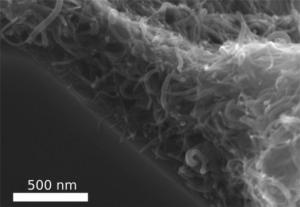
Nov 23, 2017 - New composite material made of carbon nanotubes. Due to their unique properties, carbon nanotubes would be ideal for numerous applications, but to date they cannot be combined adequately with other materials, or they lose their beneficial properties. Scientists have developed an alternative method of combining, so they retain their characteristic properties. As such, they 'felt' the thread-like tubes into a stable 3-D network.
| FULL STORYIn this simple procedure, water is mixed with the carbon nano tubes and dripped into a white ceramic material which is highly porous. Like a sponge, it sucks up the black liquid. If the ceramic scaffolding is chemically etched out, only the fine felted coat remains. The felt made of tiny tubes has thereby interconnected to form a network of larger tubes. The hollow spaces can be filled with polymers, to create a conductive and tear-resistant composite material.Credit: Fabian Schuett
Extremely lightweight, electrically highly conductive, and more stable than steel: due to their unique properties, carbon nanotubes would be ideal for numerous applications, from ultra-lightweight batteries to high-performance plastics, right through to medical implants. However, to date it has been difficult for science and industry to transfer the extraordinary characteristics at the nano-scale into a functional industrial application. The carbon nanotubes either cannot be combined adequately with other materials, or if they can be combined, they then lose their beneficial properties. Scientists from the Functional Nanomaterials working group at Kiel University (CAU) and the University of Trento have now developed an alternative method, with which the tiny tubes can be combined with other materials, so that they retain their characteristic properties. As such, they "felt" the thread-like tubes into a stable 3D network that is able to withstand extreme forces. The research results have now been published in the journal Nature Communications.
Industry and science have been intensively researching the significantly less than one hundred nanometre wide carbon tubes (carbon nanotubes, CNTs), in order to make use of the extraordinary properties of rolled graphene. Yet much still remains just theory. "Although carbon nanotubes are flexible like fibre strands, they are also very sensitive to changes," explained Professor Rainer Adelung, head of the Functional Nanomaterials working group at the CAU. "With previous attempts to chemically connect them with other materials, their molecular structure also changed. This, however, made their properties deteriorate -- mostly drastically."
In contrast, the approach of the research team from Kiel and Trento is based on a simple wet chemical infiltration process. The CNTs are mixed with water and dripped into an extremely porous ceramic material made of zinc oxide, which absorbs the liquid like a sponge. The dripped thread-like CNTs attach themselves to the ceramic scaffolding, and automatically form a stable layer together, similar to a felt. The ceramic scaffolding is coated with nanotubes, so to speak. This has fascinating effects, both for the scaffolding as well as for the coating of nanotubes.
On the one hand, the stability of the ceramic scaffold increases so massively that it can bear 100,000 times its own weight. "With the CNT coating, the ceramic material can hold around 7.5kg, and without it just 50g -- as if we had fitted it with a close-fitting pullover made of carbon nanotubes, which provide mechanical support," summarised first author Fabian Schütt. "The pressure on the material is absorbed by the tensile strength of the CNT felt. Compressive forces are transformed into tensile forces."
The principle behind this is comparable with bamboo buildings, such as those widespread in Asia. Here, bamboo stems are bound so tightly with a simple rope that the lightweight material can form extremely stable scaffolding, and even entire buildings. "We do the same at the nano-scale with the CNT threads, which wrap themselves around the ceramic material -- only much, much smaller," said Helge Krüger, co-author of the publication.
The materials scientists were able to demonstrate another major advantage of their process. In a second step, they dissolved the ceramic scaffolding by using a chemical etching process. All that remains is a fine 3D network of tubes, each of which consists of a layer of tiny CNT tubes. In this way, the researchers were able to greatly increase the felt surface, and thus create more opportunities for reactions. "We basically pack the surface of an entire beach volleyball field into a one centimetre cube," explained Schütt. The huge hollow spaces inside the three-dimensional structure can then be filled with a polymer. As such, CNTs can be connected mechanically with plastics, without their molecular structure -- and thus their properties -- being modified. "We can specifically arrange the CNTs and manufacture an electrically conductive composite material. To do so only requires a fraction of the usual quantity of CNTs, in order to achieve the same conductivity," said Schütt.
Applications for use range from battery and filter technology as a filling material for conductive plastics, implants for regenerative medicine, right through to sensors and electronic components at the nano-scale. The good electrical conductivity of the tear-resistant material could in future also be interesting for flexible electronics applications, in functional clothing or in the field of medical technology, for example. "Creating a plastic which, for example, stimulates bone or heart cells to grow is conceivable," said Adelung. Due to its simplicity, the scientists agree that the process could also be transferred to network structures made of other nanomaterials -- which will further expand the range of possible applications.
| Story Source:
Materials provided by Kiel University. || November 23, 2017 |||

Nov 23, 2017 - Legendary hedge fund manager and multi-billionaire Julian Roberston put together one of the most luxurious golfing vacations in his beloved New Zealand – and we got the inside look writes Elena Holodny for Business Insider US. On the Tiger Tour, vacationers can see both New Zealand’s North and South Islands over the course of nine nights on Roberston’s three properties: The Lodge at Kauri Cliffs, The Farm at Cape Kidnappers, and Matakauri Lodge.
Roberston, 85, a pioneer of the modern hedge fund industry, is best known for founding the investment firm Tiger Management Corp, one of the earliest funds, in 1980. After closing his fund in 2000, many of Robertson’s proteges went on to start some of the world’s largest hedge funds, such as Lone Pine and Viking Global. His net worth is estimated at $4.1 billion, according to Forbes.
The Tiger Tour is currently going on from November 17-26, 2017, but there’s another tour coming up March 1-10, 2018. The tour is limited to four couples at $28,500 per person, plus taxes, and not including international airfare and other expenses. The first stop is at The Lodge at Kauri Cliffs.
| Continue here to take your own photographic journey of the Tiger Tour || November 23, 2017 |||

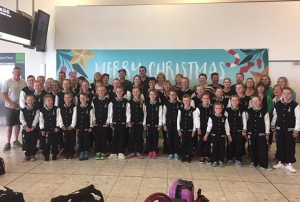
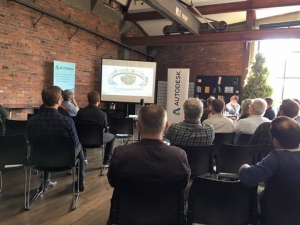
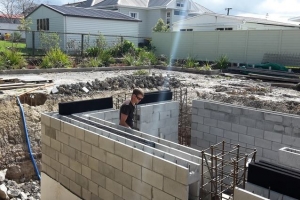
Rochelle Payne writes the third blog update on the progress of The Living House. The rammed earth

Nov 22, 2017 - In politics, timing is everything. So it might have been inopportune amid a faux furore over Auckland Council business-class travel spending for Mayor Phil Goff to have to made public the details of his two-week sojourn to Europe and Britain. Goff, however, has been around too long in the public eye, and is too much of a swot, to allow his time astride the world stage to be portrayed as some cosy junket writes Tim Murphy on Newsroom.
Instead, in full-press workaholic mode, he has revealed in a written report to councillors an eye-watering work programme of research on transport and housing and of diplomacy on climate change and World War 1 commemorations.
His 15-page note supplemented by photographic evidence and graphs, even explains that both Goff and an adviser's return airfares to Europe and accommodation in France were paid for by the global Bloomberg philanthropic foundation. (For completeness, that charity deemed business-class appropriate for a travelling public official).
What did the mayor - and the public - learn from the former foreign minister's return to a jet-setting life?
* He may have uncovered a "major New Zealand expatriate investor who is interested in investing in large-scale, built-to-rent developments to help alleviate Auckland's housing shortage. Goff's report says Kent Gardner, of multi-billion dollar investment company Evans Randall, is returning to New Zealand and is interested in projects here similar to those the company developed in the UK. "His goal is to build good-quality long-term rentals with secure tenure, including some social housing. This could represent a major opportunity to increase housing stock to address Auckland's housing shortage."
* He met New London Architecture, an independent forum for discussion on design and planning for the city, which has used 3D technology to create a 12.5 long metre scale model of London, showing in miniature the city's full 85 square kilometres. Notably, Goff says the Auckland Design Office is working with AUT on a similar model for Auckland.
* He had four and a half hours with the chief executive of Transport for London, Mike Brown, and his officials, learning that rubber-wheeled trains that can run along roads without the cost of tram-tracks were not the cost savers some think, because roads have to be strengthened to take the weight of the trams, they need power and the rides are not comfortable. TFL's experience also helped persuade Goff that elevated light rail costs four times as much as grade-level light rail - and underground light rail cost ten times that on the ground. "These costs largely rule out these options for Auckland."
* From TFL, the mayor also learned that autonomous vehicles were "highly . . .
| Continue here to read the full article on Newsroom || November 22, 2017 |||

Palace of the Alhambra, Spain
By: Charles Nathaniel Worsley (1862-1923)
From the collection of Sir Heaton Rhodes
Oil on canvas - 118cm x 162cm
Valued $12,000 - $18,000
Offers invited over $9,000
Contact: Henry Newrick – (+64 ) 27 471 2242
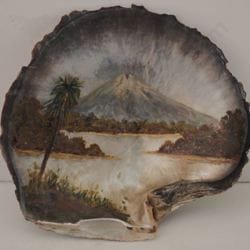
Mount Egmont with Lake
By: John Philemon Backhouse (1845-1908)
Oil on Sea Shell - 13cm x 14cm
Valued $2,000-$3,000
Offers invited over $1,500
Contact: Henry Newrick – (+64 ) 27 471 2242

|
|