
Founded by Max Farndale 1947 - 2018

Nov 22, 2017 - Company to streamline business operations and support a drive for efficiency across the entire organisation. Coda Group, one of New Zealand’s leading and most innovative logistics companies, has commenced deployment of Promapp’s cloud-based business process management software (BPM) to streamline business operations and support a drive for efficiency across the entire organisation.
Coda Group was established two years ago as a joint venture between Port of Tauranga and freight and logistics company, Kotahi, to boost the efficiency of New Zealand’s nationwide supply chain, remove wasted capacity and reduce the costs of consolidating the cargo necessary for big ships.
The joint venture brought together four of New Zealand’s leading freight brands, including DTL, Tapper Transport, Priority Logistics and MetroPack, each with their own processes, many of which were paper-based and held in a variety of formats. Many of these processes couldn’t be shared, accessed and updated across the entire Coda Group business operation.
“In order to support the overall business in driving continuous improvement, optimising freight flows and creating a leaner, more efficient organisation we needed to ensure that our processes across the business could be easily aligned with business objectives,” said Wendy Mallowes, Business Process Improvement Lead, Coda Group.
Coda Group has company-wide processes, including those involving freight management, import-export procedures, and health and safety. These need to be consistently adhered to while individual customer requirements also add to the complexity of processes and procedures with specific legal and compliance requirements.
David Choong, Coda CFO, says, “As the business has grown and gained momentum, we concluded that we needed a central repository of business processes and documents on anything relating to operations, from staff induction and everyday warehouse operation to import and export procedures. We needed these processes to be universally followed and updated by our 310 staff at any time and from any location."
Promapp was selected to support Coda Group’s requirements based on its ease of use, friendly graphical user interface and its central repository which enables individuals in an organisation to store and update processes, supporting continuous business improvement.
“Being cloud-based also means that Promapp gives us the ability to share processes with our customers and provide staff with the comfort that they are always working with the latest information,” said Mallowes.
“Promapp’s feedback options will support Coda Group’s approach to continuous improvement which will enable customers to provide feedback and remove waste from the logistics network, boost efficiency and help streamline operations."
Coda Group has also set its sights on deploying Promapp’s Process Variant Management (PVM) software which will help the company manage or eliminate process variations.
Coda Group will be able to standardise processes across the entire company, while simply incorporating process variations to meet the requirements of a specific location, product, or customer.
PVM will also enable Coda Group to customise activities and manage service delivery for key customers helping to improve customer service.
“Ultimately, Promapp will support our strategy to remove wasted capacity, reduce the cost of consolidating freight and create real change in the logistics network. The end game is to provide greater value to our customers and logistics partners and to meet our target to handle more than five million metric tonnes of containerised cargo annually,” said Mallowes.
Promapp will be gradually rolled out across all Coda Group business units during 2018.
| About Promapp
Established in 2002, Promapp (https://www.promapp.com) works with hundreds of organisations worldwide to foster a thriving business improvement and process management culture. Promapp’s cloud-based business process management (BPM) software makes it easy to create, navigate, share and change business processes, enabling continuous improvement, risk management, quality assurance and business continuity. Providing an intuitive online process repository, an integrated process mapping tool, and a process improvement toolset, Promapp’s proprietary software supports the development of smarter and safer ways to work, while encouraging sharing of information by operational teams rather than limiting it to process analysts and technical specialists.
Promapp’s wide range of public and private sector customers includes: Coca-Cola Amatil, Air New Zealand, WesTrac, Lumo Energy, Toyota, Ricoh, McDonald's, Audi Australia, Department of Justice, Victoria, Adelaide City Council, Waikato District Council and Southland Regional Council. The company is headquartered in Auckland, New Zealand. www.promapp.com
| A CSO release || November 22, 2017 |||
Nov 22, 2017 - Kiwi tech companies urged to ‘eat more of their own dog food’ when it comes to selling – Kiwi technology needs to sell itself smarter to realise its full potential to become the country’s largest export industry, according to the latest Market Measures report.
“We don’t face the same environmental constraints of the other two major export sectors –agriculture and tourism – so the potential for tech is virtually limitless,” says Owen Scott, Managing Director of Concentrate Limited, who organise the study along with fellow tech marketing company Swaytech.
“Improving our ability to sell efficiently is one way of unlocking this potential, and ultimately becoming New Zealand’s primary export industry,” says Scott.
Now in its ninth year, Market Measures gathers information about sales and marketing from over 300 New Zealand technology companies, and compares the results to similar data from the USA.
“In the 2017 study we have found that Kiwi companies are over-reliant on company founders and high-value sales people to sell their products and services. More than 46% of companies said a founder was still closely involved in sales, and the average sales person in an export market was paid a base salary almost 50% higher than the typical equivalent US sales person.”
“It’s not a scalable approach to generating export sales – 40% of the surveyed companies reported that productivity was their main problem when it came to managing their sales teams,” says Scott.
Bob Pinchin, Managing Director of Swaytech, says the fact that US companies used on average three times the number of digital sales tools (e.g. email automation, contact intelligence and similar) than their New Zealand counterparts, was evidence they were more focussed on efficiency.
“In the tech industry we call this ‘eating your own dog food’, but our firms are turning their nose up at these tools at the moment.”
“We have talented tech sales people who convert leads at an incredibly high rate, but it’s the volume of sales that is the issue – this productivity challenge is one we have to solve to overtake the other two big export industries,” says Pinchin.
“Our tech sales people are really ‘artists’, talented and creative and able to craft sales, but what we need more of is scientists – people operating within a rigorous system able to produce repeatable, predictable sales results at a lower cost,” says Scott.
Scott says that more than ever before, New Zealand tech companies must be willing to invest in sales and marketing, which has been a constant trend of Market Measures since it began in 2008.
“It ranges from a stable 25% of annual revenue spent on sales and marketing (including salaries and costs) for established companies, through to an aggressive 86% for start-up tech businesses.”
“NZTE works with an increasing number of internationally successful tech companies but as the Market Measures study suggests, some of them – big and small – are forgetting to cover some of the basics that lead to export growth,” says Charles Haddrell, Customer Director at NZTE, the principal sponsor of Market Measures.
“Getting your sales and marketing strategies right isn’t just a nice to have – it’s a must have. We’ve worked with hundreds of companies and know from experience that implementing robust sales processes, developing sales and execution skills, hiring well, and being aware of the technologies to support the sales and marketing functions are vital to being successful overseas,” says Haddrell.
The full Market Measures 2017 report can be downloaded from www.marketmeasures.co.nz at a cost of $375.
| A Concentrate release || November 22, 2017 |||
Nov 22, 2017 - Scott Technology outbid an overseas buyer when it bought Dunedin-based engineering firm DC Ross out of receivership, a six-monthly report from the receivers shows. DC Ross, which supplies precision metal formed parts, was tipped into receivership in September 2016 and in June this year Scott Technology said it had entered an unconditional agreement to purchase all the assets of the company for a total purchase price expected to be less than $500,000.
In its annual report, Scott Technology, also based in Dunedin, said it paid $375,000 for DC Ross, and its tool room and tool design capability has already enabled it to undertake significant work for an appliance manufacturer in Australia.
It also noted the inventories, plant and equipment of the DC Ross business were purchased from DC Ross’ receivers for an agreed total value which was less than market value, resulting in a fair-value gain on acquisition.
In today's report, DC Ross's receiver Malcolm Hollis of PwC said they had corresponded with multiple interested parties and attracted an overseas buyer. He did not identify the company and was not immediately available for comment. However, prior to settlement, it received a "large offer from a third party," he said in the report. "We consulted with our appointer, who agreed this was the best possible offer received to date and retained employment for all staff," said Hollis.
Hollis also said the receivers are in negotiations with third secured creditor Fletcher Steel regarding the quantum of its purchase money security interest claim - which gives it the right to receive debtor proceeds up to the value of steel contained in the part sold. According to the report, Fletcher Steel is owed $609,670.
"Once we have undertaken a review of the calculations we intend to make a final distribution to Fletcher Steel," said Hollis.
The first secured creditor is Bank of New Zealand, which is owed $4.3 million while the second secured creditor is Aorangi Laboratories, owed $13.8 million. According to Hollis' report "based on the realisations to date there will be a significant shortfall to the secured creditor and therefore no funds available for a distribution to unsecured creditors."
Scott Technology shares last traded up 1.4 percent at $3.70 and have gained 70 percent this year.
| A Sharechat release || November 22, 2017 |||

How's this for a great reference.... #Repost @the_moderndad (@get_repost) ・・・ Lisa and I are
Nov 22, 2017 - The number of online job advertisements rose slightly with an increase of 0.1 per cent in October 2017 and 8.2 per cent over the year, according to the latest Ministry of Business, Innovation and Employment (MBIE) Jobs Online report. “Job vacancies increased in five out of eight of the industry groups, with the largest contributor being the medical and healthcare industry, with an increase of 1.1 per cent. Other significant increases were a 2.2 per cent increase for machinery drivers and a 1.6 per cent rise for labourers,” says Stuart King, MBIE’s acting Labour Market Trends manager.
“In October, low-skilled occupations grew the fastest with a 1.0 per cent increase, with semi-skilled and highly-skilled occupations also increasing 0.5 per cent.”
Over the month, the strongest regional growth was in Otago/Southland with a 1.5 per cent increase, followed by Waikato and Nelson/Tasman/Marlborough/West Coast which all increased by 1.2 per cent.
“Over the year, the number of vacancies increased in all ten regions,” says Mr King.
| A MBIE release || November 22, 2017 |||

Mondo's Chris Hammonds is in Thailand and was lucky enough to experience the Thai Airways 747 Flight
Nov 22, 2017 - A five-year growth pattern could see alternative proteins lead the way for consumer choice. The growth of alternative proteins is becoming a contender for sought after analogue products in its rise to rival that of traditional meat products.
A recently-released global research paper suggested growth of alternative proteins, including plant-based meat substitutes, emerging insect or algae-based products and lab-grown meat products, had started to compete for the ‘centre of the plate’ and was stealing growth from its traditional counterparts.
Authors of the Rabobank report ‘Watch out…or they will steal your growth’ warned a five-year trend could offer the chance for alternative proteins to capture a material share of animal protein demand growth in the EU and an increased market share in the US and Canada.
Report author, Rabobank global sector strategist for animal protein Justin Sherrard also said increasing momentum of the trend would see a move towards a growth in other established markets, such as Australia and New Zealand.
He said: “Three of the strongest demand drivers for alternative protein products are essentially those that are ‘pushing’ consumers away from regular animal protein consumption, namely concerns around health, animal welfare and sustainability. “That said, there is also a number of ‘pull drivers’, such as curiosity to try new products, convenience and personal nutrition.
“Alternative proteins are not the only answer to the question the market is asking right now. But right now they are the answer that is attracting the most attention.”
| Growth
Based on a prediction of annual growth rates of about 8 per cent in the EU – and the outlook for a relatively flat consumption growth of traditional meat products – Mr Sherrard said alternative proteins could represent one-third of total EU protein demand growth in the next five years.
But Rabobank’s general manager of Food and Agribusiness Research in Australia and New Zealand Tim Hunt said domestic market penetration of alternative proteins would lag that in the EU and US because local food industries were ‘not at the pointy end of the trend towards substitute food’.
“That said, the trends in Australia and NZ often eventually follow what unfolds in the EU and US, and it would be a waste not to learn from the experiences of producers in these markets,” he added.
“In line with their processing partners, meat producers need to recognise what is driving these substitutes, and do what they can to tap into the desire for healthy, sustainable and novel products delivered through a supply chain that consumers trust.”
| A Farmers Guardian release || November 22, 2017 |||

Nov 22, 2017 - Auckland University’s Michelle Dickinson and Soul Machines business chief Greg Cross are among top key speakers at the biggest artificial intelligence (AI) event ever to be held in New Zealand next year. New Zealand’s trail-blazing AI event will be held in Auckland on March 28 and will showcase the amazing strides AI has made and is making across the country, New Zealand AI Forum executive director Ben Reid says. “AI is pervading across many walks of Kiwi life and this conference is the place to hear all about the latest in AI. Some New Zealand companies are providing cutting-edge world-first products. “We’re seeing incredible AI developments on a weekly basis and they are growing. Look at how cool Netsafe has developed the AI tool Re:scam, to stop $12 billion lost globally to phishing scams every year. The recent creation of an AI weapon against scammers is the latest example of New Zealand’s innovative culture at play “AI Forum founding member Chapman Tripp has launched a new AI service for legal due diligence. And then there’s Soul Machine’s Rachel, a digital human avatar who has been created by two-time Oscar winner Mark Sagar, now working for Soul Machines.
“New Zealand’s largest companies – including ANZ, Orion Health and Air New Zealand - are rapidly taking to AI, developing innovative new products and solutions using artificial intelligence to create new approaches to old problems. All the major players in AI around New Zealand will be at the March 28 AI Day conference.”
The conference is being organised by NewZealand.AI and the NZ AI Forum, which is part of the NZTech Alliance, bringing together 14 tech communities, over 500 organisations and more than 100,000 employees to help create a more prosperous New Zealand underpinned by technology. Reid says New Zealand is seeing so much AI appearing and changing lives and every day activities at a rate that many people cannot comprehend. “We’ll see traffic lights fitted with artificial intelligence which could spell the end of rush hour queues in our cities. The link between fashion retail and technology is growing with the rampant rise of online shopping and the use of AI technology, which is transforming the way people shop. “In Britain, national health service (NHS) patients will be assessed by robots under a controversial 111 scheme to use artificial intelligence to ease pressures on accident and emergency units. “More than one million people will be given access to a free app which means they can consult with a chatbot instead of a real person. “The speedy birth of AI in New Zealand is happening right across the country. Activity and capability in New Zealand is really gathering momentum on all fronts as the country begins to apply AI and machine learning to technology exports.” He says the future impacts on the economy and society will be significant, dramatic and disruptive.
| A New Zealand.ai release || November 22, 2017 |||
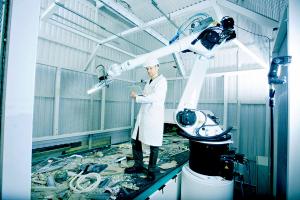
Nov 21, 2017 - Robots are now being developed to sort household recyclables and differentiate between construction wastes. What will this mean for the human workers? Matt Clay in Waste Management World writes about the increasing presence of robots in industry, in particular recyclables and waste, that robots once suitable for only niche applications, are now being developed that can sort household recyclables and differentiate between construction wastes. What will this mean for the human workers? Does it mean the start of robot revolution? How accurate is the technology?
British pre-eminent scientist Prof Stephen Hawking once warned that the “development of full artificial intelligence (AI) could spell the end of the human race”. While we are many years away from AI taking over from humans in true Terminator fashion, technology has changed how we interact.
The rise of smart phones and apps have meant that electronic devices have become an extension of the body; a high tech major organ of communication. Being without it, for many, leads to what is now being called ‘nomophobia’ – the fear of being without your mobile phone.
While devices are becoming more integrated in our daily lives, one industry that perhaps hasn’t seen technological development as fast as others is waste management. Many material recovery facilities (MRFs) do contain teams of near infrared (NIR) advanced machines sorting through waste streams at a lighting pace. Yet, teams of waste pickers – people stood in lines working long and hard hours – still remain to provide final quality control; humans are still key to the operation.
| Continue here to read the full article in Waste Management World magazine || November 21, 2017 |||

Palace of the Alhambra, Spain
By: Charles Nathaniel Worsley (1862-1923)
From the collection of Sir Heaton Rhodes
Oil on canvas - 118cm x 162cm
Valued $12,000 - $18,000
Offers invited over $9,000
Contact: Henry Newrick – (+64 ) 27 471 2242

Mount Egmont with Lake
By: John Philemon Backhouse (1845-1908)
Oil on Sea Shell - 13cm x 14cm
Valued $2,000-$3,000
Offers invited over $1,500
Contact: Henry Newrick – (+64 ) 27 471 2242

|
|