
Founded by Max Farndale 1947 - 2018

10 Nov 2017 - Blockchain is an emergent technology that may be as transformative as the internet, according to many predictions. But this innovative new technology has a surprising link to the days of medieval treasuries. Blockchain is a distributed ledger that uses cryptography—mathematical code—to chain together records of transactions in a tamper-resistant and transparent manner. It is being used as an alternative or replacement for national currencies, contracts, internet device authentication and more.
This form of record-keeping, though technologically novel in the digital era, is not so new after all. Historian M.T. Clanchy tells us that it existed in the medieval era, during the transition from oral to written forms of memorialization. At that time, symbolic objects played a crucial role in providing evidence of transactions, rights and entitlements.
I've been researching how governments and businesses around the world are either planning for or already piloting the use of blockchain for record-keeping. The goal of my research is to determine what these applications of the technology actually do—as opposed to what the marketing hype says they do.
I've been to Estonia to study how the government there is using distributed ledger technology to protect the integrity of citizens' medical records. I've been to Sweden to discuss how its land registry is testing blockchain to record the transfer of land ownership. I've reviewed proposed blockchain systems for land title registration in Honduras, new pilot implementations for land transaction records in Brazil. And I've spoken with innumerable new ventures looking to transform record-keeping with blockchain technology.
Three patterns for blockchain records
From this research, I've noticed three specific design patterns for blockchain record-keeping, which need explanation to understand how blockchain relates to medieval practices. I have classified these categories as mirror, digital record and tokenized systems.
The first of these design patterns is what I call the "mirror" type system. I characterize this type of system as being the most similar to current centralized record-keeping.
In these types of systems—be they for medical records, land titles, public archives or some other kind of records—digital records are neither created nor kept "on chain," despite some claims by blockchain companies to the contrary. Instead, a kind of digital fingerprint of the records in the form of a 256-bit random number, known as a "hash," is entered into the blockchain.
The purpose of recording this digital fingerprint in the blockchain is to protect the integrity of the records and be able to detect if they were tampered with. To prove that the records are tamper-free, the original digital records must be preserved in off-chain trustworthy digital repositories alongside preservation of their hashes in the blockchain.
Proving integrity of the records involves matching the hash of the record you want to validate with its digital fingerprint on the blockchain. If the hashes match, then the record you hold has not been altered.
Digital records
The second type of approach I've noticed is one that I call the "digital records" design pattern. In this type of system, new digital records are actually created within the blockchain itself, primarily by using smart-contracts.
Smart-contracts are computer programs that instruct the blockchain when to carry out a transaction, such as sending funds from one user to another. In these types of systems, the text of records is no longer in natural language that people can read. It is written in computer code for machines to read.
How blockchain technology has medieval roots
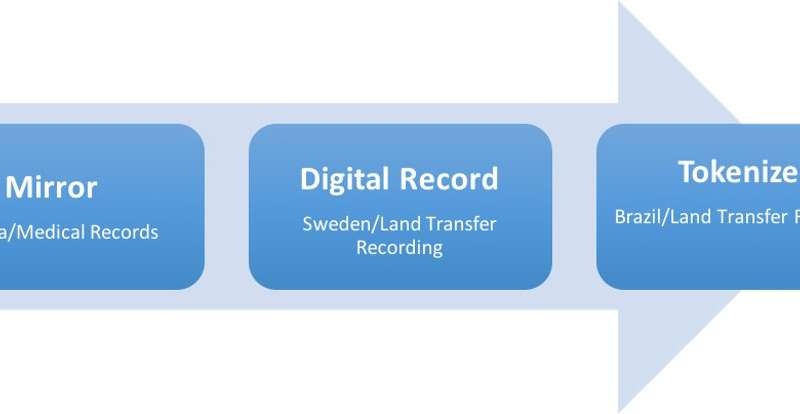 Three major categories of blockchain systems classified with examples. Credit: Victoria Lemieux
The rise of the smart contract raises a number of challenging and currently unanswered questions, such as what to do in case an error occurs and a smart contract doesn't behave as expected.
In the 2016 Decentralized Autonomous Organization (DAO) incident, for example, the attacker exploited poorly written smart code to siphon off 3.6 million Ether—an alternative to the popular cryptocurrency Bitcoin—roughly equivalent to $68 million at the time of the attack.
Equally importantly, current principles, standards and practices for managing and preserving digital records are not designed for smart-contracts and other distributed autonomous records created on chain. Ensuring that society's evidence infrastructure remains intact presents challenges similar to the early days of email and other electronic records. New approaches, yet to be developed, will be needed.
The third type of blockchain record-keeping design pattern is the "tokenized" type of solution. This is arguably the farthest from our current form of record-keeping, and many would argue the most innovative. With this type of system, not only are records captured on chain but valuable assets are represented and captured on chain.
These assets can symbolize anything of value: currency such as a primary use blockchain, Bitcoin; land, fine wine, food, diamonds, artworks—you name it.
In this third, tokenized form we can find centuries-old predecessors to blockchain.
Medieval objects parallel digital tokens
Are these assets really records? For answers, we may turn to the English archival theorist Sir Hilary Jenkinson, who observed in his 1937 Manual of Archive Administration that "there is a case where an old pair of military epaulettes; and among enclosures to letters, forming in each case an integral part of the document, the writer can recall portraits, human hair, whip-cord (part of cat-o'-nine-tails), a penny piece inscribed with disloyal sentiments, and a packet of strange powder destined to cure cancer."
In Jenkinson's view, these "exhibits" formed part of the archive, or collective body of records, because they provided evidence of business transactions.
We now have come to view these so-called exhibits more as museum objects than records because before the digital era, the physical awkwardness of these objects meant that they could not be managed with other records. Just as coins and paper currency once represented records of reserves of gold in a national treasury, Jenkinson's exhibits were themselves tokens that represented other things.
Today, what once had a material form can be essentially dematerialized. Paper currency can be transformed into cryptocurrency. Land, fine wine, artwork, diamonds, food and other material objects—though still physically in existence—can be transformed into virtual representations called "tokens." In this way, in a tokenized, blockchain record-keeping system, literally every thing potentially becomes a record.
This is not a new idea.
At the time of the Norman Conquest, many grants were conferred by the bare word (nude verbo) without a writing or charter, but only with a sword, helmet, horn or cup. One example is the broken knife of Stephen de Bulmer kept in the archives of Durham Cathedral. It bears a parchment label recording the details of a gift of land made in the middle of the 12th century—which the knife itself symbolizes.
Just like the knives, horns, cups, rings and other objects customarily used in the conveyance of land during the medieval period, today's tokenized blockchain record-keeping systems use valuable cryptocurrencies such as Bitcoin as symbolic representations of assets like land.
This raises the question of whether blockchain technology will return today's archival repositories to their medieval roots as the treasure storehouses of kings. Will it be back to the future?
| A The Conversation article || November 11, 2017 |||


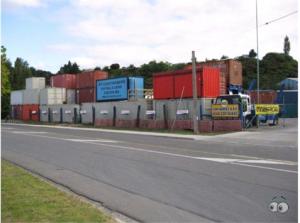
10 Nov 2017 - International port logistics company ISO Limited has been selected as the preferred operator for Kawerau's planned container terminal. This selection is a vital step towards the container terminal's completion. Kawerau District Council economic and community development manager Glenn Sutton said the decision was not easy.
"It was an extremely close choice between ISO and the other candidate, C3, as both companies were of high calibre and would have easily met the requirements for the role.
"ISO has high values and an emphasis on community involvement and development that Industrial Symbiosis Kawerau believes will complement and benefit the district."
ISO Limited is an international port logistics company, providing stevedoring, marshalling, warehousing, container-packing, IT and total supply chain solutions to exporters and importers throughout New Zealand, Australia and America.
Its New Zealand operations include Marsden Point, Auckland, Tauranga, Kaingaroa, Murupara, New Plymouth, Gisborne, Napier, Wellington, Lyttelton, Bluff, Nelson and Timaru.
"Consequently, the company brings a wealth of experience and skills to the operation of the Kawerau container terminal and is well supported by its parent company, QUBE," Sutton said.
Industrial Symbiosis Kawerau initiated the container terminal concept in 2012.
"Once completed, the terminal will provide a cost-effective logistics system for Eastern Bay of Plenty value-added exporters to transport their products to port."
Toi-EDA general manager Francis Pauwels said the terminal would support the Eastern Bay for current and predicted growth.
"This project is positive for the entire Bay of Plenty as business and industry work together to better the region.
"The overarching strategy is to achieve cost-effective and efficient logistics solutions for current businesses to grow, and to attract new businesses into the region.
"Moving freight is a key component of that, but also extends to UFB coverage, airport links, wharf facilities and safe roading networks.
"The terminal site is owned by the Putauaki Trust and represents fantastic partnerships between Eastern Bay businesses and communities."
The next step in the project will see Industrial Symbiosis Kawerau and involved partners working with ISO on the terminal's design.
| An ISO release || November 10, 2017 |||
10 Nov 2017 - Minister for Trade and Export Growth, David Parker, today welcomed the World Trade Organisation (WTO) decision to uphold New Zealand’s case against agricultural trade barriers imposed by Indonesia. On 9 November, the WTO's Appellate Body confirmed that a number of Indonesian agricultural trade barriers are inconsistent with global trade rules. The decision upholds key findings of a WTO dispute settlement Panel, which in December last year ruled in New Zealand's favour and was subsequently appealed by Indonesia.
New Zealand and the US initiated the case in 2013 in response to a range of next-generation agricultural “non-tariff” barriers applied by Indonesia to imports since 2011. They include import prohibitions, behind-the-border use and sale restrictions on imports, restrictive import licensing, and a domestic purchase condition.
This WTO case illustrates the value that New Zealand, as a small country, gains from international trade rules. Mike Moore, when Director-General of the WTO, described its dispute settlement system as “the jewel in its crown”. The last WTO case that New Zealand brought to the WTO challenged an Australian ban on our apples, which we initiated in 2007.
“These barriers affect opportunities for many New Zealand agricultural exporters, including producers of onions, apples and beef,” Mr Parker says.
“The restrictions are commercially significant for those exporters, and are estimated to have now cost the New Zealand beef sector close to a billion dollars of lost exports into an important market.”
“This decision from the WTO's highest dispute settlement body is an important result for our agricultural exporters and should pave the way to grow New Zealand exports to the Indonesian market.”
In 2010, prior to the introduction of the challenged restrictions, Indonesia was New Zealand's second-largest beef export market by volume, worth $180 million a year. That trade subsequently plummeted by 85 percent. This case aims to secure more open and predictable access into Indonesia for a range of our exports.
"New Zealand has a strong and mutually beneficial relationship with Indonesia, and this trade disagreement is only a small part of that broader bilateral relationship.
“Indonesia’s approach to these WTO hearings has been exemplary. The tone has been collegial and constructive. In the proceedings Indonesia also underlined the longstanding and mutually respectful relationship that Indonesia enjoys with New Zealand and a desire to strengthen this important relationship.
“I look forward to working with my Indonesian counterpart over the coming months to finalise resolution of this long-standing trade issue,” says Mr Parker.
Further information about the dispute can be found at https://www.mfat.govt.nz/en/trade/trade-law-and-dispute-settlement/current-disputes/
| A Beehive release || November 2017 |||
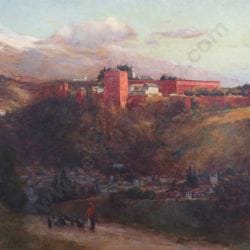
Palace of the Alhambra, Spain
By: Charles Nathaniel Worsley (1862-1923)
From the collection of Sir Heaton Rhodes
Oil on canvas - 118cm x 162cm
Valued $12,000 - $18,000
Offers invited over $9,000
Contact: Henry Newrick – (+64 ) 27 471 2242
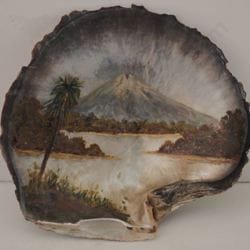
Mount Egmont with Lake
By: John Philemon Backhouse (1845-1908)
Oil on Sea Shell - 13cm x 14cm
Valued $2,000-$3,000
Offers invited over $1,500
Contact: Henry Newrick – (+64 ) 27 471 2242

|
|