
Founded by Max Farndale 1947 - 2018



IBM and Stellar Are Launching Blockchain Banking Across Multiple Countries. The news also comes as an important validation of blockchain technology. In a breakthrough for payments technology, IBM and a network of banks have begun using digital currency and blockchain software to move money across borders throughout the South Pacific.
The significance of the news, which IBM announced on Monday, is that merchants and consumers will be able to send money to another country in near real-time, accelerating a payments process that typically takes days.
The banking network includes “12 currency corridors” that encompass Australia and New Zealand, as well as smaller countries like Fiji and Tonga. It will reportedly process up to 60 percent of all cross-border payments in the South Pacific’s retail foreign exchange corridors by early next year.
The news also comes as an important validation of blockchain technology, which has long promised enormous efficiencies for the financial sector, but has been slow to move from the concept stage to the real world.
Blockchain, which relies on a disparate network of computers to create an indelible, tamper-proof record of transactions, is most famously associated with the digital currency bitcoin. But it can be used in many other applications such as tracking shipments or, as in this case, to record a series of cross-border transactions.
As an example, IBM said a farmer in Samoa will soon be able to contract with a buyer in Indonesia, and use the blockchain to record everything from the farmer’s collateral to letters of credit to payment.
“This is the next step in the evolution of blockchain technology. It’s live money moving around a network,” Jesse Lund, IBM’s VP of Blockchain, told Fortune.
Digital Currency is KeyThe new blockchain banking process is also notable because the banks will initially rely on a bitcoin-like digital currency, known as Lumens, to facilitate the cross border payments.
Currently, banks arrange such payments by maintaining foreign accounts in a local currency (so-called nostro accounts), and then debiting the accounts as required—a process that is both slow and ties up capital.
Under the new blockchain arrangement, banks will conduct the transactions using Lumens, and then rely on local market makers to convert the Lumens into local fiat currency. The Lumens are created by a non-profit company called Stellar, founded a Jed McCaleb, a well known figure in the payments and crypto-currency world.
Both Stellar and IBM are part of a project called Hyperledger Fabric, which is building open source blockchain tools to support payment infrastructures.
According to Lund, though, the banks use of Stellar’s digital currency is likely to be temporary. He predicts that, in the next year, central banks will begin issuing digital currencies of their own, and that these will become an integral part of blockchain-based money transfers.
The IBM-backed blockchain project comes at a time when other companies are creating efficient new ways to conduct global money transfers. These include BitPesa, which relies on the bitcoin network to replace traditional wire transfers between merchants in Africa, and TransferWise, which provides an inexpensive way for consumers to obtain foreign currencies.
| A Fortune release || October 16, 2017 |||

Cargo Composites (Charleston, SC, US) reports that it has partnered with Boeing (Chicago, IL, US) to deliver composite unit load devices (ULDs) to Air New Zealand. A Boeing 787 departed Charleston on Oct. 6 for Auckland, New Zealand, with Cargo Composites' newest container, an insulated ULD for transporting perishables via air cargo, called the aeroTHERM . To date, Air New Zealand has purchased more than 400 aeroTHERM units.
Cargo Composites says the aeroTHERM ULD makes shipping perishables more affordable by taking advantage of Cargo Composites' patented and proprietary design. There is no need for power or for a cooling system — the aeroTHERM's internal compartment is designed to withstand external temperatures. The insulated ULD helps protect contents from extreme temperatures experienced on the tarmac waiting for loading, when a standard ULD's internal temperature can exceed 120°F or fall below 0°F.
Tom Pherson, president of Cargo Composites, states, "We are thrilled to provide the aeroTHERM units to Air New Zealand and to partner with the local Boeing facility to deliver the composite insulated ULDs on another locally made composite product, the 787. This is another great example of how South Carolina's aerospace industry is thriving with activity around the world."
| A CompositesWorld release || October 16, 2017 |||
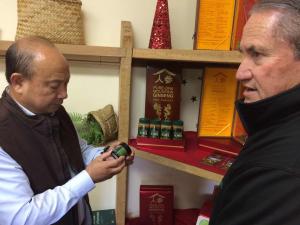
A South Waikato ginseng producer is ready to approach potential investors to increase its production and exports with the help of funding of up to $40,000 from the Ministry for Primary Industries (MPI).
Maraeroa has 20 hectares of high value wild simulated Asian panax ginseng growing on the forest floor of its 5,550 hectare pine plantation. The group is looking to double the size of its ginseng plantation by raising capital and having a purpose designed processing factory built at Pureora.
Maraeroa C Incorporation is using its MPI funding to compete an investment information memorandum and business plan for potential investors.
"The economic return from ginseng will contribute to Waikato’s economic, social and cultural growth. Growing ginseng under their existing pine tree canopy has the potential to optimise Maraeroa’s return from the land for its 1,200 shareholders," says Ben Dalton, Deputy Director General, Sector Partnerships and Programmes at the Ministry for Primary Industries.
"This has been a long-term investment for Maraeroa. Growing Ginseng started out as a trial for them in 2006 and they had their first commercial harvest in 2016. The growing conditions turned out to be right for them which is exciting as Ginseng is valued at more than $400,000 per hectare," he said. Maraeroa’s funding comes from MPI’s MÄori Agribusiness fund and contributes to regional economic growth.
The Incorporation has started looking for potential investors with existing distribution channels to China. The company currently works with a small number of Chinese distributors and retailers who sell their products around New Zealand and in Hong Kong.
Maraeroa’s Chief Executive Glen Katu said increased exporting would require additional local staff to be hired for ginseng production, processing and distribution.
"We’ll need to hire more qualified and skilled local staff to handle larger product volumes and manage exports and distribution. There’s also an opportunity for further investment in research and development to expand into new ginseng product lines and build greater awareness in China about the quality of New Zealand ginseng products.
"There could be some huge long-term benefits for other forestry operators by growing ginseng. Recent studies have shown that the Central North Island forests are an ideal place to grow good quality ginseng and there is demand for wild simulated ginseng in China. We want to provide sustainable revenue for our shareholders and their families while ensuring the land is handed onto the next generation in as good, or better condition than it was received," says Mr Katu.
MPI’s MÄori Agribusiness team helps MÄori make the most of their primary sector assets from production and processing, through to exporting via tailored support.
| An MPI release || October 17, 2017 |||
WorldSkills Abu Dhabi 2017 sees young contestants going for gold at the world's biggest vocational skills competition
There are competitions for 51 vocational skills at WorldSkills Abu Dhabi 2017 this week. Can one man watch them all?
Entering the main halls at Abu Dhabi National Exhibition Centre, the task seems daunting. Not for nothing is this known as the world’s largest vocational skills competition.
It fills Adnec and then some. There are competitors as far as the eye can see, and then beyond that, even to the other side of Khaleej Al Arabi. If this is the skills Olympics, attendance is going to be a marathon rather than a sprint.
First up in the main exhibition halls is Industrial Mechanised Millwright, which is something to do with maintaining factory machinery.
We can watch the competitors at their work from the other side of barrier, but may not disturb or talk to them.
Bioa Song Chin from China is not in his enclosure, but Tatsuya Kawozoe from Japan is busy arranging sticky notes on his bench. Clearly there is more to come.
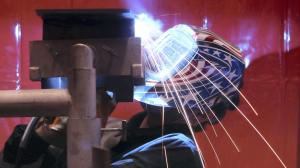
Next up is Welding. The welders live in darkened enclosures in which we peer, eyes protected, while looking for signs of life. Here’s Dylan Bloch from Australia, his face hidden by a welder’s mask, illuminated with the blue glow of his torch. The sparks are starting to fly in welding.
The contestants in Construction Metal Work also live in darkened enclosures, like nocturnal animals. Finland’s Juho Nissinen is carefully marking out his design with a metal ruler, as is Guan You Chen from Taiwan. There’s a lot of drilling and welding involved here, but not at present.
For the Manufacturing Team Challenge, competitors must make a battery powered recovery vehicle with the help of what seems include industrial quantities of Mars Bars.
In Prototype Modelling they use something called a Kunzmann Frasmachine WF 410, which also has a big role in Polymechanics and Automation.
The Kuzmann Frasmachine is particularly handy for “producing and installing parts for production machines” according to the information available.
The gold medal for Polymechanics and Automation looks to be shaping up between China, Switzerland, Taiwan, and Lichtenstein.
Moving on, we find Plastic Die Engineering, where they make stuff to make stuff. Just around the corner is the trio of CNC Turning, CNC Milling and Mechanical Engineering CAD.
The “C” in all these refers to computers and at least one of them involves robots like the demonstration model nearby assembling Rubik’s cubes.
Electronics is reassuringly about wires and flashing lights but Mechatronics sounds more like the character from a Transformers movie, even though it is actually about automated systems.
Turning the corner reveals Mobile Robotics, the first proper spectator sport at WorldSkills Abu Dhabi, with its own mini-grandstand in front of the arena where teams must move robotic vehicles around an obstacle course.
At this early stage in the competition, though, it’s mostly immobile robotics.
Industrial control seems to involve wiring up boxes with a big red “stop” button, while Electrical Installation and Refrigeration and Air Conditioning are exactly as they sound.
In Plumbing and Heating, a vocation which in my home country of Britain you take up because there is not enough money in investment banking, contestants must build a working bathroom. They have four days to finish, as opposed to four months in the UK.
Information Network Cabling involves a lot of wires and is in a dead heat with Freight Forwarding (think DHL v Aramex) as the competition least likely to threaten the Uefa Champions League as a mass spectator sport.
The most delicious part of WorldSkills Abu Dhabi is Baking, with the scent of fresh baked loaves filling the air, and Cooking, where stern-looking judges in towering touques observe those most skilled in competitive sautéing, before the dishes are served by the aspiring champion waiters of Restaurant Services.
In Patisserie and Confectionery, the talk was of the smoothness of the sugar paste and the silkiness of the chocolate ganache.
For Heavy Vehicle Maintenance there are giant road rollers to be fixed and a real Abu Dhabi Police helicopter for Aircraft Maintenance. At Car Painting, the contestants have been given a fleet of black Mercedes (“Not for painting. We’re only allowed to put marking tape on them” explained Tony from New Zealand.)
In an air conditioned tent, 20 young florists laboured on their creations, while nearby, meters of polka dot fabric was laid out for Fashion Technology.
For Hairdressing, contests cut and snip at mannequin heads, but in Beauty Therapy and Health and Social Care, real live volunteers are needed to be smeared with creams and tucked up in bed.
At the farthest flung corner, over the highway and in another tent by the water’s edge, dozens of young bricklayers are going for gold, and the Wall and Floor Tiling contests work on a design that incorporates Etihad Towers and the Sheikh Zayed Mosque.
Somewhere in between is Concrete Construction,Painting and Decorating, Plastering and Dry Wall, Joinery, Cabinet Making, Jewellery, Autobody Repair, Web Design, 3D Digital Game Design, IT Software Solutions, IT Networking, Print Media Technology, Graphic Design Technology.
And there is nothing quite like the sight of nearly 30 desert gardens, complete with palm trees, being built simultaneously under competitive conditions.
And there you have it; nearly 60 countries and 51 skills, four hours and seven kilometres later. WorldSkills Abu Dhabi 2017. Someone deserves a medal.
| A TheNational release || October 16, 2017 |||


Palace of the Alhambra, Spain
By: Charles Nathaniel Worsley (1862-1923)
From the collection of Sir Heaton Rhodes
Oil on canvas - 118cm x 162cm
Valued $12,000 - $18,000
Offers invited over $9,000
Contact: Henry Newrick – (+64 ) 27 471 2242
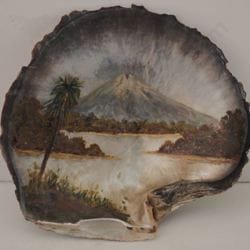
Mount Egmont with Lake
By: John Philemon Backhouse (1845-1908)
Oil on Sea Shell - 13cm x 14cm
Valued $2,000-$3,000
Offers invited over $1,500
Contact: Henry Newrick – (+64 ) 27 471 2242

|
|