
Founded by Max Farndale 1947 - 2018
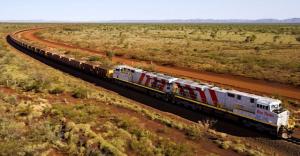
The nearly 100-kilometer pilot run was completed without a driver on board, making it the first fully autonomous heavy haul train journey ever completed in Australia write MH&L .
At its iron ore operations in the Pilbara region of Western Australia, Rio Tinto announced on October 2, that it has successfully completed the first fully autonomous rail journey.
The nearly 100-kilometer pilot run was completed without a driver on board, making it the first fully autonomous heavy haul train journey ever completed in Australia.
The journey was completed safely, being closely monitored in real-time by Rio Tinto teams and representatives of the Office of the National Rail Safety Regulator, both on the ground and at the Operations Centre in Perth.
“This successful pilot run puts us firmly on track to meet our goal of operating the world’s first fully-autonomous heavy haul, long-distance rail network, which will unlock significant safety and productivity benefits for the business,” explained Rio Tinto Iron Ore CEO Chris Salisbury.
The company is working towards commission AutoHaul project in late 2018. The AutoHaul project is focused on automating the trains that are essential to transporting the iron ore to Rio Tinto's port facilities.
Trains started running in autonomous mode in the first quarter of 2017. Currently about 50% of pooled fleet rail kilometers are completed in autonomous mode (with drivers on-board) and 90% of pooled fleet production tonnes are AutoHaul enhanced.
Rio Tinto operates about 200 locomotives on more than 1,700 kilometers of track in the Pilbara, transporting ore from 16 mines to four port terminals.
| An MH&L release || October 3, 2017 |||

The U.S. Department of Agriculture’s Animal and Plant Health Inspection Service (APHIS) is amending its regulations to allow the importation of fresh persimmons from New Zealand into the United States. After analysing the potential plant pest risks, APHIS scientists determined that persimmons from New Zealand can be safely imported into the United States under a systems approach.
A systems approach is a series of measures taken by growers, packers, and shippers that, in combination, minimize pest risks prior to importation into the United States. In this case, the systems approach requires orchard certification, orchard pest control, post-harvest safeguards, fruit culling, traceback, and sampling.
In addition, the fruit must be treated with hot water or undergo modified atmosphere cold storage to kill any leafroller moth larvae. The persimmons must also be accompanied by a phytosanitary certificate stating that they were produced under the systems approach and were inspected and found to be free of quarantine pests.
In August 2016, APHIS published a proposed rule to amend its regulations to allow the importation of fresh persimmons from New Zealand into the United States provided that they are produced in accordance with a systems approach. The final rule will publish in the Federal Register on October 3, 2017, and will become effective 30 days after publication on November 2, 2017.
| A FreshPlaza release || October 3, 2017 |||

Air New Zealand, its catering partner LSG Sky Chefs and the Ministry for Primary Industries (MPI) have teamed up to tackle inflight waste from Air New Zealand’s international services arriving in Auckland with a world-leading partnership expected to divert 150 tonnes of waste from landfill annually. The waste reduction initiative Project Green has enabled 40 Air New Zealand inflight products that were previously sent to landfill due to biosecurity controls, to be reclassified so they can be reused on future flights if removed from aircraft sealed and untouched. Products approved to date include sealed beverages and unopened snacks with further items to be added in coming months. In the first month of running Project Green across its international fleet, the airline diverted 13 tonnes of waste, including 266,000 plastic cups, 480kg of sugar packets and 3.5 tonnes of bottled water. The programme, which has been developed over 18 months, is also enabling greater recycling of low biosecurity risk packaging, more accurate loading of catering items onto aircraft and reduced waste disposal costs with fewer items sent to landfill. Waste management is a significant issue for all airlines, with International Air Transport Association (IATA) data estimating the global industry generated 5.2m tonnes of inflight waste in 2016. While Air New Zealand has always been waste-conscious, quarantine controls have presented challenges to recycling initiatives in the past. Air New Zealand Head of Operational Delivery Alan Gaskin says, “We’ve spent considerable time auditing our inflight waste to gain a better understanding of how we can improve our handling processes. By collaborating with LSG Sky Chefs and MPI we’ve been able to make significant gains and we’re incredibly encouraged by the early data we’re seeing. “Project Green is an outstanding example how airlines can work with border regulators to develop solutions to reduce cabin waste without comprising quarantine controls.” The project has required a change in onboard processes for the airline’s staff, particularly for cabin crew who play a key role by returning unused items to stowage and separating goods correctly. LSG Sky Chefs New Zealand General Manager Pieter Harting says, “Our role in Project Green is to ensure items taken off aircraft are sorted correctly and meet the standards we’ve agreed with MPI and Air New Zealand, before reloading trolleys with approved items for the next service. It’s been an exciting journey for us, requiring a big culture shift and getting our people onboard with new ways of working.” Ministry for Primary Industries Cargo Manager Stu Rawnsley says, “This project is rethinking how waste from international flights is managed in New Zealand. It’s been excellent working with Air New Zealand and LSG to ensure the initiative meets New Zealand’s tough biosecurity standards.” This is the first stage of the airline’s collaboration with LSG Sky Chefs New Zealand and MPI. Moving forward the organisations will look at how they can further expand the range of unused products that can safely be recovered and develop a more precise approach to analysing collection data to ensure aircraft are catered more accurately. Project Green is just one of several initiatives Air New Zealand has in place across its business to tackle waste. The airline also has programmes in place to recycle paper coffee cups used on domestic jet services, organic waste from head office, office materials and lounge furniture, staff uniforms and blankets. Click here or on the image below to download broadcast quality footage on Project Green, including interviews with Air New Zealand, LSG Sky Chefs New Zealand and MPI.
| An Air New Zealand release || October 4, 2017 |||
The Original Article: New Zealand First’s Winston Peters Enjoys a Clear Field of Fire in Pending General Election Booby trapped centristsSaturday, 05 August 2017 11:03
How did we get the Winston Peters ascendancy so unequivocally correct?And so early—at the start of August?
Answer: We saw that Mr Peters was the only one to present a clear slate of villains.
Then to clearly articulate what he intended to do about them.
He gave disenchanted National voters especially a wide open, unobstructed basket into which they could lob their spare vote.
But there was and is of course something else going on in the way of unspoken undercurrents.
To baby boomers Winston Peters is the reincarnation of the school master they best remember.
This is the one of the type who served on the North West Frontier and then went onto fight his way through the Western Desert and Europe.
His classes had a vivid quality about them.
Thwacking his ruler on the desk he would depart from his teacher’s script and make a dramatic segue.
He might declaim for example that this or that sector of society required a good “thrashing.”
That this or that public figure deserved an equally good “horsewhipping.”
That some other otherwise admired figure was in fact a “pompous ass.”
What this category of baby boomer voters want is similarly a clarity of opinion and thus of purpose.
Even if they do not exactly agree with what is being said they want to be left in no doubt about what is being said.
The rest of the National Government teachers common room, as it were, in contrast seemed intent on pursuing the latest fashionable fad.
One which nobody can quite recall.
It is characterised by much backing, filling, hedging, prevarication of the on- one- hand/on the- other- hand variety.
Prime Minister Bill English kept and keeps quoting statistics, synthesising issues.
He comes across as a worthy but boring schoolmaster of the type that leaves the class snoozing as they drearily follow the text book word-for-word.
Or else he delivers stunning insights into the blindingly obvious.
Or else issues generalisations of the we’ve never had it so good variety.
His right hand man, Stephen Joyce MP, all the while comes across as the head prefect of the prissy type on the look out for anything that he can quash that might turn into fun.
| This email address is being protected from spambots. You need JavaScript enabled to view it. || Wednesday 4 October, 2017 |||
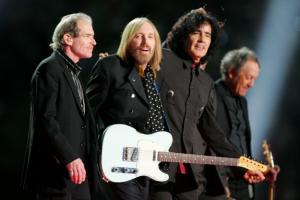
The troubled triumph of 1993’s Tom Petty & the Heartbreakers Greatest Hits by Jonny Potts | Guest writer for TheSpinOff October 3, 2017
Tom Petty died today, aged 66. Jonny Potts remembers his 1993 Greatest Hits album, one of the best single-disc greatest hits compilations ever released.
I still have my copy of Tom Petty & the Heartbreakers’ Greatest Hits on CD. It was one of the first CDs I bought after acquiring a shitty boombox from an older kid at school. Up till then, it had all been tapes: The Rhythm Volume 3, Joyride, Use Your Illusion II, The Simpsons Sing the Blues.
With a CD, you could skip the tracks. That was the big selling point. Sure, the sound quality was supposedly immaculate, but what the hell did I know? CDs were big, beautiful objects to own. They were an investment which promised, in the excessive ‘How to Care for your CD’ notes which frequently accompanied the early ones, ‘a lifetime of listening enjoyment’. No more spooling the tape back in with a pencil! For a modest investment of $33 today you can guarantee that when you’re on your deathbed you’ll be able to skip straight to ‘Informer’ on Snow’s 12 Inches of Snow.
In 1993, the massive singles from Tom Petty’s Into the Great Wide Open were still current, with the videos being played alongside Green Jelly and C+C Music Factory on RTR Countdown. But they were already classics. ‘Free Fallin’’, ‘Into the Great Wide Open’, ‘Learning to Fly’ and ‘Mary Jane’s Last Dance’ were rich and fully formed capital R Rock; they seemed to belong to another generation. The guy had a weird mumbly non-voice like the old dude off Dire Straits. The songs were kinda like Bruce Springsteen but without the bombast. And he looked like a skeleton. How old were these guys? Is it OK to keep the video recorder going to catch the creepy ‘Mary Jane’ video when all I wanted was the ‘In Bloom’ one? Brendan says this song is about drugs. Have I ever liked a song with a harmonica in it before?
The hugeness of those hits did not suggest a backstory. They were the story: massive, singalong standards that your friend’s older brother’s friend could play on guitar. They belonged to everyone. Because of this, Tom Petty & the Heartbreakers did not seem to fit anywhere. In 1993, they were not canonised, like the Rolling Stones and Pink Floyd, nor were they ushering in something new like Pearl Jam and Nirvana. And Tom Petty was in a band with one of the Beatles? What is he, like, 60? Was there anyone else making music this restrained and commercial that we all agreed on?
But though we all liked that stuff, Petty wasn’t ours. This was Older Brother’s Music. The idea of risking $33 on a copy of Full Moon Fever on CD was prohibitive, especially when you’re saving up for the Spin Doctors’ Pocket Full of Kryptonite.
The songs were insistent. They were everywhere. They became mixtape staples. They were used to score cricket highlights. You heard them coming out of builders’ radios and student flats. Nobody could change the station when they heard the chime of that opening chord of ‘Free Fallin’’. You could make a decision to not like Paul McCartney or Neil Young: with Tom Petty you had no choice.
So the release of a greatest hits album was, as the sales figures bear out, a smart move. The album was massive. There were 18 tracks on it – great bang for your buck – and I knew about six of them. The great thing was, I could skip straight to those bangers. And by not buying four CD singles, I’d saved myself about $7.
OK, I am now going to ask you to try to imagine what it is like buying a CD with ‘American Girl’, ‘Refugee’, ‘The Waiting’ and ‘Don’t Come Around Here No More’ on it having never heard those songs before.
Continue to read Johnny's full article on TheSpinoff right here || October 4, 2017 |||
Commemorations to mark one of New Zealand’s darkest days will be held in New Zealand and Belgium this month to remember the Battle of Passchendaele.
Arts, Culture and Heritage Minister Maggie Barry says the commemorative programme reflects on New Zealand’s involvement in the fighting around Passchendaele between 1 and 18 October 1917.
“Passchendaele on 12 October 1917 is still known as one of the greatest disasters in New Zealand’s history – when 843 men died in a single day. This devastating loss of life remains the highest one-day death toll suffered by New Zealand forces overseas,” Ms Barry says.
“During the Third Battle of Ypres, which included Passchendaele, New Zealand lost nearly 2,000 men. We’ll remember them and all who fought in Belgium.”
In Wellington the commemorations will begin at 3pm on October 12 at the Pukeahu National War Memorial Park.
“Immediately after the national ceremony, a memorial gifted to New Zealand by the Belgian Government will be unveiled on the eastern terraces at the Park. The Last Post will be held at the Tomb of the Unknown Warrior at 5pm,” Ms Barry says.
“The ceremony in Belgium will take place at 11am local time at the Tyne Cot Cemetery near Zonnebeke and will be attended by His Royal Highness , the Duke of Cambridge on behalf of the Queen and Her Royal Highness Princess Astrid of Belgium on behalf of King Philippe.”
New Zealand will be represented by Hon Dr Nick Smith and Rt Hon David Carter.
“This is the largest Commonwealth War Grave Cemetery in the world and contains the graves of 520 New Zealanders. Our ‘Memorial to the Missing’ in the cemetery lists the names of others who died in the Battles of Passchendaele,” Ms Barry says.
The New Zealand Passchendaele Centennial Memorial and Garden in Belgium will also be opened as part of the commemorations at 3pm local time.
“I want to commend Chris Mullane, Mike Pritchard and many others from the Passchendaele Society in New Zealand, who’ve worked so hard over so many years to have this memorial garden built. I planted the first flax there in 2016 and I know it is a fitting memorial telling our poignant New Zealand story’” Ms Barry says.
Ceremonies will conclude at sunset at Buttes New British Cemetery in Polygon Wood where 95 Kiwis are buried and where the New Zealand ‘Memorial to the Missing’ records the names of 388 New Zealanders who died near there but have no known grave.
“A group of senior secondary school students, who won the joint Ministry of Education, Fields of Remembrance Trust and the Passchendaele Society digital competition, will be attending the commemorations in Belgium. They will also attend the New Zealand Memorial and Garden,” Ms Barry says.
More information about both the domestic and overseas Passchendaele commemorations can be found at ww100.govt.nz/passchendaele-centenary.
| A Beehive release || October 3, 2017 |||
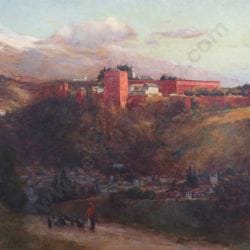
Palace of the Alhambra, Spain
By: Charles Nathaniel Worsley (1862-1923)
From the collection of Sir Heaton Rhodes
Oil on canvas - 118cm x 162cm
Valued $12,000 - $18,000
Offers invited over $9,000
Contact: Henry Newrick – (+64 ) 27 471 2242
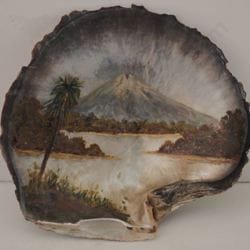
Mount Egmont with Lake
By: John Philemon Backhouse (1845-1908)
Oil on Sea Shell - 13cm x 14cm
Valued $2,000-$3,000
Offers invited over $1,500
Contact: Henry Newrick – (+64 ) 27 471 2242

|
|