
Founded by Max Farndale 1947 - 2018
Inflation targeting practises are similar across many central banks despite significant differences in their formal frameworks, says the Reserve Bank in its latest Bulletin article published today.
The Bulletin article titled “An international comparison of inflation targeting frameworks” looks at how New Zealand’s Policy Targets Agreement compares to nine other advanced economy central banks, and how the specifications in each framework compare to the actual practice of each central bank.
“In order to conduct the comparison we focused on five components of an inflation-targeting framework: the inflation target definition, communication of monetary policy, secondary considerations, assessment of inflation-targeting performance, and framework reviews and revisions,” says the article’s author, Senior Economic Analyst Amber Wadsworth.
“Overall we find that the formal inflation-targeting frameworks can differ greatly between the central bank, but, in practice, each bank operates in a similar manner.”
“The central banks we looked at have similar inflation targets and produce similar monetary policy reports and inflation targeting assessments. There is more variability in the financial stability considerations when setting monetary policy, and how the inflation-targeting frameworks are reviewed and revised,” says Wadsworth.
More informationRead the Bulletin – An international comparison of inflation-targeting frameworksListen to the Behind the Bulletin interview
| A RBNZ release || August 16, 2017 |||
|||

Latin America’s oldest English-language daily, the Buenos Aires Herald, announced its closure this week, ending an impressive 140-year run.
“There’s not much to say right now to be honest. We have been told the last edition was this Friday’s. No more to add at this point,” said News editor James Grainger on Twitter.
The paper cited modifications to government-paid advertising, distribution, and the recession in Argentina as reasons for its shutdown.
“For the journalists and the fighters for Argentine human rights, the Buenos Aires Herald was a myth. So its final closure was a hard blow,” said Carlos Cué, El País correspondent in Buenos Aires.
| From MSCNewsWire reporters desk || August 16, 2017 |||

As the world of robotic automation continues to grow, so too will the number of automation jobs. This article written by Carlos Gonzalez and published in The New Development Digest NED is from a North American perspective but is relevant beyound those shores.
In 2015, a poll of 200 senior corporate executives conducted by the National Robotics Education Foundation identified robotics as a major source of jobs for the United States. Indeed, some 81% of respondents agreed that robotics was the top area of job growth for the nation. Not that this should come as a surprise: as the demand for smart factories and automation increases, so does the need for robots.
According to Nearshore Americas, smart factories are expected to add $500 billion to the global economy in 2017. In a survey conducted by technology consulting firm Capgemini, more than half of the respondents claimed to have invested $100 million or more into smart factory initiatives over the last five years. The study concludes that at least 21% of manufacturing plants will become smart factories by 2022. This is especially true in areas of labor shortage like the U.S. and Western Europe.
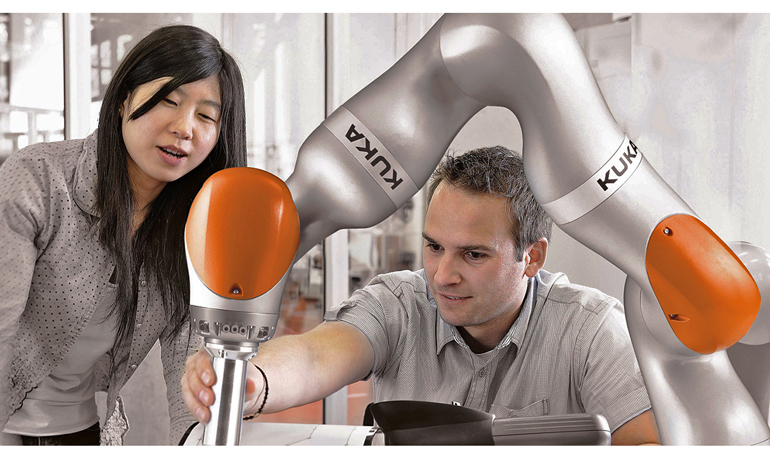
The Kuka Official Robotics Education (KORE) certificate program offers professionals and students the opportunity not only to become certified in operating Kuka robots, but also to learn robotic engineering principles.
All of this will result in the addition of more robots to manufacturing sites. Over the past seven years, the U.S. Bureau of Labor Statistics (BLS) reports that companies added 136,748 robots to factory floors. But while the conclusion of many is to assume that jobs are disappearing due to automation, the opposite is proving true. The BLS also determined that while robots were being added to factories, 894,000 new manufacturing jobs were also created as a result of automation. According to the book What to Do When Machines Do Everything by Malcom Frank, Paul Roehrig, and Ben Pring, 19 million jobs will be lost due to automation over the next 10 to 15 years—but 19 million new jobs will be created due to automation.
In other words, the job market for robotic engineers is at a prime. For the engineer either in school or already working, there are numerous resources available for educating yourself in the world of robotics. Take advantage of them, and crest the next wave of jobs in automation.
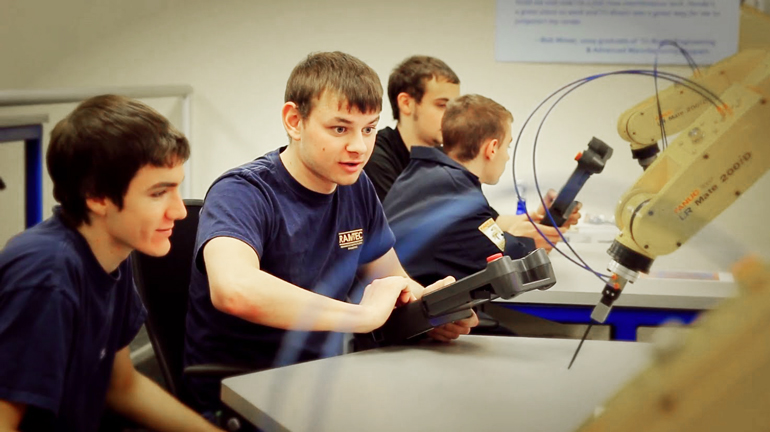 The lack of robot education in high schools and universities is creating a large gap of skilled laborers for the future of automation. FANUC CERT program brings robot certification to all levels of education, including high schools, colleges, and vocational schools.
The Robotic Job Potential
In April of this year, the Association for Advancing Automation (A3) published a white paper concluding that 80% of manufacturers report a labor shortage of skilled applications for production positions. This may result in the U.S. losing a staggering 11% of annual earnings. However, the addition of new automation technologies allows companies to increase productivity and create higher quality products. This allows them to grow their business and add jobs.
The distinction that has to be made is that while robots will automate tasks, they will not automate complete jobs. In the white paper from A3, it was noted that robots have been increasing labor productivity at the same rate as the steam engine: 0.35% annually. Amazon is a key example of how robots add jobs. In 2012, the online shopping giant acquired Kiva Systems, which became Amazon Robotics. By 2014, Amazon Robotics employed 45,000 full-time employees. Three years later, that number had doubled to 90,000, and the company is striving to break the 100,000 mark.
Machine Design recent reported that Amazon has launched 30,000 robots into service in conjunction with 230,000 employees across its fulfillment centers. The Kiva robots have led to higher efficiencies that have resulted in increased growth. Another example of growth due to automation and robotics is in the automotive industry. General Motors grew U.S. jobs from 80,000 to 105,000 from 2012 to 2016. This increase in jobs coincided with the addition of approximately 10,000 robot applications in GM plants.
The robotic engineer job market will grow between now and 2024. The BLS reports that robotics engineers, as part of the mechanical engineering field, will increase by 5% by 2024. The median annual wage for robotic engineers was $83,590 in 2015. If the rate of machines being added to factories remains consistent, then the number of skilled technicians needed to program, operate, and maintain those robots will also increase.
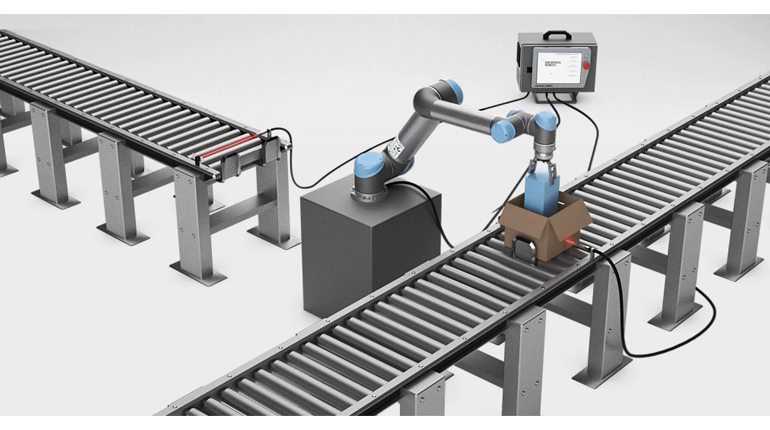 The Universal Robots Academy teaches you how to set up and program its collaborative robots online in six module training courses.
For Engineering Robotic Students
For the young engineering student looking to enter robotics, there are key areas of study that one should focus on to obtain the appropriate education. Robotics is truly an interdisciplinary career which combines several fields of engineering, including mechanical engineering, computer programming, and electrical engineering. According to Robotiq, a manufacturer of end effectors for collaborative robots (cobots), the core subjects for those at the high school level are mathematics and physics. These core areas of study make up the foundation of many robotic courses. If the student has the opportunity at the high school level, they should also take courses computing, programming, design, and extracurricular engineering electives like machine shop and manufacturing classes.
At the university level, many educational institutions offer a robotics major as its own independent field of study. However, since the field of robotics is one under constant change, many professionals reach the robotic industry through different avenues. In the Robotiq guidelines, it is possible to break down the robotic field into three key areas:
According to GradSchoolHub.com, the top 10 universities with grad school programs in robotics are as follows:
NASA has a list of robotics programs at universities across the U.S.
Robotic education in STEM is growing. In 2015, the government offered in $100 million in federal grants to support the growing workforce. The plan was to offer schools with the resources to introduce robotic education into the classroom, as well as to provide training and certification for those looking to enter the field.
| Originally published on NED || August 11, 2017 |||

The Government has today outlined new measures to promote a more competitive economy, Commerce and Consumer Affairs Minister Jacqui Dean says.
“Competition is one of the key drivers of economic success which is why the Government is focused on creating a competitive economy which delivers results and choice for New Zealanders,” Ms Dean says.
“The Business Growth Agenda Paper, Promoting Competition, which I am releasing today sets out what actions we’re taking to lift competition for the benefit of New Zealand’s consumers.”
The Government has agreed on three broad areas of focus:
“New Zealand’s competition law and our Commerce Commission are important contributors to domestic competition, and are well regarded internationally and we are continuing to build on that.
“Other recent measures include passing the Commerce (Cartels and Other Matters) Amendment Bill last week which deters anticompetitive cartel behaviour.
“And following a review of the Commerce Act, the Government is progressing legislation to allow the Commerce Commission to undertake market studies to ensure markets are operating effectively,” Ms Dean says.
Read Promoting Competition here: http://www.mbie.govt.nz/info-services/business/business-growth-agenda/pdf-and-image-library/2017-documents/promoting-competition.pdf
| A Beehive release || August 15, 2017 |||

US-based packaging and equipment solutions provider Volm Companies has opened its new 90000ft² distribution facility in Pasco, Washington.
The new distribution center is situated at 5702 Industrial Way in Pasco, which is close to the old location.
The facility will enable the business growth by providing warehouse space for inventory, LENO manufacturing equipment, equipment and parts area and increased office space.
Volm Companies president and CEO Daniel Mueller said: “We came to the Tri-Cities area in 2007 through an acquisition, and since then we’ve been so impressed by how welcoming the area has been.
"It’s inspiring to us as a company and pushes us, and without you, we wouldn’t have been able to have dedicated ourselves to this area like we are today. We also want to thank the City, giving us a lot of help throughout this process and MH Construction because this is a pretty impressive building and they have done a quality job the whole way through.”
Volm Companies specializes in food packaging, packaging equipment, custom packaging, technical mesh and erosion control.
Established in 1954 and having a workforce of over 500 people, the company offers complete expert packaging consulting services, that include package design, graphic development and full line equipment integration.
Volm Companies partnered with New Zealand-based Wyma Solutions in May 2017 to generate turn-key solutions, which will leverage the global experience of both the firms.
In November 2016, Volm Companies collaborated with weighing and packing machines manufacturer Manter International to provide innovative solutions.
| A PackagingBR release || August 16, 2017 |||
New Zealand’s new Ambassador to the Islamic Republic of Iran is Hamish MacMaster, Foreign Minister Gerry Brownlee announced today.
“New Zealand has a long-standing trade and economic relationship with Iran, established with the opening of our Embassy in Tehran in 1975,” Mr Brownlee says.
“Since the easing of United Nations sanctions in 2016 there has been increased interest in the Iranian market by New Zealand exporters.
“Exports last year were $151 million and the first export of New Zealand lamb in decades was sent to Iran in May.
“There is real scope for the further diversification of our trade relationship with Iran and New Zealand’s new Ambassador will play a key role in supporting this,” Mr Brownlee says.
Mr MacMaster is currently the New Zealand Ambassador to the Kingdom of Saudi Arabia, and has previously been posted to Turkey and Iran.
Mr MacMaster will also be accredited to Pakistan and Afghanistan.
| A Beehive release || August 15, 2017 |||
 NZ's first PET plastic processing plant opens
NZTE Export News August 16, 2017
Fletcher chair Norris hints at board refresh after year of nil return to shareholders
The Whys and Hows of Becoming a Robotics Engineer
Promoting a More Competitive Economy Paper released
Kiwi invention the Balex Auto Boat Loader is now finding favour with Australian boat owners




Palace of the Alhambra, Spain
By: Charles Nathaniel Worsley (1862-1923)
From the collection of Sir Heaton Rhodes
Oil on canvas - 118cm x 162cm
Valued $12,000 - $18,000
Offers invited over $9,000
Contact: Henry Newrick – (+64 ) 27 471 2242

Mount Egmont with Lake
By: John Philemon Backhouse (1845-1908)
Oil on Sea Shell - 13cm x 14cm
Valued $2,000-$3,000
Offers invited over $1,500
Contact: Henry Newrick – (+64 ) 27 471 2242

|
|