
Founded by Max Farndale 1947 - 2018
Young trainees and apprentices will be sharing their success stories with keen young kiwis during next week’s ‘Got a Trade? Got it Made!’ week.
“We want young people to know about the massive range of job opportunities that offer the chance to ‘earn and learn’,” says Industry Training Federation Chief Executive Josh Williams. “You can get paid and get qualified, and launch successful careers without racking up a student loan.”
Got a Trade! week begins on Monday 21 August, and celebrates 148,000 apprentices and industry trainees who work every day in over 140 trades and services.
“While three out of ten school leavers go to university, ten out of ten will need jobs,” says Mr Williams. “The number of apprentices and industry trainees now exceeds the number of university students, and this growth is set to continue.”
“New Zealand is crying out for more apprentices: There are major skills shortages in industries such as building and construction, manufacturing, infrastructure, automotive, retail, aged care, community support, electro-technology, the list goes on.”
‘More apprenticeships’ will be a catch cry this election campaign, with Government targets and opposition policies looking to grow the numbers of traineeships and apprenticeships.
“Employing young people in growing industries is a win-win. Training on-the-job develops the right skills at the right time, and individual growth translates into the regional and economic growth the country needs,” says Mr Williams.
“Trades are the way of the future and trades are what keep this country moving,” says Auckland print apprentice and Got a Trade! hero, Frank Uati. “What a good way to see the world. You earn while you learn, you’ve got a qualification that’s internationally recognised, and there’s no fees, no loan.”
Plasterer Ricky Dewes left school at 16 to find a trade, and went on to become apprentice of the year in both New Zealand and Australia, and Got a Trade! hero. His advice to young people is, if you want to own your own home, car and “toys”, as he now does, become an apprentice. Because skills become careers that can take you where you want to be.
When it comes to getting a trade, employers are also heroes. “Employers are now the largest provider of post-school education in New Zealand. We all benefit from their grateful time, talent and commitment to growing the next generation of skills,” says Mr Williams.
“We never forget the name of the person who first gave us a chance in our careers,” says Mr Williams. “Thousands of employers are out there taking on apprentices and trainees, training them up and giving them a chance. This week, we salute them too.”
| An IOT release ||| August 14, 2017 |||
Wellington Drive announces exclusive agreement with Alaska Refrigeration for the sales and distribution of its SCS Connect system in Vietnam.
Alaska Refrigeration www.alaska.vn is a refrigeration equipment manufacturer and distributor based in Vietnam, supplying a wide range of appliances for domestic and commercial applications.
Wellington’s CEO, Greg Allen said; "The agreement with Alaska is another indication of the increasing importance of Wellington’s brand and its SCS solutions in the Asia Pacific market. As the profile of SCS has grown with large global soft drink and beverage brands we are seeing increasing opportunities in new countries across the broader food and beverage market. This agreement with Alaska is consistent with our regional partnership model and utilises Alaska’s local knowledge and technical resources to service Vietnamese customers and support our mutual regional growth plans."
Commercial refrigeration systems fitted with Wellington Drive’s SCS Connect refrigeration controller already lead the way in Smarter Cooler technology. Wellington’s SCS platform and Smarter Cooler tool-set provides the commercial refrigeration market with fleet management systems and the data needed to improve the effectiveness of cooler fleets. They offer a beacon management platform and other location based digital marketing technologies to engage and interact with consumers at their point of purchase in front of the cooler.
| A WDT release || August 14, 2017 |||
It's Travel O'Clock 13-8-17 / Mondo's Weekly Travel Deals
Travel O'Clock :: A very small selection of some of Mondo Travel's best deals.
New Zealand, Australia, Europe, the USA, Canada, Asia, the Middle East, the South Pacific ... we have you covered worldwide when it comes to inspirational travel offers!
Click here for all the details
To support Money Week 2017, the Reserve Bank and the Commission for Financial Capability have collaborated in a series of videos to encourage people to better manage their debt and talk more freely about their finances.
The videos focus on this year’s Money Week theme of ‘debt’ and feature some of the families associated with our banknotes and connects with other pioneering New Zealanders, and the Queen, who appear on our Brighter Money banknotes.
| A RBNZ release || August 14, 2017 |||
The health sector needs more male nurses, but has struggled to attract men into what has traditionally been a female domain. While up to 50% of those enrolling to become doctors are now reportedly women, only 10% or less of nursing students are male.
However, a new dual, fast track graduate programme offered by Ara and University of Canterbury (UC) seems to be attracting more male students. So what is it about this qualification that works for men?
Ara nursing lecturer and researcher Dr Isabel Jamieson and her team are conducting a suite of research projects connected to the new programme - the combined Masters of Health Science at UC and Bachelor of Nursing at Ara. It is available to graduates of a health-related degree and is “utterly unique,” according to Jamieson, “especially in the way it bridges two organisations and qualifications”. The findings will be presented at the Ara Research Week, 14 – 18 August.
Jamieson suspects that prior academic achievement gives the men who enrol in the programme more freedom to choose their own path. “I guess that because these men already have degrees, they have proven themselves in the academic world and now they feel they can go and do what they want to do career wise”.“Some of these men have already undertaken what could be identified as quite masculine fields of work, such as on building sites and in farm work. One of these participants said that both his parents are nurses, but he didn’t consider it till much later in his worklife. While it is socially acceptable for girls to say they want to be a nurse, it is probably not so acceptable for boys.”
And yet nursing is “a tough job”, Jamieson says. “It is physically, mentally and academically demanding. Nurses need to be able to combine the art and science of nursing to do the job. They are balancing lots of information all the time”.
“I think the some of the general public underestimate what it takes to become a Registered Nurse. RN’s need the personal attributes of kindness and caring, as well as clinical knowledge of health issues, disease processes, pathophysiology, coupled with a social/political understanding of health politics to say nothing of the plethora of questions arising from what a patient has just read on the internet or information provided to them from the lastest app downloaded to their smart phones.”
The challenges of people living longer with more health needs, budget restraints in the sector and the well-publicised mental health challenges in Canterbury makes for a complex sector to work in, but Jamieson’s team found that the men in their study sample were as driven as female nurses to care for others.
While men are very much a minority group in nursing, they are viewed as very likely to be promoted to managerial positions. “However the men we interviewed, on the whole they didn’t want to be managers. They clearly want to be providing direct patient care.”
Diversity in the workforce is important. Nurses should represent the population they care for, and men bring different qualities to the job, Jamieson says. “They can be very pragmatic, which is very useful. If men are dealing with a male patient, the male psyche is useful, the language and understanding a man’s worldview.”
The research, which was recently published in Nurse Education in Practice journal (Attracting men to nursing: is graduate entry an answer?) was conducted with Ara nursing lecturer colleagues John Withington and Dianne Hudson, and UC colleagues Thomas Harding and Alison Dixon.
Jamieson notes that this research is a small qualitative piece of work with a sample of eight interviewees, replicating a study from Monash University in Australia which runs a similar graduate programme. The team will explore further what the male students think and how they feel about nursing.
Ara Research Week is on 14 – 18 August. See http://www.ara.ac.nz/news-and-events/upcoming-events/research-week
| Ara release || August 14, 2017 |||
Kiwis need to keep talking about cyber security as criminals are using technologies to find new ways to undertake crime, NZTech chief executive Graeme Muller says.
Criminals are using advanced technology but so are the good guys, he says. Biometrics, the use of thumbprints or retinal scans, are increasing.
Muller made the comments following the release of the latest report by CERT NZ, the new government cyber security emergency response team.
In its first three months of operation CERT NZ received 364 reports of cyber security incidents costing companies more than $730, 000.
“It is fantastic to see that organisations are reporting security breaches to the CERT as this sharing of information is one of the best ways to reduce vulnerabilities as a country. But their figures are just the tip of the iceberg.
“The CERT will also become the go-to-place for people and organisations looking for information about potential attacks and how to protect themselves.
“The connection of devices to the internet creating an Internet of Things creates opportunities for cyber criminals to access these devices if not properly secured. The US Senate is currently reviewing a Bill looking to address IOT security, the Internet of Things Cybersecurity Improvement Act of 2017.
“Here in New Zealand the National Cyber Policy Office, a branch of the Department of the Prime Minister and Cabinet, is working with the IoT Alliance to develop our local approach to this threat.
Late last year the largest single cyber-attack was carried out using the Mirai botnet which was a piece of code that infected millions of internet connected (IoT) devices such as dvr players, digital cameras and baby alarms. The cyber criminals then took control of the devices and bombarded companies in what is known as a distributed denial of service (DDoS) attack. They were able to shut down Twitter, the Guardian, Netflix, Reddit, CNN and many others.
Credit card companies are looking to move from PIN numbers to thumbprints for purchases above the pay and go level. Artificial intelligence is also being deployed to combat crime. The ability for computer systems to analyse masses of data instantly has been constantly improving, now AI technologies mean that these systems are also starting to learn and adapt to keep criminals out, Muller says.
“While there is a lot of noise out there about IOT attacks or AI crime, the biggest security threats are still actually much simpler and rely on basic human weaknesses, with phishing being the main reported cyber-attack by the CERT and by countries all across the world.
“There are some very important behaviours we have to instil in the population to keep safe. People should not click on links that look suspicious, they should keep updates up to date, they should always have a backup in place and if they suspect something contact the CERT.”
NZTech is hosting the annual national Cyber Security Summit in Wellington on October 25, which will involve senior business, government and tech leaders to work together on ensuring New Zealand remains a safe place to do business by being one of the most cyber secure nations in the world.
| A MakeLemonade/Cert rrelease || August 14, 2017 |||
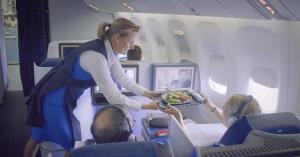
KLM’s “Anytime For You” service gives business class passengers more control over what and when they eat while flying.
Following the launch of the “Anytime For You” business class meal service on 1 July, KLM has announced that the service will be introduced on flights to and from Bangkok in October 2017.
The service, currently available on KLM’s Johannesburg services, allows World Business Class (WBC) passengers to decide when they would like to eat, instead of in-flight meal times being dictated by the airline.
Together with each passenger, crew members compile a personal service schedule for the flight. This service ensures that WBC passengers get more choice and control over their experience.
In addition to the usual three-course dinner and lunch options, the menu also includes an Anytime For You selection of eight dishes. The selected dish is prepared and served restaurant-style whenever it best suits the passenger.
Wim Spelt, Director of Product Management, KLM, said: “Judging by the many positive responses we’ve had from passengers, the new service really meets their wishes. People are pleasantly surprised by the concept, which offers them more choice and versatility. And that is exactly what we hoped to achieve: giving the passenger a positive and memorable experience.”
| An FTE release || August 14, 2017 ||| Fu
Ξ BOC launches new welding technology
Ξ More apprentices for Buckley Systems
Ξ Older workers face too much discrimination - economist 
Ξ Tips for Choosing the Right AutoDarkening Welding Helmet
Ξ Got A Trade? Got It Made! Week – 21 to 25 August 2017
Ξ U.S. Commerce Department Investigation Uncovers Chinese Aluminium Foil Subsidies of Up To 81 Percent
The Government’s planned investment in Defence over the next 15 years represents a huge opportunity for New Zealand companies, says Defence Minister Mark Mitchell.
Mr Mitchell told Defence industry representatives last night that the country needs a Defence Force that is equipped and supported to respond to a rapidly changing strategic environment.
“This requires investment. Over the next 15 years, the Government will invest up to $20 billion in new and upgraded military capability, including replacement of all our major platforms and the regeneration of the Defence estate.
“We have many companies in the Defence sector who are themselves investing and innovating in their areas of expertise. The Government’s investment in Defence promotes growth in the sector, creates jobs and means that the industry will have every chance to build on its achievements.
“While we are not builders of warships or military aircraft, New Zealand companies can support those capabilities with world-class products and systems, and also support them through life,” Mr Mitchell says.
“For every dollar spent on a new capability, four is spent supporting it through life, the bulk of which is spent locally.
“Each year the New Zealand Defence Force spends $600 million on maintenance and repair, training, and other commercial services.
“The Government is committed to ensuring New Zealand companies are given every opportunity to compete for a share of the investment in Defence.
“The products and services New Zealand companies produce are recognised as world-class, and where they can reduce the cost ownership for the Government we need to support them,” Mr Mitchell says.
| A Beehive release || August 11, 2017 |||
 Mainfreight's new depots usher in expansive phase
Expect more Chinese visitors and ‘the best FTA’
Christchurch airport spreads its wings past passengers and planes
Wellington Drive and Alaska Refrigeration in Vietnam deal
House-building factory moving to ex-Alloy premises in west Auckland
Video series for Money Week 2017
Dual Nursing Qualification Attracts Men to Nursing
CERT report captures just the tip of the iceberg
Plans for Dunedin chocolate company unveiled

Palace of the Alhambra, Spain
By: Charles Nathaniel Worsley (1862-1923)
From the collection of Sir Heaton Rhodes
Oil on canvas - 118cm x 162cm
Valued $12,000 - $18,000
Offers invited over $9,000
Contact: Henry Newrick – (+64 ) 27 471 2242

Mount Egmont with Lake
By: John Philemon Backhouse (1845-1908)
Oil on Sea Shell - 13cm x 14cm
Valued $2,000-$3,000
Offers invited over $1,500
Contact: Henry Newrick – (+64 ) 27 471 2242

|
|