
Founded by Max Farndale 1947 - 2018


Microsoft Scam Artists Have Revealed the Cause of this inevitable bias
The accelerating reduction of the domestic land line in favour of the exclusive use of mobiles will tend to favour in polling for this year’s general election the political parties that traditionally appeal to the older generation, the demographic which literally holds onto its landlines.
This will favour the National Party and also Winston Peters’ New Zealand First Party.
It will work against the parties that rely on the younger protest or ideological following such as the Greens or the new Gareth Morgan-led Opportunities Party.
This whole phenomenon has only just been identified and it was discovered due to the plague of scam callers from around the world barraging New Zealand households to the effect that their Microsoft-driven computers are a liability and that only the caller, claiming to be an "accredited" Microsoft specialist ,could fix the “problem.”
Nobody could fathom out why these scam artists were and still are laying siege to an older demographic unlikely to be dependent on Microsoft?
It was now that the obvious explanation was realised and it was that the older generation tends to be the one that hangs onto its landlines
It is thus accessible to the international scamsters who rely on scrolling through the Spark (formerly Telecom) white pages.
The incredibly shrinking printed White Pages phone books are further proof of this phenomenon.
It is now a serious issue in polling that the political class, for once, is reticent to talk about.
No wonder. It means that a growing majority of households are excluded from polling.
It means that all flatters, the one group that the parties are determined to target this year, are eliminated from polls.
Since cell-only people tend to be mostly young people, the pollsters intentionally overweight the 18-30 year olds to compensate for this effect, but as more middle aged people also drop their landlines, it is becoming a serious issue.
A baffling element of the fake Microsoft scamsters plague is why the same households, the ones still with their landlines, were targeted time after time in the same confidence trick call, sometimes in the same evening.
The reason was and is that the fraudsters' automated phone diallers are programmed on a household probability to make a defined number of phone calls. Not finding the required pre-programmed quantity of landline numbers , the system then reverses on itself and goes back over its old numbers.
Occam’s Razor holds that in any mystery at all the revealing explanation will always be the obvious one.
The foreign phone scammers have demonstrated the nature of the flaw in the polling for the general election.
It’s an ill wind………
| From the This email address is being protected from spambots. You need JavaScript enabled to view it. || Friday 7 July, 2017 |||

Turning up to the airport with an expired passport will be a thing of the past for Air New Zealand customers, with the airline’s mobile app now able to scan and save passport information and send a timely reminder when it’s time to renew.
Every month around 550 customers turn up to the airport with an expired passport, triggering a stressful situation for would be travellers.
Air New Zealand customers can now save themselves the stress and embarrassment by using their smartphone camera to capture and save their passport details. Not only will this streamline their check-in experience, it also triggers expiry reminders including providing handy click through links to renew New Zealand, Australian, British and American passports.
Currently around 10 percent of Air New Zealand customers type their passport details incorrectly as they check in online. By saving these to their profile, customers will enjoy a smoother experience and rest easy in the knowledge that their travel document has been entered correctly.
Air New Zealand’s Chief Digital Officer Avi Golan says customer feedback is driving the rollout of time-saving tools such as this and customers can look forward to an increasingly smarter digital travel experience – not just on the day of travel but in the dreaming and planning phase.
“Customers consistently tell us time is the biggest stress factor when travelling, so prioritising features that offer genuine benefits and convenience on the go is key.
“Integrating smartphone camera technology to our app paves the way for adding secure credit card scanning to our booking system, as well as longer term developments such as selfie-boarding - using biometrics and facial recognition to verify customers at the gate.”
The Air New Zealand mobile app has been downloaded by 1.3 million people. Earlier this year the popular coffee ordering function clocked up two million orders.
| An Air New Zealand release || July 7, 2017 |||
The Ministry of Transport and BusinessNZ are partnering to commission a study into how New Zealand’s economy can benefit from transport innovation, Transport Minister Simon Bridges says.
“The potential of self-driving cars and their associated economic opportunities are often the focus of research and investment, but there are many other aspects of the transport system which present economic opportunities,” Mr Bridges says.
“I want to see businesses positioned to flourish in New Zealand as intelligent transport systems (ITS) are commercialised.”
The study will be overseen by an advisory group, which will meet for the first time today, chaired by Dr David Prentice, Chief Executive of Opus. The advisory group also includes the Ministry of Business, Innovation and Employment and a range of other players from the public and private sectors. The private sector is developing much of this technology, so it is critical that the Government engages with the private sector.
“The study is expected to be completed by the end of 2017, and will make recommendations for how we can develop and grow ITS market opportunities where we have a competitive advantage, and identify areas to be strengthened” Mr Bridges says.
“There are companies in New Zealand already working in the growing ITS market, as well as companies who could do so. A number of international companies have also expressed interest in developing their ITS technologies in New Zealand.
“We have a reputation for good, effective regulation, which is enforced by practical regulators who are open to finding solutions which support innovation.
“Leveraging off these advantages to support businesses, and attracting international companies to come and develop their technology here, will have significant benefits for transport in New Zealand, and the broader economy,” Mr Bridges says.
| A Beehive release || July 6, 2017 |||

Despite the US withdrawal from the 2015 Paris Agreement on climate change, other countries, including New Zealand, remain committed to cutting their greenhouse gas emissions.
In our report, we explore how New Zealand, a trailblazer for emissions trading, might drive a low-emission transformation, both at home and overseas.Turning off the tap
Emitting greenhouse gases is a lot like overflowing a bathtub. Even a slow trickle will eventually flood the room.
The Paris Agreement gives all countries a common destination: net zero emissions during the second half of the century. It is also an acknowledgement that the world has only a short time to turn the tide on emissions and limit global temperature rise to below two degrees. The sooner we turn down the tap, the more time we have for developing solutions.
Time is running out on meeting the goal of keeping global temperature rise below two degrees. from Unsplash, CC BY-ND
New Zealand’s 2030 commitment is to reduce emissions 30% below 2005 levels (11% below 1990). In 2015, our emissions (excluding forestry) were 24% above 1990 levels. The government projects a gap of 235 million tonnes between what has been pledged and what New Zealand will actually emit in the period from 2021 to 2030.
Reducing emissions rapidly enough within New Zealand to achieve our Paris commitment could be extremely expensive, and even at a cost of NZ$300 per tonne, the target could not be met through domestic action alone.
International emission reductions help bridge the gap. New Zealand could turn off its own greenhouse gas tap while supporting other countries to do the same.Joining forces across borders
In the past, New Zealand relied heavily on the global Kyoto carbon market and purchased international emission reductions using the New Zealand Emissions Trading Scheme (ETS). Some ETS firms bought low-cost overseas Kyoto units of questionable integrity while domestic emissions continued to rise.
In 2015, New Zealand pulled out of the Kyoto carbon market and its ETS is now a domestic-only system.
Under the Paris Agreement, carbon markets have changed in three important ways:
Currently, international emission reductions can be traded only from government to government. It is no longer possible for NZ ETS participants to buy international units directly from the market.
International emission reductions sold as offsets to other countries will have to be additional to the seller’s own Paris target.
Countries have flexibility to trade international emission reductions through arrangements outside of the central UN mechanism which is at an early stage of development.
A new approach to reducing emissions
What does this mean for New Zealand? First, we cannot and must not rely on international markets to set our future domestic emission price.
Second, as both taxpayers and responsible global citizens, we need to decide where to fund emission reductions. Most mitigation opportunities are in developing countries. The benefits of investing in lower-cost reductions overseas need to be weighed against the costs of deferring strategic investment in New Zealand’s own low-emission transformation.
Third, we need an effective mechanism to direct New Zealand’s contribution to mitigation overseas.
In collaboration with others, Motu researchers are prototyping a new approach: a results-based agreement between buyer and seller governments within a climate team.
For example, New Zealand could partner with other buyers – such as Australia, South Korea or Norway – to pool funding at a scale that provides incentives for a country with a developing or emerging economy – such as Colombia or Chile – to invest in low-emission transformation beyond its Paris target. These countries could then create a more favourable environment for low-emission investment – including by New Zealand companies.
Despite the US withdrawal from the 2015 Paris Agreement on climate change, other countries, including New Zealand, remain committed to cutting their greenhouse gas emissions.
In our report, we explore how New Zealand, a trailblazer for emissions trading, might drive a low-emission transformation, both at home and overseas.Turning off the tap
Emitting greenhouse gases is a lot like overflowing a bathtub. Even a slow trickle will eventually flood the room.
The Paris Agreement gives all countries a common destination: net zero emissions during the second half of the century. It is also an acknowledgement that the world has only a short time to turn the tide on emissions and limit global temperature rise to below two degrees. The sooner we turn down the tap, the more time we have for developing solutions.Time is running out on meeting the goal of keeping global temperature rise below two degrees. from Unsplash, CC BY-ND
New Zealand’s 2030 commitment is to reduce emissions 30% below 2005 levels (11% below 1990). In 2015, our emissions (excluding forestry) were 24% above 1990 levels. The government projects a gap of 235 million tonnes between what has been pledged and what New Zealand will actually emit in the period from 2021 to 2030.
Reducing emissions rapidly enough within New Zealand to achieve our Paris commitment could be extremely expensive, and even at a cost of NZ$300 per tonne, the target could not be met through domestic action alone.
International emission reductions help bridge the gap. New Zealand could turn off its own greenhouse gas tap while supporting other countries to do the same.Joining forces across borders
In the past, New Zealand relied heavily on the global Kyoto carbon market and purchased international emission reductions using the New Zealand Emissions Trading Scheme (ETS). Some ETS firms bought low-cost overseas Kyoto units of questionable integrity while domestic emissions continued to rise.
In 2015, New Zealand pulled out of the Kyoto carbon market and its ETS is now a domestic-only system.
Under the Paris Agreement, carbon markets have changed in three important ways:
Currently, international emission reductions can be traded only from government to government. It is no longer possible for NZ ETS participants to buy international units directly from the market.
International emission reductions sold as offsets to other countries will have to be additional to the seller’s own Paris target.
Countries have flexibility to trade international emission reductions through arrangements outside of the central UN mechanism which is at an early stage of development.
A new approach to reducing emissions
What does this mean for New Zealand? First, we cannot and must not rely on international markets to set our future domestic emission price.
Second, as both taxpayers and responsible global citizens, we need to decide where to fund emission reductions. Most mitigation opportunities are in developing countries. The benefits of investing in lower-cost reductions overseas need to be weighed against the costs of deferring strategic investment in New Zealand’s own low-emission transformation.
Third, we need an effective mechanism to direct New Zealand’s contribution to mitigation overseas.
In collaboration with others, Motu researchers are prototyping a new approach: a results-based agreement between buyer and seller governments within a climate team.
For example, New Zealand could partner with other buyers – such as Australia, South Korea or Norway – to pool funding at a scale that provides incentives for a country with a developing or emerging economy – such as Colombia or Chile – to invest in low-emission transformation beyond its Paris target. These countries could then create a more favourable environment for low-emission investment – including by New Zealand companies.
| A TheConversation release || July 7, 2017

Volvo Cars has announced that every Volvo it launches from 2019 will have an electric motor, marking a historic shift from cars with only internal combustion engines (ICE) and placing electrification at the core of its future business.
The announcement represents a significant move to embrace electrification and highlights an emerging chapter in automotive history.
“This is about the customer,” said Håkan Samuelsson, Volvo president and CEO. “People increasingly demand electrified cars and we want to respond to our customers’ current and future needs. You can now pick and choose whichever electrified Volvo you wish.”
Volvo will introduce a portfolio of electrified cars across its model range, embracing fully electric cars, plug in hybrid cars and mild hybrid cars.
The company will launch five fully electric cars between 2019 and 2021, three of which will be Volvo models and two of which will be electrified cars from Polestar, Volvo’s performance car arm. Full details of these models will be announced at a later date.
The decision follows this month’s announcement that Volvo Cars will turn Polestar into a new separately-branded electrified global high performance car company.
Volvo has also stated that it will offer a range of petrol and diesel plug-in hybrid and mild hybrid 48-volt options on all models. Although this means Volvo hasn’t committed to going fully electric, it does indicate that pure ICE cars will be gradually phased out and replaced by ICE cars with electrified options.
“This announcement marks the end of the solely combustion engine-powered car,” said Samuelsson. “Volvo Cars has stated that it plans to have sold a total of 1m electrified cars by 2025. When we said it we meant it. This is how we are going to do it.”
For more information, visit the Volvo website.
| An engineering.com release || July 5, 2017 |||
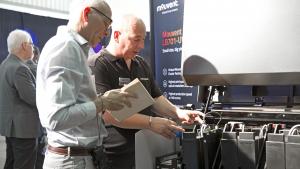
BOBST – one of the world’s leading suppliers of equipment and services to packaging and label manufacturers, and Radex – a startup company owned by multiple stakeholders with a long track record in the field of DOD inkjet digital printing, today announced the launch of Mouvent, a joint venture that will become the digital printing competence center and solutions provider of BOBST. Mouvent, which is comprised of 80 employees in Switzerland, will focus on inventing and delivering the future of digital printing.
Central to the digital innovation at Mouvent is an ingenious digital printing technology developed by Radex, which is based on a highly integrated cluster and represents a quantum leap for the industry. Thanks to its intelligent and compact design, it will be the centerpiece of revolutionary new machines developed by Mouvent for a wide variety of markets such as textile, labels, corrugated board, flexible packaging, folding carton and more.
“We truly believe this is a watershed moment for the future of digital printing independent of the industry or market,” said Jean-Pascal Bobst, CEO of Bobst Group SA. “Current industry trends – including high demand for digitalization, short runs, fast availability, promotion and versioning, personalized and seasonal products, and increasing sensitivity towards cost and environment – are driving demand for high quality and affordable digital printing machines. Through Mouvent we aim to initiate a quantum leap in this area, ultimately providing the market with what it needs most; highly reliable industrial digital printing on different substrates at a competitive cost.”
As well as the digital printing presses, Mouvent offers a fully integrated, complete solution – it develops, engineers, tests, and industrializes digital printers based on the MouventTM Cluster, it writes the software around the printers, develops inks and coatings for various substrates, as well as providing a full servicing offering. The company is promising a new standard in inkjet label production cost and quality, in ink pricing, head durability, quality and machine performance. Its first machine that has been launched is an innovative, highly productive digital printer for textiles, which prints with up to 8 colors, and there is a full product pipeline to follow.
The innovative cluster design is the base building block for all systems, current and in development. “Our radical new approach is to use a base cluster which is arranged in a modular, scalable matrix instead of having different print bars for different applications and different print width” explains Piero Pierantozzi, Co-Founder of Mouvent. “The Mouvent Cluster is the key technology behind the Mouvent machines, resulting in high optical resolution for a crisp, colorful, very high printing quality, as well as a never-seen-before flexibility and possibilities in terms of machine development. Simplicity is our engineering philosophy.”
Mouvent printers are the smallest digital printers in their category – closer to desktop printing than to traditional analogic printers like flexo – making them very compact, light-weighted and easily accessible. The modular, compact system allows easier settings and start-up with less fine adjustments required resulting in a productivity boost. The compact design has many other benefits, including smaller footprint, faster change-over, simple implementation and low cost.
“We are very excited to start rolling out the pipeline in the months ahead,” said Simon Rothen, CEO of Mouvent. “Today is the announcement of an exciting journey of bringing large-scale digital printing to various industries. The digital printing solutions offered by Mouvent will present new opportunities for all sorts of companies, bringing more flexibility, unmatched productivity, shorter time to market and infinite variation, all with a very compact and energy efficient design. This will revolutionize the digital printing world.”
The Mouvent Team welcomes you to visit their stand A60 Hall 3 during Labelexpo 2017 for the launch of the new digital printing presses for the label industry.
| A Bobst Group release || July 6, 2017 |||
 Chinese subsidies on steel imports not hitting NZ Steel margins: MBIE
Don't let TPPA fears, political point-scoring hurt business: ExportNZ
What post Brexit negotiations mean for NZ
Cranes busy dismantling wharf giant
New Zealand’s System for the Management of Hazardous Substances in the Workplace is Changing
Tony Alexander's Weekly Overview


Palace of the Alhambra, Spain
By: Charles Nathaniel Worsley (1862-1923)
From the collection of Sir Heaton Rhodes
Oil on canvas - 118cm x 162cm
Valued $12,000 - $18,000
Offers invited over $9,000
Contact: Henry Newrick – (+64 ) 27 471 2242

Mount Egmont with Lake
By: John Philemon Backhouse (1845-1908)
Oil on Sea Shell - 13cm x 14cm
Valued $2,000-$3,000
Offers invited over $1,500
Contact: Henry Newrick – (+64 ) 27 471 2242

|
|