
Founded by Max Farndale 1947 - 2018


Chris Jefferies reports in Boat International that the 24.38 metre maxi racing yacht Lion New Zealand has checked into Yachting Developments for an extensive winter overhaul. The works, which began on May 15 with her haul-out, are described as a “top-to-bottom refit”.
Designed by Ron Holland and launched in 1985 for Sir Peter Blake, Lion New Zealand raced in the 1985/86 Whitbread Round The World Race. She was purchased in 2008 by the NZ Sailing Trust, which uses her to provide sailing experiences for young New Zealanders.
In the past nine years, Lion New Zealand has covered more than 200,000 nautical miles, welcoming thousands of guests on board along the way, and the trust explains that she is in need of a much-deserved refit.
Read the full article on Boat International || May 31, 2017 |||

According to the Australian Business Traveller, the airline’s own-brand credit card will be a new Platinum-grade MasterCard, and will display the Qantas brand alone.
ABT reported that 35 per cent of all credit card spending in Australia is already happening through co-branded Qantas credit cards, in partnership with banks, American Express, and retailers like David Jones and Woolies.
Now, with Qantas not co-branding with any other company, Qantas is likely to steal a bigger slice of the profits.
It comes as Virgin Australia’s own Velocity program conducted research that found that Australian credit card use is motivated by loyalty rewards, with more than two thirds of respondents saying they will make a decision to buy an item based on whether they will receive points.
It also found that the most appealing loyalty rewards for Australians are frequent flyer points and store vouchers.
The credit card launch coincides with Qantas’ 30th anniversary of its frequent flyer program, which now boasts almost 12 million members down under.
So why should we care? Well, a few extra frequent flyer perks could be in store for Qantas members, with ABT reporting the airline has hinted at higher earning rates for its members, “exclusive travel benefits” like airfare deals and lounge access, and something Qantas is calling “uncapped earning potential”.
| A Travel Weekly release || May 31, 2017 |||
Foreign Minister Gerry Brownlee has today handed over four amphibious boats to the Fiji National Disaster Management Office at a ceremony in Suva.
“New Zealand and Fiji have agreed to trial the Sealegs boats in emergency response situations and natural disasters,” Mr Brownlee says.
“Amphibious boats do not require infrastructure to launch, which means the emergency responders will be able to get the vessels in the water more quickly and operate more effectively in flooded urban environments.
“Fiji’s emergency responders will use the vessels to reach stranded people, as well as to get support and supplies to people who have been cut off by flooding or other natural disasters.
“The $1.2 million, two-year trial will see four vessels provided to the Fiji authorities along with other emergency equipment, and a training and maintenance programme.
“The Sealegs boats will complement Fiji’s excellent emergency response systems and boost their disaster response capacity.
“This trial is a partnership between the governments of New Zealand and Fiji, to test innovative technology that will ultimately help save lives and deliver humanitarian assistance when disaster strikes,” Mr Brownlee says.
Mr Brownlee is currently in Suva for his first official visit to Fiji as Foreign Affairs Minister.
| A release from the Beehive || May 31, 2017 |||
Foreign Affairs Minister Gerry Brownlee has welcomed the announcement that United States Secretary of State Rex Tillerson will visit New Zealand next week.
Secretary Tillerson will meet with Prime Minister Bill English and Minister Brownlee in Wellington on June 6.
“New Zealand and the United States enjoy a long-standing friendship,” Mr Brownlee says.
“We share a deep interest in maintaining peace, prosperity and stability in the Asia Pacific region and we have worked closely together to counter terrorism in Iraq and Afghanistan. The United States is our third-largest individual trading partner.
“We welcome Secretary Tillerson’s visit as a chance to strengthen the close relationship between New Zealand and the United States, to discuss some of the world’s most pressing issues, and to further promote our economic ties,” Mr Brownlee says.
| A release from the Beehive || May 31, 2017 |||

New Zealand’s Most Famous Tabloid Editor Said it Does not Exist in the First Place
New Zealand’s last tough-talking Front Page era editor, the late Frank Haden, declared that the press in any official court room or other such tribunal would always emerge much the worse for the experience.
Therefore he stated the press should take every precaution against appearing before such a body for any kind of judgement at all.
The reason for avoiding court rooms and the like he stated was that “the public hates the press.”
This meant in practical terms that those seeking to represent the general public in any deliberations involving the press either separately or collectively would inevitably grasp their opportunity to “savage” the press.
Therefore he stated the press should always avoid, somehow, all such appearances, because it was simply not going to win. It could only come out of the encounter much the worse for it.
The press, insisted Haden, was reluctant to accept the loathing in which it was held and thus found itself before juries and other such panels in the fond and misguided belief that it’s clams would fall on receptive ears.
Instead, the crusty Haden insisted, the officially constituted panel would simply become a lightening rod through which the public hatred of the press would be transmitted.
It is hard not to consider the likelihood that the Haden dictum figured in the twice-declared no by the Commerce Commission to the nation’s two predominant newspaper chains ardently seeking permission to merge.
It is hard too not to entertain the notion that the Commission had no sympathy either for the individuals before them who were advocating the merger.
The two-act episode was a startling re-affirmation of Haden’s Law.
It holds that the press and those who work in it in any appearance before any group formed to represent the common weal, the considered opinion on the public benefit, will simply act as a conductor for the public antipathy to it.
The second part of Haden’s Law can be stated by saying that the only avenue open to the press in this entire matter is to do its utmost to avoid any exposure at all to these constituted courts of public opinion.
Haden’s views were expounded many years ago and were widely heeded at the time if only because of the distressing experience of the industry’s libel lawyers in a string of fixtures.
Since this raffish era and with the disappearance notably of Truth the tabloid tyranny largely subsided.
The institutionalisation of the press through the mandatory university induction process ensured a commonality of voguish opinion and thus stated views.
The era of politesse thus became well established. Gone are the Woodbine-smoking renegades who once inhabited Vulcan Lane and Cuba Street.
In their place are corporate employees nurturing their careers and sharing a similar liberal outlook. They are about as threatening to societal values as the Vienna Boys Choir.
The most interesting element in their newspapers is now the surreal debate over who owns them, and how.
The newspapers management, no longer now “bosses,” have the appearance of well-intentioned pillars of society, doing their best.
But who have been publicly slapped in the face, twice, for subverting society.
SO how did Haden’s Law propounded so long ago, and in an era in which the tabloids were often villainous, now so evidently, re-emerge like a bolt, two bolts, of lightening from the heavens?
Because the two chains in seeking to please everyone, pleased nobody.
The more they sought to personify diversity in all its forms the more constricted they appeared. Their quest for plurality led them to losing their singularity.
In Frank Haden’s era the unbridled cheek of the press meant it was feared and loathed with a sprinkling of respect.
Haden himself was the last practitioner to have worked for all of Australasia’s dynastic publishers – the Fairfax, Packer, and Murdoch families
Today, the corporatist harmonised fashionable wisdom-friendly version has instead inspired an attitude of low-resonating indifference of the type that in turn has inspired two Commerce Commission verdicts in its disfavour .
Even given their joint tendency to treat the world as if it had started this morning, the two chains who are said to be contemplating a return and third match, this time with an appeals court should now heed Frank Haden’s Law.
Stay away from these types of convocations be they judicial or quasi judicial.
| From the This email address is being protected from spambots. You need JavaScript enabled to view it.

AccorHotels New Zealand announce that Mercure Auckland will rebrand to the Grand Mercure Auckland from June 1, following an extensive NZ$22 million refurbishment, the second Grand Mercure announced this month for the region.
The hotel’s stunning transformation makes it an even more attractive base for exploring the adjacent Britomart precinct and nearby thriving Viaduct Harbour. Boasting 207 guest rooms and suites in total, all room types have been fully refurbished in harmonious textures and botanic shades. A new library, richly decorated with warm gold tones and leather, provides the ideal venue to relax and read from a collection of some of New Zealand’s finest literature. With a variety of indoor and outdoor meeting spaces, the Grand Mercure Auckland offers the largest event space of any hotel in the Britomart area with capacity for 350 cocktail style.
On street level, a new alfresco social eatery has been added, Custom Lane, which transforms from café to bar as day shifts to night, capturing a sense of the lively Britomart through eclectic street art and creative design elements. Take the lift to the hotel’s rooftop Vue Restaurant & Attica Bar, which boasts unobstructed views of Auckland’s skyline and harbour, matched by fine cuisine showcasing New Zealand’s outstanding produce and wines.
AccorHotels’ Senior Vice President Operations, New Zealand, Fiji and French Polynesia, Gillian Millar said: “Following an extensive transformation and the exciting addition of Custom Lane to tap into Britomart’s social scene, Grand Mercure Auckland redefines the upscale brand in Australasia.”
“Grand Mercure is an internationally recognisable brand name in the upscale hotel space, and we saw an opportunity to further leverage the brand’s presence in New Zealand while elevating our guests’ experience.” Grand Mercure Auckland is located at 8 Customs Street, Auckland CBD, New Zealand and joins a network of over 40 Grand Mercure hotels in the Asia-Pacific Region.
Experience the newly rebranded Grand Mercure Auckland from just $204 including breakfast. Read more at http://www.etbtravelnews.global
The wine industry has become the fourteenth industry sector to join the Government Industry Agreement (GIA) biosecurity partnership, Primary Industries Minister Nathan Guy has announced today.
“It’s very good news to have New Zealand Winegrowers working with the Ministry for Primary Industries and other industry partners on biosecurity,” says Mr Guy.
“It means we can work together on preventing, managing and responding to the most important risks like Pierce’s Disease and Brown Marmorated Stink Bug.
“This shows the wine industry takes biosecurity seriously and wants to work collaboratively with MPI on preparedness and responses.
“As the recent Biosecurity 2025 Direction Statement outlines, biosecurity is a shared responsibility. We need everyone working together sharing their expertise and experience.
“Last week I was proud to announce an $18 million boost to biosecurity in Budget 2017, meaning the total biosecurity budget is now just under a quarter of a billion – the highest ever.”
The signing of the agreement was attended by Mr Guy at a ceremony in Parliament tonight.
New Zealand’s wine exports are worth around $1.6 billion a year.
Other signatories to the GIA include:
| A Beehive release || May 30, 2017 |||
New Zealand’s financial system remains sound and the risks facing the system have reduced in the past six months, Reserve Bank Governor Graeme Wheeler said today when releasing the Bank’s May Financial Stability Report.
“The outlook for the global economy has been improving but global political and policy uncertainty remains elevated and debt burdens are high in a number of countries. A sharp reversal in risk sentiment could lead to higher funding costs for New Zealand banks and an increase in domestic borrowing costs. New Zealand’s banks are vulnerable to these risks because of their increasing reliance on offshore funding for credit growth,” Mr Wheeler said.
“House price growth has slowed in the past eight months, in response to tighter loan-to-value ratio (LVR) restrictions, and a more general tightening in credit and affordability pressures in parts of the country. While residential building activity has continued to increase, the rate of house building remains insufficient to meet rapid population growth and the existing housing shortage. House prices remain elevated relative to incomes and rents, and any resurgence would be of concern.
“Dairy prices have recovered significantly in the past 12 months, and the majority of dairy farms are likely to have returned to profitability in the 2016/17 season. However, parts of the dairy sector are carrying excessive debt burdens, and remain vulnerable to a fall in income or an increase in costs. Banks should continue to closely monitor and maintain full provisioning against lending to high risk farms,” he said.
Deputy Governor Grant Spencer said “The banking system maintains strong capital and funding buffers, and profitability remains robust. The banking system appears to be operating efficiently when compared with other OECD countries, based on metrics such as cost-to-income ratios, non-performing loans and interest rate spreads.
“Banks have generally tightened credit conditions in light of funding constraints and the increasing risks around housing. Banks are seeking to reduce their reliance on offshore funding and have raised deposit rates. The Reserve Bank supports a cautious approach to managing foreign debt, in light of lessons learned in the GFC.
“While the LVR restrictions have increased the banks’ resilience to any fall in house prices, a significant share of housing loans are being made at high debt-to-income (DTI) ratios. Such borrowers tend to be more vulnerable to any increase in interest rates or declines in income. The Reserve Bank will soon release a consultation paper proposing the addition of DTI restrictions to our macro-prudential toolkit.
“The Reserve Bank is making progress on a number of other initiatives. A review of bank capital requirements is underway and we recently released an issues paper on the intended scope of the review. We recently concluded a review of the outsourcing policy for registered banks, and the Bank and other agencies are assessing the recommendations from the International Monetary Fund’s recent (FSAP) review of New Zealand’s financial system.”
More information: Financial Stability Report
| A RBNZ release || May 31, 2017

This year's top carpentry apprentice slogged through four years of university before he realised he was never going to get the job he wanted, where he wanted it writes Alexia Russell in Newsroom today.
Chris McLean took up the tools instead and couldn't be happier about his future in construction. Now he is trying to get school leavers to take a step back before applying for their student loan, asking them to spend 10 minutes on the Government's job website researching their future.
| Read the full story on Newsroom || May 31, 2017 |||

Palace of the Alhambra, Spain
By: Charles Nathaniel Worsley (1862-1923)
From the collection of Sir Heaton Rhodes
Oil on canvas - 118cm x 162cm
Valued $12,000 - $18,000
Offers invited over $9,000
Contact: Henry Newrick – (+64 ) 27 471 2242
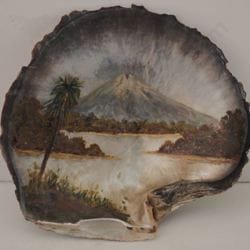
Mount Egmont with Lake
By: John Philemon Backhouse (1845-1908)
Oil on Sea Shell - 13cm x 14cm
Valued $2,000-$3,000
Offers invited over $1,500
Contact: Henry Newrick – (+64 ) 27 471 2242

|
|
