Founded by Max Farndale 1947 - 2018

 UK Women in Engineering Day goes international
Full PACER Plus details released show benefits to NZ and Pacific
NZ business confidence rises in May, along with expectations for profit, pricing and inflation
Auckland University gets share of $215m investment deal for commercialisation
Global GPS tracker latest venture from social entrepreneur Derek Handley
New Zealand Energy Corp announces Q1 2017 Results and details of AGM

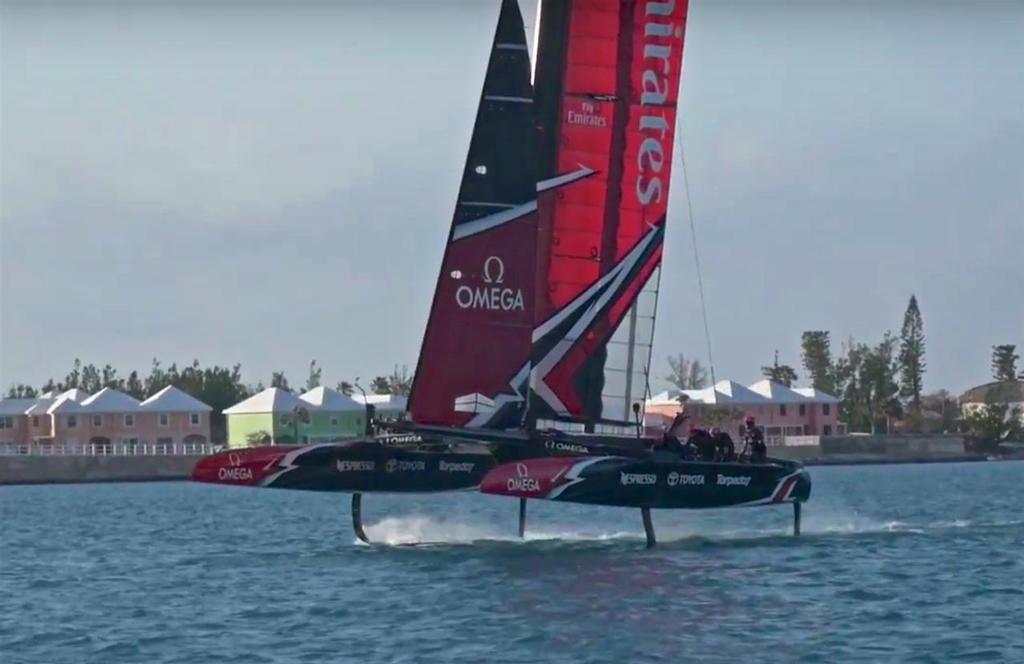
To quote 'Sailing Prof' Mark Orams from is article in the NZHerald today, "Team NZ will likely be holding back some "kit" - but all teams are limited in new equipment. They are only permitted a total of four foils (and two matching spares). The main wing, hulls and the jibs (small triangular front sail) are identical on all boats.
Rudders, fairings and the "aero-package" offer potential for change. Aerodynamic and hydrodynamic drag is a big deal, so additional fairings or configurations to reduce drag could be an option, he wrote."
So what is aerodynamic and hydrodynamic drag? Thats not a question that this writer can answer so a quick Google search came up with:
The aerodynamic or hydrodynamic lift is a force perpendicular to the movement of the fluid. It is created by the suction in a negative pressure zone, formed on top of the profile designed for this purpose. It depends on the displaced mass of fluid. - http://www.mecaflux.com/en/portance.htm - for the full article
and/or
Aerodynamic/Hydrodynamic Drag - A Unit: Dynamics (Forces) & GravitationUnderstand and correctly use the term “drag” when it refers to an object that is slowed down by a fluid.
Visit http://www.mrbigler.com/moodle/pluginfile.php/10258/mod_resource/content/1/269_page_Notes-AP-Physics-1-2016-17.pdf to view the complete unit
By the way the Google search threw up 317,000 results so within there should be enough tinformation to answer most questions on how the present lot of America Cup AC50's work. Or just ask any sailor that you sppot hanging around the Team New Zealand shed on the waterfront; there must be some left on home duties.

Email followed on heels of major international flap
A scam email today is the latest in a concerted fakes sent out to Xtra users. The current one (see below) is filled with grammatical and spelling mistakes that reveal it as a fake. It follows a similar email drop last week (see below) inviting recipients to access a fake Westpac site.
The barrage pin points the need for a central bank 0800 query pool on suspect emails. The email followed on the tail of the global WannaCry cyber attack and at a time when New Zealand households still remain plagued by phone-ins from bogus Microsoft “certified” technicians now seeking to take advantage of the enhanced fear of cyber implant disruptions.
The first bogus Westpac email reads:-________________________________
Dear Westpac Customer,
New Successful Payment.For more information about this payment please follow the link below:https://westpac.co.nz/transaction
If you received this message in your SPAM/BULK folder, it is because of the restrictions imposed by your Mail/Internet Service Provider.
2017 Westpac New Zealand Limited.
________________________
The second and most recent fake email is rather more convincing being centred on account verification procedures. Its message:-
Dear Customer,
Account Update
Due to the recent upgrade of our servers, we have urged all our online banking users for possible verfication.
Kindly use our website below to verify your profile to avoid account termination.
http://www.westpac.co.nz
Thank you for choosing us
Westpac Bank New Zealand.______________________________A problem recipients encountered with these email mass-drops, is that they feature the inference when it landed in a Westpac customer in-box that it was specially targeted at them.
In the instance of the first email inquirers had to compete with phone-ins in the regular course of bank business, as well as those now alerted by the bogus email.
MSC Newswire has lodged an enquiry with Westpac seeking to discover the source of the bogus email as well as more details on its modus operandi.
The arrival of the second such bogus email points up the problem that the Australian trading banks have in coping with this problem.
The incidents point up the need for a cooperative banking rapid response enquiry centre for customers to obtain information about all doubtful emails.
Banks of course do not contact customers with emails. Only by traditional post. Or via a customer-prompted and subsequently verified phone call.
Aware of this the international email fraudsters seek nonetheless to entice a response, in this case by conjuring up the notion of an inward payment.
The banks are no strangers to cooperative efforts.
They have profited greatly by keeping their customers at an economic distance by electronic banking, thus reducing their premises overheads.
A small proportion of these savings should now be re-invested in a quick-response shared call centre dealing with bogus emails which are now demonstrably on the increase.
When a litre of water cost more than a litre of petrol, the value of every day commodities is really concerning when water is the alexia of all life.
When we are constantly being told that the wars of the future will not be about oil, but water, we as New Zealanders need to get out Act together to protect one of our most assets.
In HB we have, a self-generating water bonanza laying under our very feet and all we are doing is arguing about the rights and wrongs of its ownership and management.
To the people of HB, we have a future opportunity, but if only we can take the affirmative and positive action to do something about it.
It is often claimed that there is lack of water or is this a myth? Do we really have a water problem in HB or do we have a management problem?
As a citizen and rate payer of Hawkes Bay for many years, I believe the main reason for the assumed water quality, storage problems of Hasting’s is not because we have a shortage, not because we have so called young water but due to mismanagement of this resource. This has been proven from the recent report of the Havelock North debacle. The over allocation of resource consents to take water from the sub and confined aquafer is a real concern but why is there no water shortage in Napier?
To solve this problem or as it is now being promoted, that there is a lack of understanding about our water. We were to have a hui, now it’s a symposium. My question is why, when we have the information, the skills and the professional expertise in the HB Regional Council.
For years, the qualified and professional staff of the HBRC have researched and documented and tested of our water resource, and produced the reports like the “Groundwater level changes in the Heretaunga and Ruataniwha Basins from 1994-2014” in 2015 (HBRC Report No. RM15-01-4738.) as is required of them with the mandate under the Resource Management Act.
I suggest you go to the HBRC web site and read this and a one page summary called “Understanding our Aquifer” Both publications are factual, informative and interesting and will perhaps dispel the myth of the so-called water quality and shortage misunderstanding.
The chairman of the HBRC, Rex Graham, is a member of the trio who called for this hui/symposium. When all the above information is freely available, why did he get the facts instead of becoming one on the three musketeers. His involvement is tantamount to nothing more than a vote of no confidence in the very people he has been elected to and paid to lead, the employees of the HBRC? Does he not have the confidence in their abilities to provide the answers instead of out of town experts at a symposium? What a waste of rate payer’s money and time. If this being the case should he not resign as the chairman?
There has been a lot of comment about the Chinese bottling plant at the Tomoana site. What is not so well known is that this is also 50% owned by a HB family but very little has said about the fact that Heinz Watties is owned by Americans, the Pan Pac Mill by the Japanese, many of the grape growing companies are owned by off shore interests or that the Russian multi-millionaire now owns the Waiwera springs and exports this water resource.
Add to this the plans that are in place by corporate investors to take water from the George river on fringe of Fiordland, to pipe it 12 kilometres and to then load it onto ships in bulk, off shore for export. This is commercially reality and while our NZ laws allow it to happen, it will continue to happen.
The fresh water supplies of England are now not owned by the English, but by the German and the French conglomerates who sub lease and the right to fish in the rivers.Could this happen to NZ? Have we as NZers missed the boat? We will, if action is not taken sooner than later. If we don’t get this sorted quickly, we are in danger of going the same way as England, we will lose control of one of our most valuable resources, water, something that most of us take for granted.
Over the last 20 years I have watched and observed the water debate, so here is a lay man’s take on this issue.
It’s been interesting to watch and read about the Dam issue, the sorrow and multimillion dollar debacle in Havelock north, the sprinkler bans and then to read about the shortage of water in Tikokino and Onga Onga.
To answer this question of water shortage and its quality, let’s start with the end in mind in Hawke Bay and then take a journey from the ranges back to Hawke Bay. There are approximately 43 fresh water springs releasing millions of litres of fresh water into Hawk Bay every day.
This is caused as is a direct result of the hydrostatic pressure (caused by the pressure of the millions of litres of water the lay directly beneath the Ruahine ranges and under the Heretaunga plains in the confined aquifer.
If we journey to the Ruataniwha plains along highway 50 to the Tikokino area, then up the Wakarara road towards the site where the controversial storage dam was to be build, you will see numerous large boom irrigators and wells to feed them.
If there is such a water shortage in this area, why are dairy farmers sinking large bores to run these beasts. Why was an application made to allow 10-12 additional bores to be sunk when there was controversy raging over the need for the dam to store water? Beats me
A number of years ago the HBRC drilled three large bores on the plains to test the age, volume and quality of water. One of these was in the Tikokino, Onga Onga area. The volume of water from this well was so great that it formed its own stream. The Central Hawkes Bay district council (CHGDC) was offered this water this was rejected and the bore was capped. Why then is there a shortage of water in the Tikokino Onga Onga town ships when this bore is available, again, the logic beats me.
During the early 1970s oil exploration and testing was being carried out on the Heretaunga plains. A drilling rig was set up just north of Kereru in the small Poporangi basin. The following was described to me by a neighbour who visited the drilling operation and was told this information by the drilling supervisor.
He explained that data from the seismic tests they had carried out, had identified that there were enormous caverns or cisterns holding trillions of litres of water under the Ruahine ranges. To further verify this that while drilling they had gone down through hundreds of feet of fresh water.
This was further verified by another independent operator who was engaged by a local grape growing company on highway 50 area to identify the best location for a fresh water bore for their business.
Fact or fiction, I don’t think so.
Is this the reason that the Heretaunga plains are full of fresh water springs in places like, the Swamp road area, Ohiti, Ferhill, Raukawa, Waiohiki and the huge rouge bore in Twyford plus others that are running 24/7 and pouring out millions of litres of water that runs into our local rivers.If you venture up into the Laurence road at the foot of the Kaweka ranges, on the side of the road there is 200 millimetre hole in the side of a bank that runs water 24/7 to feed a small lake.
An Esk valley farmer now generates power from his natural spring and feeds the surplus power into the national grid.
I lived in Meeanee for many years and I had a 50 millimetre (2 inch) on the back lawn. When this was fully turned on, it had and still can shoot a horizontal jet of solid water over 3 meters. This was under its own hydrostatic pressure with no assistance from a pump. Do we have a water shortage problem?
In 1973, I worked at the old Tomoana meat plant. William Nelson did not establish the plant there because it was close to the railway line, it was because of the availability of water.
In January/ February 1973/4, the Hasting City council installed a new sewer pipe from the city to East Clive. When working alongside the Tomoana site the contractors had to sink dozens of 100 mm (4 inch) pipes at 2 meter intervals just to draw off the water to get the pipe into the trench because of the high-water table. Remember, this was February, in the middle of the hottest and driest month of the year in Hawkes Bay. Watties, Birdseye, Fropax peas, Tomoana and Whakatu works, Tuckers Wool scour the Fertilizer works and other wet industries were in full production as well as Clive drawing water for its domestic use. Many of the companies above, don’t exist today.
So, what’s changed? Apart from Progressive Meats and tanneries near the old Tomoana and Whakatu, works there are few wet industries. Add to this the controversial water bottling plant that only takes 0.12% of the total Heretaunga aquifer resource, the question has to be asked, where is all surplus the water going?
This can be partly answered by walking the Ngaroaroa river from the cable at Whana Whana to Maraekakaho on highway 50. If you look carefully you will see all the consented large bores tucked away on river flats that are drawing water for the corporate dairy farms, cropping, sheep farms, grapes etc. It must also be remembered that a large % of the Ngaroaroa water still disappears underground between Maraekakaho and Fernhill.
So how is our water replenished? According to the HBRC information, (available on line) 19.7 billion cubic meters of rain falls in HB each year. Half of this goes straight out to sea and the rest moves through the HB aquifers, that’s nearly 10 billion cubic meters of water that is available for our use. So, do we have a shortage of clean fresh water? We don’t. What we do have is the over allocation and questionable management practices of this precious resource, Hawkes Bays liquid gold?
So, what can or should we do about it?
1. All councils to undertake a complete review of the water issue and the HBRC be endorsed to manage the resource as they are mandated to do so.
2 . If you can’t beat em, join em. Let’s pick up on the comment by Napier MP Stuart Nash on the 23rd of April last year when he said that over the next 11 years, private businesses can extract more than 40 million cubic litres of water. He floated the idea of charging a premium of 2c a litre. If this happened, Hawke's Bay could make more than $800 million over that time. With this income potential is mind blowing for the future of Hawkes Bay. Why don’t all HB councils combine and form their own water exporting business, this will allow the people of HB to capitalise on its liquid gold for the prosperity of the Bay. We don’t want to become like the UK or wake one morning and find it’s too late.
Locate the plant on the old Hill Country Meat plant site at Awatoto where wells already in place. Why this site, because it’s at the end of the Heretaunga confined aquifer flow and as I said earlier, there are 43 plus fresh water springs that are running freely out at sea.This would have a negative environmental impact but the huge direct and indirect rewards for the prosperity and future for all the people of Hawkes Bay.
Texas has oil, we have water that now costs more per litre than petrol, think about it.
Gordon AndersonNapier 26 May 2017
NewsMedia releasesReleases from the MinisterWarnings and alertsReports and papersSpeeches and presentationsIMF 2016 review of NZFMA UpdateRegulation updatesCases before the courtsInvestigationsEnforcement actionsCourt decisions
Major disruptions in world events over the last year have not dented New Zealanders’ confidence in financial markets. The FMA today released its annual survey into the public’s attitude to financial markets. The survey shows that confidence has risen significantly to 65% among all respondents, from 56% in 2016.
Investor confidence in the markets has reached its highest level (69%) since the FMA started the survey in 2013, when the score was 58%. Confidence in the effective regulation of the markets has improved to 69% from 63% last year.
Rob Everett, FMA Chief Executive, said: “Since the survey started 5 years ago the portion of investors who said they were not confident has shrunk from 32% to 20%. All these scores show we are starting to see a shift in the public’s historic mistrust about markets and financial services. Investors seem to have started paying attention to the presence of regulators, as well as ripples from world events, when expressing confidence.”
Confidence rose most sharply among people with investments. Investors with a superannuation scheme (81%) managed funds (80%) and shares (78%) were the most confident.
Mr Everett said that sentiment had typically been a big ingredient in these confidence scores. “Prior to 2015 confidence built quite steadily and then, with market ructions last year, it dipped. While market performance has been broadly positive this year, there’s been plenty of upheaval and uncertainty from Brexit and other international events.
“Despite these issues, confidence seems to have been more resilient. One of the factors influencing perceptions is likely to be the transformation of the regulation of financial service providers, completed in December 2016.
“We hope to see a continuing trend of investors retaining confidence in the conduct within, and integrity of the markets, even if the performance of their investments goes up and down.”
Over half of investors find the investment materials they receive helpful in making informed decisions. The scores are much higher for people investing in shares (67%) or managed funds (65%) than they are for investors in bonds (51%) or KiwiSaver (51%).
“Considering managed funds and KiwiSaver have similar characteristics and both are licensed managed investment schemes, there’s clearly some improvements that could help make KiwiSaver communication materials more useful for investors. Good conduct includes ensuring your customers are fully-informed about the risks and benefits of a product and they understand how market performance and costs impact the final outcome,” said Mr Everett.
One of the FMA’s statutory objectives is to promote the confident participation in NZ’s markets. The FMA commissions and publishes this survey every year as part of its efforts to measure levels of confidence in financial markets. The survey also tests the levels of confidence in the effective regulation of the markets.
| A FMA release || may 29, 2017 |||
Associate Transport Minister Tim Macindoe will tomorrow travel to Germany to attend the 2017 International Transport Forum (ITF) Summit of Transport Ministers.
The Summit is being held from 31 May -2 June and will bring together members from approximately 57 countries to explore the trends shaping transport governance and to identify the most pressing challenges in the global transport sector.
“I look forward to being able to further strengthen the connections we have with our international counterparts and to be part of shaping the transport policy agenda on a global level,” Mr Macindoe says.
Mr Macindoe will be speaking on a panel focusing on the regulation required for automated and autonomous driving.
“Among other benefits, if automated and autonomous vehicles are adequately managed they have the potential significantly to improve road safety and reduce road trauma in New Zealand, so it is vital to be part of this global discussion.
“During the panel session I will be looking both to promote New Zealand’s regulatory framework, which allows and encourages innovation, and to learn from the experiences of other members.”
Mr Macindoe will also attend meetings with ministers and technical experts from a range of countries.
| Abeehive release || May 29, 2017 |||
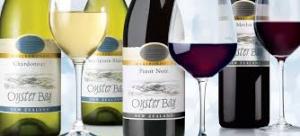
Southern Glazer’s Wine & Spirits (“Southern Glazer’s”) — the largest North American wine and spirits distribution company — today announced that it is expanding its existing distribution agreements with Delegat, a leading global super premium wine company. With the new agreements, Southern Glazer’s will be distributing Delegat brands in 15 additional markets. As a result, Southern Glazer’s will be Delegat’s exclusive distributor partner in a total of 32 U.S. market.
In addition to the 17 markets that were already represented by Southern Glazer’s, Delegat is adding Arizona, Colorado, Indiana, Kentucky, Louisiana, Maryland, South Carolina, Mississippi, Nebraska, North Dakota, South Dakota, Oklahoma, Texas, Utah, and Washington D.C.
“We are excited to extend our business relationship and represent Delegat’s world-class super premium wines across our unmatched national network,” said Mel Dick, Senior Vice President of Southern Glazer’s Wine & Spirits and President of the Company’s Wine Division. “This significantly expanded relationship further enhances our world-class wine business and enables us to introduce these great wine brands to a broader base of Southern Glazer’s customers.”
“Delegat’s Oyster Bay and Barossa Valley Estate wines are poised for growth in light of strong consumer demand for super premium brands,” added Steve Slater Executive Vice President and General Manager of the Company’s Corporate Wine Division. “Leveraging this trend, and with our new national alignment, we are confident that we can accelerate Delegat’s presence within Southern Glazer’s key national account customer base.”
“Delegat USA has worked very successfully with Southern Glazer’s over the past decade to achieve strong growth with our category leading brands Oyster Bay and Barossa Valley Estate,” said Graeme Lord, Managing Director of Delegat Group Limited. “Extending our relationship with Southern Glazer’s will provide a powerful distribution platform across 32 markets in the United States. We are looking forward to working with Southern Glazer’s to serve our customers, grow distribution and realize the significant growth potential of Oyster Bay and Barossa Valley Estate.”
| Delegats release || May 25, 2017 |||
There’s something about the crisp smoky air in Hanmer.
There’s no other place like it. In winter, it is heaven...strolling to the thermal pools in the still cold atmosphere and, after an hour of blissful soaking, ambling back up the hill, taking in the dizzy aroma of the smoke from many of the burning house fires. Our ‘home’ on St James Ave is toasty when we talk inside. We rack open a bottle of Veuve Clicquot and put our feet up by the fire. We feel so relaxed and make plans for things to do tomorrow.
During a yummy Powerhouse Café cooked breakfast we considered going mountain-biking, jetboating, horse trekking, quad biking through forests, rafting, golfing or fishing but instead choose the easy way out with a simple round of mini golf.
Skipping too much junk food recreation, we decide to walk to the summit of Conical Hill. It starts off steep but it is a breeze and so peaceful, taking 20 minutes or so through the giant conifer trees, Oregon and pine, listening to the constant whistle of bellbirds till we get to the lookout at the top. It’s a stunning view.
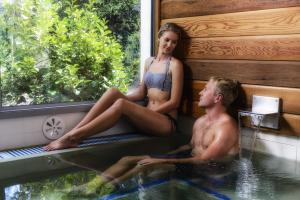
With the air cooling down fast on our return, we headed back to the pools and slipped into our private thermal pool looking out to the native ferns. The water temperature was 40°C...divine.
Shut your eyes. Imagine lazing in the giant hot tub with your partner. The sun is setting over picture postcard snow-capped mountains. Not a sound can to be heard but the occasional native bird chirp. Mmmmm.
We found out the iconic award-winning attraction sees more than half a million visitors annually. It has an array of thermal pools to suite all desires; aqua therapy, atmosphere, heat or adventure and boasts a luxurious spa with 12 treatment rooms, including a couples’ rooms.
In a bizarre dichotomy of experiences we’re shifted from moments of blissful relaxation to pure intense adrenaline as we head to the hydro slides. Hanmer has the South Island’s only SuperBowl ride which offers a cool two-person tube experience for those keen to share the rush.
It’s thirsty work relaxing so we quaffed down a pint of lager at Monteith’s Brewery Bar and munched on a tray of chips, sweet bay scallops and tiger prawns.
On our final night we enjoyed the best restaurant in town – Malabar. They say it’s a restaurant that’s broken rules because it embraces Asian and Indian cooking. They say people first eat with their eyes and then their mouth – this is what Malabar is trying to achieve.
The quality of the food and service at Malabar was first rate and we had the most pleasurable and most authentic Murgh Makhani (butter chicken) we’ve ever tasted in New Zealand. Front-of-staff Gurjeet as extremely polite, helpful, passionate and both a credit and asset to the restaurant. We will return.
Hanmer, this tiny slice of NZ paradise is a popular tourist area or get-away resort because it’s largely a place to blob out and wash away any of life’s pressures. Leafy Hanmer – hot in summer and sometimes snowy in winter – is a place for lovers, for romantic weekends and a place to unwind.
| A makeLemonade release || May 28, 2017 |||
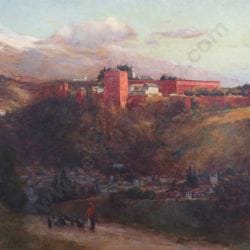
Palace of the Alhambra, Spain
By: Charles Nathaniel Worsley (1862-1923)
From the collection of Sir Heaton Rhodes
Oil on canvas - 118cm x 162cm
Valued $12,000 - $18,000
Offers invited over $9,000
Contact: Henry Newrick – (+64 ) 27 471 2242
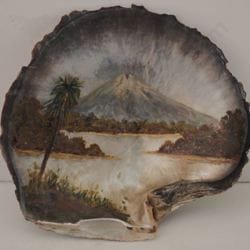
Mount Egmont with Lake
By: John Philemon Backhouse (1845-1908)
Oil on Sea Shell - 13cm x 14cm
Valued $2,000-$3,000
Offers invited over $1,500
Contact: Henry Newrick – (+64 ) 27 471 2242

|
|