
Founded by Max Farndale 1947 - 2018
| Auckland - May 2017 | Local engineering company reaps the benefit from investing in extended software training with CADPRO Systems following their purchase of new CNC machinery.
Training keeps staff fit for purpose
At Howick, whenever we sell a customer a new framing machine, we strongly recommend that they undertake specialist software training to get the most out of their investment. Even if the buyer is familiar with current machine use, there are always things that you can learn to be more productive. While some customers might baulk at ongoing training costs, we believe that investing in your operators and providing refresher courses, can only lead to improved productivity and output.
We practise what we preach
We decided to put our money where our mouth is when we recently purchased two new CNC machines. Although our operators had previously taken part in CNC training and our design team had been using SOLIDWORKS since 1998, we signed up with the supplier for training.
Even before the equipment arrived, we arranged for the team to do some initial training for HSM Works - the CAM package that integrates our designs to the machining centres. What we soon realised is that there was a lot of tooling and work holding to understand, as well as how our design effects the machining process.
Training and support
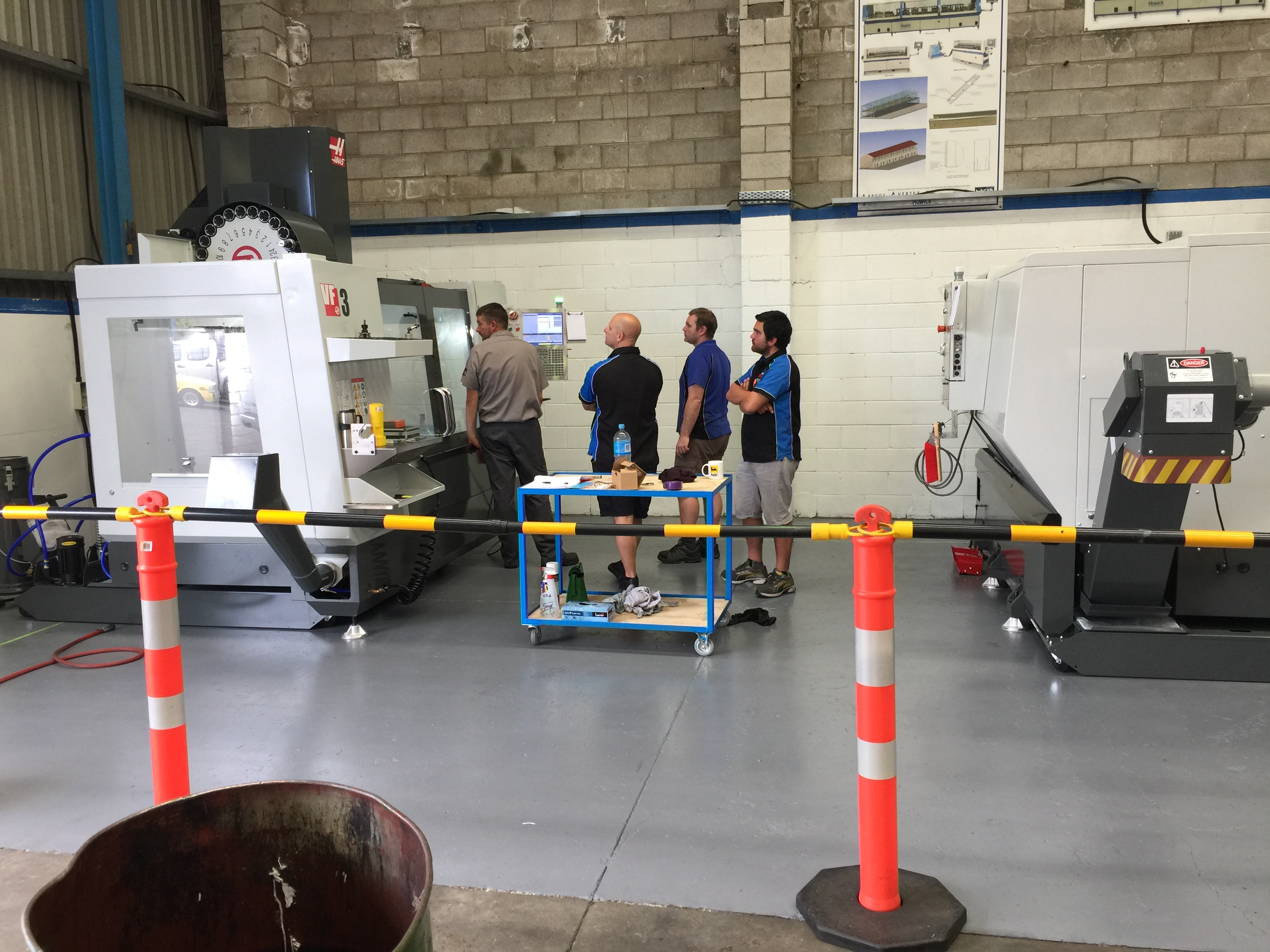
When the machines arrived, our two main operators received the standard training which, as anticipated with any new technology, was something of a steep learning curve. Once we had been running for a few weeks, we realised that there was still a knowledge gap which would only be closed through further training.
While we were having regular contact and great support from the team at HAAS Factory Outlet NZ, CADpro (HSM Works) and Sandvik Tooling, we wanted to accelerate our learning curve even faster. Understanding that we had already invested a significant amount in tooling, software, PCs and the machines themselves, we decided it was time to look at investing in our people more.
This involved getting a member of the team from CADpro in 1 day a week for 6 weeks to help us with on-the-job training. Although a significant cost, the value of the exercise can be easily seen through the accelerated learning and production it provided.
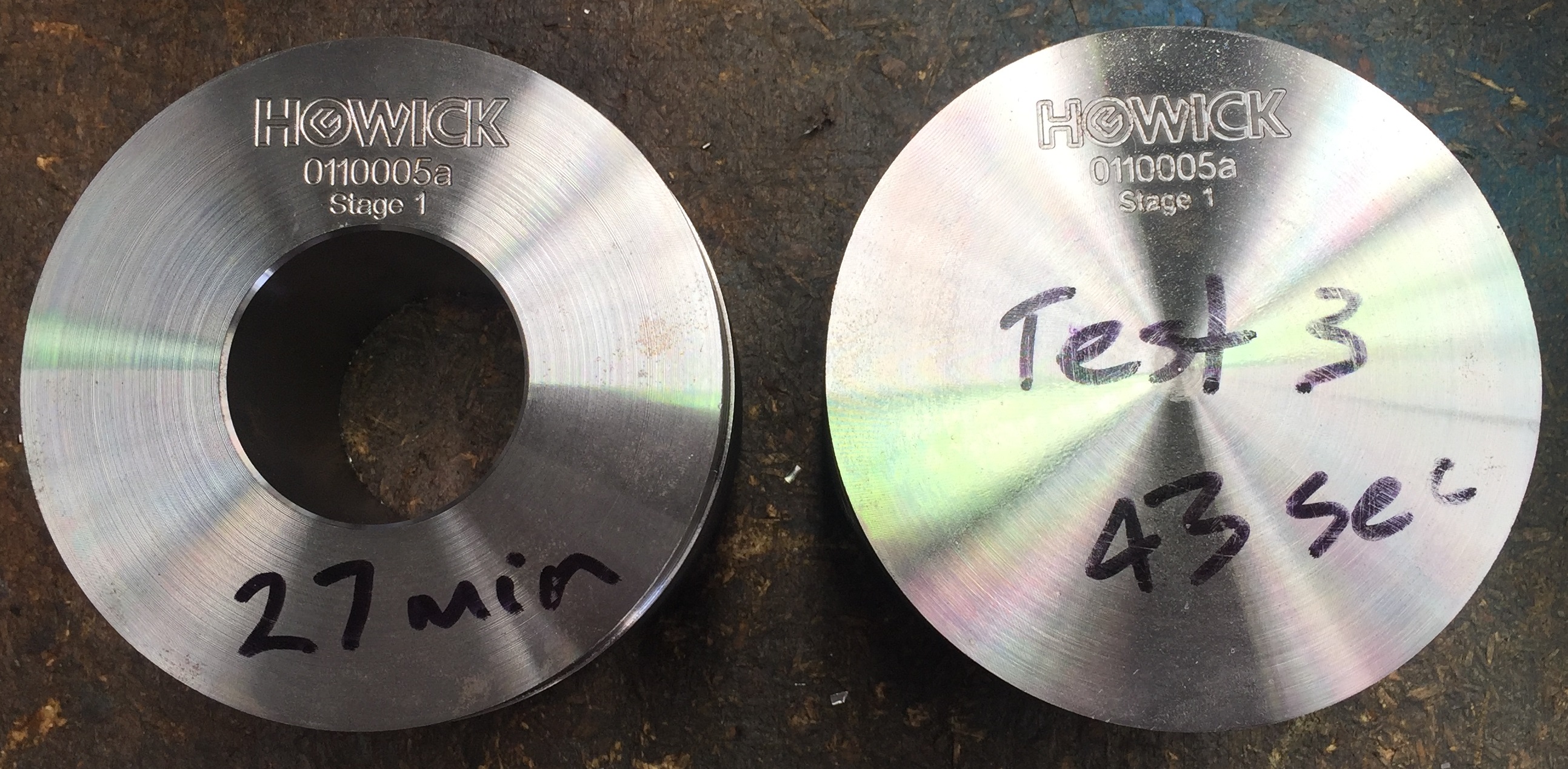
Our team got a massive boost from learning on live jobs with the trainer and were able to continue production during the week, noting down queries for the trainer to help resolve at the next session. This meant the team could keep moving forward with confidence. A great example of this is that through training, we have improved the engraving time from 27 minutes to 47 seconds on our Haas ST35 machine.
Keep up the good work
As a business, one thing we have always done since we started using Solidworks is take the yearly 1 day update course to look at new features. We find that the most valuable part of the day is when we roll out our list of things that are challenging or annoying us and receiving immediate resolutions.
The cost of sending our design team offsite for a day is quickly recouped in efficiency gains.
For us, investing in additional training was quickly recouped when you consider we achieved full production in 3 months, vs the anticipated 18 months.
Howick - here to help
For those looking at investing in a Howick FRAMA Roll Forming machine, or existing customers looking to get more out of their machine, I would suggest you talk to your chosen software partner about what they can offer training-wise to get the most out of your investment.
We have recently employed Davy Binois (a former employee at Vertex in the UK) who has trained many of our European customers. He is now New Zealand based so that we can upskill our local customers through tailored training and process development specifically related to our products.
The speed at which technology is moving is unprecedented and the adage ‘You don’t know what you don’t know,’ is more relevant now than ever. At Howick, we know our proprietary machines inside out and what capabilities they can offer. If you want to ensure your machines and staff are operating at full capacity, get in touch, and we’ll recommend a course of action – 0064 9 534 5569. www.howickltd.com
For our Customers elsewhere in the world our software partners Tekla, Strucsoft and Vertex can offer local training or remote training.
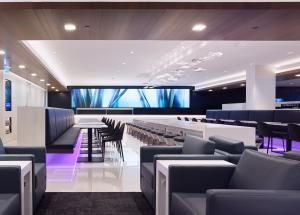
Air New Zealand will welcome customers into its significantly larger new-look lounge at Melbourne International Airport from tomorrow.
Located on the ground floor of the airport terminal, the lounge carries an ultra-modern design created in conjunction with award-winning global architectural firm Gensler and Australian based design firm Marsden Collective. The modern design follows what was first seen in the Air New Zealand Sydney International lounge.
The lounge offers five different spaces for close to 250 guests, allowing customers to relax and refresh or get some work done. A self-service food buffet, two self-service drink stations and a barista station are also available.
Air New Zealand General Manager Customer Experience Anita Hawthorne says the airline is committed to improving the customer experience and is proud to be able to offer customers flying out of Melbourne a new lounge space with 50 percent more seating than the previous lounge.
“The airline has been investing heavily in the Australian market and promoting its services through its ‘Better Way to Fly’ campaign starring Dave the goose which encourages Australians to travel Air New Zealand to North and South America.
“It’s also clear Australians love the Air New Zealand products and services after recently taking out the number one spot in AMR’s 2017 Australia Corporate Reputation Index so we look forward to welcoming customers to our new lounge.”
The Air New Zealand Melbourne International Lounge forms part of the airline’s four year $100 million programme to develop its network of lounges and follows the opening of new lounges in Sydney and Brisbane as well as in Auckland, Nadi, Wellington, Queenstown, Hamilton and Invercargill.
| An Air New Zealand release | May 08, 2017 |||
Trade Minister Todd McClay travels to Vietnam today to hold talks with Prime Minister Nguyen Xuan Phuc and Trade Minister Tran Tuan Anh to discuss developments for the Trans-Pacific Partnership (TPP) and the Regional Comprehensive Economic Partnership (RCEP) Agreements.
“New Zealand and Vietnam are both parties to the TPP Agreement and the RCEP negotiation and we have a mutual commitment to high-quality trade deals that create opportunity for our citizens,” Mr McClay says.
“The Asia-Pacific is the fastest growing region in the world and this presents a huge number of opportunities for our farmers, growers, exporters and our wider economy.”
Vietnam is due to host the APEC trade Minister meeting beginning on the 21st of May, where meetings on both the TPP and RCEP will also take place.
“We appreciate Vietnam’s hosting of APEC and its commitment to trade liberalisation. It has also rapidly grown into an important market for New Zealand exporters,” Mr McClay says.
“Since the ASEAN Australia New Zealand Free Trade Agreement (AANZFTA) came into force in 2009 our two-way trade with Vietnam has more than tripled from $430 Million in 2009 to $1.3 billion last year.
“This visit will be an important opportunity to take stock of what has been achieved and discuss how we can continue to deepen this hugely beneficial relationship for our economies.”
| A Beehive release || May 7, 2017 |||
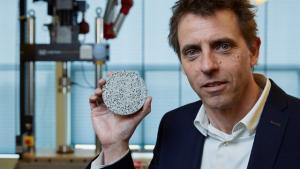
Dutch inventor of self-healing concrete named finalist for European Inventor Award
Munich/Delft, 21 April 2015 - Buildings and structures made of concrete that can "magically" seal and fully repair cracks caused by tension? What may have seemed a utopian scenario just a few years ago will soon become reality, thanks to the invention of microbiologist Hendrik "Henk" Marius Jonkers (50). His vision: to develop a bionic approach that improves the tensile strength and eco-friendly properties of concrete. The Dutch researcher set out to develop the bio-concrete of the future - with limestone-producing bacteria that can survive in a concrete structure for up to 200 years, and which "awaken" when damage occurs, enabling them to heal the cracks. In Europe, where concrete makes up 70 per cent of infrastructure, Jonkers' ground-breaking innovation promises to reduce the costs of concrete production and maintenance, as well as curb resultant carbon dioxide emissions. For his outstanding invention, Jonkers has been named a finalist for the renowned European Inventor Award of 2015 in the Research category. The 10th edition of the annual award will be presented by the European Patent Office (EPO) at a ceremony on 11 June in Paris.
"Hendrik Jonkers' bacterial concrete extends the life of bridges, streets and tunnels and opens up completely new perspectives for concrete production," said EPO President Benoît Battistelli, announcing the European Inventor Award finalists. "This forward-looking innovation is a successful combination of microbiology and civil engineering - two sciences that are unlikely collaborators at first glance."Jonkers exploits regenerative properties of nature
Henk Jonkers' passion for diving and camping was the spark that ignited his career: it began with studies in marine biology at the University of Groningen in the Netherlands. After completing his PhD in September 1999, he began to focus his developmental work on the observation of bacterial behaviour. He first experimented with limestone-producing bacteria as a research assistant at the Max Planck Institute for Marine Microbiology in Bremen. Self-healing octopus tentacles or plants that create new organisms with offshoots served as inspiration for Jonkers' invention. An expert in bacterial behaviour, he continued his career in 2006 at the Faculty of Civil Engineering and Geosciences at Delft University of Technology. Jonkers' research agenda in Delft focused on finding a solution to transfer the self-healing properties of natural organisms to a man-made building material, concrete.Self-healing agents encapsulated for over 200 years
To heal cracks in the concrete, Jonkers chose bacteria (Bacillus pseudofirmus and B. cohnii), that are able to produce limestone on a biological basis. The positive side-effect of this property: the bacteria consume oxygen, which in turn prevents the internal corrosion of reinforced concrete. However, the bacteria do not pose a risk to human health, since they can only survive under the alkaline conditions inside the concrete. Based on these findings, Jonkers and his team of researchers developed three different bacterial concrete mixtures: self-healing concrete, repair mortar, and a liquid repair system. In self-healing concrete, bacterial content is integrated during construction, while the repair mortar and liquid system only come into play when acute damage has occurred on concrete elements. Self-healing concrete is the most complex of the three variants. Bacterial spores are encapsulated within two-to four-millimetre wide clay pellets and added to the cement mix with separate nitrogen, phosphorous and a nutrient agent. This innovative approach ensures that bacteria can remain dormant in the concrete for up to 200 years. Contact with nutrients occurs only if water penetrates into a crack - and not while mixing cement. This variant is well-suited for structures that are exposed to weathering, as well as points that are difficult to access for repair workers. Thus, the need for expensive and complex manual repairs is eliminated.Sustainable prevention method could revolutionise concrete production
In recent years, bacterial concrete was subject to endurance tests under various external conditions on a dedicated testing building in Breda, the Netherlands. Plans are in place to launch the self-healing material on the market this year. Jonkers' invention has the potential to significantly reduce maintenance expenses for bridges, tunnels and retaining walls, which currently cost EUR 4 to 6 billion each year in the EU alone. Jonkers is now working on an alternative bacterial encapsulation technique. Compared to the present particle coating methodology, this technique would make it possible to cut production costs of bacterial concrete by an additional 50 per cent. Whereas production costs for conventional concrete amount to EUR 80 per cubic metre, a cubic metre of self-healing concrete would cost between EUR 85 and EUR 100 with the new encapsulated healing agent. With significantly lower repair and replacement costs over the lifetime of a building, this minimally higher investment would quickly pay itself off for all concrete structures.Additional resources
Read more about the inventorView the patent: EP2247551
Future bio-concrete as a sustainable construction technology
Super-bacteria are the answer: Jonkers' ground-breaking solution is one of many green innovations in the building sector currently under development. Bio-concrete of the future has the potential to lower carbon dioxide emissions released in Europe during construction and modernisation projects, both affordably and sustainably.
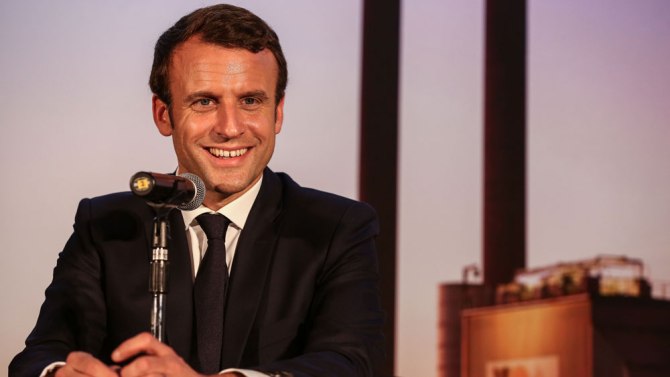
Ξ Macron win seen as market-friendly
Ξ Videos aim to promote trade to ordinary people
Ξ Wellington buildings need to be better than bare minimum, engineer says
Ξ Ruapehu Alpine Lifts launches $100m reinvestment programme
Ξ Trade group uses videos to gain public backing for new TPP
Ξ Ecostore's non-toxic products a success in Asia
Ξ McClay to hold talks with Vietnamese PM on Trade

Indicates need to distinguish between what is known and what is hoped for
The two newspaper companies always gave the appearance of being confident that they could win over to their way of thinking the Commerce Commission?They made the mistake, so evident now, of believing in their own assumption to the effect that the Commerce Commission would see the merger positively.
What were the contrary signals from the Commission that they missed?The Commerce Commission’s point of view in its rejection of the first draft of the merger proposal turned on several doctrinal, ideological, words that indicated that it was not for turning.
What were these words?Democracy, plurality and above all, diversity.
Why diversity?The loaded word runs through the Commission’s deliberations in a now clearly visible thread. It means that people considerations carry clear priority over any competing considerations in this case those of efficiency, economy of scale and so on.......
Why did the two companies go to the Commerce Commission in the first place? Would it not have been more effective to have simply concocted a new structure with a holding company?The Wellington and Auckland based companies had their hearts set on a single merged New Zealand company with a consolidated balance sheet and all that goes with it such as just one management structure.
Until quite recently the two companies worked closely together with a cooperative news pool and joint advertising sales promotion – why didn’t they just carry on as a de facto cooperative?This cooperative structure began to dissolve when the two newspaper groups came into play during the stock market bubble. The old proprietorial families moved away and were replaced by professional managers.
Where and when did they lose the plot?In their search of their competitive edge they opted for going it alone and thus they acted independently now in terms of their own evolving individual web sites and also in acquisitions. They dissolved their news gathering and dissemination cooperative, the New Zealand Press Association. Also abandoned now were certain geographic areas in which they had long agreed not to compete with one another.
Did they underestimate what the internet was going to do to them?At first the internet looked even promising. There were new personalities, celebrities that people wanted to read about. Covering the internet brought in the coveted younger demographic. Let’s look back. When television arrived in New Zealand the newspapers actually benefitted, and the Sunday papers were now launched to satisfy the interest in the new world of television
What happened with the internet?The internet instead now ushered in the era of disintermediation which is still accelerating all around us. People want to deal direct, sweep away the middle operator, the mainstream media, which had hitherto controlled the gateway to news coverage. You want an event covered?You go to Facebook. You want something known – there’s Twitter. You have an opinion? Then you start a blog. You have a range of points you want to air? Start your own website.
There are also any amount, at least 50, broadcasting channels available now. Plenty of competition you would think?The Commerce Commission took a narrower view of this scene than the newspaper managements jointly appeared to appreciate. The Commerce Commision’s verdict centred on most of the nation’s daily newspapers being held in a single set of corporate hands, and the perception thereof.
The daily newspapers published by the two groups are often considered to say the same thing about the same things anyway?The Commission concerned itself with the perception. In this case the perception of most of the dailies being controlled by just the one proprietor. It was now at the first decision that there was introduced the notion that New Zealand if the merger went through would convey a similar perception as that of China in that the press in China is controlled by just the one entity, the Communist Party. The signal was clear. It was not picked up.
The Commission’s second and seemingly last veto was delivered at the very start of International Free Press Day. Was this symbolic?Perhaps – and just because in this attenuated affair so much can be viewed as turning on symbols and perceptions.
What happens now?The two newspaper groups, the ones based in Auckland and Wellington must wash their minds of further approaches, appeals, to constituted authority including now the judiciary, and they must do so primarily on the grounds of sidestepping any further distractions. The danger of a strategic assumption, in this case that the Commerce Commission would approve the merger, is just that it is so enticing just because it makes the transition from supposition to reality. The wish becomes the fact.
In practical terms, this means....?The two groups will have to rearrange themselves around a new corporate structure and one that stops just short of a unified balance sheet. The daily newspaper business, an extremely marginal one, is riddled with intensive and in-built administration procedures especially on the subscriber and circulation side where there are stop-starts that can only be automated up to a certain point. They must now merge these departments. They must merge too their printeries.
They will have to be more radical than that, given their falling circulations?They will have to adopt a new business model and my feeling is that they will develop a franchise model which has already been experimented with by at least one rural newspaper management buyout. Print is relatively strong in the provinces. A franchise move will allow the two groups to develop their centralised services and will dilute the liability also of their substantial staff contingencies.
What about the hedge funds and such like said to be lurking in the middle distance?The two newspaper groups began to go heavily into play in the 80s bubble and will have been stripped by now of hard asset value i.e. real estate. So they are unlikely to be a target for speculators.
We keep hearing about the Auckland and Wellington-based groups. But what about the third proprietor, the one in Dunedin?The Smith family who control the Otago Daily Times group kept it within the family. They are a force to be reckoned with and in the affair under discussion remain the dog that did not bark. Or, if it did, was not heard by anyone. They remain in an envious competitive situation notably now dominating the high value tourist region centred on Queenstown.
What would you recommend that the two beleaguered would-be North Island-based suitors NOT do?Cut the frequency of any of their dailies to let us say three issues a week. The disruptive force of the internet and everything that came with it was to break the newspaper-reading habit. This custom so dominant until just so recently can only be further disrupted by meddling with the frequency of established daily titles.
One has this impression, somehow, of unfinished business. Was anything held back by any one of the parties involved?The episode was characterised by candour. It was just that the two parties looked at the same thing, the merger scheme, and each saw something that was quite different.
Your full hindsight?The two groups should have pulled back after the first round when the Commission’s viewpoint was made clear. They should have done so issuing high-minded yet truthful communiques about the severity of their position, and their continuing determination to better the lot of the public at large. In the event they appeared resentful and so their task in formulating a virtual amalgamation will be harder than before.
| From the This email address is being protected from spambots. You need JavaScript enabled to view it. || Sunday 7 May 2017 |||
Trade Minister Todd McClay will chair the first meeting of the Trade Ministerial Advisory Group today (MAG) and says it builds on a strong campaign of new engagement opportunities in the trade portfolio.
“Trade contributed $70 billion to the New Zealand economy last year alone and hundreds of thousands of jobs depend on it. We all have a stake in the continued success of our export sector,” Mr McClay says.
“The MAG has been set up with this in mind and will provide better engagement on all trade issues. It will also serve as a more direct avenue for a wider range of interested parties to engage with the Government.”
The MAG includes representation from iwi, unions and NGOs, as well as industry bodies for primary industry, wood, seafood, tourism, education, horticulture, aviation and technology.
This first meeting of the MAG will focus on the detail of Trade Agenda 2030 and the first stages in the Government’s plans for implementing the new strategy.
“Trade Agenda 2030 sets a target of 90 percent of our goods exports being covered by FTAs by 2030. We are also looking to tackle non-tariff barriers more effectively and focusing more on new growth opportunities in trade in services, investment and the digital economy,” Mr McClay says
“We are charting an ambitious course ahead for trade deals and market access. It must be underpinned by a comprehensive programme of engagement that also aims to make more information available to the wider public.”
More information about the MAG can be found at: https://www.mfat.govt.nz/en/trade/nz-trade-policy/ministerial-advisory-group-on-trade/
| A Beehive release || May 05,2017 |||

Racketeers apply two-prong scare threat pincer
Overseas scammers have stepped up their assault on domestic New Zealand internet users in a two-fold pincer movement. The first pincer is a series of telephone calls that seek to alert the user of the perils that they face from the existence on their computers of unwanted bugs of various descriptions.
This is run in harness now with the placement on the computer of an actual bug that talks back to the user and alerts them to the existence on their computer of viruses in the spyware category that have turned up on the target’s computer the existence of pornography of the most diabolical description.
The threat amounts to--- “you’ll be in trouble if you are caught with this.”
This is then bracketed by more telephone calls that are always from an international 0909 prefix number or 0988. The 0909 prefix is that of Ireland while the 0988 number is a “spoofed” prefix used by telemarketeers to avoid detection.
Computer service houses say that this new concerted campaign has caused immense distress among their more elderly users who are unaware of the measures that such scammers will go to in order to be paid to “fix” the “problem.”
The racket last reached a crescendo two years ago and in recent weeks has again been in ramp up mode in New Zealand.
The objective of the racket is to get the user to open up access to their machine via a series of set-piece instructions which allows the racketeer to secure access as and when required over the longer term to the domestic computer.
The landline-driven racket operates on the assumption that any household that still operates a landline will also be the home of an internet-linked computer and which will therefore run Microsoft applications.
The phone callers stick to their routine even if the recipient explains that they do not have a computer in the first place.
The racket operators are human and are trained to deal with objections including those of the most hostile nature.
Their task is to keep the householder talking with a view to eliciting information that may be useful later on, and which will ideally convince the target to follow their instructions.
The post-prefix numbers are scramble encrypted which means that householders who ring back are greeted by an invalid beep-beep-beep signal.
The cold callers always claim to represent Microsoft or be Microsoft “certified” technicians.
The racket is itself two-fold with the target being persuaded to transfer money to the imposters in order to have the viral infection eliminated and/or to get the access to the user’s bank pass codes.
The racketeers will seek to have “fee” money remitted them via an independent wire transfer service which from their point of view makes the transaction harder to trace, and from the target’s point of view means it can never be recovered.
The addition of the sequestration of the talking spyware into household computers with its vocalised threats introduces a new and heightened level of intensity in the racket.
Netsafe should be a first port of call from those under harassment from the racketeers -0508 NETSAFE (0508 638 723)
Meanwhile scareware, , as the malware implants are known, and quite recently upgraded to the talk-back delivery, has become increasingly applied by the international criminal gangs behind these rackets.
The scam follows a common pattern. A pop-up shows what appears to be a security scan that falsely detects dangerous or illegal files or programs. In some cases, the bogus warnings say there is porn on your computer. The malicious software may even display pornographic images on the screen. And those pop-up warnings won’t stop until your click the button that says “register now” or “remove all threats.”
Those who do that wind up on a site run by the cyberthieves. It says you need to buy their antivirus program — which is fake — to fix the security problems.
| From the This email address is being protected from spambots. You need JavaScript enabled to view it. || Friday 5 May 2017 |||
Ξ Holden: Decision to stop building cars yields 'strong profitability'
Ξ Porirua company claims meth-proof wallpaper could save home owners thousands
Ξ Tegel chairman James Ogden unexpectedly quits after less than a year in the job
Ξ Mondelez extracted $130 mln in dividends before quitting Dunedin
Ξ First MAG meeting to increase trade engagement
The ability for regions to declare themselves GE-Free in crops, forestry, and grasses won with the support of the Maori Party is a marketing advantage.
New Zealand’s free trade deal with China, our biggest market, has seen investment in New Zealand because of the assurance of quality and GE-Free status.
A Nielsen survey showed that 70% of Chinese consumers were avoiding GMOs in foods and actively seeking to buy GE-free produce.[1]
Responding to USA consumer demand, Fonterra has also launched products specifying their GE-free status.[2]
These real-world market trends signal the significance of the third reading of the Resource Legislation Amendment (RLA) Bill which was passed after the Maori Party was able to preserve the right for councils to regulate, in their plans, genetically modified (GMO) crops, including grass and forestry crops.
Originally, the Minister for the Environment had wanted to prohibit all land use regulations on GMOs in council plans, but then compromised and exempted GM crops in general.[3]
Through rigorous negotiations, the Maori Party was able to remove 43A and 43B and amend 360D, inserting a new clause that included all GE plants, including forestry and grasses, but not GE animals.
It is GE animals that represent a risk to New Zealand's reputation. Any commercialisation for GE animals is a concern to many, as field trials have shown that the transgenic manipulations are costly and cause intense suffering to the animals. [4]
Any large-scale release of GE animals would breach ethical and moral standards of humane husbandry New Zealand has spent years upholding, and would undermine New Zealand's brand image among consumers overseas.
“It is in the interest of the whole country that total GE-free production is preserved and regions can proceed to protect their businesses from any GE contamination,” said Jon Carapiet national spokesperson for GE-Free NZ.
“The removal of the GE clauses from the RMA amendments was a great outcome for democracy, upheld by the Maori Party and everyone who has fought for the regions being able to declare themselves GE-free. But the prospect of GE animals remains a significant threat.”
References:[1] http://uk.reuters.com/article/us-china-soybean-oil-demand-idUKKBN17U0SB
[2] http://www.dairyreporter.com/Ingredients/Fonterra-s-NZMP-non-GMO-ingredients-launch?utm_source=newsletter_daily&utm_medium=email&utm_campaign=18-Apr-2017&c=HwF7FPiM4jr82Hmba%2BQsQm4L0s3IosFU&p2=
[3] Resource legislation amendment Bill -Third reading
.be[4] GE Animals in New Zealand: the first 15 years http://www.gefree.org.nz/assets/pdf/GE-Animals-in-New-Zealand.pdf
| A GEFree New Zealand release || May04, 2017 |||
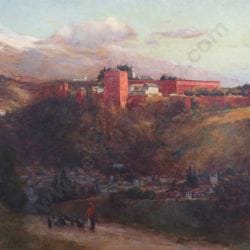
Palace of the Alhambra, Spain
By: Charles Nathaniel Worsley (1862-1923)
From the collection of Sir Heaton Rhodes
Oil on canvas - 118cm x 162cm
Valued $12,000 - $18,000
Offers invited over $9,000
Contact: Henry Newrick – (+64 ) 27 471 2242
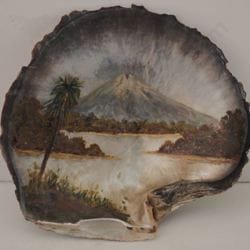
Mount Egmont with Lake
By: John Philemon Backhouse (1845-1908)
Oil on Sea Shell - 13cm x 14cm
Valued $2,000-$3,000
Offers invited over $1,500
Contact: Henry Newrick – (+64 ) 27 471 2242

|
|