Founded by Max Farndale 1947 - 2018
Air New Zealand has taken out the number one spot in AMR’s 2017 Corporate Reputation Index in both Australia and New Zealand. This is the first time in the airline’s history the airline has been named as the most reputable company in Australia and the second year in a row the company has taken out the top position in New Zealand.
In Australia, Air New Zealand has moved from sixth place in 2016 to take the number one spot ahead of Australia’s own national carriers Qantas and Virgin Australia which indexed in fifth and 16th place respectively and other big corporates such as Toyota, Apple Australia, Myer and Woolworths. In New Zealand, Air New Zealand topped companies such as Toyota, ASB and The Warehouse.
Air New Zealand Chief Executive Officer Christopher Luxon says it’s fantastic Air New Zealand not only has the number one reputation in New Zealand but has taken out the top spot in Australia for the first time.
“The results are testament to all the hard work of Air New Zealand staff who over the past decade have helped build an enviable reputation for the airline globally by delivering our uniquely Kiwi award-winning experience.
“Despite being a relatively small airline in global terms, Air New Zealand continues to punch above its weight by taking great ideas and turning these into world leading product and service offerings that enhance the customer experience.
“In Australia this includes the likes of our ‘Better Way to Fly’ campaign featuring well known Australian actor Bryan Brown as the voice of Dave the Goose encouraging Australians to choose Air New Zealand for travel to North and South America and our 2015 safety video ‘Surfing Safari’ which starred the Australian surfing legend Mick Fanning.
“It’s clear Australians love the Air New Zealand products and services and we’re thrilled to be held in such high regard on both sides of the Tasman.”
| An Air New Zealand release \\ April 26, 2017 |||
Deputy Governor Geoff Bascand has been appointed Head of Financial Stability and Deputy Chief Executive of the Reserve Bank, Governor Graeme Wheeler and Acting Governor-designate Grant Spencer announced today.
Mr Bascand will take up the role on 27 September, replacing Mr Spencer, who will be Acting Governor for six months from that date, after Mr Wheeler’s term as Governor ends.
Mr Bascand is currently a Deputy Governor and the Bank’s Head of Operations. Prior to joining the Bank in 2013, he was Government Statistician and Chief Executive, Statistics New Zealand. He previously worked in senior management roles in the Department of Labour and the New Zealand Treasury, and was a staff economist at the International Monetary Fund.
"Geoff brings considerable leadership experience, economics and public policy background to the role. Through his participation in the Bank’s Governing Committee, financial policy committees, and chairing of the Bank’s Assets and Liabilities Committee, Geoff is very familiar with the Bank’s work programmes and policy issues in the area of Financial Stability,” Mr Wheeler said.
A search firm has been appointed to undertake a search for the Head of Operations position, which will be at Assistant Governor level, and the role will be advertised in May. The Reserve Bank Board of Directors’ recruitment process to identify a successor to Mr Wheeler is to commence later in the year.
| A RBNZ release || April 26, 2017 |||
Experts from New Zealand and around the world will attend the New Zealand Society for Earthquake Engineering’s annual technical conference in Wellington this week.
Conference convenor Dr David Whittaker says about 500 earthquake engineers and scientists will meet to exchange knowledge on a range of topics, including the impacts of the Kaikoura Earthquake and how to make building structures more resilient to large earthquakes.
Dr Whittaker says around 100 international delegates will present papers and updates from the United States, Japan, China, Taiwan and Turkey.
NZSEE President Peter Smith says the conference is a chance to share the latest thinking about seismic isolation and other technologies to protect buildings from earthquakes.
“Following the Kaikoura Earthquake, the community is asking important questions of earthquake engineers about seismic risk, adequacy of codes and seismic resilience.
“At the conference, engineers will be sharing what we have learned and listening to what overseas experience can teach us, as we work towards better seismic resilience in our buildings and infrastructure.
This conference is being held jointly with the Anti-Seismic Systems International Society’s (ASSISi) 15th World Conference on Seismic Isolation.
The conference runs from Thursday 27 April to Saturday 29 April.
| An IPENZ release || April 26, 2017 |||
New Zealand is funding a five-year $5.4 million project to help Vietnam reduce dam-related flooding on the Ca River.
New Zealand is funding a five-year project to reduce dam-related flooding in Vietnam.
The two countries have launched a $5.4 million initiative focusing on the 1000km Ca River.
The aim is to halve the death toll from flooding on the river and reduce associated economic losses by 30 per cent by 2021.
Foreign Minister Murray McCully says New Zealand will be sharing its expertise in water engineering and natural hazard management.
Issues include effective assessment of dams most in need of repair, coordination between dam owners and communities, and upgrading the training for future water managers.
Vietnam has more than 7000 dams and over the past 10 years there have been 43 unplanned water releases or dam failures.
| A Beehive release || April 26, 2017 |||
If the UK adopts a 'New Zealand trade model' to source more affordable deals for its consumers, it could have a profound effect on olive oil exporters that have faced hurdles when exporting to EU countries.
At the end of March, UK Minister Theresa May officially triggered Article 50 of the Treaty of Lisbon, setting in motion the two-year negotiation process of Britain leaving the European Union – or as it’s more commonly referred to, Brexit.
The move signals a fundamental change in the way the EU and Britain will conduct trade now and in the future. Not only will this affect trade agreements between the UK and the EU (allowing the UK to freely sell goods to EU countries without incurring additional import taxes), but it’s also set to have a massive impact on food imports which could create new trade opportunities for olive oil producers and exporters located outside of the EU.
The UK currently has a strong reliance on food imports, with an estimated 27 percent of all food eaten in the UK (by value) and 40 percent of all fresh produce coming from the EU. In total, 2016 saw £47.5 billion ($60.8 billion) in food and agricultural products being imported into the UK, of which over 70 percent came from the EU. It’s a need that the UK itself cannot support, with just 164,000 of crop-growing land.
Thanks to Brexit, it is estimated that the prices for imported goods will rise by at least eight percent, with prices for items like olive oil expected to rise by up to 20 percent due to the fact that producers in countries like Italy and Greece have been experiencing poor harvests over the past few months. This price increase is unlikely to change despite any new trade deals brokered between the EU and the UK, thanks to the costly, increased border and customs controls that Brexit will require.
Dutch multinational food and agriculture finance banking company Rabobank has suggested that a solution might be found in the UK adopting a “New Zealand-style trade model,” which would see the elimination of food import tariffs altogether, opening the market to exporters outside of Europe who can offer UK customers similar products at a more favorable price.
One of the import areas where this could occur is olive oil, with UK MP and Prime Minister’s trade envoy to Morocco and Tunisia Andrew Murrison even suggesting that smaller countries with an export capacity (such as Tunisia) could be the key to a more readily available, competitively priced source of olive oil for UK consumers.
In recent years, Tunisia has outstripped several European countries in olive oil production and while the EU currently has waived taxes on up to 35,000 tons of olive oil imports until the end of the year, it is a move that that has not been well received by European farmers, many of whom fear that introducing a cheaper olive oil source into the EU market will undercut local producers.
If the UK does decide to open adopt a more free market approach, it could pose bad news to EU olive oil exporters, who will lose their preferential access to UK buyers via a single market.
Other olive oil producing countries such as Australia might also be able to benefit from Brexit, where farmers have previously complained that the stringent labeling and marketing requirements for exporting olive oil (as well as the subsidization and tariff protection of European goods) make selling to EU markets a significant challenge.
| An Olive Times release || April 25, 2017 |||
Immigration Minister Michael Woodhouse is taking steps to improve Immigration New Zealand’s decision making authority for cases involving residence class visa holders convicted of a criminal offence.
“Currently, Immigration NZ has the ability to make decisions on behalf of the Minister on deportation cases for some residence class visa holders convicted of a criminal offence,” Mr Woodhouse says.
“I have made my expectations very clear when it comes to deportation decisions involving offending of this nature and those expectations are not being met. So I am temporarily suspending Immigration NZ’s decision making authority until I have confidence that the decisions being made are consistent with my expectations.
“This course of action follows today’s New Zealand Herald article regarding an individual whose liability for deportation was suspended, despite the severity of the offending.
“It’s important we take the time to review the decision making process to ensure the right decisions are being made.
“I expect to be able to return the decision making authority to Immigration NZ within a fortnight, provided I can be assured the decision making process aligns with my expectations.”
| A beehive release || April 24, 2017 |||
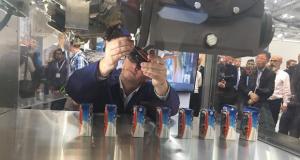
Tetra Pak has teamed up with Microsoft to introduce management and diagnosis systems and tools to reduce machine downtime and boost productivity.TetraPak_Microsoft2
The carton packaging giant has started rolling out Microsoft HoloLens mixed reality headsets to Tetra Pak on-site service engineers – who are now able to work with the company’s global experts who specialise in production line problems.
A service engineer can show live video to the correct Tetra Pak expert, who guides the on-site work through Skype.
To help prevent or predict disruptions Tetra Pak is also employing Microsoft Azure Cloud technology that enable its cloud-connected machines to predict when equipment needs maintenance.
By connecting packaging lines to the cloud, Tetra Pak can collect operational data to help predict informed maintenance timing.
Johan Nilsson, Vice President Tetra Pak Services, said: “So if you’re a service engineer and you arrive at the customer, you can use a simple app to pull up the significant performance information from that customer.
“You are much more educated when you walk into the customer, and it becomes a much more informed and fact-based discussion between the service engineer and the customer.”
Nilsson added that the Microsoft HoloLens transforms the delivery of support and enables quick resolution of quality issues.
Caglayan Arkan, general manager of worldwide manufacturing at Microsoft, said: “We are excited to bring the transformative power of mixed reality and HoloLens to Tetra Pak customers to help them transform their business and enhance their service engineers’ capabilities.”
Nilsson told Packaging News both the Microsoft HoloLens and Azure Cloud technology is designed to help make packs look exactly the same.
“The better we can ensure packaging integrity, the better we can ensure food safety. This results in a more perfectly shaped pack.”
He said when creating 190bn packs consistently, these systems will help the quality and look and fit of the pack.
“For example, if you have vibration in the machines this may result in the pack being 1% out or 3% out. The better you keep that in shape and in the right condition, the better the packs are going to look and perform.”
He explained that initially the packs will look perfect, but all production lines require maintenance over time. With this Microsoft system, Tetra Pak can take action earlier so that it does not deteriorate as much and not reach a level that the pack is unacceptable to the consumer.
“So the consistency in packaging performance in terms of shape appearance and integrity will be better secured using this system.”
Tetra Pak is piloting the service in 2017 with 50 HoloLens devices, in the Greater Middle East, Europe, and the Americas, and plans to roll-out to more markets next year.Recommended Articles
| A Packaging News release || April 25,2017 |||
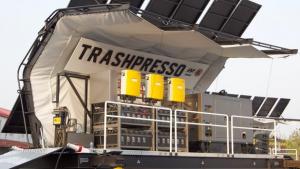
In developed countries, it's easy for most people to not give garbage disposal much thought: it's hauled to the curb, and a truck carries it away out of sight and out of mind. But isolated communities often lack that infrastructure, meaning it's harder to either truck out the trash or process it on-site. The Trashpresso is designed to lighten the load a little, as a semi-portable, solar-powered plant that turns trash into tiles.
The system was created by Miniwiz, the design company behind other creative recycling initiatives like Polli-Bricks, made from discarded plastic, and Nike's concept store in Shanghai, China, which is built entirely out of materials derived from bottles, cans and DVDs.
This latest venture is what Miniwiz calls a "mobile up-cycling plant." The Trashpresso fits inside a 40-ft (12-m) container that can be trucked around to remote locations that need some cleaning up. Once unpacked on-site, the system can wash, shred, melt and mold plastic and fabric waste into tiles, which Miniwiz says are suitable for indoor and outdoor flooring, or further refinement. The equivalent of five plastic bottles goes into each tile, and the Trashpresso can produce about 108 sq ft (10 m2) of them every 40 minutes.
To be deployed far from the grid, the Trashpresso needs to be self-sufficient, and to that end the system runs entirely on solar power. Even the water that it uses to wash the garbage is recycled back through the system, in an effort to reduce its footprint.
"Until now, industrial grade recycling was limited to plants," says Arthur Huang, co-founder and CEO of Miniwiz. "The Trashpresso overcomes the distance and energy barriers by showing that recycling is possible everywhere. Not only does it serve to transform trash on-site, it also serves as an educational tool in isolated communities."
The Trashpresso's first gig will be to clean up the glacier region of NianBao Yuze, which sits on the Tibetan Plateau and feeds into the Yellow, Yangtze and Mekong rivers. Miniwiz says that the area is seeing increased tourism and, as a result, increased litter. The company will deploy the system in July to show off its capabilities.
| A Miniwiz release || April 24, 2017 |||
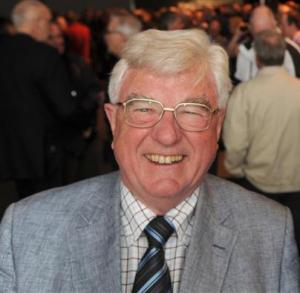
As its future hangs in the balance a veteran EU trouble shooter weighs up the Union, past and present. Five questions now for Michael Lake.........
This email address is being protected from spambots. You need JavaScript enabled to view it.Few officials have been involved in the EU at such a high level for so long and in so many sensitive postings as New Zealand-born Michael Lake, former EU ambassador to Turkey and to Hungary. Along the way he served also in New York, Brussels, and Tokyo. He was witness to the EU and participant in its operations from the outset of Britain’s membership when he was literally drafted in to assist the UK blend itself into European institutions.
Looking back between the 1975 referendum, the one which saw the UK joining the EU, and now Brexit, what went right? What went wrong?
What went right? Where do I start? Seventy years of peace, democracy and stability in western Europe after France and Germany had been at war with each other three times during the previous 70 years, usually dragging others into their fighting, notably Britain twice. Also the achievement of common policies which run more or less successfully today on international trade and remember that the EU is the world’s biggest trading bloc by far. It has acted in agriculture (sometimes too protectionist), and over the years in several other areas where it is more effective to act together than alone such as in climate change and the environment generally, energy policy, consumer rights, social policy especially in workers’ rights, and in the 35 chapters of the body of EU law.
There is the single market of 500 million consumers, which Mrs Theresa May seems to want Britain to leave. There is expansion of the EU to 28 members (soon to be 27) by including those countries recently released from 40-50 years of Soviet rule. Then there is the EU’s status as a community of law.
What went wrong? Time and forgetfulness, and younger generations decade by decade who have taken it for granted and are unaware of its benefits. Too much regulation, certainly. Although what happened was that the EU regulations replaced national regulations in order to make a level playing field for trade. So the aggregate of regulations in this area has not changed much. A newish one is that such regulations forbid state aid for industries. State aid is a subsidy and thus unfair. It’s like doping. It is allowed in special circumstances such as in restructuring major basic industries like steel and coal which are now almost irrelevant anyway, but which require concomitant efficiencies, such as down-sizing and major investment.
Generally speaking, the EU has always had trouble communicating with the public, largely because it can be highly technical and very diverse, and because national media tend to concentrate on national stories, thus undermining the more general overview of Europe working on a daily basis. Britain is particularly bad at this and over 40 years the coverage has been on a win/lose basis. In fact Britain has won most of its disputes by far, whether they actually got to the European Court of Justice or not.
The European Parliament which has a far closer hands-on role in governance on EU matters than ordinary British MPs have on British affairs is nevertheless remote from ordinary people partly because constituencies are too big and the media coverage has always been scant. But the European Parliament has the power of co-decision on most things with the Council of (national) Ministers. It can vote against and thus wreck a Brexit deal with the UK.
You became the European Union’s ambassador to Turkey and as such point man for a policy to integrate Turkey into the EU. In the light of developments over the past year, how do you view this policy now?
I was EU ambassador in Turkey and then, as you know, in Hungary. Here I was locally in charge of monitoring Hungary’s “accession” or membership process covering the 35 chapters I referred to in your previous question.
I was also closely involved earlier with Turkey joining the EU customs union, the only country to be in the customs union without full membership. This had a huge effect in Turkey such as when. the first department stores opened, and the expansion of trade offered consumers better quality at more competitive prices. Turkey relies on the EU market for more than 50% of its exports. Turkey no longer qualifies for membership and would be blocked because of its moving away from the pillars of democracy such as freedom of expression, a free media, and an independent judiciary.
It still does meet the requirement for pluralistic elections. Erdogan is now in charge of a bitterly divided country which is not what he intended. He expected to win by 60 per cent. Turkey’s candidacy for membership has not yet been revoked. But if Erdogan goes ahead and reintroduces the death penalty it would be revoked by the EU. This would be highly unpopular amid large swathes of the Turkish population who are pro-EU and highly sophisticated.
The recent referendum was so close as to create a new situation - Erdogan not only lost in his home city, Istanbul, but in his own constituency, Fatih, which is very conservative and rife with burkhas. Watch this space...Meanwhile it’s a tragedy, but in spite of Erdogan’s dictatorial rule the country remains a very important member of Nato and largely western values on the edge of a region in turmoil. There is no appetite to cut Turkey off.
Many believe that the United States was behind the expansion of the EU. To what extent was/is this true?The United States has always, and now, even under a revised Trump II, been strongly in favour of the EU for the democratic and economic values it represents. The EU and the US are each other’s biggest trading partner. I have never heard of the US specifically interfering in EU policies except once which happened to be in my own case. This was when the US ambassador in Turkey came to me and said that the White House wanted to know how they could help get the fractious European Parliament to endorse Turkey’s membership of the customs union?
I told him how this could in fact be done. He followed my advice. Tony Blair and ( Spain’s premier) Felipe Gonzales personally gave instructions to their delegations which comprised the biggest political group in the European Parliament and the deed was done.
There was, however, a case where the US may have taken a discreet lead and must indeed have agreed. At the G-7 summit in Paris in 1988, which I attended along with the seven other G7 summits in which I participated, the EU for the first time ever was given a role in eastern Europe and thus the Soviet bloc which hitherto had been the sole policy preserve of Nato
As Poland and Hungary, and indeed even East Germany, were showing signs of relaxing under the Soviet governance of Gorbachev there was a role for the EU in economic and social development (including more openness) of the bloc. The US strongly supported the enlargement of the EU from 15 to 27 in 2005 for strategic reasons. We have to remember too that the US has many, many citizens whose families hail from central and eastern Europe.
How do you gauge the success or otherwise of the Euro currency?The adoption of the Euro has been a boon to ease transactions without exchange rate costs across most of Europe. Anyone travelling on the Continent or involved in cross-border trading, whether in goods or finance, realises this immediately. But the system lacks a unifying authority, such as a Federal Reserve Bank, able to take decisions and able to issue eurobonds. The issue of a federal Europe is still controversial, but there is still widespread reluctance to go further towards further union that the EU has done with the Treaty of Lisbon. So when the banking crisis hit the world in 2008 the euro system was unable to cope properly because it was still subject to a national decisions. The European Central Bank has coped by effectively printing money but this is ultimately not sustainable. This instability in the euro zone remains. And it has exacerbated a prosperity gap between the richer northern Europe and the poorer southern, Mediterranean countries
If you were asked for advice on the EU by anyone in the New Zealand diplomatic-trade sphere, what counsel would you proffer?Quite simply I would say this. Take any opportunity at all seriously and go for it. The EU should be seen as the land of opportunity from a national point of view and on an individual level, a career-enhancing prospect.
| From the MSCNewsWire reporters' desk || Tuesday 25 April 2017 |||
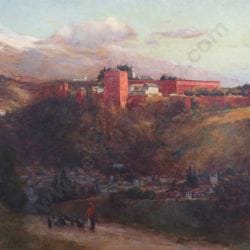
Palace of the Alhambra, Spain
By: Charles Nathaniel Worsley (1862-1923)
From the collection of Sir Heaton Rhodes
Oil on canvas - 118cm x 162cm
Valued $12,000 - $18,000
Offers invited over $9,000
Contact: Henry Newrick – (+64 ) 27 471 2242
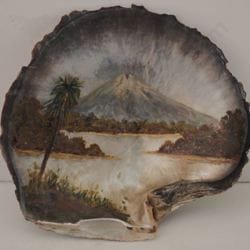
Mount Egmont with Lake
By: John Philemon Backhouse (1845-1908)
Oil on Sea Shell - 13cm x 14cm
Valued $2,000-$3,000
Offers invited over $1,500
Contact: Henry Newrick – (+64 ) 27 471 2242

|
|