
Founded by Max Farndale 1947 - 2018

UK soft drinks firm Britvic has said it has reached a major milestone in efforts to develop a wood fibre bottle.
The firm revealed the advance in its 2016 sustainability report and said it could revolutionise packaging across multiple sectors.
Britvic has been working on the packaging over the last three years in partnership with Innovate UK and UK-based SME Natural Resources (2000).
It said that this year it had managed to produce bottles on a prototype manufacturing line using the technology and had also begun to develop a bottle closure system using similar wood fibre-based material.
“This new technology has the potential to significantly reduce the environmental impact of packaging as the materials are sustainably sourced, renewable and fully recyclable,” said Britvic.
It added that the new process requires less energy to produce a bottle than its contemporary equivalents.
In the report CEO Simon Litherland said the company had made significant investment in manufacturing sites to improve productivity and resource efficiency.
Investments made in the firm’s Leeds plant last year have led to water and energy consumption falling by 22% and 45% respectively, relative to production.
“These upgrades have also allowed us to access the latest in packaging technology, resulting in lighter bottles and less packaging materials being used,” he added.
The company reported 84% of its manufacturing waste was recycled in 2016.
Some 90% of direct suppliers are linked on the company’s responsible sourcing platform, Sedex.
And while the company’s road mileage has increased this year, resulting in a 5% increase in emissions to 25,177 tonnes of CO2, part of the reason for this increase was temporary changes to production locations.
The company said it had optimised pallet movements to maximise efficiency, which had helped to save the equivalent of 265 tonnes of CO2.
And during 2016 the company identified which of its sourcing regions are at risk from water scarcity and discussed with suppliers how they were managing these threats.
“Next year will see us continue our engagement activity, aiming to educate our suppliers on responsible water practices,” said Britvic.
| A SupplyManagement release | March 30, 2017 |||
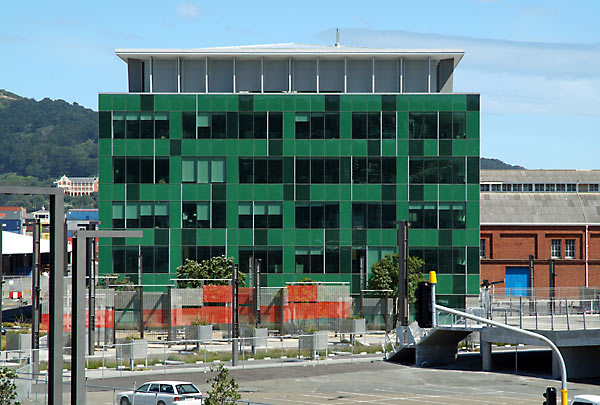
Design standards and building laws will be reviewed in response to an investigation into structural damage to Wellington’s Statistics House in the Kaikōura earthquake, Building and Construction Minister Dr Nick Smith says.
Dr Smith today released an independent panel’s findings into the performance of the building during the 14 November 2016 quake, focussing on its design and construction, and the land influences on it.
“The performance of Statistics House in the Kaikōura earthquake was unacceptable and could have caused fatalities. This quake was large and unusually long but a modern building like Statistics House should not have had life-threatening structural damage. The building was designed to the industry practice of the time but this did not fully account for the effects of beam elongation during an earthquake, an issue that was deficient in the Concrete Structures Standard at the time of the design.
“The design flaw is quite specific to highly ductile framed concrete buildings with pre-cast floor slabs and particularly those with multi bay frames. We need to follow up on similarly designed buildings through councils and engineering companies so that where it is a problem, it can be rectified. This has already been done in respect of Wellington as a consequence of the preliminary findings in Statistics House but now needs to be followed up elsewhere. We also need to amend the Concrete Structures Standard to ensure newly designed buildings are adequately designed to cope with beam elongation during long duration earthquakes. This will be done this year.
“A compounding factor was geological basin effects that are not well understood but which have also been observed in other earthquakes internationally. This is not to do with reclaimed land but the amplification of ground shaking in a basin. This phenomena is similar to the way sea waves respond to a wall in an enclosed bay. This is an area of seismic science that needs further research, particularly in respect of Wellington, and to be considered as part of a review of the Earthquake Actions Standard.
“There is a building law issue that arises from this report on which I have asked officials to report. The Ministry of Business, Innovation and Employment (MBIE) has limited powers to follow up on design deficiencies like those identified in this report beyond those specifically provided for following civil emergencies. This means MBIE cannot require building owners to follow up on these sorts of potentially serious technical problems. I have asked MBIE to report on whether additional powers are needed in the Building Act.
“New Zealand is at the cutting edge of international seismic design standards but we have not yet solved all of the potential ways a building can fail. Most buildings in Wellington performed well despite the ferocity of the Kaikōura earthquake. We need to take the opportunity following such earthquakes to learn as much as we can and to further strengthen our standards and systems to improve building safety for the future.
“These detailed issues over the performance of modern buildings are important for improving design standards but they should not divert attention away from the far more significant risk to life of older buildings. The Kaikōura earthquake was sufficiently distant from Wellington that the city did not get the dangerous high-frequency shaking that poses the greatest risk to life.
“The largest safety gains for Wellington are to be made in the initiatives requiring unreinforced masonry facades and parapets to be tied back over the next year and all earthquake-prone buildings under 34 per cent of Building Code to be upgraded under the new law coming into effect on 1 July.”
The Statistics House investigation report is available at http://www.mbie.govt.nz/info-services/building-construction/safety-quality/statistics-house-investigation
| A Beehive release | March 31, 2017 |||
Engineers say results from the Statistics House investigation will help build more resilient buildings.
New Zealand Society for Earthquake Engineering (NZSEE) President Peter Smith says every earthquake provides new information on how to improve building design.
“Investigations like this are crucial to making our buildings safer. We need to gain access to detailed information on how other buildings performed, to help widen understanding of whole-of-building performance.
“Statistics House illustrated how different factors can combine in unexpected and unprecedented ways.
“In Wellington, this earthquake most severely affected mid-height buildings. Because the earthquake was so far away, only low-frequency waves made it to the Capital. These waves resonated with mid-height buildings, which combined with the earthquake’s long duration meant mid-height buildings experienced severe shaking.
“Basically these flexible, modern buildings experienced a design-level earthquake – an earthquake that met or exceeded what they were designed to withstand.
“At the same time, shorter and stiffer buildings experienced an earthquake that wasn’t even one-third of Code. But these earthquake-prone buildings still pose a significant risk to public safety, especially in an earthquake centred closer to Wellington. It’s really important that vulnerable features on these buildings, such as parapets and facades, are secured during this time of heightened seismic risk.”
Structural Engineering Society (SESOC) spokesperson Paul Campbell says the Statistics House investigation has revealed that buildings with key characteristics may be vulnerable in an earthquake that’s both large and long.
“In a large and long-duration earthquake, these key characteristics are flexible frames in combination with precast floors.
“Flexible frames are designed to bend so that the ends of the beams experience controlled damage.
“But the Kaikoura earthquake has confirmed that if an earthquake is strong enough and long enough, the damage can make the beams grow in length. This means the supports for the pre-cast floor system can move too far apart, potentially causing parts of the floor to lose their support and collapse.
“When Statistics House was built, the Building Code did not allow for this combination of factors – but it does now.
“The Canterbury earthquakes led to Building Code changes – and now more changes are likely given what we have learned from the Kaikoura earthquake.
“Engineers will be working with MBIE to further develop detailed guidance on assessing and retrofitting buildings with these characteristics.”
| An IPENZ release | March 31, 2017 |||
SESOC and NZSEE are IPENZ technical groups.
Rising property values helped lift New Zealand’s net worth to just over $1.39 trillion at 31 March 2015, up 9 percent on 2014, Stats NZ said today.
“Net worth reflects the balance of what New Zealanders own and what they owe – that is, assets minus debts held by households and government,” national accounts senior manager Gary Dunnet said.
Except for a 3 percent decline in 2009, net worth has grown steadily since 2007 – from just over $1 trillion in 2007 to $1.39 trillion in 2015.
Graph, New Zealand's net worth,at 31 March, 2007–15
From 2007 to 2015, household net worth increased $319 billion (35 percent), to about $1,236 billion. Investment in land and buildings (non-financial assets) was a significant contributor to this increase, although this was partly offset by increased mortgage debt (loans liabilities).
Over the eight years, households also built up wealth through increased bank deposits (up 58 percent), investment in business shares (up 28 percent), and insurance and superannuation funds (up 90 percent).
The value of all assets owned by New Zealanders was nearly $4.0 trillion ($3,953 billion) in 2015. This figure consisted of financial assets (cash and deposits, loans, and investments) and non-financial assets (land and buildings; plant, machinery and equipment; and business inventories) valued at $2,404 billion and $1,549 billion, respectively.
All financial liabilities totalled $2,557 billion in 2015, with the largest contributions coming from equity (37 percent), and loans (30 percent).
Over the 2007–15 period, the net amount New Zealanders owed to the rest of the world rose from $130 billion to $153 billion.
“This first release of balance sheet statistics marks a significant milestone in our ongoing work to achieve a full set of national accounts,” Mr Dunnet said.
“Balance sheets help to relate economic growth to the accumulation of wealth, and to understand how financial shocks affect the productive economy. By filling these gaps, government, businesses, and households will have more economic information to make better decisions.”
Balance sheets are used to provide estimates of assets, liabilities, and net worth held by New Zealand businesses, households, and government.
Annual balance sheets are now part of Stats NZ’s suite of annual macroeconomic statistics. In coming years, we’ll add related financial information, including quarterly balance sheets and flow-of-funds estimates.Information in this release is based on data from a range of sources, some of which is only available up to 2015.

French Polynesia begins in New Zealand
He looks like the star of a television series set in the 1950s about British country doctors or family solicitors of those solid and dependable times. But former French premier Francois Fillon considered by the English-speaking world to be a shoo-in for his country’s presidency is now looking anything but a winner.
In recent weeks the Mr Clean of europolitics has found himself be-spattered in every variety of calumny and remarkable even for a country renowned for its political spoils system.
The hapless Mr Fillon is looking less and less like the fulcrum around which will rally the centrist forces in the event of a first round win by the National Front’s Marine Le Pen.
At the cusp of the 1960s/1970s France was the focus of New Zealand’s global trade interest for the way in which it was perceived to be throwing a spanner into the primary produce works as Britain made its transition into the Common Market, as the EU was then described.
Yet in a bizarre about turn France has now become as important to New Zealand industrially as Britain was in those days.
This is artfully concealed from public view though by a politico-media determination to keep the trade spotlight on Asia and the Middle East
Here though are just some of the French companies that dominate their sectors in New Zealand:- ‘
* Veolia Water and commuter transport in Wellington and Auckland. Controls Transdev * Axa Finance – (controls AMP) * Pernod Ricard Owns Montana * Lafarge Holcim Cement * Schneider Electrical manufacturer, formerly PDL * Accor Hotelier * Air Liquide Industrial n gases * Allflex Livestock management applications * Danone Dairy * Parmalat Dairy * Synlait Dairy * Alcatel Information technology * Thomson Air traffic control * Alstom Transport * Rexel Office supplies
This unacknowledged state of affairs took on a humorous form when one of the New Zealand government start-up technology incentive funds invested in what appeared to be a local computer games producer only to find out that it was in fact controlled by Vincent Bollore.
He is known as the Breton Raider, and who from his gigantic holdings in transport and commodities in Africa has devolved into the leisure-entertainment sector.
The officially encouraged focus on the East contains a romantic Prester John–like flavour in refusing to acknowledge how hard it is for anyone but the very biggest traders to actually get paid from anyone in these regions.
It also shrouds the mercantile dependence on a country such as France. This is demonstrated by a French trade deficit of $845 million in 2014. In France’s favour.
Back now to Mr Fillon who until a few weeks ago was considered the favourite for the Elysees and thus the man to usher in New Zealand’s EU trade agreement.
His role even as the rallying point as the second round coalition leader in the French presidential double is now being questioned.
The favourites now are the National Front’s Marine Le Pen head-to-head with the former Socialist Party economics minister Emmanuel Macron and his own personal party France on the Move.
For Mr Fillon trouble does not travel alone. Not only is he being charged with putting his family on his parliamentary payroll, and for influence peddling, which is all pretty much part of French political life anyway.
In the unkindest cut of all he is also being accused of receiving his fine-cut English style suits as gifts from wealthy benefactors.
| From The This email address is being protected from spambots. You need JavaScript enabled to view it. \ Friday 31 March 2017 \\\
Energy and Resources Minister Judith Collins is leading a petroleum sector trade delegation to Texas and an electricity sector trade delegation to Silicon Valley next week.
Ms Collins will be accompanied by a petroleum sector delegation, which includes representatives from New Zealand Oil and Gas, Todd Energy and the Petroleum Exploration & Production Association of New Zealand, to Texas.
In Texas, Ms Collins will be attending the American Association of Petroleum Geologists’ Annual Convention & Exhibition in Houston, as well as meeting with exploration and service companies to discuss investment opportunities in New Zealand.
Ms Collins will then lead an electricity sector delegation, which includes representatives from Mercury, Contact Energy, Vector, Power Systems Consultants and Genesis Energy, to California’s Silicon Valley.
“The electricity sector is going through a lot of change internationally and the trade mission to Silicon Valley will help New Zealand companies learn about the opportunities with emerging technologies, support New Zealand businesses looking to partner with US firms, and encourage electric vehicle manufacturers to enter the New Zealand market.”
The delegation to Silicon Valley is due to make calls on Tesla’s electric vehicle plant, Siemens, Volkswagen, energy technology company Enphase, Plugshare, SolarCity, Pacific Gas & Electric, Wrightspeed and Californian State energy regulators.
Ms Collins will be in the United States from 1 to 7 April.
| A Beehive release | March 31, 2017 |||
Twelve of the 15 regional economies in New Zealand recorded nominal GDP increases in the year ended March 2016, Stats NZ said today.
Provisional estimates show the largest percentage increases were in the Bay of Plenty (7.7 percent), Auckland (6.0 percent), and Otago (4.8 percent). The national increase was 4.1 percent.
“The Bay of Plenty’s increase was underpinned by strong performances across the professional and administrative services, and agriculture, primarily kiwifruit,” senior national accounts manager Gary Dunnet said.
“The increase in Auckland was driven by the professional services, finance, and transport industries.”
Decreases were recorded in Taranaki (8.5 percent), the West Coast (2.8 percent), and Southland (1.0 percent).
“These decreases reflected a fall in mining and agriculture activity, mainly from the impact of lower international prices for oil, coal, and dairy products,” Mr Dunnet said.
Despite a fall in the region’s GDP, Taranaki retained the highest GDP per capita ($71,297), followed by Wellington ($67,888) and Auckland ($58,717). The Northland region had the lowest GDP per capita ($36,531). The national average was $54,178.
New Zealand's regional economies 2016 visually presents the key measures of the 15 regional economies.
This year's regional GDP release includes an additional year of provisional data for 2015 about regional industry activity.
Regional Gross Domestic Product: Year ended March 2016 – for more data and analysis
| A STATSNZ release | March 30, 2017 |||
Ξ Statistics House investigation findings released
Ξ New Zealand's net wealth tops $1.3 trillion
Ξ Latest NZTE Export News
Ξ Regional Gross Domestic Product: Year ended March 2016
Ξ Windows 10's next major update arrives April 11

Ξ Malaysian civil defence force place order with Sealegs
Ξ Explanation of America’s Cup rules and process for rule changes
Ξ Windows 10's next major update arrives April 11Windows 10's next major update arrives April 11
Ξ Trans-Tasman telco cable completed
Ξ Russia willing to re-start NZ free-trade talks frozen over Crimea conflict
Ξ The Reserve Bank Bulletin article reviews business cycle
Ξ Last chance to register for - Export Documentation for Food and Beverage seminar

In a bid to get around terrestrial height restrictions, Clouds Architecture Office has proposed suspending the world's tallest skyscraper from an asteroid, leaving residents to parachute to earth.
New York-based Clouds Architecture Office drew up plans for Analemma Tower to "overturn the established skyscraper typology" by building not up from the ground but down from the sky by affixing the foundations to an orbiting asteroid.
"Harnessing the power of planetary design thinking, it taps into the desire for extreme height, seclusion and constant mobility," said the architects, who have previously drawn up proposals for space transportation and a 3D-printed ice house on Mars.
"If the recent boom in residential towers proves that sales price per square foot rises with floor elevation, then Analemma Tower will command record prices, justifying its high cost of construction."
Continue here on de zeen to read the full article with images | March 30, 2017 |||

Palace of the Alhambra, Spain
By: Charles Nathaniel Worsley (1862-1923)
From the collection of Sir Heaton Rhodes
Oil on canvas - 118cm x 162cm
Valued $12,000 - $18,000
Offers invited over $9,000
Contact: Henry Newrick – (+64 ) 27 471 2242

Mount Egmont with Lake
By: John Philemon Backhouse (1845-1908)
Oil on Sea Shell - 13cm x 14cm
Valued $2,000-$3,000
Offers invited over $1,500
Contact: Henry Newrick – (+64 ) 27 471 2242

|
|