Founded by Max Farndale 1947 - 2018
Other countries that are not even “clean-green” have dealt with the tyre problem
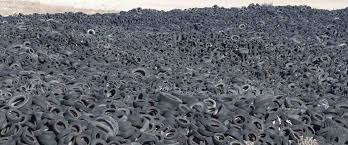
Governmental public hand-wringing over the rural mountains of old tyres must be tempered with the understanding that central and local government was quite literally upto its neck in creating the detritus, noted the nation’s foremost developer of tyre remediation machinery.
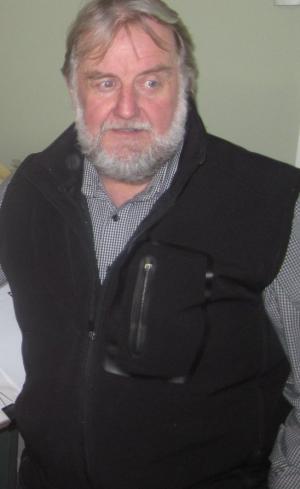
Ken Evans (pictured) of Tekam Closed Loop is responsible for the New Zealand’s first all-size tyre granulator which converts discarded tyres into a variety of paving products.
Neither central nor local government encouraged the use of these granulated paving products and in some cases even discriminated against their use.
Government in all its forms had long failed to understand that the allocation of national and district contracts also militated against the use of granulated composition in roading and also in amenities surfacing.
Tekam Closed Loop’s tyre granulator is dual function in that it granulates the tyres in toto complete with their radial steel bands, or extracts the bands prior to granulation.
One of the reasons that surplus New Zealand tyres were being shipped to China was that the Chinese routinely used granulated tyre paving as a standard roading application.
Rubber roads are now standard in China, Brazil, Spain and Germany. The technique has been found to cut traffic noise by about 25 per cent, he noted.
Other applications in these countries convert tyres into ground rubber or rubber shreds, used to create ground cover for playgrounds, backfill for civil engineering projects, garden mulch, erosion control barriers or drainage foundations around buildings.
Low shock industrial surfaces such as those required for stock handling was another such example.
In his experience, Mr Evans noted, district and regional councils simply talked about installing granulation systems.
Though stockpiling old tyres in land dumps was now banned in the EU simply because they are not bio degradable, the practice continued unabated in this country, and showed every signs of continuing to do so once the current round of crocodile tears had dried up.
The technology existed in converting old tyres into asphalt, yet it was ignored in favour of instead formulating directives and policies instead of dealing with a problem that countries which do not even market themselves as being clean-green had long eliminated.
Another problem in New Zealand he said was that district authorities tended to consult on the problem with their roading contractors who had a vested interest in ensuring the continuation of the status quo, and thus doing nothing about the tyre problem.
Tekam Closed Loop developed the granulation system in conjunction with Napier Engineering and Contracting.
| From the MSCNewsWire reporters' desk | Monday 6 March 2017 ||
Foreign Minister Murray McCully travels to the Gulf region this weekend for meetings in Qatar, United Arab Emirates, Kuwait and Bahrain.
“Our relationships with this important region are growing at a great pace and my visit will be an opportunity to continue discussions about priority areas, including the NZ-GCC FTA, regional security issues and cooperation in areas such as renewable energy,” Mr McCully says.
The Gulf Cooperation Council (GCC), comprising Bahrain, Kuwait, Oman, Qatar, Saudi Arabia and United Arab Emirates, is New Zealand’s eighth largest trading partner, with annual two-way trade exceeding $3.2 billion NZ dollars.
“The relationship with the GCC has grown remarkably in a very short space of time, underpinned by forty two air services per week between the Gulf and New Zealand, an increase of 50% since 2013,” Mr McCully says.
"Our economies are highly complementary, and there is huge potential for greater cooperation. The NZ-GCC FTA will help deliver on that potential and I look forward to discussing this opportunity on my visit.”
| A Beehive release | March 06, 2017 ||
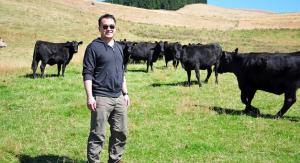
New Zealand’s sheep and beef farmers have a profound story to tell about where and how our meat is produced, says Mike Lee.
New Zealand’s sheep and beef farmers are sitting on a grass-fed gold mine.
This is according to Mike Lee, the CEO and founder of New York-based food design and innovation agency Studio Industries, who says this country’s farmers have a great story to tell consumers hungry to know where and how their meat is produced.
Visiting this country, Lee says it is about creating the profound out of the mundane – and for NZ sheep and beef farmers – their mundane is profound.
“New Zealand farmers are grass farmers and it’s about building that image of turning grass into the protein on your plate.
“To me, it’s a romantic image.”
Stories, he says, are what connects people and any story about food is actually a human story – the story about the growers and farmers and where and how they produce food.
“Your story connects the food system with the human experience.”
While historically, stories were exchanged around the campfire, today’s digital “campfire” allows global connections and as Lee says, there are now so many ways consumers can hear and learn about food and the people who produce it.
He urges this country’s red meat industry to identify people who can tell stories on its behalf.
“Empower people as ambassadors to tell your amazing story for you – it’s just a matter of finding the right people.”
Lee says food today is no longer just about sustenance, it is intrinsically linked with social bonds and values. The food consumers eat says something about how they want the world to be, so in essence people are eating their values – and these include the way animals are farmed – although food also needs to deliver on taste.
To consumers, the process is the product and in the case of meat, this is about how animals are grown.
The adage “you are what you eat” has been expanded to “you are what you eat eats”- and this is where NZ’s grass-fed story is so valuable.
In New York, grass-fed meat fetches a premium and is a selling point on restaurant menus and in bone-broth cafes.
Thanks in part to the vilification of sugar, meat is now trendy, and butchers the new rock stars. In the US, there has been a resurgence of craft butcheries such as the “The Meat Hook” in New York city, where customers can watch carcases being boned out and gather information about how to make use of every part of the animal - not just the primal cuts. Even the meat sections in supermarkets are being transformed into old-fashioned butcher shops, where the carcases are cut in full view of the public, rather than being hidden away.
Lee says the “eat local” movement is acknowledging that local is not always better and how a product is produced can offset disadvantages of distance – which again favours NZ red meat producers.
| An article published on Beef+Lamb | March 01, 2017 ||
Apr 03: Fonterra makes a splash at China’s largest food ingredients show
Mar 28: Infrastructure key as MoC signed
Mar 23: Horticultural stalwarts win Farm Environment Awards
Mar 21: Horticultural stalwarts win Farm Environment Awards
Mar 21: Beef prices boosted by US demand
Mar 17: New Zealand-Argentina agricultural agreement signed
Mar 17: NZ wool market improves at double auction
Mar 16: Ravensdown to make early rebate payment
Mar 14: Bottled water debate misses mark says Nick Smith
Mar 14: SFO probing free-range claims
Mar 13: NZ agri innovation helping meat exports to Asia's diverse markets
Mar 11: Award for 'can-do' essential oil ventureAward for 'can-do' essential oil venture
Mar 10: 'Sexy sector' seeking staff with tech skills'Sexy sector' seeking staff with tech skills
Mar 09: Price drop predicted for milk
Mar 08: Fruit sales boost wholesale trade stats
Mar 07: Farmers threaten to desert Westland Milk Products for Fonterra
Mar 07: Client-centred upgrade for GDT Events
Mar 06: Thirst for beer drives growth for hops
Mar 06: New venison plant ‘not able milestone’
Mar 06: Primary industry careers on show
The strategic view that Britain needs to be in the EU remains universal among New Zealand strategists. However the Leaves did not vote geopolitically but on domestic considerations including, apparently, resentment of immigration and of the unequal gains from trade. New Zealand has little alternative but to accept the direction the Brits are taking, albeit with regret.
Withdrawing from the EU is proving more difficult than anyone anticipated. Almost every week there is a revelation of an additional complication. Two years to negotiate the deal is just absurd, indicative of how little David Cameron, the previous British prime minister, had thought things through.
I do not think any informed person – anywhere in the world – takes seriously Theresa May’s view that Brexit represents no retreat, but rather that it will be the making of a ‘truly global Britain’ and that as a result the country will be ‘more outward-looking than ever before.’ The hard fact is that, as every New Zealander working in the international sector knows, being a small country isolated from the big trading blocs is a huge challenge. Sure, Britain is bigger than New Zealand but small compared to China, the EU and the US.
New Zealand’s interests will be challenged by Brexit. A couple of examples. We are currently in early negotiations with the EU over a free trade agreement. Almost certainly they will be delayed because the EU will be focusing on the Brexit negotiations; in any case they were going to be tortuous because they involve every member of the EU agreeing to the deal which, if it is of any significance to us, is going to affect their key farm interests.
Second, because of Brentry and subsequent multilateral negotiations, such as the Tokyo and Uruguay rounds, we already have various trade deals with the EU. However they are not with its individual members. What happens to them when one leaves?
For instance, there is a New Zealand sheep meats quota for the whole 28 countries; about two fifths of our lamb goes to Britain. That quota is ‘bound’, in effect it has a standing in international law and cannot be unilaterally abrogated. What happens to it if Britain leaves? We could insist that we will continue to have access for the whole quota to the remaining 27 countries and then negotiate a separate one with Britain outside the EU in exchange for trade concessions here. I imagine the EU will want us to agree that the quota be divided between the EU27 and Britain. The permutations are enormous; it will be a miracle if they are settled within two years, given there are many other examples like this involving other commodities and other countries.
So tiny New Zealand will be directly involved in some aspects of the Brexit negotiations even if we find it hard to get the EU 27 to focus on an FTA. Meanwhile, according to EU rules, Britain cannot begin negotiating trade agreements on its own behalf until after it leaves the EU.
During the Brentry negotiations, half a century ago, New Zealand’s negotiating strength included some ‘moral’ weight. At that time more people living in New Zealand said they were British-born than said they were Maori, underlining emotional attachments between the two countries. But those attachments have become attenuated with the external and internal diversification.
I won’t say we had a veto on Brentry in 1973, but undoubtedly the British government of the day wanted our support because it feared the anti-Brentry forces would use New Zealand to intensify their campaign.
That won’t happen this time. Instead of moral considerations we are going to have to depend upon the WTO rules. In principle that should mean that we will be no worse off – except where we have better deals than the legal bindings. And undoubtedly, we will suffer if the British economy suffers, as it is expected to. (However, except for some products, ties of sentiment mean New Zealanders tend to overestimate the importance of the British economy to us today.)
Moreover with a few exceptions, such as the RCEP (the Regional Comprehensive Economic Partnership of 14 Asian nations and Australia and New Zealand), other international trade deals are going to go be put on hold. That particularly affects our campaign to reduce world food protectionism in the interest of consumers and efficient farmers.
Of course, Brexit may not go ahead. A possible scenario is that when the deal is agreed, Britain will have a second referendum offering a real choice between the specific Brexit terms and Remain. May’s ‘hard-Brexit’ is designed to meet the demands of the extreme Brexiters, especially over migration, but it sacrifices a lot to do that. The softer Brexiters may reject the hard-Brexit terms. Already there is a growing group of doubters – Bregretters.
Although there are hard liners among the other 27 EU, who will not offer Britain an easy deal, one hopes commonsense will mean the 27 will leave open the option of Britain abandoning Brexit when the terms are settled and it becomes evident (to just about everyone) how painful the exit option is.
What may be crucial may be this year’s elections in France and the Netherlands, where immigration issues are expected to play an important role. Supposing that the electoral outcomes do not totally disrupt EU unity, it seems likely, nonetheless, that the EU will soften its commitment to free movement of labour. That would make it easier for Bregretters to change their minds.
Whatever, New Zealand’s global trading ambitions – especially over better access for its farmer products to protected markets – are going to have to be put on hold. But we will still pursue quality trade deals whenever the opportunities arise even if there are less of them.
| By Brian Easton published on pundit | March 6, 2017 ||
This is a follow up ‘Brentry: How New Zealand Coped’, setting out some of the challenges which face New Zealand today.
Ξ Big turnout for Women in Construction forum
No room for CEOs to be complacent about health and safety
Minister addresses Co-operative Business Leaders' Forum
Brexit: How New Zealand Might Cope
New Miller Digital Infinity Series helmets offering the best view around
Aluminium, beef lift commodity index
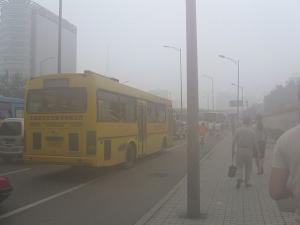
According to a report from China’s central government, production of steel and aluminium by producers in over two dozen cities will drop significantly over the winter months. The move is seen as another salvo in the ongoing battle against smog.
The document, which is a joint statement from the Ministry of Environmental Protection (MEP), Finance Ministry, National Development and Reform Commission (NDRC) and the National Energy Bureau, in conjunction with local governments, carries a date of February 17, also includes plans to limit coal use in Beijing as well as pulling back on coal transport to northern China.
According to the document, steel producers in the provinces of Hebei, Shanxi, Shandong, Henan, Tianjin, and within the city of Beijing will be called upon to cut production in half during the peak heating months between November and February, inclusive. The amount of steel capacity to be curtailed is dependent upon the emission cuts to be made in the region, per the report.
The document details cuts in aluminium capacity by over thirty percent and alumina by nearly the same amount in those cities as well. Cuts in Hebei, Henan, and Shandong are particularly significant, as seventy percent of China’s total aluminium production is located in those three provinces.
The cuts would see China’s yearly steel output fall by 8 percent per annum and aluminium output lowered by 17 percent per year, according to calculations performed by Reuters, the news service that originated the story.
In addition to capacity cuts, the transportation of coal will be limited to railroad in Hebei and Tianjin, eliminating trucks as a method for transport starting in September. As the lion’s share of aluminium production in China is powered by coal-fired power plants, the implication for aluminium production is obvious.
China has long been battling smog, and this winter’s air quality has proven to be the worst in decades. Heavy industry, coal burning for heat in private homes, and increased transportation has taken a toll on air quality in cities like Beijing, which finds itself engulfed in even worse levels of smog than normal.
| From Aluminium Insider | March 01, 2017 ||

Five Questions for Dr Don Brash..............................
Nobody today in so many different roles and for quite so long has stood at the centre of public life so enduringly as Don Brash. Economist, businessman, banker, politician, the former Governor of the Reserve Bank and leader of the National Party has defied typecasting. At one and the same time severe yet extravagant, austere yet colourful, scholarly yet populist, he has contrived always to reconfigure himself around the times. Now he has stridently intervened in institutionally-fuelled separatism. Shrouded in a protective veneer of high-minded fashionable purpose that makes ordinary people fearful to question it, Dr Brash vehemently, unequivocally declares the voguish syndrome as ultimately destined to tear the nation apart......
You are often considered to be at heart primarily concerned with matters economic and their corresponding data. Yet here you are now immersing yourself in what many might consider a socio-ethical issue?
Yes, most of my career has been about monetary policy, banking, and economic issues more generally. But my interest in economics has always been because of my interest in the well-being of society more generally. I have long felt, for example, that it will be difficult or impossible to maintain a broadly egalitarian society in New Zealand – the kind of society in which I was brought up – if average living standards fall too far below those in Australia because of the ease with which skilled New Zealanders can cross the Tasman for very much higher incomes in Sydney or Melbourne.
If we want the kind of healthcare which those in advanced developed countries take for granted, we have to have the living standards to support that healthcare. A few years ago, there was a big debate about whether Pharmac should subsidize the provision of Herceptin for the treatment of certain kinds of breast cancer, and it was noted that Australia did so. The fact of the matter was that at that time virtually all the countries which subsidized access to Herceptin had higher living standards than New Zealand did; those which did not provide a subsidy, had lower living standards – we were right on the cusp. For me, interest in economics has always been about the implications of economic policy for the well-being of society.
Hence, I was strongly opposed to inflation in part at least because of the totally capricious effects which inflation has on wealth distribution – those who save in fixed interest instruments being thoroughly gutted by inflation, while those who borrow heavily to invest in, say, property, make huge and totally untaxed gains with little or no effort. That has always seemed to me to be grossly unjust.
Will the Hobson’s Pledge Movement become a force in the pending general election?I certainly hope so. I find it very depressing that the National Party has moved such a long way from its roots in this policy area. In 2002, Bill English gave a lengthy and very thoughtful speech, demonstrating clearly that Maori chiefs had ceded sovereignty in signing the Treaty and arguing that the only way for a peaceful future for New Zealand was a “single standard of citizenship for all”.
In May 2003, he pledged that a future National Government would scrap separate Maori electorates, as the Royal Commission on the Electoral System had recommended in the late eighties if MMP were adopted. I made similar commitments when I was Leader of the National Party, as did John Key in the election campaign of 2008. And yet we’ve seen the National-led Government retreat a very long way from that position.
I applaud the fact that the current Government has accelerated the resolution of historical grievances, but utterly deplore the fact that too often resolution has involved not just financial redress but also “co-governance”.
We see the proposed amendment to the RMA requiring all local councils to invite their local tribes into so-called “iwi participation agreements”, involving co-governance on a grand scale. We saw the legislation establishing the Auckland super-city requiring an Independent Maori Statutory Board, with the Auckland Council giving members of that unelected Board voting rights on most Auckland Council committees.
We see the Government negotiating behind closed doors with the so-called Iwi Leaders Group to give tribes some form of special influence over the allocation of water, despite pretending to believe that “nobody owns water”. We see a proposal to make half the members of the Hauraki Gulf Forum tribal appointees.
The myth that the Treaty of Waitangi created some kind of “partnership” between Maori on the one hand (or more accurately, those who can claim at least one Maori ancestor, always now along with ancestors of other ethnicities) and the rest of us on the other is increasingly accepted as Holy Writ, subscribing to which is becoming essential for many positions in the public sector.
So I’m very much hoping that Hobson’s Pledge can help to substantially reverse this highly undemocratic drift after the next election.
You say that the National government is “pandering” to “separatist demands.” Which of these demands do you consider the most dangerous?
Where do I start? I’ve just listed some of the specific policies which are totally inconsistent with any reasonable definition of democracy. Most of those specific policies stem from the underlying myth that the Treaty established some kind of “partnership” between those with a Maori ancestor and those of us without, as I’ve just mentioned. But as David Lange said in the Bruce Jesson Memorial Lecture in 2000, “the Court of Appeal once, absurdly, described [the Treaty] as a partnership between races, but it obviously is not. The Treaty itself contains no principles which can usefully guide government or courts.... To go further than that is to acknowledge the existence of undemocratic forms of rights, entitlements, or sovereignty.”
All the specific examples I gave in answer to the previous question stem from the underlying nonsense that there are two (and only two!) distinct groups of New Zealanders, those with preferential constitutional rights and those without them. This is leading New Zealand to disaster with a whole generation of part-Maori believing that they really do have superior constitutional rights to the rest of us.
To what degree would you ascribe this separatist development agitation as being primarily a project of the political class from whatever background?
Certainly, I think what you call the “political class” is the main driver of this separatist agitation, together with arguably most of the educational establishment, where adherence to so-called “Treaty principles” seems to be an absolute prerequisite for appointment to any teaching or leadership position.
The same is true in the public healthcare sector. But there is plenty of evidence that large numbers of the “general public” do not support the separatist agenda but are literally cowed into silence on the issue.
I regularly get people sidle up to me in the street and, after looking furtively up and down the street lest they are recognized by friends or acquaintances, tell me that they strongly agree with me. One university professor did this recently, but swore me not to mention his name or university department. And some of these people are Maori.
Of course, Hobson’s Pledge has two official spokespeople, one of whom is me and the other is Casey Costello, a woman of Ngapuhi and Anglo-Irish ancestry. But two of our very strongest supporters (though not members of our council) are Maori – one a prominent member of the Ngapuhi tribe and the other Ngati Porou.
The latter was a member of our council when we first established Hobson’s Pledge but, because he is closely associated with a political party, withdrew lest his membership of Hobson’s Pledge raise a question about whether we are a front for the political party he is closely associated with.
He resents the separatist agenda because he believes strongly that it is patronizing, implying that Maori aren’t quite good enough to make it successfully without these constitutional preferences.
Bearing in mind your underpinning career in banking, economics and looking now at the broader picture: where is the country now in your view in terms of nuts and bolts things such as balance of payments and foreign debt?
Compared with some other countries, we are in a good spot, with the economy growing, unemployment fairly low and government debt modest relative to GDP. Our banking sector is in reasonable shape. Even the extent of the country’s (public and private sector) total net external indebtedness is somewhat better than it was a decade ago, though still high by developed country standards.
But there are significant problems just below the surface of that apparently rosy picture. Yes, the economy is growing, but that is largely because the number of people in the workforce is growing strongly because of a high level of net immigration: productivity, and thus per capita income, is growing very slowly indeed, and the Government’s initial objective of closing the income gap with Australia by 2025 is not only not going to be achieved, the gap hasn’t reduced materially over the last eight years.
The ratio of government debt to GDP is modest by the standards of many other developed countries, but the Key Government did absolutely nothing to prepare the population for the need to adjust, for example, the age of eligibility for New Zealand Superannuation if government debt is not to explode, relative to GDP, over the next few decades. (Mr English, to his credit, has refused to renew Mr Key’s pledge on this issue.)
And while the country’s net external indebtedness, relative to GDP, has improved somewhat in recent years, that external indebtedness remains at a high level, the consequence of New Zealand’s running a current account balance of payments deficit every year since 1974. Much of that deficit has been funded by banks borrowing on the international markets to fund the explosion of private sector housing debt, the result in turn of another serious policy failing, the failure to deal with the enormous increase in the price of housing (or more accurately, of residential land).
| From the This email address is being protected from spambots. You need JavaScript enabled to view it. | Friday 3 March 2017 |
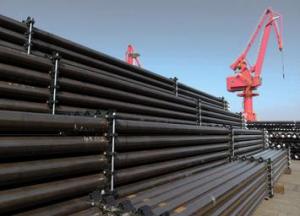
AutoInformed.com on Chinese Steel DumpingThe Australian Workers’ Union (AWU) announced at its National Conference that it will take legal action against Chinese steel dumping. Newly elected national secretary Daniel Walton said that the union would lodge a complaint with the government’s Anti-Dumping Commission. The resolution calls on the Commission to impose a significant tariff on Chinese steel. “Dumping is cheating,” it says.
The Commission has the power to impose tariffs to address dumping. However, in 2004, Australia became one of only two major developed economies to grant market economy status to China (after New Zealand), severely hampering its policy options for addressing Chinese steel dumping.
“Chinese dumping has put our manufacturing sector on the brink of collapse,” he said. “There can be no place for trade cheats.”
Walton explained that vast sums of money are being spent by the Australian government on infrastructure projects that use no Australian steel. At the same time, more than 8,000 workers at the Arrium steel plant in South Australia face an uncertain future as it went into administration (bankruptcy) last year.
The AWU is holding its National Conference on the Gold Coast in Queensland this week. Following a panel discussion on Chinese dumping, where experts debated the effects of dumping on the domestic market and strategies to fight it, delegates passed an anti-dumping resolution, accusing China of flooding the international market with 100 million tons of steel sold at prices below the cost of production.
The steel industry is in crisis across the world, of course, and IndustriALL affiliates are taking action to defend the industry and the jobs it provides. In November last year, thousands of steel workers marched through Brussels to demand action on dumping.
An action plan was adopted at IndustriALL’s base metals conference in Duisburg, Germany, committing affiliates to coordinate initiatives to oppose market economy status for China, on the grounds of unfair trade practices. In 2004, Australia became one of only two major developed economies to grant market economy status to China (after New Zealand), severely hampering its policy options for addressing Chinese dumping.
IndustriALL will participate in the next OECD Steel Committee on 23-24 March and together with affiliates, as well as in the G20 forum on steel overcapacity, for measures to be taken against dumping.
IndustriALL assistant general secretary Jenny Holdcroft, who was at the AWU National Conference, said:
“This is neither free nor fair trade when a country subsidizes its own industries at the expense of workers, their jobs, families and communities, in other countries. The AWU has taken an important step by demanding that its own government stands up to dumping. We will support them, and coordinate with our affiliates in the steel industry across the world to develop a united trade union response.”
| An AWU release | March 02, 2017 ||
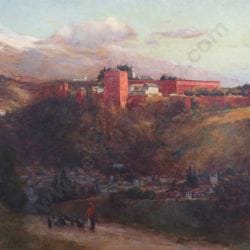
Palace of the Alhambra, Spain
By: Charles Nathaniel Worsley (1862-1923)
From the collection of Sir Heaton Rhodes
Oil on canvas - 118cm x 162cm
Valued $12,000 - $18,000
Offers invited over $9,000
Contact: Henry Newrick – (+64 ) 27 471 2242
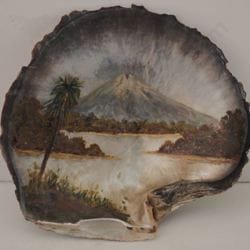
Mount Egmont with Lake
By: John Philemon Backhouse (1845-1908)
Oil on Sea Shell - 13cm x 14cm
Valued $2,000-$3,000
Offers invited over $1,500
Contact: Henry Newrick – (+64 ) 27 471 2242

|
|