
Founded by Max Farndale 1947 - 2018
 Ξ uArm Swift home robot designed not to cost an arm and a leg
Ξ Govt launches $3M fund, compels building owners to fix quake-risk masonry within a year
Ξ Management friction, unpaid bills sink promising pre-fab housing
Ξ Brexit: Supreme Court says Parliament must give Article 50 go-ahead
Ξ NZ economy seen leading the pack again
Ξ Work begins to develop open-ocean marine farms
Ξ Collision Repair Association says apprentices urgently needed
Ξ Wool a way forward in filter technology
Ξ While you were sleeping: DuPont bolsters Wall St
Ξ TPP survival tactics dominate new PM's first press conference
Ξ Hellaby execs sell down holdings to Bapcor, but one retains stake
Ξ Govt hikes minimum wage 3.3% to $15.75/hour
Ξ Food industry holds sway over public policy with lobbying tactics, study says

Robotic arms are moving out of large-scale factories and into homes or small businesses, and are increasingly used to help disabled people feed themselves and perform other tasks. Price is a problem though, so outside of some very specific use cases, they generally aren't worth it for interested tinkerers. But now, Ufactory has unveiled new versions of its consumer-level robot arms, the uArm Swift and Swift Pro, that are aimed at being cheap enough to splash out on, even if all you ever program it to do is stir your coffee for you.
Following the release of its first product, the uArm, back in 2014, Ufactory's next iterations – currently at the prototype stage and up for crowdfunding on Indiegogo – are reportedly smaller, stronger and more versatile. Both models can move across four axes, can lift 500 g (1.1 lb) and work between 5 and 32 cm (2 and 12.6 in) from the base.
Picking up and moving stuff is the uArm's specialty, and to that end it has a suction cup, gripper or a "Universal Holder" at its disposal. A modular attachment called a Seeed Grove socket adds other tools to its arsenal, including an electromagnet, RGB backlight, mini fan, and sensors for motion, color, temperature and humidity.With the help of an OpenMV Cam, the uArm Swift Pro can be taught to play...
They're powered by Arduino, and being open source, Ufactory is aiming to let the DIY crowd create their own programs and tasks for the arm through a visual programming language based on Blockly. These instructions can be relayed through USB and Bluetooth 4.0 connections, or the arm can be directly controlled through a keyboard-and-mouse setup or a smartphone app called uArm Play. There's a manual learning mode too, allowing you to guide the robot arm through a certain motion by physically moving it.
The base model uArm Swift is designed for beginners, packing this decent feature set into a frame that weighs 1.2 kg (2.6 lb) and measures 15 x 13.2 x 28.1 cm (5.9 x 5.2 x 11.1 in). The Swift Pro, on the other hand, is a little bulkier but far more precise, repeatable down to 0.2 mm, lending itself to more delicate tasks like drawing, 3D printing and laser engraving. With an OpenMV Cam, it can recognize, follow and respond to faces, colors and markers, allowing it to try its hand at chess or keep a fan aimed at your face.The uArm Swift robotic arm can be taught a movement by manually guiding the robot through...
Usually, playing around with all this tech comes with a hefty price tag. The Dobot M1, for example, which has an almost identical spec list, slugs your wallet for US$1,600, and more advanced options from bots like Rethink Robotics' Sawyer approach the $30,000 mark.
Spending thousands on a device that messily serves your breakfast or dynamically holds a lamp over your desk is excessive, but Ufactory is looking to make such things much more affordable. The company is currently seeking funding on Indiegogo, and is asking just $209 for basic model early bird pledge, representing a 51 percent saving on the expected retail price of $426. The Swift Pro, meanwhile, is currently up for a pledge of $339, and is expected to retail for $626. If all goes to plan, the uArm bots should be knocking on your door by May.
The uArm Swift can be seen in action in the campaign video.
| Source: Ufactory and New Atlas | January 24, 2017 |
Waste-to-energy showcase for reluctant New Zealand dairy sector
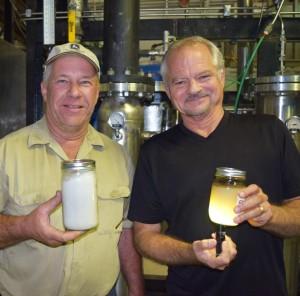
A 1,100-cow dairy in southern California became the first-ever operation in the world known to produce no-sulfur renewable diesel products from manure on a livestock facility in late April.
The milestone is the culmination of three years of collaboration between Scott Brothers Dairy in San Jacinto, California, and Ag Waste Solutions (AWS), a privately held company that designed the farm’s manure processing system.
“To make it to the top of the hill is a euphoric moment,” dairyman Bruce Scott says.
Steve McCorkle, founder and CEO of AWS, announced the partnership’s achievement on Facebook on April 27, 2015. The company claims its technology is the “future of sustainable farming.”
“We have proven that we can complete the circle of energy for individual farms while creating profit centers from manure, enabling farmers to exceed regulatory requirements and truly control their own destiny,” McCorkle said in a statement.
Scott says he is most proud to have produced a “deliverable” for the California Energy Commission, which helped fund the project. As far as he understands, the commission has no other no-sulfur diesel projects dealing with this type of waste stream, so he is pleased to have “crossed the finish line” by submitting a final report. The next step for the system is to prove it can operate continuously and thus be a commercially viable option for other agricultural operations.
“I didn’t expect to win over favor on this project quickly. But I’ve firmly believed in the direction of this project,” Scott says. “The tunnel may have gotten longer, but the light at the end of it has always stayed visible in my mind. I still believe it’s the most viable technology to get rid of a waste stream and produce something that’s value-added at the same time.”
Processing manure into renewable diesel products is just one of the system’s manure processing capabilities.
The dairy’s multi-stage system first separates high-BTU manure solids from the dairy’s liquid manure effluent. McCorkle says the first stage removes 98 percent of the total suspended solids and 40 percent of the dissolved solids, making good irrigation water for most farms.
The extracted water is further purified at Scott Brothers Dairy to remove the other 2 percent of suspended solids and the remaining dissolved solids, making the water potable. (This step was to satisfy manure application requirements that were specific to the dairy’s regional regulatory agency. See this Progressive Dairyman Feb. 7, 2014 article for more background about dairy’s unique permitting situation.)
The dairy’s manure solids are then fed to a pyrolysis gasifier. The gas production module then thermochemically decomposes the manure solids in the absence of air to produce syngas. The gas is then scrubbed of impurities and compressed for storage.
Using a Fischer-Tropsch process, the hydrogen and carbon in the gas is then converted in the system’s final stage into no-sulfur renewable diesel products. The Fischer-Tropsch process had been used to convert other feedstocks to renewable diesel but until recently was never proven to work with manure, let alone on a farm.
Perhaps more importantly than producing diesel, the process also produces a refined wax product in a controllable diesel-to-wax ratio. McCorkle says the wax product’s market value is three times that of the renewable diesel and can be further processed or blended off-site with other petroleum products, such as jet fuel or kerosene.
“We exceeded our own expectations on the first pass,” McCorkle says. “We were able to control the types and factions of liquids and waxes created. And we were able to attain the optimal ratio of liquids and waxes. This satisfies our business model of making enough diesel fuel for farm use and selling the wax products off-farm to create additional profit centers from manure.”
The system on Scott Brothers Dairy that produces renewable diesel products was built at pilot-project scale, meaning it is not commercially sized nor automated enough in order to operate 24-7 with minimal manpower.If the dairy had an adequately sized liquid fuels production module that ran continuously, it could produce at least 1 gallon of diesel fuel from three cows’ manure for a day. Right now the system can convert only one-eighth of the dairy’s gasified manure per day and has not yet been automated to run continuously.
The first production run of renewable diesel products was evaluated in an on-site lab as well as sent to an external lab for validation.. Future production runs will be tested to validate the fuel is consistently comparable, or superior, to other diesel fuels. Initial tests have shown the fuel has very similar characteristics to pump diesel but without detectable levels of sulfur. Even ultra low-sulfur pump diesel contains up to 15 ppm of sulfur.
When asked if it passed the sniff test and whether he would put it in his own tractor, Scott says: “No question about it.”
McCorkle suggests the next steps toward a commercially viable, 24-7 system require more funding to upsize the liquid fuels production module in order to match the size of the rest of the system and to demonstrate that the system can run continuously and more automatically with predictable results and with minimal personnel.
McCorkle is optimistic both goals can be achieved. For now, his countenance glows over the petrochemical milestone he and the dairy have achieved almost entirely by themselves.
“We didn’t achieve these results in a large, complex refinery with tens of engineers, chemists and scientists. We achieved these results with only a handful of people working in a remote farm environment,” McCorkle says.
| From the This email address is being protected from spambots. You need JavaScript enabled to view it. | January 25, 2017 |
This email address is being protected from spambots. You need JavaScript enabled to view it.
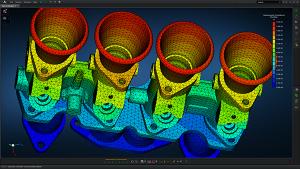
A story from from Reuters has generated rumors suggesting that private equity firm CVC Capital (CVC) will be acquiring MSC Software (MSC) for $800 million dollars. But why should engineers care? Well it could point to an interesting future for computer-aided engineering (CAE) users.
The recent trend in CAE acquisitions was one in which larger CAD or CAE firms would gobble up smaller ones. The path here is simple: add to the larger firm’s existing technology, broaden multiphysics and increase compatibilities and capabilities. This doesn’t seem to be the case here with the potential acquisition of MSC; however, it might be the end game achievement for CVC given MSC’s sales price.How MSC’s Rumored Sale Compares to Others in the CAE Industry
The rumored purchase price of $800 million for MSC isn’t a bad return for the privatization costs at $360 million, but, it pales in comparison to the sale of Mentor Graphics’ to Siemens PLM Software for $4.5 billion.
Given the similar employee size of the companies this might look like a good comparison, and the rumor mill agrees. It has suggested that the differences in price have been caused by “declining revenues.” However, these sources failed to take internal industry strategy into consideration.
Mentor Graphics specializes in electronics design automation (EDA) and computational fluid dynamics (CFD) simulations; whereas MSC focuses mostly on finite element analysis (FEA)-based physics. FEA is much more common in the industry.
| Continue to read full article on engineering.com | January 18, 2017 |
Kiwi ingenuity has seen a New Zealand owned cement company take lessons from ancient Roman concrete to create and launch a ground-breaking low-carbon footprint cement that helps reduce global CO2 emissions.
“HR CEMENT, based in Mt Maunganui, has managed to differentiate a basic commodity and develop a more environmentally friendly cement called ECO-CEM that has significant benefits when compared to standard cements,” said Chris Hall, Managing Director of HR Cement.
“ECO-CEM has the potential to reduce the carbon footprint of concrete utilised on construction sites by 15-30% and set a New Zealand benchmark for low-carbon concretes in New Zealand,” said Mr Hall.
“We looked at millennia-defying concrete mixtures used by the ancient Romans and, after applying modern cement manufacturing techniques, engineered a new cement using Pozzolan from the Central Plateau of the North Island.
Our focus when developing ECO-CEM was to produce a cement that has no downsides compared to the standard General Purpose cement available, coupled with all the clear advantages of a Pozzolanic cement, at a similar cost.
“The use of pozzolan and subsequently ECO-CEM, has significant advantages over standard concrete which are well known internationally. In comparison to standard cement, ECO-CEM gets stronger as time goes on, increases abrasion resistance, improves durability and permeability, alongside having a high resistance to the harsh climatic conditions experienced in New Zealand,” said Mr Hall.
One of ECO-CEM’s greatest strengths is that it is significantly more environmentally friendly than the existing production of Portland cement which is energy intensive and results in significant global greenhouse gas emissions.
The company’s location, being located within a volcanic field near high quality and natural Pozzolanic materials, gives HR CEMENT an economic advantage.
HR CEMENT believes ECO-CEM is a game-changer for the New Zealand concrete market as it will ultimately produce a stronger, more durable and more sustainable product,” Mr Hall said.
! An HRCement release | January 24, 2017 |

Political Class-Media Armageddons Recalled
Three scaremongering and imminent disaster predicted without qualification by the political classes that would paralyse civilisation in the new millennium have now conspicuously failed to come to pass.
The millennialist threats in terms of the disaster they were predicted to precipitate were:-
The Y2K COMPUTER paralysis was predicted to hit civilisation with the advent of the current millennium, the second millennium. In the event global data processing continued as before. The pretext for the scare was that computer operating system clocks were said to be self-eliminating at the point of entry into the new millennium.
What was the existing evidence to reveal the bogus nature of the claim?
The existence of a operating systems that were timed to run out prior to the millennium. Among these was the widely used Pick operating system, designed originally for the military, and which went on the market in 1973. In the event Pick operating systems having run through two clock changes (its proprietary one and the millennium one) continue to function as originally specified.
What happened? Global computational carried on as before, regardless of the digital changes inherent in the new digital time zone.
Who benefited? Computer service companies which toward the end of the first expansionary period of digital processing enjoyed a burst of activity in systems reworking.
FOOD MILES gripped the minds of the fashionable and media classes in the general superstitious frenzy attendant on the new millennium. This panic theory fed off the Peak Oil one. The contention was that any imported foods ate up miles in bringing them to the mouths of the consumers in the importing nations. Therefore everyone should eat locally, and ideally, organically produced foods.
What was the existing evidence that would have debunked this one?Any sea freight shipping price schedule.
What happened? A surplus of refrigerated shipping tonnage meant that the cost-per- food mile of imported food dropped substantially below that of freighting the same foodstuffs internally the process which further worsened the urban congestion of developed nations. It was also discovered that producing local foodstuffs organically or off season in greenhouses in fact consumed more energy than was involved in bulk carrier freighted imports.
Who benefited? Food miles gave traction primarily to urban non-productive activists. The scare was eventually abandoned as it became obvious that it was now being taken up by nations which saw it as an opportunity to erect non-tariff barricades to keep out imports.
PEAK OIL Anyone who sought to be acknowledged as being fashionable early in the millennium needed to let these two words trip off their tongues. The claim was that all the oil in the globe would simply run out. Or, as a consequence would become so expensive as to be beyond the reach of anyone or any institution. Whole nations we were reliably informed would become paralysed.
What was the existing evidence that would have readily debunked the panic?
Any perusal of North American shale oil projections.
What happened? New resources cut in and oil in relative terms is now cheaper than it has been for a generation simply because there is more of it.
Who benefited? The oil industry and oil producing nations took advantage of this scaremongering which had the effect of exaggerating the value of their product simply by advertising its scarcity.
| From The MSCNewsWire reporters' desk | Tuesday 24 January 2017 |
The minimum wage will increase by 50 cents to $15.75 an hour on 1 April 2017, Workplace Relations and Safety Minister Michael Woodhouse announced today.
The starting-out and training hourly minimum wage rates will increase from $12.20 to $12.60 per hour, remaining at 80 per cent of the adult minimum wage.
“The Government is committed to striking the right balance between protecting our lowest paid workers and ensuring jobs are not lost,” says Mr Woodhouse.
“An increase to $15.75 will benefit approximately 119,500 workers and will increase wages throughout the economy by $65 million per year.
“At a time when annual inflation is 0.4 per cent, a 3.3 per cent increase to the minimum wage will give our lowest paid workers more money in their pockets, without hindering job growth or imposing undue pressure on businesses.
“Annual increases to the minimum wage since 2009 reflect this Government’s commitment to growing the economy, boosting incomes and supporting job growth throughout New Zealand.”
| A Beehive release | January 24, 2017 |

Why Trump will find it hard to achieve his economic plans
From a shortage of skilled workers to income inequality, Donald Trump will face at least six challenges.
WASHINGTON—President Donald Trump’s economic plans are nothing if not ambitious: Annual growth of 4 per cent — or more. A diminished trade gap. The creation of 25 million jobs over 10 years, including the return of good-paying factory positions.
It all adds up to an immense challenge, one that Trump aims to achieve mostly by cutting taxes, loosening regulations, boosting infrastructure spending and renegotiating or withdrawing from trade deals. At the top of his agenda: Pulling out of the 12-nation Pacific trade agreement and rewriting the North American Free Trade Agreement to better serve the United States.
Yet to come anywhere near his goals, economists say Trump would have to surmount at least a handful of major hurdles that have long defied solutions. He may yet succeed. But he faces deep-rooted obstacles that have bedevilled presidents from both parties for years. Among the challenges are these:
A SHIFT TOWARD AUTOMATION
Trump’s goal of vastly expanding manufacturing would require at least the partial reversal of a decades-long trend toward a service-oriented economy and away from factory work. Former President Barack Obama sought to add 1 million manufacturing jobs in his second term but came up two-thirds short.
Even if Trump could return factory production to its heyday by toughening trade deals and threatening to slap tariffs on America’s trading partners, a surge of new jobs wouldn’t necessarily follow. The increased use of robots and automation has allowed factories to make more goods with fewer workers. Research shows that automation has been a bigger factor than trade in the loss of U.S. factory jobs.
The trend is spreading outside factory gates. Uber is experimenting with self-driving cars. Restaurant chains like Eatsa can now serve meals through an automated order-and-payment system. No cashiers or servers are needed.
“You cannot just slap tariffs on and hope that will bring back middle class jobs,” says Daron Acemoglu, an economist at MIT. “The jobs that went to China would come back to robots rather than people.”
A SHORTAGE OF SKILLED WORKERS
Jobs that can’t be automated typically require education beyond high school. Yet not everyone can or wants to attend college. Many analysts say the economy needs better and more widely available post-high school education and training, whether through community colleges, vocational schools or boot camps offering technology training.
Such a boot camp is how Sharnie Ivery managed to move beyond the retail and sales jobs he’d held right after high school. In 2013, Ivery began a six-month computer coding boot camp at Flatiron School in New York through which he obtained internships. Last year, he began working as a software developer at Spotify, the music streaming service. “There weren’t many opportunities for a career in technology” without training and experience, Ivery, 24, said.
Last year, the Obama administration opened some financial aid programs to Flatiron and other boot camps. But such efforts remain in an experimental phase, and any widespread successes from those programs are likely years away.
A lack of technological skills isn’t an issue only for the tech industry itself. Modern manufacturing work increasingly requires high-tech know-how requiring some education or training beyond high school. Since the economic recovery began in 2009, only 12 per cent of manufacturing jobs have gone to workers with no more than a high school degree, according to research by Georgetown University’s Center for Education and the Workforce.
SLUGGISH WORKER PRODUCTIVITY
In the past decade, the growth of American workers’ productivity — the amount they produce per hour worked — has slumped to roughly half its long-term average.
That slowdown has imposed a dead weight on the economy. When employees become less efficient, it slows economic growth, and companies can’t raise pay without boosting prices. A faster expansion needs a combination of more people working and more efficient workers.
Trump’s proposals might help somewhat. He favours expanded tax breaks for companies that invest in new machinery and equipment, which typically make workers more productive. And he’s vowed to build more roads, tunnels and other infrastructure, which can save on shipping and commuting costs.
Douglas Holtz-Eakin, president of the conservative American Action Forum, says Trump’s push to loosen regulations might also lead to more startup companies, which could prod established businesses to become more efficient.
Still, many economists, like Robert Gordon of Northwestern University, argue that today’s innovations — in mobile communications and biotechnology, for example — aren’t transformative enough to fuel the explosive productivity growth that resulted from inventions like the automobile, telephone and computer.
INCOME INEQUALITY
Economic growth since the recession ended has been both slow and uneven: It’s benefited wealthier Americans far more than low- and middle-income households. Trump’s nominee for Treasury secretary, Steven Mnuchin, noted this concern at a confirmation hearing last week: “The average American worker has gotten nowhere,” he said.
The tepid gains for low- and middle-income families have slowed the economy because those groups typically spend more of their income than do affluent households, and consumer spending is the economy’s primary fuel. Against that backdrop, Trump’s goal of 4 per cent annual economic growth — a formidable one under any circumstances — might be next to impossible.
Mnuchin said the administration’s proposals to cut taxes for individuals and businesses would shore up families’ finances and encourage companies to hire more. Yet America’s wealth gap has widened even as previous presidents have cut individual taxes.
A SLOW-GROWING WORKFORCE
Trump has pledged to add 25 million jobs over the next decade. But with fewer people looking for work now than just a few years ago, it’s unclear where all those extra workers would come from.
The president’s pledge will run up against a long-standing trend: A decline in the proportion of Americans either working or seeking work. That’s largely a reflection of an aging population. Roughly 10,000 baby boomers turn 65 every day, and many retire. The Congressional Budget Office forecasts that the proportion of Americans working or looking for will keep dropping to 61.5 per cent by the end of 2020.
Mark Lashinske of Tempe, Arizona-based Modern Industries, which makes machine tools, says he’s struggling to fill 14 machinists’ positions. He blames the steady loss of manufacturing jobs since 1980 for discouraging an entire generation from factory work. His company is expanding its efforts to find younger job applicants.
The company has established an internship program and is working with a non-profit group to encourage disadvantaged high school students to consider manufacturing careers.
“We’ve been looking for quite a while,” he says. “We have such a shortage.”
Most economists argue that encouraging more legal immigration could help counter an otherwise slow-growing workforce and might help accelerate economic growth. Yet Trump campaigned on tightening immigration restrictions.
“In the absence of immigration, we shrink the size of our population and our economy and our global influence,” Holtz-Eakin says.
STRONG DOLLAR
Through renegotiating treaties like NAFTA and pushing companies to keep more jobs at home, Trump hopes to reduce — or even eliminate — the trade deficit, a measure of how much more America imports than exports. The U.S. has run trade deficits since 1975.
Yet if Trump’s policies accelerate growth, the Federal Reserve would be more likely to raise the short-term interest rate it controls to keep inflation in check. Faster growth and higher rates, in turn, would attract more investors to the dollar, raising its value compared with other currencies.
The catch? A stronger dollar makes U.S. exports costlier and imports cheaper — a recipe for an even wider trade deficit and a headwind for growth.
Read more:
| Published in thestar.com January 23, 2017 |
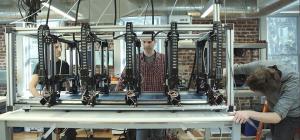
Back in March 2016 Slash gear ran this item about Autodesk's Project Escher printer. This new 3D printer from Autodesk wants to revolutionize 3D printing technology by allowing users to print larger items. Project Escher is an assembly line of 3D printers with a smart setup controller that is able to control an endless number of print heads to create larger items. Rather than having a single printer working on one large project, Project Escher has multiple print heads each working on one section of an object.
By having multiple heads working on a large project, the item can be completed more quickly. “By intelligently distributing toolpaths between multiple collaborating machines, systems enabled by Project Escher can manufacture parts faster than traditional 3D printers,” say the developers. “Project Escher is a parallel processing system where numerous independent tools collaborate to fabricate a design. It’s faster because whatever the job is, there are more workers on that job. And there is no compromise to detail because we’re using proven existing technology.”
Each of the independent printers has interchangeable tool heads. The company hopes to make the tool head changing automatic, along the lines of how a CNC machine works. The team of designers also hopes to create Pick-and-Place tools that would put pre-made components into an object during the printing.
Autodesk also expects to integrate other technologies into the printer including laser cutting. One key bit of information that is outstanding right now is when Project Escher will hit the market. Developers of Project Escher are looking at a 2017 or 2018 launch. The faster multi-head printer would be able to complete a larger piece for inspection the same day.
As exciting as the technology is, the industry has been waiting for signs that Project Escher would actually be available to the public. At CES this year, the wait was put to an end as Colorado-based start-up Titan Robotics showed off Cronus, the first commercially available 3D printer relying on Project Escher technology.
> > > Continue to read full article

 ∩ Trump executive order pulls United States out of TPP trade deal
Ξ Hellaby execs sell down holdings to Bapcor, but one retains stake
Ξ Govt hikes minimum wage 3.3% to $15.75/hour
Ξ NZTE Export News January 24, 2017
Ξ New Zealand's top 30 cooperatives generate sales of more than $40 billion
Ξ While you were sleeping: Trump axes trade deal
Ξ Poor honey crop hits Comvita
Ξ Todd Corporation behind $5.9b mining project in Western Australia

Palace of the Alhambra, Spain
By: Charles Nathaniel Worsley (1862-1923)
From the collection of Sir Heaton Rhodes
Oil on canvas - 118cm x 162cm
Valued $12,000 - $18,000
Offers invited over $9,000
Contact: Henry Newrick – (+64 ) 27 471 2242

Mount Egmont with Lake
By: John Philemon Backhouse (1845-1908)
Oil on Sea Shell - 13cm x 14cm
Valued $2,000-$3,000
Offers invited over $1,500
Contact: Henry Newrick – (+64 ) 27 471 2242

|
|