
Founded by Max Farndale 1947 - 2018
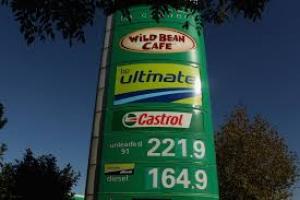
The Automobile Association is calling on petrol companies to display all their petrol prices and says the government should force them to if they don't.
Under the law petrol companies are required to display the price of all fuel products at the pump - and they are meeting that obligation.BP petrol station in Kaikōura
The AA says petrol companies should put the price of premium petrol as well as 91 octane on their roadside boards. Photo: RNZ / Rebekah Parsons-King
But AA petrolwatch spokesperson Mark Stockdale said there were many complaints about service stations not putting the price of premium petrol on their roadside price boards.
In a survey of AA members, 77 percent said they kept an eye on roadside boards and 81 percent felt all fuel prices should be on them.
The boards are required to show the price of 91 and diesel, but not 95 or 98 octane. It's estimated 20 percent of cars in New Zealand use premium petrol.
| Continue to the full article | January 19, 2017 |

Slack, the popular work chat app, has launched one of the features that users have been clamoring for over its entire lifetime: threaded messages.
On Wednesday, the company began the process of rolling out the update to all of its users, which will allow them to keep conversations about a particular topic corralled into a single thread. The feature is designed to keep conversations on a particular topic out of the main flow of a chat channel, the company said in a blog post.
Starting a thread just requires users to hover over a message, click the “Start a Thread” button, and type their response. Replies will be grouped into a sidebar thread, and a small link will appear below the original message showing who has replied to a thread and how many replies it has garnered.
Users have been requesting threaded replies for years as a way to help deal with crowded chat channels where multiple conversations are going on at once. Slack allows users in a channel to talk with one another in a single, uninterrupted flow, which means it can be difficult when folks are discussing two or more different topics. This feature should help with that, along with assisting in reducing clutter from ancillary discussions.
Launching threaded replies will also help Slack compete with other messaging services like Microsoft Teams, which has pushed its support for threading replies as a key feature. Microsoft is slated to make Teams generally available next month, and a recent survey of IT professionals showed them optimistic about the tech giant’s chances of competing with Slack.
| Continue to full article here | January 18, 2017 |
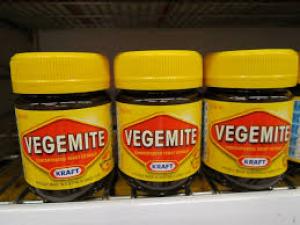
MELBOURNE, Australia, Jan. 18, 2017 (GLOBE NEWSWIRE) -- Mondelēz International, Inc. (NASDAQ:MDLZ) has reached an agreement to sell most of its grocery business in Australia and New Zealand to Bega Cheese Limited (ASX:BGA) for $460 million AUD. The transaction adds the iconic VEGEMITE brand and other well-established grocery brands to Bega’s portfolio. The move enables Mondelēz International to further focus its portfolio and drive profitable growth by investing in its core snacks categories and Power Brands, including Cadbury Dairy Milk chocolate and Oreo biscuits.
“We’re extremely proud of our history as the custodian of the VEGEMITE brand for over 90 years, transforming it from its local roots into a global icon that’s synonymous with Australia,” said Amanda Banfield, Vice President Australia, New Zealand and Japan for Mondelēz International. “It’s been a privilege stewarding this brand, which is found in almost every Australian household and is part of the fabric of the nation. As we continue to execute our strategic growth plan, with a keen focus on core snacks categories and global Power Brands, we’re excited to see VEGEMITE and these much-loved brands continue to grow and thrive under Bega’s ownership.”
Bega Cheese’s Executive Chairman Barry Irvin said he was ecstatic to be bringing together two companies with an Australian heritage spanning over 200 years. "We believe these iconic brands alongside the Bega Cheese brand are strong building blocks to enable Bega Cheese to become a great FMCG business.
“We feel privileged to be taking on the responsibility and guardianship of one of Australia’s most loved brands, VEGEMITE, and look forward to working with the people at 1 Vegemite Way in Port Melbourne to continue the legacy of this great company.”
Included in the sale are Mondelēz International owned brands – VEGEMITE, ZoOsh, Bonox – and other products that use the Kraft brand under license, such as peanut butter, nut spreads, processed cheese slices, ambient cheese spread, mayonnaise, parmesan cheese, Kraft Easy Mac and Kraft Mac & Cheese. Bega will receive a license to the Dairylea brand for use in Australia and New Zealand. The Philadelphia business is not included in the deal as it is a Mondelēz International Power Brand.
The Port Melbourne manufacturing site will transfer to Bega as part of this agreement and approximately 200 colleagues who spend most of their time working on this part of the business will be offered roles on comparable terms with Bega. The transaction is expected to close in the coming months.
The Reserve Bank has released a Bulletin article examining the core macro-economic model it uses to support the monetary policy decision making process.
The New Zealand Structural Inflation Model (NZSIM) provides the central organising framework for the Reserve Bank’s forecasting and economic analysis. It is a structural model that provides a platform for evaluating the growth and inflation effects of various economic scenarios, including potential policy responses.
The Bulletin article provides a brief review of the Bank’s recent forecasting models, the philosophy underpinning the design of NZSIM and explains how the model is used in the Reserve Bank’s forecasting process.
More information
| A RBNZ press release | January 19, 2017 |

Airbus is planning to test self-piloted personal aircraft by the end of the year as a way of reducing traffic on inner-city roads.
The announcement was made by the aerospace group's CEO, Tom Enders, on Monday at the DLD digital tech conference in Munich.
During his keynote speech, Enders said Airbus is investing in driverless technologies and artificial intelligence, which could lead to them developing a fleet of flying cars.
"One hundred years ago, urban transport went underground. Now we have the technological wherewithal to go above ground," he said, adding that he believed the company would be testing flying single-person transport by the end of the year.
"We are in an experimentation phase. We take this development very seriously," he said. "If we ignore these developments, we will be pushed out of important segments of the business."
Enders also noted how the development could affect city planning and infrastructure, saying that flying means you don't need to "pour billions" into concrete bridges and roads.
The personal aircraft is being explored in Airbus' Project Vahana. The project grew out of the company's Urban Air Mobility initiative, dedicated to less-conventional vehicle concepts, like vehicles to transport individuals or helicopter-style vehicle that carry multiple riders.
The aim would be for people to book the personal aircraft using an app, similar to car-sharing schemes such as Uber.
Airbus has also been working on "vertical take-off and landing" (VTOL) technology that would allow vehicles to pick up passengers in busy urban areas, and has said it expects to be putting them into production by 2021.
"We seek to help enable truly vertical cities by opening up urban airways in a predictable and controlled manner," said the company in a blog post.
"We believe that full automation will allow us to achieve higher safety by minimising human error. Our aircraft will follow predetermined flight paths, with only minor deviations if obstacle avoidance is needed."
Airbus' announcement appears to support transport designer Paul Priestman's prediction last year that passenger-carrying drones would be the future.
"We've got these electric drones flying around everywhere," he said. "[Electric planes are] just a scaled up version really. I think that's going to get really interesting – it could be the beginning of personalised transportation."
"It's like going back to the idea of jetpacks, but with lots of little drones," he added.
Airbus has filed a number of unusual patents over the years. In 2014 the company applied for a patent on bicycle-style seats that would replace seat cushions with saddles, and in 2015 filed one for two-storey passenger seating that would make the most of unused cabin space by stacking travellers one on top of another.
Most recently, the company patented removable aeroplane cabins for faster boarding.
| Originally published on Dezeen | January 17, 2017 |
The experience of a New Zealander who served in three White House Administrations suggests Chris Liddell will have a front row seat to history while working as an assistant to Donald Trump.
Peter S Watson grew up in Mt Eden and attended Auckland Grammar, but a career in law later spanned top US law firms and saw him become involved in politics.
Watson worked for George Bush Snr's Administration as a director of Asian Affairs for the United States National Security Council, and later held top posts in the George W. Bush Administration.
A Republican, he was appointed chairman of the high-powered US International Trade Commission by the Clinton Administration.Chris Liddell. New Zealand Herald Photograph by Doug Sherring. Chris Liddell. New Zealand Herald Photograph by Doug Sherring.
Back in New Zealand in 2007, Watson - now president of the Dwight Group, a Washington, D.C.-based investment bank - told the Herald of the experience and pressures of working in the White House, at times directly reporting to the President.
As Asian director of the National Security Council - the advisory group to the President - Watson's role covered South East Asia, Indochina and the South West Pacific.
He played a part in efforts to end the rule of the Khmer Rouge in Cambodia and had to respond to coup attempts against the then Philippine president Corazon Aquino.
Watson, a dual citizen of New Zealand and the US, recounted being in the situation room when rebel forces were strafing Aquino's presidential palace.
"When these crises are evolving, you always have to keep in the back of your mind a sort of DNA reference of what you stand for long term," he said of the experience.
Associate Professor Stephen Hoadley, international relations scholar at the University of Auckland, said a New Zealander being appointed to the sort of positions held by Watson and now Liddell was unusual.
That was despite a large number of foreigners working in Government in the US, which was an "amazing open system", Hoadley said.
As well as his business experience, Liddell was previously chairman of Project Crimson, a charitable trust that aims to protect New Zealand's endangered pohutukawa and rata trees.
"He does have a green inclination - like all New Zealanders do - and that may in fact put him at odds with Trump's 'drill baby, drill' and 'climate change is a hoax' approach," Hoadley said.
"He will be his own man - he has been chairman of Xero and he is pretty strong minded individual. He won't be bulldozed by Trump's somewhat misdirected urges."
Hoadley said Liddell had the chance to make a difference.
"The good thing about Trump - if there is any good thing about him - is he does want governmental reform, he wants change, he wants efficiency like a well-run business.
"If Liddell can contribute to tidying up the apparatus of US Government that must be good for everyone."
| MyInforms.com | January 18, 2017 |
The British Prime Minister Theresa May spoke enthusiastically about the opportunities provided by the Commonwealth during a landmark speech on the British Government’s plans for Brexit.
Speaking at Lancaster House, London, Mrs May said, “I want us to be a truly Global Britain... A country that goes out into the world to build relationships with old friends and new allies alike.
“Even now as we prepare to leave the EU, we are planning for the next biennial Commonwealth Heads of Government meeting in 2018 – a reminder of our unique and proud global relationships.”
The next Commonwealth Heads of Government meeting is to be held in the UK with Her Majesty Queen Elizabeth II in attendance. Heads of state and senior officials from all of the 52 counties which make up the Commonwealth will be invited.
Throughout the much anticipated speech, the prime minister announced intentions to lead Britain to a single market with significantly increased trade between Britain and both the remaining EU members and countries outside Europe. She expressed her focus to build free trade agreements between Britain and emerging global superpowers, including some Commonwealth nations.
We want to get out into the wider world, to trade and do business all around the globe. We have started discussions on future trade ties with countries like Australia, New Zealand and India.She said, “We want to get out into the wider world, to trade and do business all around the globe. We have started discussions on future trade ties with countries like Australia, New Zealand and India.”
At the inaugural Commonwealth Trade Ministers Meeting taking place in March, trade opportunities post-Brexit will be high on the agenda. Ministers for economy, trade and industry from across the Commonwealth are expected to attend.
The Secretary-General, Patricia Scotland, welcomed Mrs May’s recognition of trade opportunities with Commonwealth nations. She said, “Countries like India, South Africa, Nigeria, Kenya, Jamaica and Sri Lanka have already asked the Secretariat to undertake a detailed analysis of the trade opportunities which may arise post-Brexit and the ways in which they can deepen their trading engagement with the UK.
The meeting of trade ministers in March will explore the existing opportunities within the Commonwealth and ways in which we can strengthen intra-Commonwealth networks, improve the way we trade and provide mutual support to boost competitiveness of our nations. Our research shows that when both partners are Commonwealth members, trade costs between them are 19 percentage points lower than other country pairs.”
| A PressReleasePoint release | january 17, 2017 |
As New Zealand marks the one-year anniversary of its Free Trade Agreement (FTA) with South Korea, Fonterra Co-operative Group is gearing up to take advantage of huge potential for its dairy products there, particularly cheese.
Since the FTA was signed in December 2015, New Zealand has experienced 16 per cent growth in exports of food and beverage products to Korea.
The country is New Zealand’s fifth largest cheese market, worth US$50 million (NZ$70m) a year – comparable to New Zealand’s cheese trade to the United States.
New Zealand’s new annual duty free quota of 7000 metric tonnes (MT) of cheese to Korea will increase by three per cent a year.
Tariffs on cheddar and block mozzarella will be removed after seven and 12 years respectively, with all cheese tariffs eliminated and quotas removed after 15 years.
Quotas and tariffs on butter, anhydrous milk fat and infant formula will also be phased out over 15 years.
Fonterra has seen strong interest in its products off the back of the Agreement, reflecting the growing demand for high quality dairy in Korea, Jason Murney, Fonterra’s Country Manager Korea, said.
“A lot of our existing customers and new customers are approaching us to develop new business opportunities,” he said.
“The FTA will help Fonterra deepen its commercial relationships in the market over time, as our access continues to increase.
“We have already seen positive results, with government import statistics showing that New Zealand’s share of the Korean cheddar market has grown to over 60 per cent in 2016, up from 50 per cent in 2015.”
So far Fonterra has developed a new cheese specifically designed for use on pizzas, which will be launched in Korea. This will help the Co-operative meet Koreans’ growing taste for pizza and fusion foods.
Fonterra has expanded its Korea team and is investing in a warehouse so that it can import and distribute more high value products itself.
Consumption of dairy products is rising in Korea, as dietary trends follow those of neighbouring Asian countries such as Japan. In 1990 Koreans consumed 43.8kg liquid milk equivalent per capita but by 2014 that had risen to 72.4kg.
The access under the FTA allows Fonterra to invest in product and supply chain innovations, and implement a strategy to transition its Korean business from low risk ingredients to higher value food service.
“The development of the Korean market is absolutely in line with Fonterra’s strategy of moving more milk volumes into higher margin products, thus earning greater returns for our farmer shareholders,” Murney said.
| NZFoodworks Directory | January 18, 2017 |
∩ New Zealand presses Gulf states to finalize stalled trade deal
∩ McClay seeks free trade with Gulf countries
∩ Steel & Tube staffer pays 97% premium to fully paid for shares held under 24-year old scheme
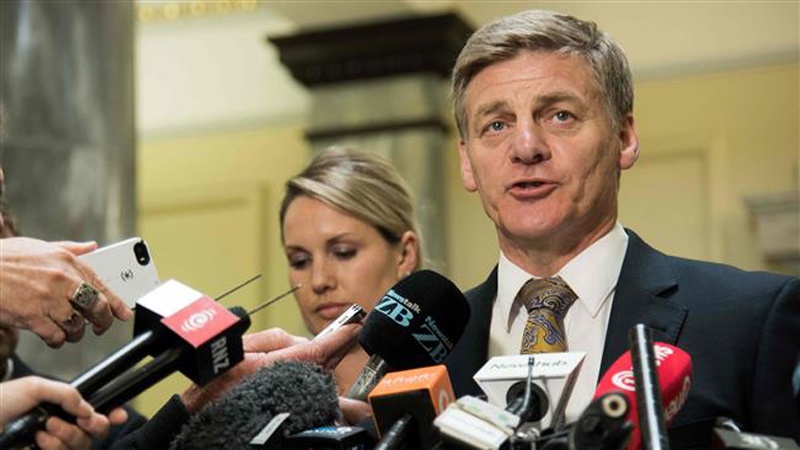
∩ Kiwi businessman to join Trump team
∩ Ravensdown appoints new eastern North Island regional manager
∩ Netherlands company Jacobs Douwe Egberts(JDE) purchase BrewGroup- includes Bell Tea
∩ Otago's economic outlook up 13.9%
∩ Dyson launches worldwidesearch for 110 new software engineers
∩ While you were sleeping: Dollar too strong for Trump
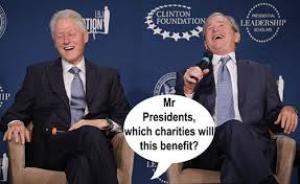
Watchdog is determined to extract Foreign Aid facts
The determination of the public spending watchdog the Taxpayers Union collective to extract from the government an explanation for its foreign aid donations to the Clinton fund has only increased with the dissolution of the Clinton Foundation when a final pledge of $5.5. million from New Zealand is still due.
Foreign aid remains a substantially unquestioned sector of public expenditure with the political class only differing on the extent of the budgetary increases.
Each year the proclamation is made by this non-productive sector that New Zealand’s aid expenditure is well below that of other nations which are said to be more conscious of their responsibilities.
In fact New Zealand’s annual aid contribution is generous in comparison with that of these nations being 0.27% of GNI.
Britain for example has only just met its 0.7 percent GNI target for the first time.
New Zealand’s 0.27 percent meanwhile remains a substantially more generous aid budget in terms of GNI than the budgets among other nations of the United States, Japan, Italy, or in Nordic terms, even Iceland.
The Clinton fund donations have something in common with the Taxpayers Union’s other bone of contention which it similarly refuses to let go of.
This is the Middle East stock handling and processing depot designed to offset the National government’s surprise decision, for Gulf importers, to veto licences for the export of live sheep to the Middle East.
In both these instances the public contributions via the New Zealand Ministry of Foreign Affairs and Trade might reasonably be considered by accounting standards to fall into the insurance category of expenditure.
The insurance being to ensure a favourable attitude to New Zealand in the event of the Clinton family re-occupying the White House, and in the instance of the Gulf states to ensure against a boycott of New Zealand exports.
Deliberately overlooked in New Zealand’s foreign aid expenditure is the matter of New Zealand having no foreign possessions in which to invest its aid.
For example a major Pacific recipient of British aid remains the Pitcairn Islands which are classified as a British overseas territory and which contain immense strategic value in terms of the sea area that the Pitcairn Islands command.
| From the MSCNewsWire reporters' desk | Wednesday 18 January 2017 |
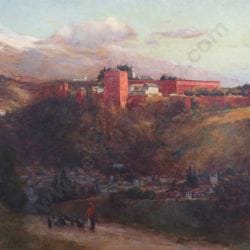
Palace of the Alhambra, Spain
By: Charles Nathaniel Worsley (1862-1923)
From the collection of Sir Heaton Rhodes
Oil on canvas - 118cm x 162cm
Valued $12,000 - $18,000
Offers invited over $9,000
Contact: Henry Newrick – (+64 ) 27 471 2242
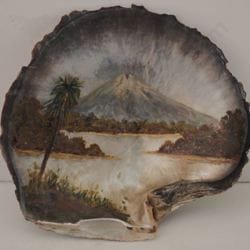
Mount Egmont with Lake
By: John Philemon Backhouse (1845-1908)
Oil on Sea Shell - 13cm x 14cm
Valued $2,000-$3,000
Offers invited over $1,500
Contact: Henry Newrick – (+64 ) 27 471 2242

|
|