
Founded by Max Farndale 1947 - 2018



January 2017 Edition
A newly launched joint data sharing system between New Zealand and Chinese Customs will give kiwi exporters a competitive advantage, says Customs Minister Nicky Wagner.
“Having the Joint Electronic Verification System operational gives New Zealand a big advantage over other exporters to China as we are only the second country in the world to have this sort of system in place with them.
“JEVS makes the customs process simpler to accelerate border clearance, provide greater assurance over goods, and decrease the risk of goods being held up due to minor issues.
“The new joint system automatically sends New Zealand’s Certificate of Origin data to China electronically. A Certificate of Origin is important because it allows overseas clients to claim tariff benefits.
“It will give New Zealand businesses the opportunity to maximise our Free Trade Agreement with China while minimising the risk of goods being held up at the border,” Ms Wagner says.
| A Minister of Customs release | January 15, 2017 |
 ∩ Christchurch Airport ushers in the driverless era
∩ Opinion: Resolution 2334 - Preserving the two state solution
∩ Silver Fern Farms sinks to $30.6 million loss
∩ Bapcor lifts interest in Hellaby to 56% after declaring takeover unconditional, extending offer
∩ Completion of trans-Tasman cable delayed until March after mishap
∩ Bill English refuses to speculate on who will take on Foreign Affairs role
∩ Southland's Lochiel Engineering offer to thief
∩ Oil prices expected to stay low
∩ English to meet with Angela Merkel tonight
∩ 2016 was the year Chrome became most popular browser
∩ Trade deals will be fast-tracked but immigration restrictions unlikely to change
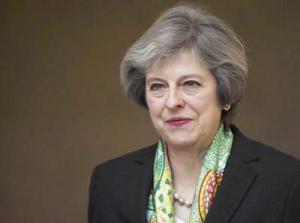
Theresa May is expected to reveal the most detailed insight yet into her approach to Brexit negotiations, in a speech on Tuesday.
She will urge people to give up on "insults" and "division" and unite to build a "global Britain".
Downing Street said reports she may signal pulling out of the single market and customs union were "speculation".
It comes as the chancellor said the UK could "change its economic model" if it loses access to the single market.
The BBC's political correspondent, Chris Mason, said Downing Street was confirming little about precisely what Mrs May would say in her Brexit plan speech, but "a possible route map the prime minister could be preparing to follow is emerging".
Her desire to control immigration suggested giving up the UK's existing membership of the single market, he added, while her enthusiasm for trade deals with countries such as New Zealand implied leaving the customs union.
Several of Sunday's newspapers claim Mrs May will indicate she is prepared to outline a "hard Brexit" approach.
The Sunday Telegraph quoted a government source as saying: "She's gone for the full works. People will know when she said 'Brexit means Brexit', she really meant it."
In her speech, the prime minister is expected to call on the country to "put an end to the division" created by the EU referendum result.
She will urge the UK to leave behind words such as "Leaver and Remainer and all the accompanying insults and unite to make a success of Brexit and build a truly global Britain".
Mrs May is also expected to outline a commitment to building a Britain more open to the rest of the world while building a new relationship with EU countries.
On Friday, she met New Zealand's prime minister Bill English who said he wanted to negotiate a "high quality" free trade agreement with the UK once it left the EU.
Mrs May said she was looking forward to starting talks on what she called a "bold" new trade deal between the two countries.
Writing in the Sunday Times, Brexit Secretary David Davis said the government needed to persuade EU allies that a "strong new partnership" with the UK would allow the EU to prosper.
He admitted agreeing new terms would be "testing" and suggested there might be a transitional arrangement to ensure Britain's exit was a smooth process.
| A NewNation release | January 16, 2017
The spirit of unanimity in which the United Nations Security Council passed resolution 2334 on December 23 stands in sharp contrast to the condemnation and accusations that have dominated subsequent commentary from Israel and that country's supporters.
New Zealanders deserve to know why the issue of settlements has become so challenging, and why it came before the council in December 2016.
At the heart of this whole debate is whether we will see a future in which two states, Israel and Palestine, live side by side in peace and security. This two state solution has been the accepted basis for resolving the Palestinian question for many decades now, enshrined in various negotiated accords and UN Security Council resolutions, and the focus for several unsuccessful attempts to broker final agreement between the parties,
The most recent attempt was led by US Secretary of State John Kerry. After showing great promise those talks broke down in 2014.
No one should underestimate the challenges associated with negotiating the terms for a two state solution. Significant compromises are required of both sides, and the domestic political challenges for both are formidable.
But there has been agreement in principle on the key components, security guarantees for Israel and a state for Palestinians based on the 1967 borders but with negotiated land swaps, including a negotiated approach to managing Jerusalem's holy sites. Resolution 2334 reinforces the international community's commitment to this negotiated outcome.
Resolution 2334 condemns the obstacles to a negotiated two state solution: incitement and acts of violence and terror against civilians of all sides, and the ongoing settlements programme which carves ever more deeply into the land available for a Palestinian state on the West Bank.
There have been some misleading and irresponsible claims made by critics of the resolution: that it somehow predetermines negotiations between the parties, affects the rights of Israelis to access certain religious sites, or changes the legal status of the West Bank. None of those claims is correct. New Zealand would not have supported it if those assertions were correct, and the US would most certainly not have allowed the resolution to pass.
The focal point for much of the critics' anger is the direct call for a halt to the settlements. But that call by the council was clear and deliberate because continuing settlement growth at anything like the current rate will render the two state solution a purely academic concept. There will be nothing left to negotiate.
The other reality is that without a two state solution, demographic and security considerations will pose a serious challenge to the future character of Israel. Kerry put it starkly in his statement the week after the adoption of Resolution 2334, "If the choice is one state, Israel can either be Jewish or democratic - it cannot be both - and it won't ever really be at peace."
Those who doubt the seriousness of the settlements issue should read the report of the Middle East Quartet of July 1, 2016. The Quartet comprises the European Union, Russia, the United Nations and the United States. Its report outlines in a careful and factual way the impact of ongoing settlement activity, and more recent moves by the Israeli Parliament to retrospectively legalise settlements developed in contravention of Israeli law.
In Israel this is a politically difficult topic. The settler movement is very influential in the current government, and its leaders occupy a number of key Cabinet posts.
For the whole of New Zealand's two year term on the Security Council, the Secretary-General and his Special Co-ordinator have expressed alarm that the forces of incitement and violence and the relentless progress of the settlement programme were undermining the two state solution.
Some quite exotic theories have been advanced as to why this resolution was dealt with in the final month of New Zealand's council membership. The truth is: the United States would not accept any resolution on this topic until after US presidential elections in November. The domestic politics would have been too difficult.
In late 2014 three quarters of the countries in the United Nations voted for New Zealand's election to the Security Council. They did so because New Zealand has a long standing and respected record for fairness. They also knew of New Zealand's long standing bi-partisan support for the two state solution as a basis for resolving the Palestinian question.
Against that background it would be very difficult to explain why we would not support a resolution seeking to reinforce the notion of two states living peacefully, side by side, and which called for an end to the incitement, violence and the settlements that pose such a serious threat to it.
| Murray McCully Foreign Affairs | January 12, 2017 |
PrivacyAccessibilityCopyrightwww.govt.nz
WELLINGTON, Jan. 13 (Xinhua) -- New Zealand Trade Minister Todd McClay will be in Kuwait and the United Arab Emirates (UAE) next week in another bid to finalize a free trade agreement (FTA) with the Gulf states.
MClay said Friday he would be pressing for a conclusion to the negotiations between New Zealand and the six-nation Gulf Cooperation Council (GCC), which began back in 2009.
McClay would meet bilaterally with ministerial counterparts and business leaders, including UAE Minister of Economy Sultan bin Saeed Al Mansoor and Kuwaiti Minister of Commerce Khalid Nasser Al Roudhan.
"This is my third visit to the region since becoming trade minister and it is important that we continue to lobby for the conclusion of the agreement. Progress on a GCC FTA will offer greater opportunity for New Zealand companies in this highly competitive market," McClay said in a statement.
The GCC comprising Saudi Arabia, the UAE, Kuwait, Qatar, Bahrain and Oman was New Zealand's eighth largest trading partner, with annual two-way trade exceeding 3.5 billion NZ dollars (2.49 billion U.S. dollars).
In September last year, New Zealand and Saudi Arabian leaders appeared to have overcome stumbling blocks towards a long-anticipated FTA, after McClay held talks with Saudi Minister of Commerce and Investment Dr Majid bin Abdullah Al Qasabi and they agreed to work towards its early completion.
In 2015, then New Zealand Prime Minister John Key visited the GCC states, and said Saudi Arabia was going to be the stumbling block to the deal.
It was believed that Saudi government took umbrage over New Zealand's ban on exports of live sheep a trade in which Saudi businesses had invested heavily.
McClay would travel to Switzerland on Jan. 19 and 20 to attend a meeting of key World Trade Organization (WTO) trade ministers to discuss developments in the multilateral trading system and prospects for progress ahead of the 11th WTO Ministerial meeting in Buenos Aires.
| A SINA release | January 13, 2017 |
The Reserve Bank has appointed Klarissa Plimmer as Chief Information Officer and Patrick Hoerler as Head of Risk Assessment and Assurance.
As Chief Information Officer, Klarissa Plimmer is responsible for the Bank's information management and technology. Ms Plimmer was previously the Director ICT Solution Delivery at the New Zealand Defence Force, and has worked in a number of ICT leadership roles at the BNZ for 13 years.
Patrick Hoerler heads the Bank's Risk Assessment and Assurance unit, which is responsible for ensuring that financial, operational, and reputational risks faced by the Bank are identified, monitored and managed in line with best practice. The unit includes the Bank's internal audit function and legal services.
Before joining the Bank Mr Hoerler was the Risk Assurance Officer for Mercury (formerly Mighty River Power and Mercury Energy) and was previously their treasurer. Mr Hoerler has a background in international banking, working with Credit Suisse and Zurich Kantonalbank in the US and Asia before migrating to New Zealand to work as treasurer for ENZA and in banking with HSBC.
| A RBNZ release | January 13, 2017 |
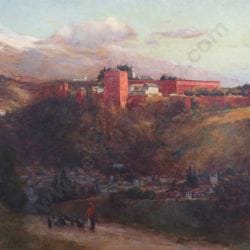
Palace of the Alhambra, Spain
By: Charles Nathaniel Worsley (1862-1923)
From the collection of Sir Heaton Rhodes
Oil on canvas - 118cm x 162cm
Valued $12,000 - $18,000
Offers invited over $9,000
Contact: Henry Newrick – (+64 ) 27 471 2242
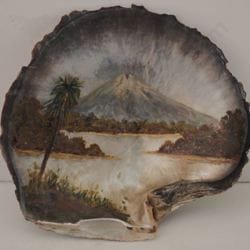
Mount Egmont with Lake
By: John Philemon Backhouse (1845-1908)
Oil on Sea Shell - 13cm x 14cm
Valued $2,000-$3,000
Offers invited over $1,500
Contact: Henry Newrick – (+64 ) 27 471 2242

|
|