
Founded by Max Farndale 1947 - 2018
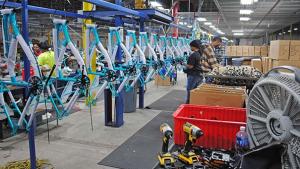
From hand-crafted boutique brands to high-volume manufacturing and assembly, dedicated U.S. bicycle makers are reshoring bike production to the U.S. A confluence of factors including rising offshore costs, the benefits of a “local for local” business strategy, the growing popularity of bikes in expanding urban areas and patriotism are giving rise to new opportunities for an “old” mode of transportation.
The move of American-made bicycles offshore began with industry leader Schwinn shifting manufacturing to Asia in the 1980s. In an effort to take advantage of low wages, other large bicycle manufacturers like Huffy and Trek soon followed, at least in part. “By 2015 only 2.5 percent of the estimated 12.6 million bikes sold in the U.S. (not including those for children) were made here, according to the National Bicycle Dealers Association.” However as offshore wages began to rise, bicycle manufacturers began to rethink their offshore manufacturing and sourcing decisions. Driven by rising offshore costs, the cost savings of automation and innovative processes, and the benefit of “Made in USA” branding, reshoring bike manufacturing and assembly began to make good economic sense.
U.S. Domestic Bike Production
According to the International Bike Organization, the U.S. was in the top five for bicycle production in 1990 at 5.6 million units. As more offshoring occurred, U.S. bike production fell to a low of 200,000 units in 2015 but the trend is looking up. The U.S. is on track to produce over half a million bikes this year.
Continue to full item | Published Dec 8, 2016

Textile Clothing and Footwear (TCF) Council of Fiji has received a grant of $100,000 from the ministry of industry, trade and tourism to develop the manufacturing sector. The aid will help TCF sector to establish more industries especially in the western division to explore new markets, said Shaheen Ali, industry, trade and tourism permanent secretary.
The initiative by the government will help establish service and manufacturing zones that will attract investors, said Ali during the $100,000 grant handover ceremony at the ministry. The trading can improve as the manufacturing zone is also closer to Nadi international airport and international port.
TCF industry is one of the major contributing factors to Fiji’s gross domestic product. Australia and New Zealand are main export markets for Fiji’s TCF industry. The financial assistance will allow TCF Council to promote business in North America, Europe, Pacific Island countries and Asia, Fijian media reports said.
“The readymade infrastructure in Nadi will have manufacturing companies including IT and business process outsourcing operations that will also increase the scope of employment for young graduates,” said Ali. “The same concept is being followed in China, India and Singapore. It will take us some time, planning and investment to implement it.”
The grant has allowed the industry stakeholders to come under one umbrella, said TCF president Kaushik Kumar.
The TCF industry has received a grant of $850,000 in the last eight years from the government under the National Exports Strategy grants, said Ali.
Nearly 7,000 people are employed with the TCF industry with nearly 90 per cent of them being women. (RR)
| Fibre2Fashion | Dec 9, 2016 |
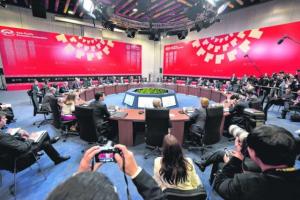
In one corner, there is the United States; in the other, China.
The sole superpower trying to maintain its top position versus a dormant giant now increasingly ready to assume what it deems its rightful place in the world.
Or so the popular narrative goes.
It sees both nations vying for influence in the region by binding other countries to them through trade deals: the Trans-Pacific Partnership (TPP), which the US is a part of, and the Regional Comprehensive Economic Partnership (RCEP), which China is in.
This impression has been reinforced by rhetoric from both sides.
US President Barack Obama, in championing the TPP, argued that if the US did not take the lead in setting trade rules, other countries would have a chance to set less stringent standards.
When it was signed by its 12 member countries - Australia, Brunei, Canada, Chile, Japan, Malaysia, Mexico, New Zealand, Peru, Singapore, the US and Vietnam - the TPP was hailed as a landmark trade deal setting high standards in labour and environmental regulations.| Continue to full article | Published Dec 11. 2016 |

Non tariff measures (NTMs) are becoming increasingly worrisome for New Zealand exporters. Our firms know these NTMs impose considerable costs, reduce trade volumes and eat into margins posts John Ballingall, Deputy Chief Executive, NZ Institute for Economic Research (NZIER) on TradeWorks.
NTMs are regulatory tools, other than standard border tariffs, that can have potential economic effects on trade – either a decrease in quantities traded, an increase in their price, or some combination of both. Common examples are quotas, technical standards (TBT), registration processes, labelling, sanitary and phyto-sanitary (SPS) measures and biosecurity procedures.
NZIER wanted to estimate just how serious these costs are. NZIER’s recent paper presents a number of key findings. Here are the top 5:
1. Not all NTMs are born equal; all impose costs but some deliver benefits
NTMs may be imposed by a government for genuine policy reasons, such as protecting human, plant or animal life or health (mainly SPS measures) or protecting the environment and consumer safety (mainly TBT) or even national security. These measures can be seen as delivering benefits in terms of domestic welfare gains.
Yet they also distort trade: this can harm both domestic consumers and firms (i.e. they must pay higher prices or have less choice) and the welfare of other economies (because exporters can’t fully exploit their comparative advantages).
NTMs are also used for more nefarious purposes – largely to protect domestic producers from international competition, much in the same way that punitive tariffs do. These are often referred to as non-tariff barriers or NTBs, and are the most trade-distorting and expensive NTMs.
2. NTMs cost Kiwi exporters billions every year
The overall cost of NTMs imposed by other governments on New Zealand’s primary sector exports to APEC economies is NZ$6.7 billion (based on 2011 trade). For our overall export portfolio, the cost is NZ$8.4 billion.
The vast majority of these costs are imposed on the dairy (NZ$3.9 billion), beef (NZ$1.1 billion) and food products (NZ$ 1.0 billion) sectorsn – precisely the things New Zealand is good at exporting.
3. Governments’ use of NTMs is growing significantly
As tariff levels have fallen over time due to bilateral and regional trade agreements, the use NTMs has become more common in the Asia-Pacific region. The total number of NTMs imposed by APEC governments APEC has increased by 74% from 814 in 2004 to 1,414 in 2015.
4. NTMs are three times as costly to APEC firms as tariffs
If you convert NTMs to tariffs, NZIER estimates that the tariff equivalent of NTMs in APEC is 9.7%, compared to an average APEC tariff of 2.9%. That means these measures add almost 10% to the costs of doing business in APEC.
NTMs cost APEC economies some US$790 billion each year, around three times as much as tariffs.
5. NTMs are complex to negotiate away
The delineation between an NTM and an NTB is nearly always blurry. One country’s legitimate policy justification is another’s protectionism in disguise. This makes establishing the costs and benefits, and apportioning them across economies, especially challenging. In turn, this makes any rational ‘exchange’ of offers to reduce NTMs in trade negotiations very tricky.
New Zealand’s suite of free trade agreements makes a start to putting in place more effective rules for NTMs. That said, given the very high cost to consumers and firms of NTMs in the APEC region, any regional initiatives to reduce NTMs would be hugely valuable, and very much welcomed!
| A TradeWorks release | Dec 9, 2016 |
Trade Minister Todd McClay will meet Brunei’s Second Minister of Foreign Affairs and Trade tomorrow.
The Minister, Pehin Lim Jock Seng is visiting New Zealand along with Brunei’s Industry Minister, Pehin Yasmin Umar.
“Brunei is a good friend of New Zealand, working cooperatively with us within ASEAN and beyond,” says Mr McClay.
“Brunei and New Zealand cooperate in trade, defence, and education – and Brunei is also a strong supporter of trade liberalisation.
“Two-way trade is worth NZ$506 million and is dominated by oil. Of our more modest exports, butter accounts for 30 per cent.
“I look forward to talking to the Minister about our bilateral relationship and the agreements we have in common, such as TPP and RCEP.”
Mr McClay will also host the Brunei delegation in his Rotorua electorate at the weekend.
 Air New Zealand passengers miss flights after Auckland Airport traffic chaos
Bill English: 'I'll have to appoint a Cabinet and there'll be changes'
Mercer sells 130.8M shares to fund acquisition, one-third sold to managers
Foreign ownership of listed NZ companies rises above a third
Boeing's newest 787 prepares to take off as Trump roils trade
While you were sleeping: ECB extends asset purchases
Fairfax confirms third party buy offer
2017 holds considerable uncertainties: Wheele
Takeover target Hellaby hints at breakup
Te Rapa Gateway gains momentum with two new industrial developments
Global business calls west Auckland home
John Key Fades Away-– a Market Trader Quits his Position at The Top

Duo master every contingency. But honeymoon will be brief
The pending official emergence of the new top two at the helm of New Zealand’s National government confirms the National Party’s routine boast that it represents the cross section of the nation’s electorate.
The new top team of Bill English and Paula Bennett has been crafted by outgoing premier John Key with the active assent of his leading lieutenants, notably Murray McCully, the foreign minister – strategist.
Paula Bennett who will emerge Monday at the National Party’s caucus-coronation personifies the National Party’s operational formula of being all things to all people.
She is posh and she is working class. She carries one of the most aristocratic of names in the Maori sphere, Bennett.
She is a solo mother whose early career was janitorial, she was a dishwasher for a while, before she segued into the social studies academic world.
She has the essential component for success in politics which is luck having fallen into the aegis of National strongman Murray McCully while working for him in a secretarial role.
Like her pending boss Bill English she is at one and the same time a professional politician or not a career politician which ever way you look at it.
The point being that she is not an immediate candidate for what has now become a bad brand, that of professional politician.
She fits the generational identi-kit being still comfortably in her 40s. She has the experience, having entered parliament in 2005.
Her cabinet career has been characterised by urban social issues portfolios which she has handled with a smiling equanimity in spite of the inevitable incendiary episodes which such roles must traverse.
Geography is always a National Party preoccupation and here again the dream time comes up, well, trumps.
She is from the north. He is from the south.
The honeymoon though will be brief.
The pair must confront a low-level radiation of opposition from Her Majesty's official Opposition.
But their biggest worry will be the more elusive cabal within their own party led by Mrs Judith Collins in the Brutus role.
In a cross-bencher sense they must also confront lurking like a Muldoon-era wraith in his own perennial Shakespearean role the brooding King of Coalition, Winston Peters MP.
Outside parliament and the party structure they must devote a weather eye to the activities of prairie populist Gareth Morgan.
His threat?
Drawing attention to National’s embedded technique of burying the nasty issues under the carpet of face-value prosperity.
Think here of things such as entitlements, national debt, immigration, ........
One could go on.
But let's not spoil that honeymoon.
From the MSCNewsWire reporters' desk | Friday 9 December 2016

Another interesting new product out of the Saint Gobain/Solar Gard stable is the Mirror Shield product.
Now this application can replace the traditional mirrored surface thus eliminating the “breakage” possibilityand resulting inconvenience. Add to this that advertising can be printed on this surface all of a sudden the spacetaken up by thetraditional mirror turns into a “mirrored promotional space” that can be changed out as requiredand economically.
You can LINK HERE to the specs sheet and local supplier details or for a product sample call Ross Eathorne on09 441 0040 or This email address is being protected from spambots. You need JavaScript enabled to view it. - Friday 9 December 2016
Prime Minister John Key and Transport Minister Simon Bridges have turned the sod on the first section of the long awaited Pūhoi to Wellsford Road.
The Puhoi to Warkworth road will be a new 18.5km motorway between Auckland and Northland. It is the first section of the Pūhoi to Wellsford Road to get underway, one of the Government’s Roads of National Significance.
“Extending the Northern Motorway between Pūhoi and Warkworth will enhance inter-regional and national economic growth and improve the reliability of the transport network between Auckland and Northland,” Mr Bridges says.
“It will also support population growth, connecting the expanding Warkworth area which is expected to grow to 20,000 residents in the next few decades.”
The $709.5 million project is being delivered through a Public Private Partnership, the second for a state highway in New Zealand.
Progress is also being made towards starting the second stage between Warkworth and Wellsford.
“The NZ Transport Agency has been undertaking investigations and will be sharing an indicative route with the public early next year,” Mr Bridges says.
“Both of these projects will reduce the overall travel time between Auckland and Northland, bypassing town centres and avoiding State Highway 1’s current steep and winding route.
“It will also create a better freight connection for Northland to the Upper North Island freight “Golden Triangle” of Auckland, Waikato and Tauranga.”
The road is planned to be open to traffic in late 2021.
More information is available at http://www.nzta.govt.nz/projects/ara-tuhono-puhoi-to-warkworth.
European manufacturers are failing to make the most of data and analytics tools to plan and segment their supply chains, according to a new report.
JDA Software Group and Warwick Manufacturing Group's (WMG) report the Supply Chain Segmentation: A Window of Opportunity for European Manufacturing found that only 18% of respondents took into account historic, present and future data in the supply chain planning process.
The report surveyed 100 manufacturing organisations across Europe to benchmark their supply chain segmentation practices.
Only 39% of respondents’ segmentation models were data-driven and 23% of organisations stated they prefer the use of “rules of thumb” to any kind of data-driven methodology.
“The survey highlights that the majority of organisations are not using dynamic or data-driven models,” said Hans-Georg Kaltenbrunner, vice president manufacturing industry strategy, EMEA at JDA.
“Indeed, more organisations are driving their supply chains forward by looking in the rear-view mirror, rather than looking at the road ahead.”
Kaltenbrunner said that as well as an over reliance on historic data, research suggests that some organisations may not have the capability to accurately navigate their supply chain along the business roadmap.
“A lack of analytics capabilities is widespread, along with a consistent end-to-end analytics approach,” he said.
This meant first movers would quickly gain a competitive advantage.
Twenty nine per cent of respondents said they implemented supply chain segmentation practices, in a top down manner – which the report said indicated that the strategic nature of segmentation is not being recognised in practice.

Palace of the Alhambra, Spain
By: Charles Nathaniel Worsley (1862-1923)
From the collection of Sir Heaton Rhodes
Oil on canvas - 118cm x 162cm
Valued $12,000 - $18,000
Offers invited over $9,000
Contact: Henry Newrick – (+64 ) 27 471 2242
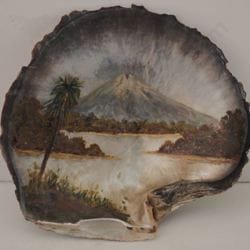
Mount Egmont with Lake
By: John Philemon Backhouse (1845-1908)
Oil on Sea Shell - 13cm x 14cm
Valued $2,000-$3,000
Offers invited over $1,500
Contact: Henry Newrick – (+64 ) 27 471 2242

|
|