
Founded by Max Farndale 1947 - 2018
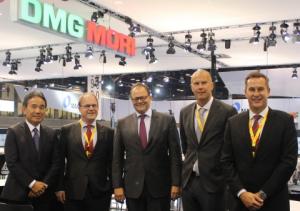
Cutting tool and tooling systems specialist Sandvik Coromant has signed an agreement to become a Premium Partner of leading machine tool manufacturer DMG MORI. The deal, which makes Sandvik Coromant the only tooling manufacturer to be named as a DMG MORI Premium Partner, will further strengthen the relationship between the companies on a global scale. Machine shops around the world will benefit from the combined knowledge and experience of the two market leaders.
As a DMG MORI Premium Partner, Sandvik Coromant will work with the machine tool builder on a wide-range of initiatives, including R&D and engineering, open house events, trade show appearances, technical seminars, website collaboration, and the DMG MORI Journal. Specifically, the agreement will give users of DMG MORI machines access to the turning, parting and grooving, threading, milling, drilling, boring, and reaming tools from Sandvik Coromant, as well as tooling systems and the company’s extensive range of knowledge, industry solutions, and services.
“This agreement confirms our position as one of our industry’s true premium and forward-looking companies,” said Klas Forsström, Global President of Sandvik Coromant. “As we join forces with a leading machine tool builder, for example, on turnkey projects, we take an active role in advancing technology for the industry.”
Sandvik Coromant will equip DMG MORI machines with a wide range of products, services, and know-how. For example, a customized start-up tool kit and service will be supplied with each NLX series universal lathe and NT turn-mill center in selected markets. On the CLX/CMX (previously Ecoline) entry-level machines and DMC V vertical machining centers, users will receive a defined tool kit and global service provision.
Evidence of the successful collaboration between Sandvik Coromant and DMG MORI was seen recently when the two companies partnered with Rota Metal, a distributor in Turkey, and its customer Polat Makina.
Polat, a food technology company, was ready to make the switch from individual machining to multi-tasking machines. Sandvik Coromant recommended a complete new tooling package based on the company’s Coromant Capto® modular quick-change tooling concept. The DMG MORI machines included an NTX 2000 with Capto C6 spindle, an NT 5400 with Capto C8 spindle, and an NT 6600 with Capto C8 spindle. Sandvik Coromant tools specified to help complete the switch included Silent Tools®, CoroTurn® HP, CoroCut® SL, CoroDrill® 860, CoroTap® 300, CoroChuck® 970, and CoroChuck 930. The changes resulted in a reduced machining time, from 2500 to 500 minutes, for a finished end product. The 500% savings is helping ensure rapid return on the company’s investment.
Added Ibrahim Polat, owner of Polat Makina, “Sandvik Coromant did not just supply the tools, they supplied the solution.”
A Sandvic Coromant release Dec 7, 2016
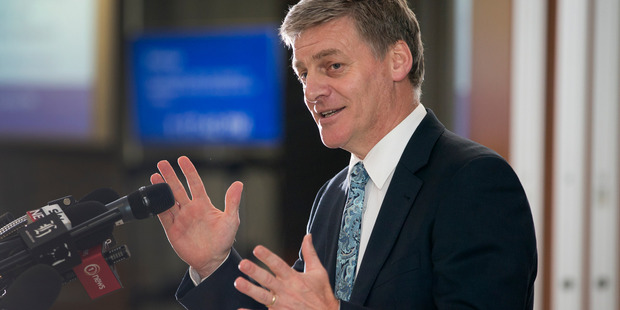
Bill English: 'I'll have to appoint a Cabinet and there'll be changes'
Mercer sells 130.8M shares to fund acquisition, one-third sold to managers
Foreign ownership of listed NZ companies rises above a third
Boeing's newest 787 prepares to take off as Trump roils trade
While you were sleeping: ECB extends asset purchases
Fairfax confirms third party buy offer
2017 holds considerable uncertainties: Wheele
Takeover target Hellaby hints at breakup
Te Rapa Gateway gains momentum with two new industrial developments
Global business calls west Auckland home
John Key Fades Away-– a Market Trader Quits his Position at The Top
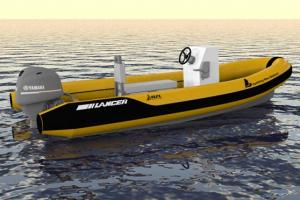
Yachting New Zealand has selected after an in depth design process the Lancer RK5000 “Ultimate Support Boat” as their new coach boat for their development programs.
From the outset of the project it was clear that modern sailing has put even greater demand on support vessels than is currently available. Lancer Industries Ltd and Yamaha Motor New Zealand who are long term suppliers to Yachting New Zealand, have teamed up to create a RIB package that will perform to these high standard requirements.
Lancer drew on the extensive knowledge of coaches, fleet managers and experts to create three key requirements; safe sea keeping, ease of operations and ergonomics. Consistent feedback was that many existing coach boats were recreational craft adapted for coaching and were simply a compromise.
The Lancer and Yamaha package is clearly the result of a customer led design. The unique hull has a long fine bow entry which leads to fixed lift tabs on the transom. This will really assist operation as the majority of work is done at low speeds and RPM, where the 60hp four stroke Yamaha has excellent torque.
A challenge was set by a user group for ‘Clean Decks’ but with a twist, everything below deck had to have good access, and no fixed fuel tank. This has led to a clever straddle seat that opens to a locker capable of storing two Yamaha 24 litre fuel tanks. There are many benefits, weight is low and well balanced, maintenance will have excellent access and all lines or cables commonly found on the decks of coach boats are hidden
The pedestal console used on the RK5000 is a well proven model used in the last two Olympic campaigns on Yamaha powered Lancer RIBS. More ergonomic consumer led design can be found in the placement of grab handles and stash bags so equipment is easy to reach and safety is increased.
The RK5000 is finished off with Lancer’s 3T designed hypalon tubes that allow for more contour and shape to create a fuller bow. Lancer’s inflatables tubes have a legendary status of longevity and reliability which reduces the true cost of ownership.
The first RK5000 is set to be launched for the ISAF Youth Worlds on 14-18 December with a more to follow. This is a very fitting debut for a RIB designed to excel in these conditions.
08 December 2016
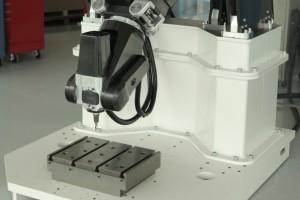
The Advanced Manufacturing Research Centre in Sheffield has developed what is believed to be the world’s first carbon composite reconfigurable machine-tool.
Lightweight and made using a modular design, the tool can be easily moved around by two people and, according to the AMRC, could reduce tooling costs in aerospace and other industries.
The tool was developed in collaboration with system manufacturer Exechon, which specialises in a type of machine tool using a system known as parallel kinematics. Rather than mounting all of the axes of the machine in a row, with the ‘end effector’ that holds the actual cutting or milling tool on the end, parallel kinematics mounts the end effector between two movable arms that hold the workpiece and move it through the X, Y and Z dimensions. Proponents of this system say that it can move as flexibly within the same volume as the conventional serial linkage type of machine tool, but with greater accuracy and stiffness.
“Making the structure modular and from composites means the robot can be dismantled and moved easily by two people,” said Ben Morgan, head of the AMRC’s integrated manufacture unit. Moreover, because composites are less susceptible to thermally induced expansion and contraction than metals, the conditions inside the factory will have less effect on the robot’s accuracy, he added.
The machine tool was made as part of the AMRC’s contribution to the Factory of the Aircraft Future project, a UK government-backed initiative to help protect the country’s status and expertise in the aerospace manufacturing industry. It was also a collaboration within the AMRC itself, with most of its parts made by the Composites Centre and its metal components made by the Machining Group and apprentices from the Training Centre.
“Potential applications include drilling and milling holes in wings faster and without having to make major investments in purpose-built machine tools, which cannot be moved easily,” Morgan said. The integrated manufacturing group is now running tests on the machine tool to fully validate it.
Release published in The Engineer
The Zespri Board last night approved plans for a new office building on its current site in Mount Maunganui.
Zespri Chief Financial Officer Dave Hazlehurst explains that Zespri’s new building will provide a home for its brand and a future-proof building to support possible future growth in the industry.
“Zespri has well and truly outgrown our existing building as the organisation has grown to support our industry’s rapid progress. With global sales expected to more than double to $4.5 billion by 2025, the new building will provide the facilities we need to deliver this growth for the kiwifruit industry. We’re excited to show our community and growers something we can all be proud of.
“This development will connect us with both our local community and the global markets, and includes redeveloping the public park so the community can continue to enjoy this green space in the heart of the Mount. Zespri’s investment in the new building shows our long-term commitment to the Bay of Plenty which produces around 80 percent of our premium Zespri Kiwifruit,” says Mr Hazlehurst.
The new building will be a hub for the kiwifruit industry with facilities to host growers and office space for other kiwifruit organisations. It will also provide a venue to host international trade, government and media delegations on behalf of the industry.
Zespri is investing over $40 million for the design, build, fit out, furnishing and landscaping of the new 4,800m2 landmark office complex. The three-story complex will stand in a park-like setting and includes onsite parking.
“We’ve incorporated some features to make the building more efficient and sustainable, like a smart façade, efficient heating and air conditioning services, and water recycling. We’ve also developed flexible working arrangements to allow staff to work in different workspaces when doing different work – this increases productivity and reduces the physical footprint of the building,” says Mr Hazlehurst.
The architects for the project are Warren & Mahoney and Beca has been appointed as the project manager. The construction contract will open for tender shortly.
Zespri bought the land on its site at 400 Maunganui Road from Tauranga City Council in December last year and has been operating from the site since 1996. Work will start on the site in the first quarter of next year, with the building set for completion by the end of 2018. The old brick Zespri building, constructed in the 1970s, will eventually be demolished and replaced with parkland.
A Zespri press release - Dec 7, 2016
The factory to the world has a new export: inflation. And it’s shipping faster than many thought possible just a few months ago.
China’s weakening yuan, stimulus designed to ensure robust growth ahead of a crucial Communist Party Congress next year, and rebounding commodity prices are pushing up factory prices. Having turned positive in September for the first time in more than four years, producer prices rose 1.2 percent in October from a year earlier. That will almost double to 2.3 percent in November, according to analysts surveyed ahead of data due Friday.
The pace is seen quickening even more next year: JPMorgan Chase & Co. estimates factory inflation will rise to as high as 4 percent in the first quarter while Commonwealth Bank of Australia sees it peaking at 6 percent in the third quarter of 2017.
Such increases would ripple through China’s vast supply chain across Asia, and to consumer markets from New York to New Zealand. The price turnaround coincides with a recent spike in oil prices and rising expectations for global reflation as U.S. President-elect Donald Trump prepares to boost fiscal and infrastructure spending.
Continue to full Bloomberg released article
Brexit trade minister and North Somerset MP Liam Fox has admitted Britain will have to effectively have the same trade agreements with other countries around the world – even after leaving the European Union.
Dr Fox announced he has opened discussions with 164 other countries in the World Trade Organisation, but because Britain has just two years before it leaves the EU, he will have to 'replicate as far as possible' the current agreements and 'obligations' to the World Trade Organisation.
And that - given the Brexit campaign was won largely on the basis of the promise of bespoke trade deals between Britain and other major countries outside the EU, like Brazil, China and the US – has caused criticism from Brexit campaigners.
Whitehall officials said Dr Fox's announcement is the first and necessary part of the process of leaving the EU, but the International Trade Secretary is in a Catch-22 situation because although Britain needs trade agreements in place with other countries outside the EU, most of the 164 members of the World Trade Organisation are waiting to see the deal Britain strikes with the EU on the terms of Brexit.
The prospects look promising for New Zealand’s economic expansion to continue in the face of considerable international uncertainties, Reserve Bank Governor Graeme Wheeler said today.
Speaking to the Development West Coast Conference in Greymouth, Mr Wheeler said that in many respects the economy is performing well.
“Relative to the trends over the past two decades, New Zealand is experiencing stronger economic growth, lower inflation, and a lower unemployment rate – even with record levels of labour force participation. The Achilles heel of many New Zealand expansions – a large current account deficit – has not eventuated.
“However, not everything is as positive. The overall expansion, now entering its eighth year, is weaker than other post-WWII expansions. GDP growth on a per capita basis has been slow and labour productivity growth has been disappointing. House price inflation is much higher than desirable and poses concerns for financial stability, and the exchange rate is higher than the economic fundamentals would suggest is appropriate.”
Mr Wheeler said that, in the absence of major unanticipated shocks, prospects look good for continued strong growth over the next 18 months, driven by construction spending, continued migration, tourist flows, and accommodative monetary policy. Supply disruptions associated with the Kaikoura earthquake are unlikely to have a major impact on overall economic growth, while some increase in freight costs and construction cost inflation is likely.
“Our November 2016 Monetary Policy Statement forecasts show annual real GDP growth of around 3¾ percent over the next 18 months, with inflation approaching the mid-point of the target band, the unemployment rate continuing to decline, and the current account deficit remaining within manageable levels.
“The low point for CPI inflation has probably passed and, supported by the improvement in global commodity prices in recent months, we expect the December quarter 2016 CPI data to confirm that annual CPI inflation is moving back within the 1 to 3 percent target band.
Mr Wheeler said that New Zealand will enter 2017 with considerable political and economic uncertainties.
“The greatest threat to the expansion lies in possible international political and economic developments and their implications for the global trading environment. The main domestic risk – and one that could be triggered by developments offshore – is a significant correction in the housing market. Numerous measures indicate that New Zealand house prices are significantly inflated relative to usual valuation indicators.”
“As has been the case in several other countries, monetary policy has been made more challenging in New Zealand by low global inflation and zero or negative policy rates in several major economies. This has put downward pressure on our interest rate structure and contributed to asset price inflation and upward pressure on the New Zealand dollar. This trend may finally be turning.
“At this stage, global and domestic developments do not cause us to change our view on the direction of monetary policy as outlined in the November MPS. We expect monetary policy to continue to be accommodative, and that the projected policy settings will help generate sufficient growth to have inflation settle near the middle of the target range.”
Read the speech: http://www.rbnz.govt.nz/research-and-publications/speeches/2016/speech-2016-12-08
A new Land Transport Rule will help increase efficiency and ease congestion on our roads by enabling trucks to carry more freight, Associate Transport Minister Craig Foss says.
The new Vehicle Dimensions and Mass (VDAM) rule makes small adjustments to the rules covering height, width and weight limits for trucks and some buses.
“Maximising the potential of our heavy vehicle fleet will increase capacity and improve productivity across the transport sector,” Mr Foss says.
“Enclosed vehicles such as refrigerated trailers will be able to load three more pallets side-by-side, increasing capacity by 10 per cent and reducing the number of these vehicles on the road by a similar amount.”
The VDAM changes include:
“Safety is always the Government’s primary consideration. The rule will encourage operators to purchase newer vehicles aligned to international dimensions with more technology and safety features,” Mr Foss says.
The VDAM Rule 2016 comes into force on 1 February 2017.
For more information, visit: www.nzta.govt.nz/vdamrule2016
Foreign Minister Murray McCully has welcomed the visit to New Zealand later this week by Brunei’s Second Minister of Foreign Affairs and Trade Pehin Lim Jock Seng and Energy and Industry Minister Pehin Yasmin Umar.
“Brunei is an important partner for New Zealand in South East Asia, and we enjoy friendly cooperation in defence, trade and education,” Mr McCully says.
“During the visit, we will discuss Brunei’s plans to diversify its economy and how New Zealand can best support these efforts. Our talks will also focus on regional economic and political issues.”

Palace of the Alhambra, Spain
By: Charles Nathaniel Worsley (1862-1923)
From the collection of Sir Heaton Rhodes
Oil on canvas - 118cm x 162cm
Valued $12,000 - $18,000
Offers invited over $9,000
Contact: Henry Newrick – (+64 ) 27 471 2242
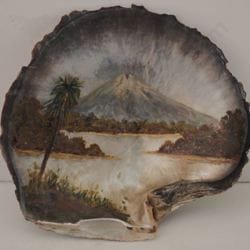
Mount Egmont with Lake
By: John Philemon Backhouse (1845-1908)
Oil on Sea Shell - 13cm x 14cm
Valued $2,000-$3,000
Offers invited over $1,500
Contact: Henry Newrick – (+64 ) 27 471 2242

|
|