An ex-employee reader responds to the question “Do you want another Ministry of Works?”
For a while in the 1960s I worked as a labourer at the Ministry of Works Benmore dam site. It has been fashionable now for an entire generation to deride the MoW, everything it stood for, and everything it did. Yet I believe that the MoW is now worthy of some impartial scrutiny and especially so in the way in which it routinely went about its business in what are now viewed as critical spheres of activity in the productive sector. Among them:- * Quality Control * Staff induction and management * Technical training * Environment * SafetyFirst though a personal disclosure. When I signed up at Otematata other than a strong back there was little to recommend me in terms of formal qualifications. In the event I was hired and assigned to the single men’s camp, and told to turn up at a designated truck stop early the following morning to be taken to the site.
In fact, the next morning, I was dropped off at the site plant nursery. It was only much later that I realised that during my preliminary interview I had mentioned a very brief holiday job planting trees and a vague interest in silviculture in general. This had been carefully noted.
I was to find in the Otematata site nursery that everyone involved in it was highly qualified, notably the head nurseryman named Sid who had spent his entire career in the vocation. In various other roles in and around Benmore I was to find that the Ministry of Works had in common with the army a dislike of on-the-job training. You had to arrive at the job, whatever it was, already trained for it.
The planting out of the trees, notably willow and poplar poles, around the Benmore Lake area was then described as being for erosion control. But I noted too that care was taken that ornamental species were dotted in and around the more functional tree species.
After a while I was sent to another depot, this time with quite a different purpose, and known as The Reclaim. This was simply a vast open air yard reconditioning plant in which the wooden boxing used to shape and form the poured concrete was scraped bare so that it could be used again. Mechanical equipment was similarly scraped of concrete so that it too could be re-applied.
It was only much later that I came to realise that I had been involved, courtesy of the Ministry of Works, with what would now be readily described as recycling, or, more grandly, the environmental “movement.”
On the dam site itself I observed at every stage the calculating and re-calculating of every operation before it in fact took place. In terms of concrete pouring nothing happened at all without the sanction of what was known as the concrete “technician,” who generally turned out to be Dutch.
The Ministry of Works had a safety record that would stand up to this day. Nothing was taken for granted.
On one smoko break in the middle of a particularly arid part of the site area a group of us were sitting down and using the tyres of a Euclid as back rest.
A Land Rover came to an abrupt halt in front of the group. A foreman leaped out and crisply instructed us to move away. There had been a case somewhere of such a giant earthmover tyre bursting and injuring those close to it.
A criticism of the MoW nowadays is to the effect that the labouring force was stuck there in the labouring category and that there was no upward path in terms of promotion. In fact, I observed that any reasonably diligent youngster could work his way up. Again, and as with the army, you worked your way up through the ranks--- leading hand, charge hand, foreman. Then there was the opportunity of breaking into the commissioned officer class via an engineering degree.
Engineers ran the show. They exercised their authority by moral suasion. At the very top was the Project Engineer. The following tale will demonstrate the absence of any elitism.
On one occasion I was invited to a party at the house of a fellow-labourer who happened to be married and thus lived in the married people’s section of the town which featured uniform state house design white painted bungalows.
On inquiring who my friend’s neighbour was I was mildly surprised to learn that it was the Project Engineer who lived there, next door, in an identical house and with his wife and family.
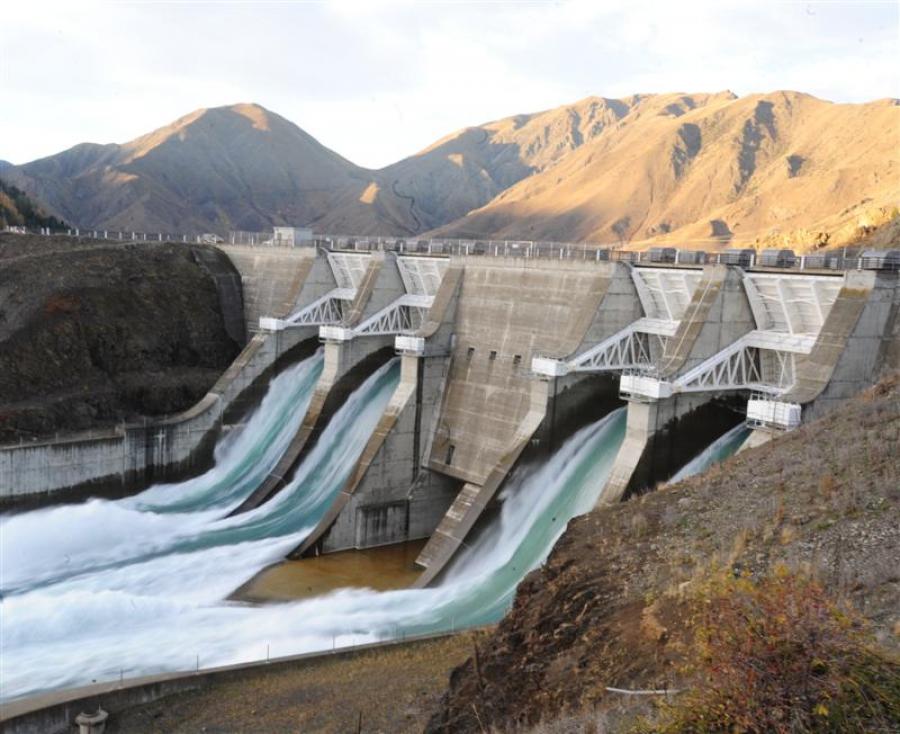
An Englishman present was incredulous that someone who was personally responsible for the success or otherwise of one of the world’s major construction schemes (Benmore, pictured, was then the planet’s biggest earth-fill dam) could possibly be billeted next door to one of his labourers.
Yet this was the case. The Ministry of Works never fell into the trappings trap.
The days of which I write were sometime before the era in which the productive sector, like all other areas of human activity became engulfed in the newspeak required to blunt the sense of anything upon which might be placed an impolite construction.
The single men’s cabin camp had emblazoned on its main entrance a sign which stated “Women and Bailiffs not Allowed.”
The camp sergeant, as he would not now be described, was a larger-than-life fellow called Taffy. He was rumoured to be rich, owning a large farm in the region, but finding it more congenial to run the camp rather than his farm which was in the hands of a manager.
He was ultra frugal. A curious thing about the camp cabins was that in spite of their proximity to this immense electrical generation capability, each one of them was metered. Taffy, when the time came for a brew up, would always take his Zip to one of the communal areas, such as the laundry, in order to by-pass his own meter.
Anyway, on one occasion, I asked him about the sign at the gate, the one forbidding females.“Oh,” he responded in a matter of fact manner. “That is what the men here wanted.”
The Waitaki River stepped hydro scheme was the high water mark of the Ministry of Works. This was the culmination of its role as the national concentrated focus of civil engineering resources in order that gigantic works which otherwise would be unachievable were in fact achieved.
Nothing lasts for ever and the nibbling away at its authority was even then visible. Much earlier Bechtel did the Rimutaka Tunnel. Problems with construction tunnelling was an acknowledged deficiency in the Ministry of Works armoury and at Benmore I noticed how readily hard rock miners from the Balkans were welcomed into the polyglot fold.
Downer did Roxburgh. Utah, Manapouri. Then Codelfa, Tongariro. The writing was on the penstocks.
The Ministry of Works was swept away in the 1980s and its expertise sold-off to Malaysia in the form of Opus (Latin for work.)
So why am I writing all this, more than half a century afterward? It is because at an engineering conference in Wellington I, along with the rest of the audience, was rhetorically asked by a high-level speaker defending the government position on several contentious fronts .....
“Do you want another Ministry of Works?”This is exactly the kind of rebellion-quelling response that high-level officials are trained and qualified to give.
My answer, had I been required to respond individually would have been.“No I do not. The government can no longer run the risk of being both simultaneously operator and regulator.”
Had I been, in my imagination, pressed further I would have mentioned the perilous wire tripped by the state’s dual involvement as operator-cum-regulator in mining. Pushed, I might have mentioned its similar dodgy dual role in loosey goosy sectors such as entertainment.
As is the New Zealand way when the old Ministry of Works was declared a bad thing, everything about it was bad, and over the years, as the government speaker knew, got worse in memory with each year that passed by.
And yet....and yet.....Along with others who were there, I remember the expert but no-frills management style, the exceptional ability of the engineers and the loyalty and the diligence it all inspired in the workers of which for a while I was one.
From the MSCNewsWire reporters' desk - Friday 21 October 2016