
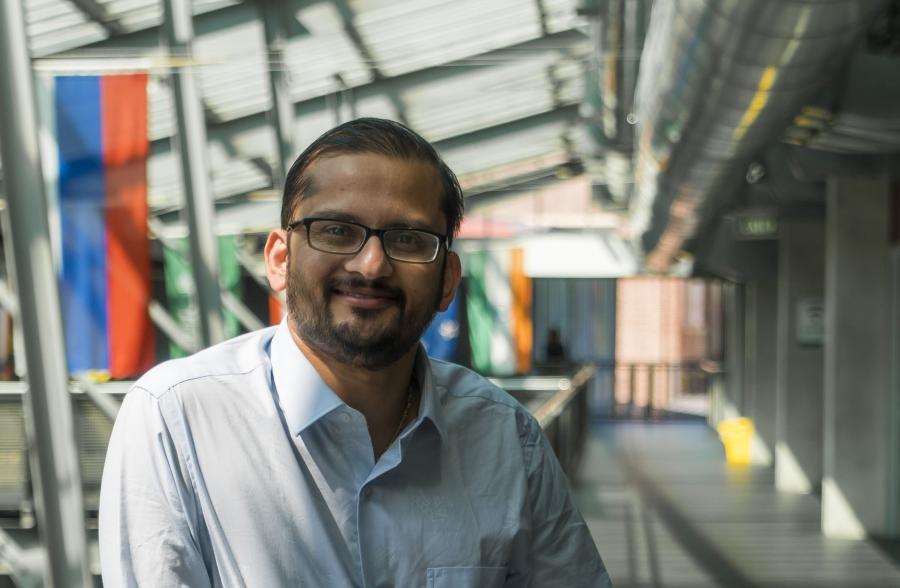
15 Nov 2017 - Ara computing senior lecturer Amit Sarkar interviewed the top decision makers at 30 organisations that survived the Christchurch earthquakes, and found that Information Systems (IS) resilience was a major factor in their continued operation and successful recovery. This held true for large organisations and small organisations, both public and private sector.
Amit’s work impressed participants and jury at the European, Mediterranean and Middle Eastern Conference on Information Systems (EMCIS), where it was awarded best research paper this year. The paper Governing Information Systems Resilience: A Case Study is co-authored by Stephen Wingreen from UC and John Ascroft from Jade Software. Another paper in this series, CEO Decision Making under Crisis: An Agency Theory Perspective, is co-authored by Stephen Wingreen and Paul Cragg from the University of Canterbury, and was published in the Pacific Asia Journal of the Association for Information Systems (June 2017).
“Information Systems (IS) resilience is fundamental to an organisation’s survival,” Amit says. “In every organisation, if there is downtime in an organisation’s IS then there is a very slim chance that they will survive. Snail mail and paper-based accounting is almost obsolete. So the IS is quite central to the business. If the IS is down, if they can’t receive or send data and they can’t do any transactions, then what are consequences?”
Resilience is widely recognised in related disciplines such as Computer Science, Crisis Management and Safety Engineering, but there had been very little attention paid by Information Systems scholars to IS resilience. Business leaders who Amit interviewed told him that IS resilience was very important, but simply had not been documented.
Canterbury’s computing experts and business leaders have a lot of wisdom to share about business preparedness for disaster and Amit collated this using Q spot methodology to identify not only the most important factors in IS resilience, but also how decision makers prioritise these factors for resourcing.
Successful organisations, he found, had an IS resilience plan and, most crucially, they had practised it, challenged it and embedded it into the organisation.
“Good process means you are taking it seriously and practising it, trying to find the loopholes and debating, learning from the drills what went wrong and how to improve, so that when the real thing comes you are super ready. That cannot happen from reading the plan on the day. The plan goes out the window when the disaster strikes, so this is significant.”
Often basic preparation included migrating data to the cloud – something the city council fortuitously completed just four hours before the first, September 2010, earthquake struck. When there is no physical access to servers, then the cloud becomes essential for retrieving stored data.
Diversity and complementarity within the company was important to testing resilience plans for many eventualities and for practising problem solving. When a range of thinking styles was employed, IS resilience plans were more thoroughly tested. IS resilience is as much about people as it is about technology, Amit says.
“All the companies that survived put people in the centre. There is a huge emotional toll that happens and every single organisation in the study, including Ara, took care of the people, by making sure salaries are paid, checking on employees and so on. It’s a symbiotic relationship. If you look after your employees, they will look after your technology and processes.”
Not only did organisations need to be resilient themselves, but they had to choose partners carefully to ensure they were also resilient. Having robust systems would be pointless if the supply chain collapsed because other organisations were not prepared. This also applied to overseas partners.
An in-depth case study on Jade Software in Christchurch has now evolved into a proposal to develop an app to periodically check organisations’ resilience status. This could create a valuable tool that can be used in different countries and cultures, Amit says.
| An ARA release || November 15, 2017 |||