
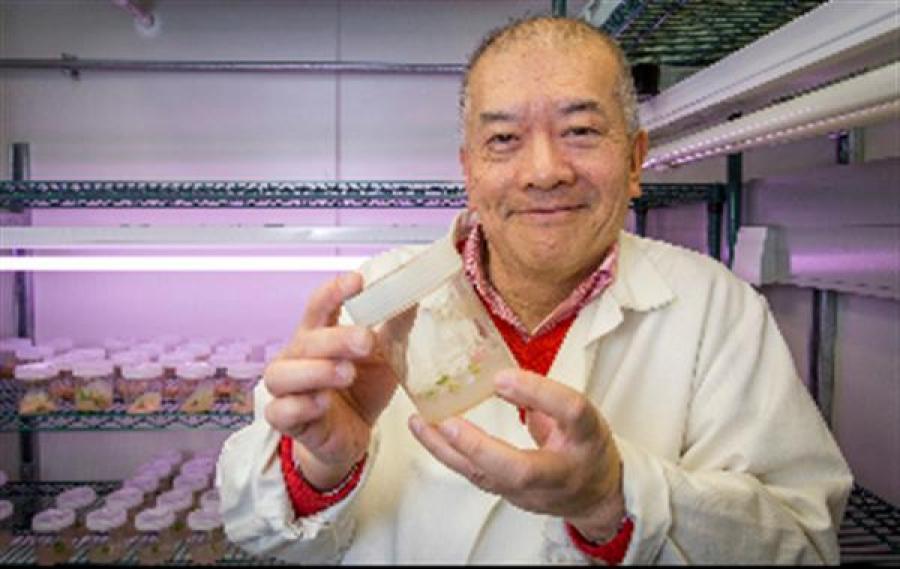
It seems like 3D printing has taken root at the University of Canterbury in New Zealand. Just last month, the university’s archeological faculty announced its intentions to 3D print educational models of 3,000-year-old artefacts. Now, its biological sciences department is planning to use 3D printing to fight deforestation, with associate professor David Lueng having just been awarded a government grant to explore the development of synthetic wood through the 3D bioprinting of live plant cells. The research project aims to provide the wood industry with a sustainable alternative.
Given the global problem of deforestation, creating viable 3D printed wood would be a huge achievement. Nearly half of all original forests have already been cut down, and the global trend is not slowing down. According to some estimates, up to 13 million hectares of forest is lost every year–the equivalent of 36 football fields per minute. Deforestation is also known as a very important contributor to global carbon emissions, so all wood alternatives are very welcome.
Professor Leung might have a solution: 3D bioprinting artificial wood that can be harvested to provide a customizable alternative to the real thing. The New Zealand government believes that the plant physiology expert could be onto something, and has provided him with a NZ$255,000 grant over a three year period. If successful, he could provide the New Zealand manufacturing sector with a new, sustainable biomaterial.
A lot more is happening over in New Zealand, as Leung’s initiative was just one of 10 ambitious seed projects that received grants from the NZ$826,000 fund of the Science for Technological Innovation (SfTI) National Science Challenge (2016). The ten selected projects were recently announced by Science and Innovation Minister Steven Joyce.
Professor Leung himself is also a biotechnology expert, and his project (entitled ‘Enabling sustainable economic development with advanced additive manufacturing of wood’) is seen as having a lot of economic potential. “Although challenging, there is potential to use live cells as an advanced manufacturing material in a yet-to-be invented, new industry,” Leung said. In this application, 3D printing would become an industrial, mass-production tool.
The viability of Leung's method has already been demonstrated during a test with live green algal cells, but the associate professor is confident that the project can go further: “It is possible that other types of plant cells, such as the wood-forming cells of eucalyptus trees, could be used as bio-printing materials," Leung explained. "Hence, it is a potential, socially acceptable opportunity for sustainable economic development derived from native forests."
In particular, Leung is currently looking at live eucalyptus tree cells: “They will be physiologically primed in a 3D structure in the biotech lab at the University of Canterbury, without any genetic modification, to be capable of responding to the appropriate triggers for transformation into a principal wood cell called a tracheid,” he said. “The changes in the cells will be studied in relation to the characteristic morphological features and chemical properties of tracheids using various microscopic, histochemical staining and fluorescence techniques.”
If successful, this study could make a huge contribution to the fight against deforestation while simultaneously promoting and pushing other 3D bioprinting initiatives and even enabling the widespread implementation of 3D bioprinting on a larger scale. It’s clear that we’ll have to keep an eye on the University of Canterbury.