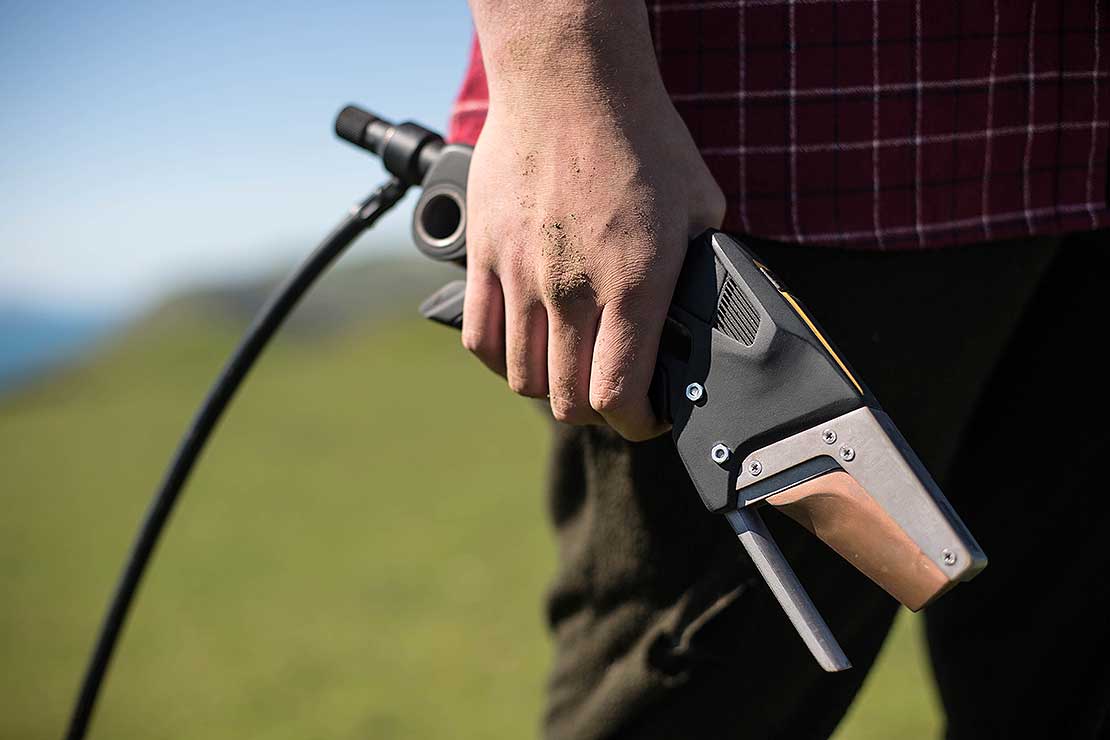
 Palmerston North - A Massey University student has redeveloped the humble docking iron aiming to increase function, usability and minimise repetitive strain injuries.
Fourth year industrial design student, Nicole Austin felt there was an opportunity to improve some of the more conventional hand tools used by sheep farmers. “A lot of sheep farming is very traditional. I found that recent innovations in sheep farming tend to be highly technological and involve heavy investment. Little attention has been given to redevelop older tools that are seen commonly from farm to farm,” she says.
Image Docking irons are regarded as being faster and more humane than rubber rings with nearly 60 per cent of farmers using the tool to cut the tails off lambs.
Ms Austin surveyed 300 farmers about their use of docking irons and discovered that while they regarded the existing models as robust and functional, they also found them to be uncomfortable to use for extended periods. Feedback included the irons being too hot, too heavy and “there are bugger all options on the market.”
“The traditional iron is hard to hold, the grip span is huge and there is a high risk for repetitive strain injury,” Ms Austin says.
Design criteria included optimising usability and comfort, being effective in all weather conditions, docking the tail properly and cauterizing the wound effectively.
“The design had to be reliable, robust and familiar. I did a lot of testing and made 15-20 ergonomic prototypes. I aimed to use familiar characteristics of the previous model to provide a practical lamb detailing tool for New Zealand and the international agricultural sector.
"The main body is glass-reinforced injection moulded nylon which has strong impact resistance and will withstand high temperatures,” she says. “The grips are made from a co-injection moulded elastomer, which won’t conduct heat and means the device is much easier to hold over extended periods," she says.
The original docking iron is fuelled by LPG, however farmers reported the flame blows out on windy days and can be difficult to reignite. Ms Austin’s design, which is also LPG, is self-igniting. She has developed a double-chamber dampening shaft - a mechanism designed to shield the internal flame from the wind. The design offers a greater temperature consistency in the copper blade and is about 35 per cent lighter.
Ms Austin will be getting feedback about her design from farmers and would like to see her prototype developed for the market. “There is definitely an opportunity to redevelop this tool. I would love to work with engineers to make refinements and confirm the design. There’s still a bit more work to be done.”
On graduating, Ms Austin will be looking for a job and likes the idea of eventually designing functional, utilitarian products for the agriculture and forestry sector as part of a design team. “Being at Massey has fostered that team approach. I really enjoy it.”
Ms Austin’s docking iron will be on display at the annual Exposure exhibition at Massey’s College of Creative Arts in Wellington alongside more than 300 projects from final year students in a range of disciplines from fine arts and photography to visual communication, fashion, textile, spatial and industrial design.
Open daily from 5 -19 November, between 10 am and 4 pm, the Exposure exhibition is located in Fine Arts Block 2, The Engine Room Gallery and Te Ara Hihiko Block 12 on Massey’s Wellington campus (entrance C off Wallace St or E off Tasman St).
A Massey University release