
Founded by Max Farndale 1947 - 2018

Initial Coin Offering earned the reputation as a legitimate way of fundraising. In this guide, I will explain the essentials on how to pick the right ICO investments. Read on to find the guidelines.
Digital currencies feature in an article published today in the Reserve Bank Bulletin that outlines different forms of digital currencies.

Mar 26, 2018 - New Zealand is becoming a global blockchain centre, FintechNZ general manager James Brown says. New Zealand is a living laboratory for global tech developments and inventions and Kiwis are producing blockchain businesses that have a global market place, he says.

New Zealand-based financial services company Ilumony has launched a cryptocurrency portfolio investment platform that is it says is designed to make the cryptocurrency investment accessible to everyone writes Stuart Corner for ComputerWorld.

A consortium comprising AB InBev, Accenture, APL, Kuehne + Nagel and a European customs organisation has successfully tested a blockchain system that can eliminate the need for printed shipping documents and save the freight and logistics industry hundreds of millions of dollars annually, Accenture said.

All appears quiet in the world of crypto. The roaring optimism we saw last year has died down considerably. With bitcoin falling 50% to US$9,900, the headlines are no longer shouting, ‘It could hit 1 million’. And as for the other all-star coins, well, they haven’t been faring much better either.

Jan 3, 2018 - Adding Ripple to Coinbase could send an already rising value skyrocketing writes Alasdair Wilkins on Inverse Innovation. While no cryptocurrency is yet ready to rival bitcoin, a surprise contender has popped up in the race for the silver medal. Originally designed in 2012 to ease bank-to-bank transfers, Ripple now has the biggest market cap of any non-bitcoin cryptocurrency, and there’s still one obvious thing holding back its potential: It’s not yet on Coinbase, the world’s most popular cryptocurrency exchange.

Dec 19, 2017 - Bitcoin: Flipping the Coin - You must be familiar with the above quote if you’ve watched the Christian Bale movie The Big Short. Does that mean the Bitcoin is a bubble waiting to burst? Maybe. The truth is no one knows just yet. It’s difficult to assess whether something is a bubble by simply reading the news or following the market. So, let’s begin by understanding what is a Bitcoin?
Bitcoin is a decentralized, digital cryptocurrency. Confused? Let’s take an example. Let’s say that you are ordering headphones from Amazon via a seller and you want to know exactly where they’ve been before they were shipped to you. How do you find out? The answer is, you cannot. You can’t know the exact source of the product and you definitely cannot find out all the transactions related to those specific headphones.
Imagine if there was some sort of a digital ledger that could tell you all that and more? There is. Blockchain is a distributed digital ledger that stores all transactions related to a specific product or asset. But then what is a Bitcoin? Blockchain technology is what makes the Bitcoin possible.
Bitcoin is a peer to peer decentralized digital currency that is used to buy and sell products online. Decentralized means that the Bitcoin is not managed or issued by a company, government or financial institution. Bitcoin uses blockchain to store all transactions in a digital ledger which is then accessible to everyone globally using their computers. Now that you understand the basics, let’s understand why there is so much hype surrounding the Bitcoin.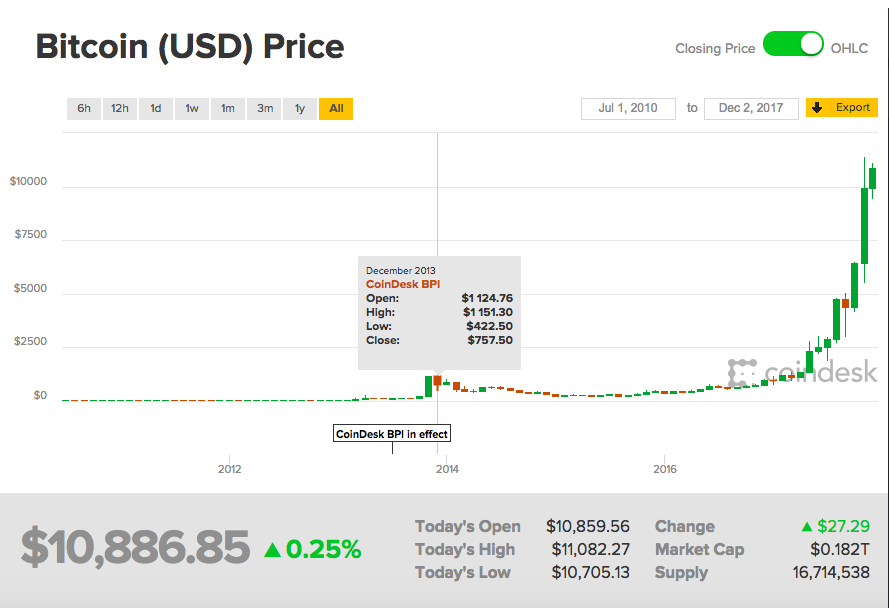
1 Bitcoin costs $10,886.85 at the time of writing this article. Crazy, right? Bitcoin was worth $1 in April 2011 and now, 6 years down the line, it’s worth more than 10,000 times its original value. But, why is the price of the Bitcoin so high? Bitcoin’s growing demand and the awareness amongst the public about cryptocurrencies is causing the price of the Bitcoin to rise.
The price of the Bitcoin has been fluctuating a lot recently but some are betting that the price of the Bitcoin will rise to $40,000 by the end of 2018. People are even purchasing 5% of 1 Bitcoin so that they can sell it off and earn a profit when the price rises again. Various Bitcoin exchanges like Coinome, Zebpay, Unocoin and several others in India are currently allowing the public to purchase and sell Bitcoin also known as BTC. So, should you invest in Bitcoin? I hope I can help you answer that question by the end of this article.
Warren Buffett, one of the world’s wealthiest individuals and a person who is widely regarded as one of the best investors of his time had this to say about the Bitcoin: “It’s a mirage.”
Several others share his thoughts but does that mean that they are right? Well, they could be but it’s quite difficult to assess something like this and who knows what could happen in the future. Let’s take a look at some important points:
Hopefully, some of these points helped you make a decision whether you should or should not currently invest in Bitcoin. Invest wisely and only invest in something you truly understand and believe in.
Source: FreeCodeCamp || December 2, 2017 |||

Dec 13, 2017 - Earlier this year, we committed to placing 55 billion XRP in a cryptographically-secured escrow account to create certainty of XRP supply at any given time. As promised, today we completed the lockup. By securing the lion’s share of XRP in escrow, people can now mathematically verify the maximum supply that can enter the market. While Ripple has proved to be a responsible steward of XRP supply for almost five years – and has clearly demonstrated a tremendous track record of investing in and supporting the XRP ecosystem – this lockup eliminates any concern that Ripple could flood the market, which we’ve pointed out before is a scenario that would be bad for Ripple!
This move underscores Ripple’s commitment to building XRP liquidity and a healthy and trusted market. Long term, the value of digital assets will be determined by their utility. XRP has emerged as the only digital asset with a clear institutional use case designed to solve a multi-trillion dollar problem – the global payment and liquidity challenges that banks, payment providers and corporates face.
Unlike other digital assets purely driven by unexplained speculation, real institutional customers are already using and finding value in XRP, and governments, regulators and central banks are increasingly recognizing the role it could play in the global system.
XRP goes beyond what Bitcoin does well — a store of value — and delivers transaction speed and throughput that is orders of magnitude faster than BTC or ETH. While other digital assets continue to bump against their transaction limits, XRP remains the fastest, most efficient and most scalable digital asset in the world – making it the best digital asset for payments. It’s no surprise that institutions are looking to XRP to provide much-needed on-demand liquidity for cross-border payments.
Game changer for $XRP! 55 billion XRP now in escrow Tweet This
Here’s how the escrow works:
The Escrow feature in the XRP Ledger allows parties to secure XRP for an allotted amount of time or until specific conditions are met. For example, Escrow allows a sender of XRP to put conditions on exactly when a payment can be completed, so the payment remains cryptographically locked until the due date.
We use Escrow to establish 55 contracts of 1 billion XRP each that will expire on the first day of every month from months 0 to 54. As each contract expires, the XRP will become available for Ripple’s use. You can expect us to continue to use XRP for incentives to market makers who offer tighter spreads for payments and selling XRP to institutional investors.
We’ll then return whatever is unused at the end of each month to the back of the escrow rotation. For example, if 500M XRP remain unspent at the end of the first month, those 500M XRP will be placed into a new escrow account set to expire in month 55. For comparison, Ripple has sold on average 300M XRP per month for the past 18 months.
Ripple’s vision remains the same – to enable the Internet of Value in which money moves like information moves today – and XRP is at the heart.
To learn more, please visit ripple.com/xrp.
| A Ripple release || December 7, 2017 |||

Dec 8, 2017 - Over its long history, Canada’s banking industry has absorbed a range of adjacent players in the sprawling world of financial services: trust companies, investment dealers, property and casualty insurers, and wealth advisors. Many of these structural mergers involved both extensive regulatory reform as well as significant cultural shifts within the industry. Yet as Canada’s banks consolidated and expanded into these other verticals, they tended to impose their cautious ways rather than adopt the more free-wheeling ethic of the smaller players they had raced to acquire.
The fintech revolution, however, will demand a complete reboot of this well-established dynamic. As these ambitious startups evolve from giant-killing disrupters into innovation-minded partners for the banking sector, both sides are struggling to figure out how to live with one another.
Fintech firms offer entrepreneurial energy, innovative technologies and highly flexible consumer engagement techniques. But they also bring a healthy dose of impatience to a famously staid industry that was widely congratulated, almost a decade ago, for the corporate caution and regulatory prudence that allowed Canada’s banks to ride out the 2008 credit crisis.
Banks, for their part, are awakening to the realization that younger consumers want to do most of their banking on their mobile devices, which is also how they shop and consume news. The American Banking Association even published a tip sheet for its members on how to “make friends” with fintech.
It’s a tall order. The sluggish pace of in-branch or web-based banking and lending, hard-wired into the banking industry’s culture, is anathema to the fintech industry’s sense of urgency and opportunity, and reveals, to many of these startups, a reluctance to take chances on new mobile and data technologies.
Fintech firms offer entrepreneurial energy, innovative technologies and highly flexible consumer engagement techniques. But they also bring a healthy dose of impatience to a famously staid industry
As a former banking consultant who now helps raise capital for fintech startups, I can see both sides.
If it hopes to survive, the banking industry needs to find new ways of partnering with these nimble newcomers. Yet the learning has to happen in the other direction as well: if they want to succeed and grow, impatient fintech entrepreneurs must find ways to work with these large, closely regulated institutions.
Let’s start with the source of the chafing. Various fintech players with serious ambitions have told me they often feel worn down by bank clients’ insistence on historical performance data for innovations with no past, the dearth of seasoned innovation champions within these huge organizations, the lasting effects of legacy technologies, and frustratingly diffuse decision-making processes.
Risk aversion runs deep in the banking sector, and, in many cases, it seems to be a point of pride. As some fintech founders report, they’re often told by bank partners that every feature of a new service must work perfectly, while potential downsides are scrutinized to the point of exhaustion. And though fintech founders are acutely aware of the fast pace of their own industry, many come away from these encounters sensing that their banking partners have little sense of urgency.
Today, some banks are starting to see that there may be risks associated with their institutional inertia. Most have established innovation labs or are backing proof-of-concept projects with fintech partners. While some fintech startups express skepticism about these ventures, others offer up useful advice for their bank partners on how to make such forays succeed:
— resist the analysis-paralysis instinct and give your innovation teams sufficient scope to dive into proof-of-concept partnerships, knowing that some will fail
— ensure that there’s a business sponsor behind such pilot projects, as well as a path that leads to a possible deal, and
— be prepared to pay fintech partners for the value they create through successful initiatives that generate new service offerings and improved customer engagement.
But it’s a two-way street. Fintechs need the support of banks to help overcome one of their main challenges: getting to scale and ultimately putting products in front of customers. This can entail something of a Catch-22, however, because banks often seem to be more receptive to partnerships with fintech firms that have already created a compelling brand promise, have a consumer track record and bring their own investors or sponsors to the table.
Fintech options ease the pain points of financing for entrepreneurs ‘There’s no silver bullet here’: Global financial firms still grappling with fintech challenge, report finds
So, what does a successful partnership look like? These pairings, fintech firms say, will increase addressable market segments; demonstrate how an improved user experience leads to increased adoption; expand the lifetime value of a customer relationship; and focus on service offerings that minimize competitive tensions.
To work with fintech firms, banks also need to reconcile themselves to some unfamiliar practices, such as associating their brands with products and services they don’t necessarily own. And both parties have to find common ground on technical issues such as customer data sharing, anti-money-laundering/know-your-client compliance and which key performance indicators will be employed to measure success, given that at least initially, the new fintech partnerships are unlikely to make a dent in the top line.
As this difficult pairing game proceeds, it may be useful to look beyond the banking industry for learnings. My own suggestion: IBM in the early 1990s, when then-CEO Lou Gerstner, a former consumer packaged goods executive, radically shook up the sleepy culture of a massive tech manufacturer. Recognizing the mortal threats facing his company from both the hardware and software sides of the computer industry, Gerstner forced IBM’s tens of thousands of employees to begin thinking about creating business solutions that actually responded to its customers’ needs. The end result? During Gerstner’s tenure, among many other changes, he shut down unprofitable businesses and added valuable service offerings to the commoditized hardware business, increasing the market cap of IBM to US$168 billion from US$29 billion.
Simply put, fintechs are to the banking sector as Gerstner was to IBM: crucial change agents, pushing these giants to confront the uncertain future taking shape outside the walls of a fortified industry that’s far more exposed than Canada’s bankers may realize.
Change, as we know, is hard. Not changing, however, would be worse.
Roy Kao is senior advisor, Finance & Commerce, MaRS Discovery District. This article first appeared in the Ivey Business Journal.
| A Financial Post release || December 8, 2017 |||

Palace of the Alhambra, Spain
By: Charles Nathaniel Worsley (1862-1923)
From the collection of Sir Heaton Rhodes
Oil on canvas - 118cm x 162cm
Valued $12,000 - $18,000
Offers invited over $9,000
Contact: Henry Newrick – (+64 ) 27 471 2242

Mount Egmont with Lake
By: John Philemon Backhouse (1845-1908)
Oil on Sea Shell - 13cm x 14cm
Valued $2,000-$3,000
Offers invited over $1,500
Contact: Henry Newrick – (+64 ) 27 471 2242

|
|