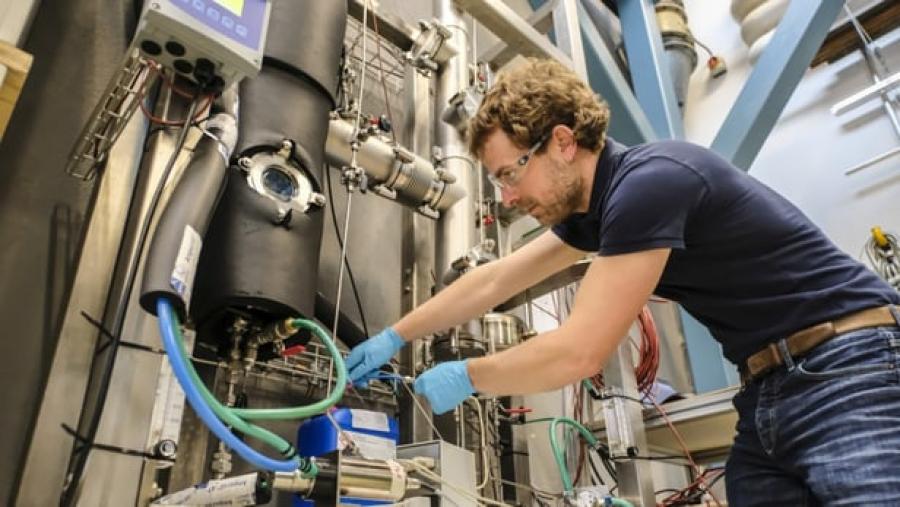
Though still in the prototype stage, EMPA is currently looking for commercial partners to assist in creating a compact version of the system for household domestic use(Credit: EMPA)
Making the move away from using fossil fuels for heating is a necessary part of creating a sustainable future, but it's often a difficult ask for many people when turning up a thermostat on a gas or electric heater provides instant, trouble-free warmth. If people are to be convinced to switch to more renewable sources, it makes sense that there need to be easy-to-use systems available to encourage them to do so. A group of Swiss researchers claim to have come up with a process that stores heat captured during summer for easy, flick-of-a-switch use in winter, with the added benefit that the captured energy can be physically transported anywhere it may be needed.
Created by researchers working at EMPA (Eidgenössische Materialprüfungs-und ForschungsAnstalt or, in English, the Swiss Federal Laboratories for Materials Testing and Research), the new system uses concentrated sodium hydroxide (NaOH) as the thermal storage medium, and a collection of largely off-the-shelf components to capture, convert, and release heat energy on demand.
To achieve this, the researchers rely on the fact that when water is poured onto dry sodium hydroxide an exothermic reaction ensues, where the chemical energy contained in the NaOH is released as heat. As NaOH is also extremely hygroscopic (that is, having a great attraction for dragging in and holding water molecules from the surrounding environment), more heat is produced from water condensing from vapor in the air and the sodium hydroxide solution is heated even further. In this way, large amounts of heat may be liberated from NaOH simply by the addition of water.
Conversely, if heat energy (collected from the sun, for example) is fed into a solution of sodium hydroxide diluted with water, the moisture readily evaporates and the NaOH solution becomes more concentrated and, therefore, effectively stores the supplied energy. This concentrated mixture may then be kept stored for many months (even years), until the heat is once again liberated when the NaOH is exposed to water again. The solution can also be easily transported in tanks to other areas where heat energy is needed.
In practice, the storage medium is a viscous liquid composed of a 50 percent NaOH solution that is made to trickle along in a spiral pipe (created from heat exchangers normally found in instantaneous water heaters), where it soaks up water vapor along the way and then conveys the generated heat into the pipe. The heat is then free to radiate, convect, and conduct into the area requiring warmth.
During this process, the sodium hydroxide solution cascades down the outside of the heat exchanger spiral, where it is diluted to around 30 percent in the steamy atmosphere of the inside of the system, and the water temperature within the pipe rises to around 50° C (122° F). Which, in a happy coincidence, makes it ideal for under floor heating.
The reverse of this process – passing heat through the medium to store energy – has also been demonstrated in the system. Specifically, the moisture from the NaOH solution evaporates when heat is applied, which is then siphoned off and condensed. The solution that exits the heat exchanger is now back up to 50 percent strength, and "charged" with heat energy. The researchers suggest that the heat for this step could be renewably produced using solar collectors (similar to those used in solar-powered air conditioning systems).
The heated water generated in the process of condensation is then transferred to a geothermal probe (generally loops of pipes embedded vertically in the ground) for storage and retrieval. After the stored condensation's temperature has dropped to somewhere between 5 and 10° C (41 to 50° F) it is returned to the apparatus to drain the store.
Though still in the prototype stage, EMPA is currently looking for commercial partners to assist in creating a compact version of the system for household domestic use.
The EMPA heat storage device is one of three competing systems in the COMTES project, which has the goal to develop and demonstrate compact seasonal storage of solar thermal energy.
| A Swiss Federal Laboratories for Materials Testing and Research (EMPA) release | January 12, 2017 |