
MSC NewsWire

Founded by Max Farndale 1947 - 2018
  • Home
    • About Us
    • Pricing
    • Global Presswire
    • Industry Organisations
  • News Sectors
    • Headlines Through Today
    • Environmental Talk
    • Out of The Beehive
    • Primary Sector Talk
    • Reporters Desk
    • The MSC NewsReel
    • MSCNetwork
    • FinTech Talk
    • The FactoryFloor Newsreel
    • Trade Talk
    • News Talk
    • Industry Talk
    • Technology Talk
    • Blockchain
    • Highlighted
    • The TravelDesk
      • TravelMedia
      • Sporting Tours
      • Holidays Tours Events + More
      • Airfares
      • Travel Enquiry Form
      • TravelBits
    • Travel Updates
    • The MSC TravelDesk Newsreel
    • Travel Talk
    • Travel Time
    • The Bottom Line
    • Regional News
    • News to Run Advice Form
    • World News
    • NewsDIRECT
    • MSCVoxPops
    • Press Releases
  • National Press Club
  • Contact Us

Smart windows channel magnetic fluids to shade and heat rooms

  • font size decrease font size decrease font size increase font size increase font size
  • Print
  • Email
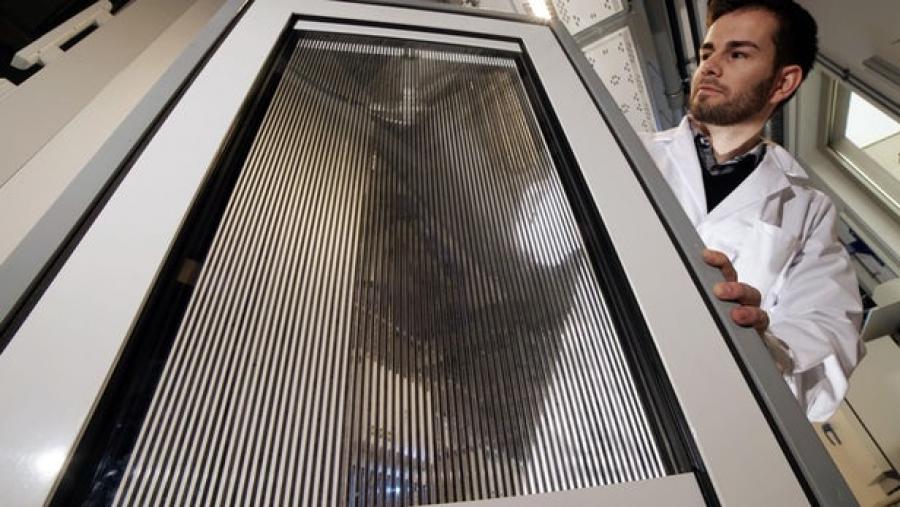
A prototype of the Large-Area Fluidic Windows, which can control shade and harvest heat using magnetic nanoparticles suspended in liquid( A prototype of the Large-Area Fluidic Windows, which can control shade and harvest heat using magnetic nanoparticles suspended in liquid( Credit: Jan-Peter Kasper/FSU)

Jan 18, 2018  -  Our future selves might look back and wonder how we ever handled having just plain old glass in our windows. Curtains or blinds might get the flick in favor of a variety of smart windows that can tint themselves or turn opaque on command, and now a team of German engineers has demonstrated a new design. Dubbed Large-Area Fluidic Windows (LaWin), the system uses iron particles suspended in liquid to block sunlight at different levels and harvest heat energy from the Sun.

Most of the smart window systems we've seen in the past are electrochromic, meaning they change tint or opacity in response to electrical signals passing through wires embedded in the glass. That lets users cloud the window over if they want both privacy and natural light, or darken the glass to keep the house cool.

This new system has similar applications but takes a completely different approach. To make a fluidic window, magnetic iron nanoparticles are suspended in a liquid, which is contained inside vertical channels in the glass itself. These particles cloud up the window, blocking light to different degrees and soaking up heat as needed. When you want to make it transparent, switching the LaWin on triggers magnets to pull these particles out of the liquid.

"Our project's key feature is the use of liquids in windows and façades, for example, as heat carriers or to enable additional functions," says Lothar Wondraczek, coordinator of the project. "To this end we develop new glass materials, into which large-area channel structures are integrated. These are used for circulating functional fluids. Depending on the number of the iron particles in the liquid, the liquid itself takes on different shades of grey, or it will even turn completely black. Then, it becomes possible to automatically adjust the incidence of light, or to harvest solar heat which can then be put to further use within the building."

In terms of heat gain by area, the researchers say the system is as about as efficient as solar thermal facilities. The team also says that no electrical connection is needed at the windows because toggling the particle capture system "happens in a separate tank."

The LaWin system might be more fiddly to produce, since the specialty channels need to be built right into the glass, but according to the developers these windows should continue to function for as long as the building is in use. While the current prototypes were manufactured in batches measuring 200 sq m (2,150 sq ft), the researchers say the technology should be scalable to standard sizes of window frames, including double- and triple-glazing frames.

The end goal is to cut back on energy costs, particularly in terms of heating and cooling of buildings which can make up a huge percentage of energy consumption. The design has already been funded to the tune of several million euros, and commercial applications are apparently planned for later in 2018.

A research paper describing the prototype was published in the journal Advanced Sustainable Systems.

Source: New Atlas - Friedrich-Schiller University Jena  ||  January 17, 2018   |||

 

Published in ENERGY
Tagged under
  • Construction
  • environment
  • industry talk
  • Energy

Related items

  • Plastics industry helps designers create easy-to-recycle packaging
  • Consultation opens on Block Offer 2018
  • FIRST Up: A Robotics Competition That Teaches Real World Engineering Skills
  • NZTech will launch New Zealand’s first formal digital identity organisation in Auckland on Monday.
  • GM is slashing more than 14K factory, white collar jobs; may close 5 factories
More in this category: « NZ proposes global trade solution to fossil fuel subsidy challenge SCG turns reservoirs into solar energy generating systems »
back to top

Palace of the Alhambra Spain

Palace of the Alhambra, Spain

By: Charles Nathaniel Worsley (1862-1923)

From the collection of Sir Heaton Rhodes

Oil on canvas - 118cm x 162cm

Valued $12,000 - $18,000

Offers invited over $9,000

Contact:  Henry Newrick – (+64 ) 27 471 2242

Henry@HeritageArtNZ.com


Mount Egmont with Lake

Mount Egmont with Lake 

By: John Philemon Backhouse (1845-1908)

Oil on Sea Shell - 13cm x 14cm

Valued $2,000-$3,000

Offers invited over $1,500

Contact:  Henry Newrick – (+64 ) 27 471 2242

Henry@HeritageArtNZ.com

MSC NewsWire is a gathering place for information on the productive sector in New Zealand focusing on Manufacturing, Productive Engineering and Process Manufacturing

  • Home
  • Global Presswire
  • Industry Organisations
  • National Press Club
  • Disclaimer
  • About Us
  • Pricing
  • Sitemap
Copyright © 2025 MSC NewsWire. All Rights Reserved.
Site Built & Hosted by iSystems Limited
Top
The MSC TravelDesk Newsreel