
MSC NewsWire

Founded by Max Farndale 1947 - 2018
  • Home
    • About Us
    • Pricing
    • Global Presswire
    • Industry Organisations
  • News Sectors
    • Headlines Through Today
    • Environmental Talk
    • Out of The Beehive
    • Primary Sector Talk
    • Reporters Desk
    • The MSC NewsReel
    • MSCNetwork
    • FinTech Talk
    • The FactoryFloor Newsreel
    • Trade Talk
    • News Talk
    • Industry Talk
    • Technology Talk
    • Blockchain
    • Highlighted
    • The TravelDesk
      • TravelMedia
      • Sporting Tours
      • Holidays Tours Events + More
      • Airfares
      • Travel Enquiry Form
      • TravelBits
    • Travel Updates
    • The MSC TravelDesk Newsreel
    • Travel Talk
    • Travel Time
    • The Bottom Line
    • Regional News
    • News to Run Advice Form
    • World News
    • NewsDIRECT
    • MSCVoxPops
    • Press Releases
  • National Press Club
  • Contact Us

New Zealand is beating Australia regarding Pacific work force

  • font size decrease font size decrease font size increase font size increase font size
  • Print
  • Email

Both New Zealand and Australia want to attract tourist fruit pickers [‘backpackers’] and seasonal workers from around the Pacific. However, latterly the numbers are becoming somewhat skewered. For every 1,000 backpackers picking fruit and vegetables in New Zealand, there are about 3,000 seasonal workers from the Pacific.

In Australia, the mix is different: for every 1,000 backpackers there are only about 250 Pacific seasonal workers.

The Australian outcome is what the research literature predicts: employers preferring the more flexible, much less regulated backpacker. It’s less hassle, and as recent media and academic research has shown, easier to get away with underpaying backpackers, where no government approval or reporting is required, than with seasonal workers, where stringent approval and reporting requirements are imposed.

How then to explain New Zealand’s contrary performance? There seem to be five factors which explain why New Zealand’s 2007 seasonal worker scheme (called the RSE or Recognised Seasonal Employer) has been much more popular than Australia’s 2009 Seasonal Worker Program (SWP).

First, New Zealand’s horticultural sector has a much stronger export orientation. As a result, the sector is more focused on quality and compliance, as stories of worker exploitation risk the loss of export markets. In contrast, Australian farmers are producing mainly for the domestic market, with little external scrutiny of workplace conditions and employee rights. They are focused primarily on costs rather than reputation.

Second, collective action is easier in New Zealand. New Zealand’s horticultural sector is much better organised than in Australia, and has a single peak body. It played a leading role in developing the RSE, and employs someone to promote it.

Third, the costs of regulatory compliance are also lower in New Zealand. Australia’s minimum wage is significantly higher than New Zealand’s, which creates a stronger incentive to avoid it.

Australia also has a weaker enforcement regime, making it less likely that you’ll be caught if you cheat. This is again due to the tyranny of size, but also because Australia has put less effort into developing a licensing regime for labour hire companies. This situation is now changing, which explains the growth of the SWP in recent years (as noted below).

Fourth, while Australia’s and New Zealand’s backpacker and seasonal worker schemes are very similar, there are subtle differences in their design, history and implementation, which have made a difference.

New Zealand introduced the RSE in 2007. At the time, Australia wasn’t prepared to follow suit. Instead, in response to farmers’ complaints about labour shortages, it introduced the second-year backpacker visa to funnel backpackers into agriculture in their first year with the offer of a second-year visa.

Finally, there is the simple fact that Australia simply attracts far more backpackers than New Zealand, making the potential pool of backpacker farm labour that much larger. In the 2017-18 financial year, Australia had 210,000 backpackers while New Zealand had only 70,000.

Source: asiancorrespondent.com
  • Source/ReadMore: A FreshPlaza release
Published in HORTICULTURE
Tagged under
  • Horticulture
  • news talk

Related items

  • Sir Bill English to be honoured by Victoria University of Wellington
  • Higher bank capital better for banking system and NZ
  • Plastics industry helps designers create easy-to-recycle packaging
  • Great Barrier unhappy with Auckland’s marine sludge plan
  • XE Update Friday 30 November, 2018
More in this category: « Strong demand for the KORU® apple in Asian markets Trade deal fantastic for horticulture »
back to top

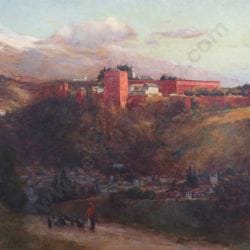
Palace of the Alhambra Spain

Palace of the Alhambra, Spain

By: Charles Nathaniel Worsley (1862-1923)

From the collection of Sir Heaton Rhodes

Oil on canvas - 118cm x 162cm

Valued $12,000 - $18,000

Offers invited over $9,000

Contact:  Henry Newrick – (+64 ) 27 471 2242

Henry@HeritageArtNZ.com


Mount Egmont with Lake

Mount Egmont with Lake 

By: John Philemon Backhouse (1845-1908)

Oil on Sea Shell - 13cm x 14cm

Valued $2,000-$3,000

Offers invited over $1,500

Contact:  Henry Newrick – (+64 ) 27 471 2242

Henry@HeritageArtNZ.com

MSC NewsWire is a gathering place for information on the productive sector in New Zealand focusing on Manufacturing, Productive Engineering and Process Manufacturing

  • Home
  • Global Presswire
  • Industry Organisations
  • National Press Club
  • Disclaimer
  • About Us
  • Pricing
  • Sitemap
Copyright © 2025 MSC NewsWire. All Rights Reserved.
Site Built & Hosted by iSystems Limited
Top
Travel Talk