
Founded by Max Farndale 1947 - 2018
The Government today launched in Wellington a scheme to recycle soft plastics such as shopping bags as part of a national partnership with the retail sector and packaging industry.
“This soft plastics recycling scheme is the next logical step for households in reducing waste. We have made huge progress, with most households now recycling paper, cardboard, glass, metal cans and hard plastic containers. Soft plastics which are used with shopping bags, frozen vegetable bags and hundreds of other products will now be able to be collected, re-manufactured and re-used,” Environment Minister Dr Nick Smith says.
The initiative is funded through grants of $700,000 to the Packaging Forum and $510,000 grant to Astron Plastics Group from the Government’s Waste Minimisation Fund.
“The extra challenge with soft plastics is finding a practical way of collecting them and keeping them clean enough for re-use. This scheme of locating recycling services at 51 Countdown, New World, Pak’nSave, Moore Wilson’s and The Warehouse stores across Wellington is modelled on a successful programme in Australia.”
The Packaging Forum grant has enabled the establishment of this recycling service at The Warehouse, Pak ‘n’ Save, New World and Countdown stores across Auckland, Hamilton, Christchurch and now Wellington. The Astron Plastics Group grant helped establish a new dry-cleaning facility in Auckland that will recycle soft plastics and reduce the requirement to import virgin plastic polymers.
“In Australia this scheme operates through the Coles Group and has saved thousands of tonnes of plastic going to landfill. This innovative and collaborative approach has proved successful in other locations around New Zealand and I’m looking forward to seeing Wellingtonians embrace it,” Dr Smith says.
“The longer-term objective is for 70 per cent of New Zealanders to have access to a drop-off facility for soft plastics within 20 kilometres of their home.”
New Zealand’s population will likely hit 5 million around 2020 and could reach this milestone sooner, Statistics NZ said yesterday.
In the year ended June 2016 the population grew at its fastest rate since the early 1960s, up 2.1 percent or 97,000.
"Our population was estimated to be 4.69 million at 30 June 2016, with net migration being 69,100 over the June year," Statistics NZ senior demographer Kim Dunstan said.
The latest projections show a high chance of the population rising to between 4.9 and 5.1 million by 2020. By 2025 the population is expected to be between 5.0 and 5.5 million. By 2068, the projections indicate a population of between 5.3 and 7.9 million.
The long-term median (mid-point) net migration is assumed to fluctuate around 15,000 a year. However, if there was average migration of 30,000 a year, the population could reach 7.5 million by 2068. Alternatively, that 7.5 million figure could also be exceeded with much higher fertility rates.
If there was no migration, the population would peak at 5.3 million around 2050 and then slowly decline.
The latest national population projections that look out to 2068 are not designed to be exact forecasts or predictions, but rather a guide to help planning.
85+ to tripleThe projections also show growing numbers of older people in coming decades.
The number of people aged 85 years and older will more than triple, from about 83,000 in 2016, to between 270,000 and 320,000 in the next 30 years. Those aged 65 years and older will roughly double, from about 700,000 now to between 1.3 and 1.5 million in 2046.
Overall population growth is expected to slow in the longer term as the population ages and the gap between births and deaths narrows. The rate of population growth may halve to less than 1 percent in the 2030s.
Webinar DetailsYour Presenter 
Samuel MacalisterSenior Technical Sales Specialist, BIM,Autodesk ANZMore information
Wednesday 26th October 20162:00 – 3:00PM NZST
Steinlager have returned as a sponsor to Emirates Team New Zealand for the 35th America’s Cup challenge in Bermuda in 2017.
For the first time since 2003, the famous Steinlager brand will be back on the kiwi boat as Emirates Team New Zealand race, to once again win the oldest trophy in international sport.
New Zealand’s involvement in the America’s Cup began with Steinlager proudly as a sponsor for the 1986 Fremantle America’s Cup with KZ-7, The ‘Big Boat’ challenge with KZ-1 in 1988, the New Zealand Challenge in 1992 and continued all the way through to the ultimately successful campaigns 1995 and 2000.
Communications Minister Amy Adams confirmed today that the Government has delivered on its commitment to make connecting to the Ultra-Fast Broadband (UFB) network free for virtually every household.
“I want as many New Zealand homes as possible to enjoy the benefits of the Government’s $1.6 billion UFB rollout. Under previous arrangements, almost all non-standard UFB residential connections were free until the end of this year. I’m delighted that we’ve been able to extend that agreement to the end of phase one the UFB build in December 2019 and intend to ensure similar provisions exist in contracts for UFB phase two,” says Ms Adams.
“This means that almost all households who are able to connect to UFB can do so at no charge to them. This increases the accessibility of UFB and allows the Government to fulfil its commitment to make residential UFB connections free,” says Ms Adams.
The agreement forged between Crown Fibre Holdings (CFH) and Chorus means Chorus will continue to offer free residential UFB installations for almost every homeowner until the end of the UFB initiative.
The local fibre companies, Northpower, Enable and Ultrafast Fibre, have already agreed to provide free non-standard installations to the end of 2019.
The agreement with Chorus extends an arrangement reached in 2012, which was due to expire at the end of this year, under which it will not charge a wholesale fee to install UFB into stand-alone homes and multi-dwelling units (MDUs) of three floors or less, which are up to 200 metres from the boundary. For MDUs over three floors, Chorus is required to fund the first $1000 per unit before seeking building owner’s contributions. Chorus will continue to charge for business installations.
“The agreement is a pragmatic solution and has been agreed without further funding from CFH,” says Ms Adams.
The Request for Proposals for the phase two UFB extension programme also provides for free residential connections for homes which are up to 200m from the boundary. UFB2 negotiations are underway and announcements can be expected by the end of the year.
Q&As on Non-standard installations
Who qualifies for free residential connections?
Crown Fibre Holdings has extended its existing agreement with Chorus that provides an allowance of 200 metres per house for residential connections until the end of 2019. The local fibre companies Ultra-Fast Fibre, Enable and Northpower had already undertaken to provide free residential connections until 2019.Virtually all households will be able to connect for free, as in practice it’s extremely rare to find a residential home in an urban area set further than 200m away from the boundary.
What was the previous agreement?
Chorus and CFH had been negotiating to extend Chorus’ agreement, which has allowed for residential connections up to 200 metres per house and was valid until the end of this year. This is simply an extension of that. The LFCs had already agreed to cover the cost of non-standard installations.
What about people who live in apartments?
Under the package, fibre connections are also free for people who live in a multi-unit complex which is three storeys or less.
For multi-unit complexes that are more than three storeys, the UFB partners have already agreed to fund the first $1000 of installation costs per tenancy under their existing wholesale agreements with retail service providers.
What about private roads or rights of way?
The 200 metre limit for free installation will be applied on a pro rata basis for residences with shared access. For example, three houses sharing a right of way would have up to 600 metres of installation length free.
What about business connections?
There has been no change. Chorus provides a standard installation and can charge a connection fee, depending on the service being provided.
What consents are needed for connections to homes in a right of way, or private road, or gated community?
Before UFB can be deployed down a right of way, private road, or within a gated community, all of the property owners must provide written consent.
What is the Government doing to make this process easier?
The Government has introduced Land Access Reforms to reduce delays and frustrations with getting properties connected to UFB. Under Phase One of the changes, a tiered consent regime will provide two new categories of simplified approvals according to the impacts the fibre installation are considered to have on the property. Those outside these two categories will continue to require consent of all affected owners as currently occurs. Phase two of the Land Access Reforms look at additional proposals to help people living in multi-unit complexes connect to UFB.
The consumers price index (CPI) inflation rate was 0.2 percent in the September 2016 quarter, Statistics New Zealand said today. This follows inflation of 0.4 percent in the June 2016 quarter.
“Higher housing-related prices were countered by lower transportation prices,” consumer prices manager Matt Haigh said.
Housing and household utilities prices rose 1.1 percent in the September 2016 quarter. This rise was influenced by higher prices for purchase of new housing, excluding land (up 2.0 percent), and local authority rates (up 3.0 percent).
Transport prices (down 3.0 percent) made the largest downward contribution for the latest quarter. Other private transport services fell 28 percent, reflecting cheaper vehicle relicensing fees implemented from 1 July. Petrol prices fell 1.7 percent, with the average price of a litre of 91 octane petrol at $1.75. Prices for new and used cars also fell.
Annual CPI inflation rate 0.2 percentCPI inflation was 0.2 percent in the year to the September 2016 quarter. This compares with 0.4 percent annually for both the June and March 2016 quarters, and the 16-year low of 0.1 percent in the year to December 2015.
Housing-related prices continued to be the main upward contributor, up 3.2 percent in the year. This increase was influenced by higher prices for purchase of new housing, excluding land (up 6.3 percent), and rentals for housing (up 2.1 percent). Property maintenance prices, such as painting and plumbing, have also increased steadily throughout the year and are now 3.1 percent higher than a year ago.
Transport prices made the largest downward contribution for the year, down 6.7 percent as prices for petrol and vehicle relicensing fell.
"Petrol prices in the September 2016 quarter were 11 percent lower than a year ago," Mr Haigh said. Petrol makes up around 5 percent of the CPI basket.
Excluding petrol, the CPI showed a 0.8 percent increase in the year to the September 2016 quarter.
The CPI measures the rate of price change of goods and services purchased by New Zealand households. See the interactive CPI visualisation for further information.
Consumers Price Index: September 2016 quarter – for more data and analysis
Nanette Byrnes wrote this interesting and in-depth article on technology’s impact on industry and the way we work published in MIT Technology Review. Greenville, South Carolina, has bet its future on high-tech manufacturing. Who wins and who loses in this increasingly automated economy?
In the foothills of the Appalachian Mountains in a corner of South Carolina sits a town that should be economically dead. For decades, Greenville was the heart of the state’s textile industry—and its economic engine. First attracted by the area’s fast-moving rivers as a way to power looms, textile manufacturers employed tens of thousands of people here. Beginning in the 1970s, however, facing competition from lower-cost manufacturing regions like Mexico and Southeast Asia, these companies began to struggle. Over the next decades, many factories closed. Others moved production overseas. In 1990, 48,000 people still worked in textile manufacturing in the Greenville area, according to the U.S. Bureau of Labor Statistics. Today fewer than 6,000 do.
Yet Greenville is booming. Visit its pretty downtown and you will find runners pushing jogging strollers and tourists snapping shots from the pedestrian bridge across the Reedy River in Falls Park. On Main Street you can eat at nationally recognized restaurants. A flock of construction cranes spend the days erecting pricey new condominiums. In recent years, the city and its surrounding counties have benefited from large increases in tax revenue and improved funding for local schools.
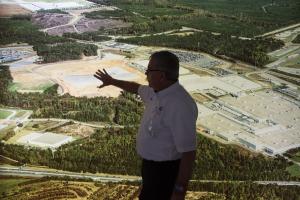
An aerial view of the BMW plant in Greer, South Carolina. Already producing more cars than any other BMW factory, it is now adding a new body shop.While Charlotte, North Carolina, a 90-minute drive to the northeast, bet on financial services as the centerpiece of its economy, and other cities have tried to cultivate software hubs or tourism, Greenville has remained focused on manufacturing. Major global manufacturers with outposts here include BMW, ABB, Fluor, Michelin, Bosch, and General Electric’s power division. As local factories have adopted increasingly computerized and automated techniques, the region has evolved into one of the country’s leading centers of advanced manufacturing.
The payoff for Greenville has been a strong economy by many conventional measurements. Though it sank with the rest of the country during the recession, it has bounced back since. Unemployment today is below the national rate at 4.7 percent, and median household income and property values have risen in recent years. Between 2010 and 2014, $1.5 billion was invested in businesses in the county, which added 8,947 new jobs. New businesses are being created here faster than anywhere else in the southeastern U.S., according to data tracked by the South Carolina Department of Commerce.
Webinar DetailsYour Presenter Steven EllisSenior Technical Specialist, Civil InfrastructureAutodesk ANZMore information
Wednesday 19th October 20162:00 – 3:00PM NZST
Cooperation between the companies could go deeper than manufacturing.
Deepening ties between Tesla and Panasonic could help the U.S. car maker fast track its ambitious plan for solar-powered systems that charge smart homes and electric cars.
The two companies said Monday that Panasonic will use what would have been a SolarCity factory in RiverBend, New York, to manufacture up to 10,000 solar panels per day. Tesla will buy the panels for use on houses as part of the deal, which is contingent on its acquisition of SolarCity.
The partnership extends work between the two companies that began with Panasonic's Gigafactory in Nevada. The multi-billion-dollar factory is a huge manufacturing facility for lithium-ion batteries used in Tesla's electric cars.
But the companies share a grander vision: one where energy from solar panels is pumped into storage batteries in each house rather than being sold to the power company. Combined with smart home technology, the batteries could virtually eliminate reliance on the power grid and recharge Tesla electric cars each night, but adoption of the batteries remains an elusive goal due to their high cost.
Bystronic, provider of state of the art sheet metal processing systems and services has agreed an innovation partnership with Lantek, leaders in software solutions and the development and deployment of software systems for the optimized production of sheet metal, tube and profile parts.
The two companies have entered into a long term technology partnership and a strategic global alliance whereby Lantek will provide Bystronic with manufacturing management software systems and consultancy expertise.
Bystronic wants to satisfy its customers’ needs with a reliable and robust manufacturing management system which has been widely tested worldwide to support its excellence in machines and its global sales network. Lantek brings its global presence, its software engineering expertise, and its unique and powerful manufacturing management system, providing an ideal match for the manufacturer. Together, Lantek and Bystronic will be able to accelerate the pace of key developments.
The aim is for the companies to collaborate to develop an MES system which will be seamlessly integrated with Bystronic‘s machine systems and software, resulting in a solution which will excel in cooperating with the Bystronic’s systems, raising them to the next level of productivity and efficiency.
The collaboration between these two industry leaders will help in the realization of the digital factory for both Lantek and Bystronic customers. The combining of the resources and experience of these two industry pioneers in machine tools and software is a critical step in driving innovation and making the digital factory a reality. Together, Bystronic and Lantek have a great legacy and will be instrumental in building the most advanced sheet metal production facilities ever constructed.
Alberto Martinez, CEO, Lantek said, “I am thrilled that Lantek is now a technology partner for Bystronic, a symbol of innovation for machine tool builders worldwide. The Lantek technology portfolio is wide and deep, and Bystronic’s excellence in machine construction is world renowned. With innovation a part of the DNA of both companies, this partnership will help Bystronic’s customers transform how they manage Bystronic machines and transcend the established boundaries in the sheet metal industry.”
Bystronic CEO, Alex Waser, says: “With Lantek, we have gained a strong partner who will help us expand our existing software portfolio with new solutions. This partnership will provide our customers with twofold know-how. Together, Bystronic and Lantek will develop innovations that will guide users into a world of digitally networked manufacturing.”
Both Lantek and Bystronic are celebrating their 30th anniversary this year, so the alliance marks this milestone for the two companies. For Lantek, the agreement will underpin its strategy which focuses on the digitalization of sheet metal companies worldwide.

Palace of the Alhambra, Spain
By: Charles Nathaniel Worsley (1862-1923)
From the collection of Sir Heaton Rhodes
Oil on canvas - 118cm x 162cm
Valued $12,000 - $18,000
Offers invited over $9,000
Contact: Henry Newrick – (+64 ) 27 471 2242

Mount Egmont with Lake
By: John Philemon Backhouse (1845-1908)
Oil on Sea Shell - 13cm x 14cm
Valued $2,000-$3,000
Offers invited over $1,500
Contact: Henry Newrick – (+64 ) 27 471 2242

|
|