
Founded by Max Farndale 1947 - 2018
Anti-static packaging is one newer area where graphene’s conductivity properties could soon be commercially applied. Brent Balinski reports on Manufacturers' Monthly.
After nearly two years of exploration, two Australian companies have signed an agreement to take the “wonder material” graphene into its next commercial domain: in anti-static and static-dispersive polymers.
Yesterday graphene technology business Imagine Intelligent Materials and engineering plastics specialist Duromer Group announced an MoU to develop commercial applications that use graphene’s unique properties operating with a state- of-the-art operation in Vietnam (Durocolour Vietnam Ltd).
When it comes to able-bodied engineers designing products for differently abled individuals, misunderstanding can lead to products that are perceived to be optimized yet actually miss the mark.Running blades are a great example of this important concept of human-centered engineering. This is because some argue the blades offer an advantage over able-bodied runners. But when you dig deeper with a human-centered approach, you might see that this is not truly the case.
“Current running blades are incredible devices. But for every perceived advantage, there are 10 to 20 disadvantages we see with things like health, mobility, psychology and the mental game of sport,” expressed Kevin Shinn, vice president of industrial design at Altair Thinklabs. “There is not an advantage there. At the end of the day, these people are differently abled, so they will need to adapt in some way compared to able-bodied people. You have to look beyond just the device themselves, and that’s what we’ve done.”
Engineers Learn Blade Runner Challenges to Optimize the DesignThe goal of human-centered engineering is less about finding solutions and more about understanding problems.
“These devices are so cool that people assume there is an advantage,” said Shinn. “Somebody with no legs with a pair of devices has an advantage. It’s kind of absurd when you think about it, but we needed to find that out to be sure and learn about the right questions to ask. To do that, we took a human-centered approach.”
Picture this: The products you work so hard to sell online have "sell by" dates that are enforced by law. After this date, you have to throw them out. What would that scenario do to your supply chain and your efforts to manage inventory, not to mention your sales?
While common items like clothing, electronics and jewelry can sit around for weeks or months before someone purchases them, you, too, might have your own internal "sell by" benchmarks - dates by which you want to get them off the shelf and out the door so you can sell newer or different items.
For those who grow, manufacture, or distribute food products, time is of the essence and "sell by" dates are very real. They face other challenges as well:
Regulation. Food has to be traced and tracked by regulatory agencies. The producer has to know where an item or "batch" of items is at any given moment so they can be recalled if required.Unleashed, an inventory management software product developed in New Zealand, helps food producers keep track of what they sell and how much it costs to produce. It's specially tailored for the unique challenges facing merchants who supply restaurants, other food producers, and the general public, and who sell both online and off.
Almost half of all broadband connections in New Zealand had unlimited data plans at 30 June 2016, Statistics New Zealand said today. In 2016, there are 43 percent more unlimited data plans than in 2015, when only around one-third of connections were unlimited.
This is coupled with a large increase in the amount of data used by broadband connections compared with 2015. In total, residential and business connections used over 143,000 terabytes in the month of June 2016, a 70 percent increase from 2015.
“Residential broadband connections in New Zealand used an average of 88 gigabytes each during the month of June 2016,” business performance senior manager Jason Attewell said. “That’s equivalent to 85 hours of video or TV streaming. Kiwis are really making the most of their unlimited data plans, considering that half of the broadband connections in June 2016 had no data cap.”
This increase in data usage is likely to coincide with the increasing number of streaming services available, and the continuing popularity of these. Additionally, telecommunications services are 20 percent cheaper in June 2016 than in June 2011 (see Consumers Price Index: June 2016 quarter).
“It’s never been cheaper to have unlimited data plans, and there are so many options for how to use the data – watching movies, streaming music, creating and sharing content, and communicating with friends and family,” Mr Attewell said. “A few years ago only 5 percent of us had uncapped broadband connections, so it’s exciting to think where we could be in another few years.”
These figures come from the annual Internet Service Provider Survey, which is sent to all internet service providers in New Zealand.
The number of fibre-optic broadband connections in New Zealand has more than doubled since June 2015, Statistics New Zealand said today. Over 220,000 broadband connections in New Zealand are made through fibre, compared with 105,000 one year ago. As at 30 June 2016, over 12 percent of all broadband connections were through fibre-optic connections, a high-speed way to use the internet.
“In 2016 around 1 in 8 broadband connections is made through a fibre-optic connection,” business performance senior manager Jason Attewell said. “The market share that fibre occupies has really taken off, since it was only 1 in 20 connections one year ago. The total number of fibre connections has doubled in each of the last four years.”
While copper (digital subscriber line) remains the most common type of connection technology, with 65 percent of connections accessed this way, fibre connections are likely to continue their growth into the future. The government aims to have 80 percent of New Zealanders able to access the internet using fibre by 2022.
“As the ultrafast broadband rollout continues, more and more people are taking the opportunity to get faster internet at their home or business,” Mr Attewell said. “This can make it easier for businesses to grow and for households to use the internet for streaming movies, online gaming, and communication.”
These figures come from the annual Internet Service Provider Survey, which is sent to all internet service providers in New Zealand.
Following a joint directive from the Federal Aviation Authority (FAA) and the United States Department of Transportation (DOT), Air New Zealand is placing a total ban on the carriage of Samsung Galaxy Note 7 devices from 5am (NZ time) Sunday 16 October 2016.
These devices cannot be accepted for carriage either in person, in carry-on luggage, or in checked luggage.
Air New Zealand is strongly advising travellers not to bring these devices to the airport with them. They cannot be accepted for travel and there is no storage facility available for them at our check in areas. Owners of these devices should contact Samsung for advice on how to return their devices.
Air New Zealand apologises to customers for any inconvenience, however, this is an FAA and US DOT safety requirement.
Air New Zealand has also been in consultation with the NZ Civil Aviation Authority on this matter.
Siemens Postal, Parcel & Airport Logistics (SPPAL) has been commissioned by New Zealand Post to equip the country’s sorting centres with the latest mixed-mail sorting machines and extensive corresponding software.
Three new Open Mail Handling Systems (OMS) will be installed in Auckland, the country’s largest city, and in Christchurch, where they will be used for the efficient sorting of letters, flats, newspapers, open and plastic-wrapped magazines and small parcels. With two induction lines, the OMS can process up to 25,000 items of mail every hour.
Siemens will also implement a suite of comprehensive software packages that will control all mail sorting operations across the whole country. New Zealand Post’s existing sorting machines will be integrated into the overall system so that they can interoperate seamlessly with the new software.
Siemens Postal, Parcel & Airport Logistics (SPPAL) has been commissioned by New Zealand Post to equip the country’s sorting centres with the latest mixed-mail sorting machines and extensive corresponding software.
Three new Open Mail Handling Systems (OMS) will be installed in Auckland, the country’s largest city, and in Christchurch, where they will be used for the efficient sorting of letters, flats, newspapers, open and plastic-wrapped magazines and small parcels. With two induction lines, the OMS can process up to 25,000 items of mail every hour.
Siemens will also implement a suite of comprehensive software packages that will control all mail sorting operations across the whole country. New Zealand Post’s existing sorting machines will be integrated into the overall system so that they can interoperate seamlessly with the new software.
“We view the collaboration with New Zealand Post as a strategic project that sets an important precedent,” said Michael Reichle, CEO of Siemens Postal, Parcel & Airport Logistics.
The key features of the OMS include the high level of automation for letter and flats sorting, coupled with fast sequencing and sorting processes in an ergonomic environment. The software suite comprises the trend-setting fingerprint technology, the address reading software ORCA (Open Reading Coding Architecture), and the reliable Address Data and Sort Plan Management system (ADM-SPM). The fingerprint technology and ORCA guarantee high read rates with the lowest possible error rate, and reduce overall network costs. The system is designed so that it can be adapted to changes in requirements in the future. Because the machines are connected to statistics software, the customer is able to obtain a comprehensive overview of the system’s capacity utilization at any time.
“We opted for the high-performance technology from Siemens because the OMS is capable of processing the maximum bandwidth of New Zealand mail types and formats, in an ergonomic way. This ensures our people’s health and wellbeing is preserved. We feel that in Siemens, we have an experienced partner that can provide us with an integrated solution that has been proven in many other postal organisations around the world and will provide us with the flexibility to adapt our solution as the volume and mix of mail products changes over time,” explained Nicola Wright, Programme manager Processing Innovation Project, New Zealand Post.
New Zealand Post is a state-owned enterprise and processes almost 600 million items of mail in the country every year. Alongside postal and parcel services, the company also offers various transport and logistics services.
Source: The STAT Trade Times
North Thin Ply Technology (NTPT; Renens, Switzerland) has launched a new composite tube manufacturing process. The patent pending process involves a unique fiber placement capability that has reportedly enabled the first real major technological development in golf shaft manufacturing since the mass adoption of graphite golf shafts in the 1980s.
The fully automated tube winding process enables “perfectly concentric carbon golf shafts that are set to take the golfing world by storm,” the company stated. The shafts were recently launched under the brand name TPT Golf at Evian 2016, having been successfully used by professional golfer Lydia Ko to win her silver medal at the Rio 2016 Olympics.
TPT Golf shafts are manufactured using NTPT's Thin Ply Technology lightweight prepreg plies in combination with the new manufacturing process. The result is a perfectly centered and near homogenous shaft giving golfers greater stability during their swing and a better feeling impact that imparts lower spin to the ball - resulting in higher yardage and a lower shot dispersion.
The micro-structure of a thin ply laminate results in higher mechanical properties. Within a golf shaft, or any other tubular product, the use of thinner plies offers nearly unlimited options for fiber angles and fiber type combinations. NTPT’s novel process ensures that each of the carbon plies are laid concentrically, resulting in a symmetrical shaft (or tube) with no spine.
The process also enables a precise control over the ratio of longitudinal plies to off axis plies along the length of the shaft. The resulting uniformity of wall thickness and control of fiber alignment provides a smoothly changing flex profile exactly matching the specific design.
Biomechanical specialist Jean-Jacques Rivet has been instrumental in the development of the range and its performance validation. Golf coach David Leadbetter has also provided technical feedback during the development of the shafts.
Leadbetter says, “In a sport where feel is everything, TPT shafts offer a level of feel to golfers that is completely unique. This is undoubtedly the most technically advanced golf shaft for distance and direction.”
NTPT’s novel composite tube manufacturing process sees its first commercial application on the golf course but the overall potential of this new manufacturing technology includes automotive drive shafts, aircraft struts, windsurf masts, as well as other sports equipment shafts and frames. Those are just a few example applications with the process being ideal for any tubular structures where weight, performance and cost are critical factors.
"We are hugely excited to launch our unique composite tube manufacturing process at Evian 2016 and to bring a truly revolutionary product to the golf market. This is just the beginning of the journey for us, and one in which we can start to see our manufacturing technology being applied to a wide spectrum of performance critical tubular structures,” says NTPT’s CEO James Austin.
Rocket Lab is dedicating itself to launching small satellites cheaply and efficiently — a capability the American company thinks the burgeoning private spaceflight industry desperately needs writes Calla Cofield on Space.com. Small satellites, some no bigger than a lunch box, are revolutionizing how people gather data about the Earth, and they might be the future of global communications.
Rocket Lab's business model is a bit like Henry Ford's was when he started selling Model T's: keep the machine simple, produce a lot of them and keep them affordable. Peter Beck, the company's owner, told Space.com that he'd like to reach a point where Rocket Lab launches one of its custom-made, small-satellite rockets about once per week. And similar to Henry Ford (who didn't even want to make different colors of the Model T), Beck said that until that basic goal is met, he has no plans to diversify the company's services.
"Generally, when people come to us and want us to get involved in other projects, we won't, simply because what we're trying to do here is so important," Beck said. "Who knows what the future holds, but we're laser-focused on getting this launch vehicle to market and, hopefully, liberating the small-satellite world."

Palace of the Alhambra, Spain
By: Charles Nathaniel Worsley (1862-1923)
From the collection of Sir Heaton Rhodes
Oil on canvas - 118cm x 162cm
Valued $12,000 - $18,000
Offers invited over $9,000
Contact: Henry Newrick – (+64 ) 27 471 2242
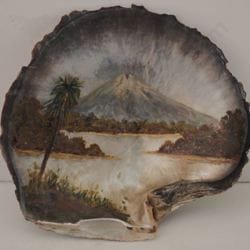
Mount Egmont with Lake
By: John Philemon Backhouse (1845-1908)
Oil on Sea Shell - 13cm x 14cm
Valued $2,000-$3,000
Offers invited over $1,500
Contact: Henry Newrick – (+64 ) 27 471 2242
