
Founded by Max Farndale 1947 - 2018
The 2016 National Maintenance Engineering Conference takes place at the Claudelands Event Centre in Hamilton on 9/10 November so it seemed timely to take a look at the origins of the event and how it has developed over the years with Craig Carlyle.
The origins of the NMEC came about after a request by a national meat company, who had engineers all over New Zealand and recognised the regional differences and different engineering solutions and wished to bring engineers together in one spot. Up until that time there were existing engineering conferences but the problem was that all the conferences available were all ‘high-brow’ and really did not relate to the practical guy!
Carlyle says there was a tale about a foreman from provincial New Zealand turning up to a conference in his Swanndri only to find everyone else dressed in suits!
A practical maintenance management conference that the average guy could relate to was required – one with no airs and graces. A rule was immediately adopted – there were to be no ties worn. If you don’t think the rule will be enforced then be aware that when Peter Tennent, a former Mayor of New Plymouth, addressed the conference on one occasion his tie was cut off!
That ethos has remained since those beginnings in 2003. Put away your pretentiousness, sit down and start talking across the table. It doesn’t matter who you are or where you are from the conference is an opportunity to sit down and talk and discover common ground.
That, in a nutshell, is the essence of the success of the NMEC.
It has all grown from those original values. There had been other attempts to organise engineers in societal groups– some worked, some didn’t. The Maintenance Engineering Society of New Zealand had a low profile at that stage and Carlyle says he went to a MESNZ meeting to see what the organisation was doing and immediately saw a fit with his own personal goals of sharing his experience with engineers. Carlyle gifted the event to the society and agreed to stay on as Event Director.
Craig’s wife Judy Cranston, well known in music and entertainment circles, co-directed the event from day one, specialising in the social agenda and being mother to everyone. The event quickly generated a collegial feel with attendees making an annual pilgrimage.
The conference itself understands the pressures and responsibilities of an engineer in a workshop trying to solve problems of the world. “Not all problems were engineering problems they could be about line management or other issues. We take a holistic approach and tackle issues such as Health & Safety and Human Relations. One year we had a paper on how to pat employee on the back followed by one on how to fire their butt!”“For most engineers only a small percentage of their time is pure engineering. Our whole goal is to help the engineer with workplace issues. That stands MESNZ aside from others. VANZ for instance, who we have a wonderful relationship with, is focused on purely technical topics.”
In the early years the society ran the conference and other activities such as one day seminars but it was eventually decided to focus all the effort into the NMEC.
“We dropped the seminars but now a decade later we have Network Evenings.They fill that gap and we are totally committed to the Kaeser Compressors Network Evenings. They are fantastic and a secret to their success and also that of the conference is that we understand that the engineering world budgets are tight and engineers need approval to attend. We work hard to keep the costs low and make it easy timewise to attend.”
“There are a number of success stories. Engineers turn up at conference with a look on their face and you watch their faces change as they discover common problems and solutions by talking to each other. They can’t wait to get back to work after they chat and take their learnings back to the workplace.”
Examples of the society meeting the needs of the engineers are reflected in the initiatives introduced over the years. “Deputy dog” pricing where a second representative from the same organisation can attend at a lesser rate means engineers can bring their 2IC’s and share the inspiration. The society has also provides apprentice and student rates.
For many years the conference was held all over New Zealand, North Island, South Island, anywhere and everywhere, with varying results. “As the conference grew, the risk grew and it became a luxury we couldn’t afford. Now you know where you are going every year. We have always had the best response from Waikato, it is central, it suits most and there is a wealth of places for field trips.”
The committee are yet to exhaust entertainment ideas for the conference. “Our entertainment is always slightly different. We don’t like doing things conventionally. We like to test people, have fun, and find a way to mix everyone together. The entertainment is legendary. Every year we wonder how to top the last one. We have had paintball wars, karaoke, we’ve gone out on boats, had Fawlty Towers nights, raced trolleys and chased sheep. What we do is always kept a secret. We try to keep the atmosphere convivial, have a few drinks without going overboard so everyone enjoys the night and is ready to go again the next day. The whole evening is quite an art. The entertainment also helps reinforce new relationships.”
In recent years the attention has been on the move to make the conference bigger and increase the resources to manage that. “We had Chris Thomas on board in the first years and brought him back more recently, while Leanne Powley has been an immense help in recent years. The committee members too are on the front desk, relishing the opportunity to personally meet the attendees. The society takes a long term view of the conference. A good example of this is the conference papers which are now driven by Barry Robinson, Larry Wiechern and Kevin Ingle who are looking at the topics we need to cover. The speaking plans are planned up to 2 years out. The emphasis changed with SKF coming on board as a sponsor. That enabled us to engage international speakers but we don’t want only internationals as we value local input as well. Engineers want to see a common neighbour.”
Longer term goals include reaching out to touch more and more engineers. “A lot of local engineers don’t know we exist. We will also open doors to more international speakers.”
“This year we are budgeting on 60 exhibitors, up from 40. The Exhibition Hall is a big event but we do not want to let that override the conference part. There are one day options, student options, bring a friend options and a lot of interest in the free Public Trade Expo.”
Each year there is a pre-conference field trip (this year Stainless Design are opening their doors to the group). One of the innovations this year is the Conference Training Village running on the day before the conference. This will offer engineers the opportunity to access expert tuition and advice in multiple training rooms in the conference venue. This is an added value to the conference and that is one of the big drives of the Society, to always offer value.
The Conference Training Village is the biggest change this year while the Exhibition Hall is growing while there will be lots of refinements and a very strong speaking schedule.
There is always a lot of interest in the Stuart Tolhurst Apprentice Trophy and Bill Buckley Scholarship Award recipients as well.
The big drive this year is for more attendees so if you are looking for solutions or something you can do better and want to get a sympathetic ear then find a way to wangle your way to NMEC 2016 on 9/10 November. The conference is always a highlight whether you are meeting old friends or finding new ones!
A NMEC release - Monday 26 September 2016

CADPRO Systems, iConstruct, Global Survey, Autodesk, and Sharp invite you to join us for demonstrations of software & hardware showing workflows and insights into the latest BIM tools for Construction.
BIM For Construction - Technology Day
Location : Christchurch & Auckland
Dates : 10th October (Monday) & 12th October 2016 (Wednesday)
Time : 9:00pm - 4:00pm
Reserve your place and remember you can claim CPD (Continuing Professional Development) points for this event.
Check out the agenda for the day, availability and registration.
CADPRO Systems, iConstruct, Global Survey, Autodesk, and Sharp invite you to join us for demonstrations of software & hardware showing workflows and insights into the latest BIM tools for Construction.
BIM For Construction - Technology Day
Location : Christchurch & Auckland
Dates : 10th October (Monday) & 12th October 2016 (Wednesday)
Time : 9:00pm - 4:00pm
Reserve your place and remember you can claim CPD (Continuing Professional Development) points for this event.
Check out the agenda for the day, availability and registration.
The Commerce Commission has released a report for consultation indicating its intention to recommend to the Minister for Communications that Spark’s resale voice services be deregulated.
Spark’s resale voice services enable other retail service providers (RSPs) to rebrand and on-sell fixed‑line phone services based on Spark switches, avoiding the need to deploy their own infrastructure. These services are provided on a commercial basis. The inclusion of these services in the Telecommunications Act gives the Commission the ability to specify terms for the services but this has not been required to date.
Telecommunications Commissioner Dr Stephen Gale said providers including Chorus, local fibre companies and fixed wireless operators offer wholesale voice services that compete with Spark’s resale service.
“Broadband networks now cover 97% of commercial and residential landlines and provide competitive alternatives for delivering voice services. The remaining 3% are mainly remote voice-only customers where Spark is the sole fixed line wholesale provider. However, for the majority of these remote lines, RSPs can use fixed wireless services from either the Rural Broadband Initiative or based on extended mobile networks. A small number of outstanding consumers that can access voice only lines are protected by a separate regulated price cap. Given this, our view is we should remove the resale services from the Act,” Dr Gale said.
The draft report can be found on the Commission’s website. Submissions close on Monday 17 October and cross-submissions on Wednesday 26 October. A public conference to discuss the Commission’s view and submissions will be held on 1 November.
The Commission expects to provide its final recommendation to the Communications Minister in January 2017.Background
Schedule 1 of the Act contains the regulated wholesale services. The three wholesale services that are the subject of this review are used by RSPs to supply the most common retail telecommunications services to end-users. As markets evolve, new retail services are developed and wholesale service providers can face increased competition, to an extent that it may no longer be necessary to mandate access to a service through Schedule 1. On 30 June 2016 we announced we would investigate removing three resale services from Schedule 1 of the Act:
The delivery of the Bachelor of Food Technology with Honours programme at the Singapore Institute of Technology (SIT) is underway, with the first cohort of students beginning lectures in Singapore earlier this month. The programme is a joint partnership between Massey University and SIT.
Sixty food technology students have begun their studies on SIT’s Dover campus. Fifty are in second year, articulated into the programme after completing a diploma, while another 10 students are starting their first year.
Massey staff from the College of Health and College of Sciences travelled to Singapore to teach, including Associate Professor Marie Wong and Dr Richard Love from the School of Food and Nutrition, Professor Clive Davies from the School of Engineering and Advanced Technology, and Dr Scott McMaster from the Institute of Fundamental Sciences.
Associate Professor Rachel Page, director of research and education for Massey’s School of Food and Nutrition, says the partnership is exciting. “It allows for staff from both institutions to work together in producing high calibre multidisciplinary graduates pertinent for the food industry in Singapore and South East Asia.”
Programme director Associate Professor Marie Wong says it has been great to meet and teach the students in Singapore. “They were keen to get started and are excited about the opportunity to come to New Zealand during their degree. The students are looking forward to being exposed to the variety of successful careers food technology can offer. Staff are happy to be back teaching in Singapore and looking forward to developing more graduates.”
The SIT-Massey University programme focuses on food product technology, combining food science, food engineering and food business. The programme educates and equips students with the fundamentals of food science and applied food technology skills required for global careers in the food industry.
Students learn in the classroom and in practical laboratory and workshop sessions that focus on industry problems and solutions, obtaining hands-on experience in industrial-standard food processing plants.
Students complete 28 weeks of an integrated work study programme through real work and experience in food manufacturing companies. In their final year, students complete a food technology research project and a food product development project.

The Lattey Civil team from Hastings travelled to Napier to finish off last week on a high
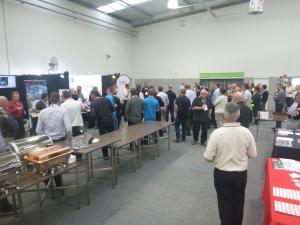
The 2016 National Maintenance Engineering Conference takes place at the Claudelands Event Centre in Hamilton on 9/10 November so it seemed timely to take a look at the origins of the event and how it has developed over the years with Craig Carlyle.
The origins of the NMEC came about after a request by a national meat company, who had engineers all over New Zealand and recognised the regional differences and different engineering solutions and wished to bring engineers together in one spot. Up until that time there were existing engineering conferences but the problem was that all the conferences available were all ‘high-brow’ and really did not relate to the practical guy!
Carlyle says there was a tale about a foreman from provincial New Zealand turning up to a conference in his Swanndri only to find everyone else dressed in suits!
A practical maintenance management conference that the average guy could relate to was required – one with no airs and graces. A rule was immediately adopted – there were to be no ties worn. If you don’t think the rule will be enforced then be aware that when Peter Tennent, a former Mayor of New Plymouth, addressed the conference on one occasion his tie was cut off!
That ethos has remained since those beginnings in 2003. Put away your pretentiousness, sit down and start talking across the table. It doesn’t matter who you are or where you are from the conference is an opportunity to sit down and talk and discover common ground.
That, in a nutshell, is the essence of the success of the NMEC.
It has all grown from those original values. There had been other attempts to organise engineers in societal groups– some worked, some didn’t. The Maintenance Engineering Society of New Zealand had a low profile at that stage and Carlyle says he went to a MESNZ meeting to see what the organisation was doing and immediately saw a fit with his own personal goals of sharing his experience with engineers. Carlyle gifted the event to the society and agreed to stay on as Event Director.
Craig’s wife Judy Cranston, well known in music and entertainment circles, co-directed the event from day one, specialising in the social agenda and being mother to everyone. The event quickly generated a collegial feel with attendees making an annual pilgrimage.
The conference itself understands the pressures and responsibilities of an engineer in a workshop trying to solve problems of the world. “Not all problems were engineering problems they could be about line management or other issues. We take a holistic approach and tackle issues such as Health & Safety and Human Relations. One year we had a paper on how to pat employee on the back followed by one on how to fire their butt!”“For most engineers only a small percentage of their time is pure engineering. Our whole goal is to help the engineer with workplace issues. That stands MESNZ aside from others. VANZ for instance, who we have a wonderful relationship with, is focused on purely technical topics.”
In the early years the society ran the conference and other activities such as one day seminars but it was eventually decided to focus all the effort into the NMEC.
“We dropped the seminars but now a decade later we have Network Evenings.They fill that gap and we are totally committed to the Kaeser Compressors Network Evenings. They are fantastic and a secret to their success and also that of the conference is that we understand that the engineering world budgets are tight and engineers need approval to attend. We work hard to keep the costs low and make it easy timewise to attend.”
“There are a number of success stories. Engineers turn up at conference with a look on their face and you watch their faces change as they discover common problems and solutions by talking to each other. They can’t wait to get back to work after they chat and take their learnings back to the workplace.”
Examples of the society meeting the needs of the engineers are reflected in the initiatives introduced over the years. “Deputy dog” pricing where a second representative from the same organisation can attend at a lesser rate means engineers can bring their 2IC’s and share the inspiration. The society has also provides apprentice and student rates.
For many years the conference was held all over New Zealand, North Island, South Island, anywhere and everywhere, with varying results. “As the conference grew, the risk grew and it became a luxury we couldn’t afford. Now you know where you are going every year. We have always had the best response from Waikato, it is central, it suits most and there is a wealth of places for field trips.”
The committee are yet to exhaust entertainment ideas for the conference. “Our entertainment is always slightly different. We don’t like doing things conventionally. We like to test people, have fun, and find a way to mix everyone together. The entertainment is legendary. Every year we wonder how to top the last one. We have had paintball wars, karaoke, we’ve gone out on boats, had Fawlty Towers nights, raced trolleys and chased sheep. What we do is always kept a secret. We try to keep the atmosphere convivial, have a few drinks without going overboard so everyone enjoys the night and is ready to go again the next day. The whole evening is quite an art. The entertainment also helps reinforce new relationships.”
In recent years the attention has been on the move to make the conference bigger and increase the resources to manage that. “We had Chris Thomas on board in the first years and brought him back more recently, while Leanne Powley has been an immense help in recent years. The committee members too are on the front desk, relishing the opportunity to personally meet the attendees. The society takes a long term view of the conference. A good example of this is the conference papers which are now driven by Barry Robinson, Larry Wiechern and Kevin Ingle who are looking at the topics we need to cover. The speaking plans are planned up to 2 years out. The emphasis changed with SKF coming on board as a sponsor. That enabled us to engage international speakers but we don’t want only internationals as we value local input as well. Engineers want to see a common neighbour.”
Longer term goals include reaching out to touch more and more engineers. “A lot of local engineers don’t know we exist. We will also open doors to more international speakers.”
“This year we are budgeting on 60 exhibitors, up from 40. The Exhibition Hall is a big event but we do not want to let that override the conference part. There are one day options, student options, bring a friend options and a lot of interest in the free Public Trade Expo.”
Each year there is a pre-conference field trip (this year Stainless Design are opening their doors to the group). One of the innovations this year is the Conference Training Village running on the day before the conference. This will offer engineers the opportunity to access expert tuition and advice in multiple training rooms in the conference venue. This is an added value to the conference and that is one of the big drives of the Society, to always offer value.
The Conference Training Village is the biggest change this year while the Exhibition Hall is growing while there will be lots of refinements and a very strong speaking schedule.
There is always a lot of interest in the Stuart Tolhurst Apprentice Trophy and Bill Buckley Scholarship Award recipients as well.
The big drive this year is for more attendees so if you are looking for solutions or something you can do better and want to get a sympathetic ear then find a way to wangle your way to NMEC 2016 on 9/10 November. The conference is always a highlight whether you are meeting old friends or finding new ones!
A NMEC release - Monday 26 September 2016
This Sunday is World Rivers Day, and Land Air Water Aotearoa (LAWA) is joining over 60 countries around the world to raise awareness of the need to take better care of our water resources. LAWA is marking the day by launching a video that celebrates New Zealand’s waterways and the community effort being put into protecting them.
Rivers are not only essential for water supplies, but they are also home to aquatic plants and animals, including many species native to New Zealand. Many of our rivers are also a recreational playground for anglers and water sports.
There are many communities around New Zealand that are actively making a difference to the health of our rivers, and LAWA is releasing a video to celebrate World Rivers Day that highlights what regional councils, organisations, iwi, land owners and community groups are doing.
Stephen Woodhead, chair of the regional sector group of Local Government New Zealand, said sixteen rivers from the regions around New Zealand have been featured in the River of the Month video series. The videos have been produced with funding from the Tindall Foundation, and show how groups and individuals have worked together to improve their regions’ waterways for future generations to enjoy.
“The hard work people are putting into restoring the health of rivers and lakes in their region is inspirational,” Mr Woodhead said. “People from all walks of life are involved, and their efforts should be reflected by improvements in water quality over time.
“LAWA is proud to acknowledge World Rivers Day by releasing a video that summarises the River of the Month stories from around New Zealand and highlights the diversity of groups and individuals who have come together to nurture our waterways. They are our river heroes,” he said.
LAWA connects the public with the environment by sharing local stories and information about the quality of New Zealand’s lakes, rivers, beaches and air, as well as water quantity data. Regional and unitary councils have updated the freshwater and recreational data available on the LAWA website for this weekend, so the public can find up-to-date information for their area, including the health of rivers.
Stephen Tindall, Co-founder of The Tindall Foundation and supporter of LAWA since it launched in 2014, encourages all Kiwis to explore the LAWA website.
“There is a wealth of information on the site that everyone can take advantage of. Jump on to find out about the water quality at your local beach or how healthy the air is in your region. LAWA connects people with their environment by sharing scientific data. The Tindall Foundation is delighted to support such an important source of information made available to all Kiwis thanks to LAWA.”
On the face of it, U.K. supercar maker McLaren would seem an odd partner for Apple Inc. as the consumer electronics and software giant seeks to crack the global auto industry.
With its racetrack heritage and gas-guzzling models priced from 126,000 pounds ($165,000), Woking, England-based McLaren is a world away from the mainstream auto market, which Apple appears to be targeting and where it would face brands with a global profile to match its own.
Yet McLaren’s rich history in Formula One, the most elite level of auto racing, means the company has as much in common with Apple as it does with more-conventional carmakers such as Ford Motor Co. and General Motors Co. Formula One is a technology-led circuit in which engines and chassis are highly regulated and minute electronic enhancements can make the difference between winning and finishing last.
McLaren has also achieved the transition from developer of industry-leading technology to a full-scale producer of street-legal cars in just six years, presenting a blueprint for making a splash in the auto market in short order. Apple is exploring a strategic investment with the carmaker, people familiar with the matter said, though both parties denied that talks are under way.

“Love my Vote – Love My Dogs”
Dogs are the forbidden issue in the pending New Zealand local government elections. None of the candidates want to introduce, let alone discuss, the increasingly raw topic of the nation’s dogs and their owners.
There are two reasons behind the electoral blind eye to an increasing health problem which takes two forms.
These are the growing number of attacks by dogs on humans, especially children, in addition to the perennial fouling problem.
Local government candidates avoid the issue in the knowledge that dog owners are single-issue electors in that any measure against their pets are considered also as a personal and repressive measure against the owner.
Local government officials if cornered on the dog problem tend to sidestep it by claiming that the problem is one for Parliament to regulate.
This is not true. Local and municipal regional governments enjoy considerable latitude in coping with the nation’s dog problem, especially in regard to the now rampant dangerous dog one.
Local authorities can ban dogs from whole areas, such as beaches and retail districts. They can regulate areas in which dogs even if they are allowed have to be on leashes..
They can also administer regulations and penalties in the matter of dog-fouling.
New Zealand local authorities have enjoyed some success in handling an earlier dog problem, the one before the current and unavoidable dangerous dog one.
This was the barking problem which local authorities have taken seriously in the form of employing and empowering noise control officers.
Local authorities have also stepped up their dog ranger activity especially in terms of getting tough with the adoring owners of dangerous dogs. But in keeping silent on the problem candidates demonstrate their belief that dog owners, the ones that vote, are single issue voters who in effect are saying to them...............
“Love my vote/ love my dogs.”
From the MSCNewsWire reporters' desk - Friday 23 September 2016
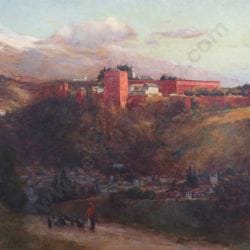
Palace of the Alhambra, Spain
By: Charles Nathaniel Worsley (1862-1923)
From the collection of Sir Heaton Rhodes
Oil on canvas - 118cm x 162cm
Valued $12,000 - $18,000
Offers invited over $9,000
Contact: Henry Newrick – (+64 ) 27 471 2242

Mount Egmont with Lake
By: John Philemon Backhouse (1845-1908)
Oil on Sea Shell - 13cm x 14cm
Valued $2,000-$3,000
Offers invited over $1,500
Contact: Henry Newrick – (+64 ) 27 471 2242

|
|