
Founded by Max Farndale 1947 - 2018
NZMEA Chief Executive Dieter Adam says, “The exchange rate remains overvalued, adding significant pressure to manufacturing and exporting businesses, hitting margins and competitiveness, both in our vital export markets such as Australia, and for those competing against imports in New Zealand.
“We need to see the downward correction of our currency restart. The longer it remains significantly overvalued, the bigger its effect will be on manufacturers and exporting businesses, hitting their ability to invest in the future, through R&D, new equipment and staff. New Zealand manufacturers operate against global competitors, and this investment is vital to ensure we remain competitive and productive into the future.
Looking towards the Reserve Bank of New Zealand’s (RBNZ) OCR decision tomorrow, the exchange rate remains at a level that is putting a lot of pressure on manufacturers and exporters. Building financial stability issues, here and abroad also present a significant future risk, say the New Zealand Manufacturers and Exporters Association (NZMEA).
NZMEA Chief Executive Dieter Adam says, “The exchange rate remains overvalued, adding significant pressure to manufacturing and exporting businesses, hitting margins and competitiveness, both in our vital export markets such as Australia, and for those competing against imports in New Zealand.
“We need to see the downward correction of our currency restart. The longer it remains significantly overvalued, the bigger its effect will be on manufacturers and exporting businesses, hitting their ability to invest in the future, through R&D, new equipment and staff. New Zealand manufacturers operate against global competitors, and this investment is vital to ensure we remain competitive and productive into the future.
“We would encourage the RBNZ to continue moving the OCR downward and closer to rates seen in the rest of the world, to spur inflation to the target range and help our currency move along a downward path.
“However, we face a potentially much bigger threat from growing financial stability risks, both in New Zealand and globally. New Zealand’s debt-to-income ratio has now reached levels higher than before the GFC – sitting at 165%, which is significantly higher than a year ago at 159%. This build-up of private debt leaves New Zealand more exposed to global risks, as well as increasing the potential for disturbance in our housing market. This is not an abstract threat to our economy, it is a tangible threat to many New Zealand households exposed to debts they may no longer be able to service if economic conditions change, be that a loss of an income, or an increase in interest rates on their debt.
“We know from experience during the GFC, the large effect such crisis can have on all parts of our economy, especially our manufacturing sector where many rely on export income. In our NZMEA survey, export sales made up 60% of sales for respondents in July.
“The RBNZ should continue their work on shoring up our financial system against potential stability threats and expand their tool-set of macro-prudential tools, including exploring debt-to-income limits on property lending.
“It is worth remembering that RBNZ’s responsibilities currently are inflation management and financial stability. The responsibility for rising housing costs lies with the Government.
“It is important that the work on housing continues, to give the RBNZ the freedom to deal with inflation, stability and the resulting exchange rate. There has been progress on the supply side, with the Auckland Unitary Plan, however, there are still additional measures that could be undertaken on the demand side of the equation. “Says Dieter.
Tuesday, September 20, 2016 — Dubai, UAE – Emirates has revamped its corporate loyalty programme, Emirates Business Rewards, to provide greater value and added features for customers. The new programme has been simplified and made more competitive to allow for easier redemptions and upgrades even on last minute bookings.
One of the biggest features in the newly improved programme is the ability to use Business Rewards Points to book any commercially available seat at any time giving members cash-like convenience. Emirates is the first and only airline in the region to offer such flexibility as part of its corporate loyalty programme – improving cost-effectiveness for business travel.
Emirates recently commissioned an independent survey on the perception and habits of over 800 business travellers and decision makers of business travel in the UAE[i]. The key findings reiterate the need for cost effectiveness and flexibility in corporate travel which resonates with the new features of Emirates Business Rewards. According to the survey, the top 3 factors considered for airline selection were fare (30%), flight timings (26%), and value for money (23%).
Emirates Business Rewards will satisfy customer needs and provide value-added benefits catered to organisations of any size, charities and clubs. In addition to allowing redemptions for any seats, there is also greater flexibility when it comes to earning and redeeming the Business Rewards Points.
According to the survey, respondents most commonly book business travel online directly with the airline (29%). Smaller organisations were even more likely to conduct bookings directly online with more than 50% of their corporate travel booked this way. With less reliance on third party booking agents, Emirates Business Rewards has enhanced user-experience with easy-to-use customer dashboards. These include tools to manage and book services for employees, and monitor the savings accumulated so far on the programme.
Enrolment has also been simplified regardless of organisation size. The introduction of the ‘Guest Traveller’ function means that organisations can include non-company persons, such as consultants, or clients who travel on behalf of the organisation, and still earn Business Rewards Points.
While the programme will continue to provide value and service to key industries such as Manufacturing, Oil and Gas, Trading and IT, the simplified system and unlimited employee enrolment will also allow other industries with a large labour force, such as the construction industry to benefit from the programme.
Emirates provides direct connectivity from Dubai to over 150 destinations across six continents. In all classes, Emirates provides quality products and value for money with luxurious private suites in First Class, flat-bed seats in Business Class and the iconic A380 Onboard Lounge, the largest in-seat screens in the world in Economy class at 13.3 inches and more than 2,500 channels of on-demand entertainment in all cabins. This is complemented by excellent on board service from an international cabin crew who speak over 60 languages.
For more information please visit emirates.com/businessrewards
Starting with SOLIDWORKS 2017, expected to start shipping on October 10 of this year, the world’s most popular 3D CAD software will be available for rent. Since its inception in 1995, SOLIDWORKS has been available as a “perpetual license” for about $4K. While it will continue to offer the application with a one-time up-front purchase cost, Dassault Systèmes, SOLIDWORKS’ parent, is adding an option to rent the software for three-month or one-year periods.
The pricing change is offered in response to a growing trend in software towards less big-ticket upfront prices
Christchurch – Ultimately, for New Zealand to diversify its export base, technology will play a critical role in improving value-add in agricultural exports, a leading New Zealand agri-tech expert says.
Craige Mackenzie, chair of Precision Agriculture Association of New Zealand (PAANZ), says precision agriculture has a lot to offer the bright future of the second biggest New Zealand industry sector.
“There is growing interest in the benefits of precision agriculture for environmental and financial viability of our New Zealand farms but we have a challenge ahead to get greater engagement with more farmers and companies in this sector.
“We are also being approached by local and central government for advice and we are seeing some exciting new technologies being introduced to agriculture. We are excited about the development of new precision agriculture software which has integrated affordable satellite images as well as being able to send and receive application files to give proof of placement. The use of such software to store and handle data will continue to be as important as the technology used in the field.
“Next year we are hosting the seventh Asian-Australasian conference on precision agriculture in Hamilton. This will be the first time the event will be held outside of Asia so it will be important to make a success of it. This will be a landmark occasion for our New Zealand industry to showcase the best of what we do.
“Global agritech investment is growing rapidly, with investment in 2014 estimated at over $US2.36 billion making the sector larger than the global fintech market. With our traditional strengths in agriculture and our growing strengths in tech this is an opportunity we should pursue with vigour.
“There is an enormous opportunity for New Zealand to use technology as a means to support the economic growth of our agri sector and to also work with the sector to become a world leader in a fast growing agritech market.”
Mackenzie recently received the 2016 international Precision Ag Farmer of the Year award in the United States, for being identified among the most innovative farmers in the world. In 2008 as a recipient of a NZ Nuffield Farming Scholarship, Mackenzie spent six months studying agricultural innovations overseas.
Rural New Zealand is predominantly devoted to agricultural activities. Despite being outside the tech sector, agriculture is a big user and creator of technology. The Sapere research group says agricultural producers are generally low users of internet services relative to other industries, but they are still highly connected.
Mackenzie says the rollout of networks and the increasing availability of internet connectivity, especially driven by the Rural Broadband Initiative, are enabling transformation in the way the agricultural sector operates and how suppliers integrate into the supply chain from pasture to plate.
“There are significant positive impacts available from connecting farms to broadband and from relatively simple data sharing applications. Internet connectivity and broadband brings the prospect of increased digital customer interactions for businesses.
“For example, online transactions and data transfers between dairy farmers, Fonterra and the Livestock Improvement Corporation reduce transactions costs and improve logistical co-ordination and farm management. There are also opportunities for the application of big data and analytics, particularly as speedy online transfers of data between farmers and suppliers become the norm.”
Source: Make Lemonade Wednesday 21 September 2016
In Indonesia, Mr McClay will meet with new Trade Minister Enggartiasto Lukita, as well as deliver a keynote speech at the World Renewable Energy Congress.
“I am pleased to be returning to Indonesia and look forward to continuing our productive discussions on bilateral trade priorities, including market access for New Zealand beef and horticultural exports,” says Mr McClay.
Indonesia is New Zealand’s 13th largest trading partner with two-way trade worth NZ$1.6 billion.
In the Gulf, Mr McClay will lead a business delegation to the United Arab Emirates, and Saudi Arabia and, he will also lead New Zealand’s biennial trade and economic discussions with the Saudi Government.
“This meeting is the main trade and economic dialogue between our two countries,” says Mr McClay.
While in Riyadh the Minister will also meet with a range of senior Saudi Ministers to discuss trade issues including the finalisation of the Gulf Cooperation Council-New Zealand Trade Agreement initialled in 2009.
In the United Arab Emirates, Mr McClay will focus on promoting New Zealand as a food security partner and source of high tech innovation and services.
The Gulf Cooperation Council, comprising Saudi Arabia, the United Arab Emirates, Kuwait, Qatar, Bahrain, and Oman is New Zealand’s sixth largest export partner, with annual exports worth over $1.7 billion.
The Royal New Zealand Navy’s new logistic support ship will be built by Hyundai in Korea, using an innovative front section design licensed by Rolls-Royce, which will also supply the power plant and related systems. Rolls-Royce has secured a milestone contract with Hyundai Heavy Industries (HHI) to provide a concept design based on the Rolls-Royce Environship Leadge Bow. This marks the first reference for the award-winning wave-piercing hull form in the naval sector. Rolls-Royce will also equip this new 23,000t Polar-class logistics support vessel, which will replace the New Zealand Defence Force’s 30-year-old tanker HMNZS Endeavour.
The prime contractor HHI will undertake detailed design and build the vessel as part of the NZDF’s Maritime Sustainment Capability (MSC) project, using the Rolls-Royce Environship concept design under licence.
Commenting on the contract, Sam Cameron, Rolls-Royce, Senior Vice President Sales and Business Development – Naval, said: “We see significant value in the Environship concept in the naval sector. Winning this milestone contract is of considerable importance to our naval ship design offering, which is new to Rolls-Royce.
“We have worked with HHI on a number of vessels, but this the first project in which we will collaborate on the conceptual design requirement. We look forward to working with HHI in delivering the MSC Support Ship and providing through-life support to the New Zealand Navy.”
The vessel will be based on a modified Environship hull form designed to meet NZDF requirements for a heavily winterised, ice–strengthened vessel capable of carrying out operations in a challenging Antarctic environment.
Aside from the bespoke Environship concept design, the Rolls-Royce scope of supply is extensive and includes a Combined Diesel Electric and Diesel (CODLAD) propulsion plant based on twin Bergen main engines. These will each drive, via reduction gears, a controllable pitch propeller. Rolls-Royce will also supply the propeller shafts.
Electrical power will be supplied by Rolls-Royce in the form of four MTU gensets from Rolls-Royce Power Systems, which will also provide power to the Rolls-Royce supplied switchboards, motors, drives, bow thruster and the electric RAS/FAS system, which allows for simpler and quieter replenishment/fuelling-at-sea operations. Rotary vane steering gear and rudders form part of a stand-alone package.
Ben Dunscombe, Rolls-Royce, Programme Executive – Asia, who is responsible for the delivery of the project, said: “We have pooled our resources across Rolls-Royce to bring together a unique array of our equipment to meet the specification. To meet the high winterisation and Polar Code 6 requirements, propellers and the main and auxiliary engines will be slightly larger.”
In what is an ambitious time frame, Rolls-Royce is scheduled to deliver equipment to the South Korean builder from 2018. The vessel is scheduled for a 2020 delivery.
(Source: Rolls-Royce plc; issued September 20, 2016)
The Royal New Zealand Navy’s new logistic support ship will be built by Hyundai in Korea, using an innovative front section design licensed by Rolls-Royce, which will also supply the power plant and related systems. Rolls-Royce has secured a milestone contract with Hyundai Heavy Industries (HHI) to provide a concept design based on the Rolls-Royce Environship Leadge Bow. This marks the first reference for the award-winning wave-piercing hull form in the naval sector. Rolls-Royce will also equip this new 23,000t Polar-class logistics support vessel, which will replace the New Zealand Defence Force’s 30-year-old tanker HMNZS Endeavour.
The prime contractor HHI will undertake detailed design and build the vessel as part of the NZDF’s Maritime Sustainment Capability (MSC) project, using the Rolls-Royce Environship concept design under licence.
Commenting on the contract, Sam Cameron, Rolls-Royce, Senior Vice President Sales and Business Development – Naval, said: “We see significant value in the Environship concept in the naval sector. Winning this milestone contract is of considerable importance to our naval ship design offering, which is new to Rolls-Royce.
“We have worked with HHI on a number of vessels, but this the first project in which we will collaborate on the conceptual design requirement. We look forward to working with HHI in delivering the MSC Support Ship and providing through-life support to the New Zealand Navy.”
The vessel will be based on a modified Environship hull form designed to meet NZDF requirements for a heavily winterised, ice–strengthened vessel capable of carrying out operations in a challenging Antarctic environment.
Aside from the bespoke Environship concept design, the Rolls-Royce scope of supply is extensive and includes a Combined Diesel Electric and Diesel (CODLAD) propulsion plant based on twin Bergen main engines. These will each drive, via reduction gears, a controllable pitch propeller. Rolls-Royce will also supply the propeller shafts.
Electrical power will be supplied by Rolls-Royce in the form of four MTU gensets from Rolls-Royce Power Systems, which will also provide power to the Rolls-Royce supplied switchboards, motors, drives, bow thruster and the electric RAS/FAS system, which allows for simpler and quieter replenishment/fuelling-at-sea operations. Rotary vane steering gear and rudders form part of a stand-alone package.
Ben Dunscombe, Rolls-Royce, Programme Executive – Asia, who is responsible for the delivery of the project, said: “We have pooled our resources across Rolls-Royce to bring together a unique array of our equipment to meet the specification. To meet the high winterisation and Polar Code 6 requirements, propellers and the main and auxiliary engines will be slightly larger.”
In what is an ambitious time frame, Rolls-Royce is scheduled to deliver equipment to the South Korean builder from 2018. The vessel is scheduled for a 2020 delivery.
(Source: Rolls-Royce plc; issued September 20, 2016)
An expanding county company, with an office in Pukekohe, is celebrating hiring its 100th employee.
Muddy Boots Software is predominantly based in Phocle Green, near Ross-on-Wye in the UKbut their workforce extends to Australia, New Zealand, Germany, Kenya and Egypt.
Over the past four years it has grown both financially and in headcount and is not only one of the county’s leading technology businesses, but also one of the world’s primary developers of food supply chain software solutions.
Jack Evans, head of commercial at Muddy Boots, said: "Our mission is to produce food industry software and apps that deliver visibility, efficiency and trust.
"Five of the top seven retailers in the UK now rely on our systems to deliver safe and fresh food to the consumer. We also help several major brand holders, including Unilever with their global sustainability agendas."
The business' main hive of activity is very much still in Ross.
It started as a small group of technicians developing early farm recording software 20 years ago.
Mr Evans said: "We are still very attached to our roots. We began as a development house for farm recording software, and even now, that still makes up 18 percent of our business.
"The Wye Valley is one of the most fertile regions of the UK and as a result many of our customers are within walking distance of the office.
"In fact, we consider these growers more partners than customers because many of them have been with us since our inception 20 years ago."
He said it wasn’t long before Muddy Boots saturated the farm market but this coincided with a time when the food industry was really starting to embrace the ideas of quality control along the whole supply chain.
Mr Evans said: "We really just saw an opportunity to capitalise on this, and so we used our expertise to develop solutions that would cater for organisations up the chain, and we were fortunate in being able to secure some big names early on in the form of Unilever and M&S."
He said the growth is only set to continue as they begin to take advantage of huge opportunities in the USA.
But as their global reach extends, Mr Evans said the company is still very proud to be part of the local community, adding: "We’re now one of the biggest employers locally, certainly in the field of software development, and as we grow and mature, we look forward to welcoming an ever increasing workforce."
Source: Hereford Times
General Manager Manufacturing and Bioproducts at Scion Elspeth MacRae, with Dr Will Barker, CEO of NZBIO (left) and Jared Scarlett of Baldwins.
Scientists at Scion have solved a growing environmental problem for wood panel manufacturers.
Warren Grigsby and his team have developed the world's first wood panel resins (glue) using biobased ingredients.
That solution has earned the team the "Biotechnology of the Year" award at NZBIO's annual conference in Auckland.
When Scion, the Crown Research Institute that specialises in science around forestry, wood products and bio materials, learned the level of formaldehyde emissions from wood panels were being regulated lower in countries like Japan, the United States and in the European Union, with New Zealand following suit, it looked to biotechnology to find ways of reducing the emissions.
Wood panel resins (glues) are traditionally made with formaldehyde and urea or phenol from petroleum based precursors. The Scion team developed a biobased resin replacement that gives off less formaldehyde emissions than natural wood.

Palace of the Alhambra, Spain
By: Charles Nathaniel Worsley (1862-1923)
From the collection of Sir Heaton Rhodes
Oil on canvas - 118cm x 162cm
Valued $12,000 - $18,000
Offers invited over $9,000
Contact: Henry Newrick – (+64 ) 27 471 2242
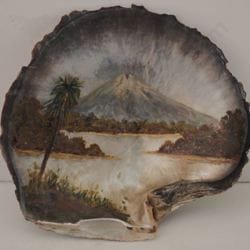
Mount Egmont with Lake
By: John Philemon Backhouse (1845-1908)
Oil on Sea Shell - 13cm x 14cm
Valued $2,000-$3,000
Offers invited over $1,500
Contact: Henry Newrick – (+64 ) 27 471 2242
