
Founded by Max Farndale 1947 - 2018
It's now more than two months on from Brexit - or the date Nigel Farage hoped would be known as "United Kingdom Independence Day" - writes James Penn in today's NZHerald and we have little more knowledge about what a post-European Union Britain will look like.
This British free-trade-agreement opportunity is one that should not be missed, and negotiations should begin now. Importantly, the deal New Zealand requires to maintain or even grow exports in the wake of Brexit is itself dependent on how the relationship between Britain and the EU plays out.

European experience points to need for suppliers to add value, diversify
The blockade by angry French dairy farmers of the Lactalis HQ at Laval carries a strong message for their New Zealand counterparts similarly dismayed by their returns, though not possessed of the Latin temperament required to man the barricades.
The lesson centres on the wisdom of signing up for a fixed volume and price contract which is the issue underpinning the Lactalis ructions, writes our European Correspondent.
The problem is that the dairy farmer cannot recover fixed costs by supplying milk at any price. In contrast a cooperative, Fonterra is the obvious example, is required to take all the milk that their members can supply.
The Lactalis blockade also brings into focus several other issues that are central to any business at all. First among them is the wisdom of having just the one outlet, in this case Lactalis. The other is the absence of any added value or diversification among the aggrieved suppliers.
These directly relate to the New Zealand situation. There is the dependence on the single client, and the absence of any value added alternatives in product diversification of which cheese is the obvious example.
Nobody can deny that the New Zealand single-desk procurement tradition has made it difficult for farmers to diversify their products and thus their source of income.
Lactalis (the “s” is sounded) is best known in New Zealand for its control of Parmalat. It is here that the roots of the current imbroglio started. During the acquisition of the Italian company Lactalis was required to supply details of its balance sheet.
Coordinates from these reluctantly provided figures indicated that the French company operated on a ratio principal of a 10 percent margin on anything it sold.
The company has not gone out of its way to cultivate its suppliers. It is owned and controlled by the Besnier family. It is now into its third generation in the form of Emmanuel Besnier, a man who makes the late Howard Hughes appear in comparison like a publicity hound.
In a country which specialises in recording the activities of the super rich there are just four photographs of Emmanuel in existence (above.)
He does not attend cocktail parties, show up at flashy restaurants or make appearances at any of France’s numerous business forums.
He “just works” we are told.
The company is responsible in 43 countries for the employment of 75,000 people. It rivals Nestle the other privately held milk European conglomerate.
The direct blockade of the Lactalis HQ and factory at Laval also draws attention to the shift in strategy by the dairy farmers or “raisers” as they are known.
A year ago their focus was on making trouble for the main hypermarkets which are known as the “big surfaces.”
Now the same farmers are content to wander through these big surfaces applying stand over tactics with the purpose of dissuading shoppers from buying the products of targeted processors, in this case Lactalis. They are free to do all this as and when they please.
The main thrust, the dumping of manure, and the rings of tractors and the road fires are now directed at the processor or “transformer” source, Lactalis.
President Francois Hollande’s socialist government can only let this state of affairs continue while trying to be seen to be inducing Lactalis and its belligerent suppliers to work something out.
From the MSCNewsWire reporters' desk - Wednesday 31 August 2016
Out of the Staes comes this article published on Fast Company about a company who reduced their working week to 5 hours a day and introduced a profit share scheme. Would it work for your business?
In every office, I've often felt, there are just a few people who do three times the work of everyone else, yet their reward is only marginally higher. As an entrepreneur, I've been managing my own productivity time—not on-the-clock-time—pretty effectively for over 15 years, and I've largely been able to work fewer hours than my friends in the corporate world. So when I started Tower, my company that sells stand-up paddle boards, I figured (or at least hoped) that I could hire just these types and give them a better deal in the process.
Two Napier Port workers were tested for exposure to methyl bromide after the second accidental venting of the powerful fumigant at the port in less than a year.
The New Zealand wine industry must be ready to take full advantage of the United Kingdom leaving the European Union, says a visiting wine trader from the UK. UK Wine and Spirits Trade Association chief executive Miles Beale has been in this country for the wine industry's annual conference which was held in Blenheim. Mr Beale said the United Kingdom's planned exit from the EU will open up opportunities for New Zealand as the UK starts doing its own trade deals. He suggests exporters move early and start discussions with the UK.
One of New Zealand’s leading unions confirmed today that it has ratified a new collective agreement for workers in the metal and manufacturing industry.
E tū members accepted the two-year Metal and Manufacturing Industries Collective Agreement – also known as ‘Metals’ – following talks in June and July.
Anita Rosentreter – E tū’s industry co-ordinator for manufacturing – said says there is no loss of conditions and a number of minor improvements have been made, including amendments to health and safety.
The agreement – which has long set the pace for other pay deals in manufacturing, and for other industries and unions – promises a two per cent pay rise this year and another two per cent rise in 2017.
Auckland-based Rosentreter said the deal has been ratified by the seven original parties to the agreement but noted that related industries were following suit.
“Dozens of other companies in manufacturing and related industries have now begun work to ratify the settlement for their workers,” she said.
“With the Consumer Price Index at a mere 0.4 per cent for the past year, the settlement provides real wage growth for these workers”, she added.
Metals is E tū’s oldest and biggest manufacturing industry agreement, covering more than 600 workers across more than 80 employers.
A United States based product developer, who is an MSC NewsWire subscriber, is looking for a company to manufacture a product, namely a doorstop that they have designed.
Interested parties should contact us here at MSCNewsWire on This email address is being protected from spambots. You need JavaScript enabled to view it. before Friday 9 September 2016.
The Holcim Cement Works at Cape Foulwind Westport, which is now closed. A $250 million waste to energy plant proposed for the West Coast would burn rubbish collected from around the South Island. Buller mayor Garry Howard said the plant could be the key to reviving the West Coast economy. He was confident a private company could set up a high-tech plant in Buller converting the South Island's rubbish into electricity.
Continue to full article in The Press
Spark will increase the data quotas for the majority of its home and many of its business broadband customers by 50 percent writes Stuart Corner for Computerworld New Zealand.
Spark will increase the data quotas for the majority of its home and many of its business broadband customers by 50 percent. New home customers for fibre and wireless broadband plans will also be hit by a price rise of $5 per month and business customers of $3 per month. These price rises will not be applied to existing home customers until September 2017 and to business customers until September 2018.
Home customers on a 40GB plan will receive a data increase to 60GB and those on an 80GB plan will get an increase to 120GB, across ADSL, VDSL, fibre and wireless broadband. Business customers on 30GB bundles will receive a data increase to 50GB and those on 80GB plans will get an increase to 120GB, across ADSL, VDSL and wireless broadband.The increases will apply only to customer on current plans, not those on old plans that are no longer offered.
Spark said that approximately 85 percent of Spark Home customers and over 99 percent of Spark Business customers would either receive additional data at no extra cost or would be affected by these changes.
Spark explained the price rises by saying that, as more customers used more data – and as more customers moved to unlimited plans – the cost to provide broadband services had increased. “First, the wholesale charges that ISPs like Spark pay lines companies on connections is increasing annually. Second, Spark has been investing in increased local and international data capacity,” the company said.
Defence Minister Gerry Brownlee today welcomed the signing of a contract to upgrade the Royal New Zealand Air Force Underwater, Intelligence, Surveillance and Reconnaissance capability on our six Orion aircraft with Boeing for a total of $36 million.
Mr Brownlee says having an underwater surveillance capability deters interference with the sea lines of communication that New Zealand and many of its friends rely on for trade purposes.
“Knowing what is happening underwater is integral to monitoring submarine activity,” Mr Brownlee says.
“This is particularly important in the Asia-Pacific region which is home to two-thirds of the world’s submarines.
“The current Orion systems are old and have become less reliable.
“I am pleased that New Zealand businesses Safe Air, Beca and Marops Limited will also be involved in supporting this acquisition through its life, with around 25 per cent of the value of the contract being spent with these companies.”
The recently released 2016 Defence White Paper confirmed the importance of the New Zealand Defence Force having capabilities to cope with the realities of a complex and changing strategic environment, and to enable it to operate across a broad spectrum of geographic and operating environments.
Work is already underway within Defence on the Future Air Surveillance Capability project which will select a replacement for the Orion aircraft, which is due to retire from service in the mid-2020s.

Palace of the Alhambra, Spain
By: Charles Nathaniel Worsley (1862-1923)
From the collection of Sir Heaton Rhodes
Oil on canvas - 118cm x 162cm
Valued $12,000 - $18,000
Offers invited over $9,000
Contact: Henry Newrick – (+64 ) 27 471 2242
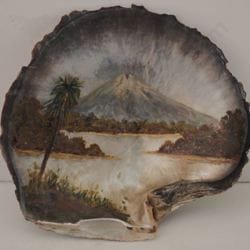
Mount Egmont with Lake
By: John Philemon Backhouse (1845-1908)
Oil on Sea Shell - 13cm x 14cm
Valued $2,000-$3,000
Offers invited over $1,500
Contact: Henry Newrick – (+64 ) 27 471 2242

|
|