
Founded by Max Farndale 1947 - 2018

Our European Correspondent Remembers .............
For many business to manage their chemical and hazardous substances compliance to meet the requirements of the 1996 HSNO Act is, many company owners put in the too hard basket.
Now there is a simple and smart way to do this using a multi-functional software program, Hasmate.
Hasmate is a one stop shop that provides you with a easy process to record all the key information about your chemicals for the training of your employees prior to them using them.
Hasmate also provides you with the facility to produce a training procedure as well as allowing you to attach the relevant material safety data sheet, your risk registers, photographs and any other documents to the file for future reference.
In addition, it also allows you to maintain an inventory of the chemicals and the function to alert you if you have a withholding period for the chemical especially if it is used for food production.

How connected products are changing the landscape for manufacturers and why it's going to be critical to your success. This is just one of the topics that will be presented at the CADPRO Systems organised Autodesk Manufacturing Event being held in Auckland next Wednesday the 24th of August and Christchurch the following day.
The era of connection is upon us. Already consumers expect to be connected to their products whenever they want and wherever they are. And over the next decade the expectation is that the number of connected devices is going to significantly increase, enabling companies to provide unique customer experiences, incorporate agile design and implement predictive maintenance.
Together we'll look at how we, as an industry, need to look at the next generation of products we design and services we offer as a means of growing company revenue and possibly implementing Products as a Service.
This session will be very practical looking at genuine applications for manufacturers. Join presenter Matthew McKnight, Autodesk Australia at next week’s events in Auckland or Christchurch.
New Zealand’s wine industry is well on track to reach its target of $2 billion of exports by 2020, according to Chair of New Zealand Winegrowers, Steve Green.
New Zealand Winegrowers’ Annual Report shows exports have risen 10% in the last year, to just under $1.6 billion. This is the 21st consecutive year the industry has experienced significant export growth.
"The on-going progress towards the $2 billion goal is founded on our reputation as a wine exporter of the first rank, known for crafting and marketing distinctively New Zealand, high quality, high value wines," said Mr Green.
"This continued strong performance is testament to underlying market and consumer demand for our wines in key markets."
With demand strong the improved supply from Vintage 2016 is expected to lift export volumes by a further 10% over the next 12 months.
The 2016 Annual Report can be accessed here and is available at: http://www.nzwine.com/media-centre-1/statistics-information/
Mandatory labelling of palm oil is likely to mislead consumers by implying that the world’s most sustainable vegetable oil crop is a toxic ingredient that is best avoided, says Katherine Rich. She was responding to a report that New Zealand's four largest zoos have joined a lobbying effort to force food companies to reveal whether they use palm oil.
The NZ Herald reports that government representatives are expected to decide in November whether its inclusion in any products sold in New Zealand and Australia must be clearly labelled. It reported that there are expectations that FSANZ will vote for mandatory labelling, following the US, Canada and the European Union.
But Food Safety Minister Jo Goodhew is quoted as saying the Government would "consider the advice" of the technical report ahead of the meeting with nine Australian Ministers.
Katherine Rich says palm oil is not a toxic ingredient that should be avoided.
“When grown on appropriate farming land, palm oil is the most environmentally sustainable, cost-effective and versatile vegetable oil available in the world today.
“It has the highest yield of any oil seed crop. More oil is produced with less land than any other crop. Other vegetable oils can require up to 10 times the land to produce the same amount of oil.”
Katherine Rich says food labelling is increasingly being used as “an easy battleground for issues as diverse as deforestation, animal welfare, obesity and human rights”.
“As a country we need to be realistic about what can and can’t be solved by a product label. FGC supports the stance of Food Standards Australia New Zealand and the New Zealand Food Safety Authority that labelling should be used for issues relating to health and safety. From a health perspective, it’s more important for consumers to know how much saturated fat is contained in a product rather than what that fat might be.
“FGC doesn’t support mandatory labelling of specific vegetable oils.
“It’s an issue of practicality. Palm oil is one of more than 70 vegetable oils used in food production for a variety of reasons. Before regulators make detailed listing compulsory there has to be a good health or safety reason for doing so.
“Calls for palm oil labels haven’t been thought through. Labels will only indicate whether palm oil is used, but will say nothing about where the oil was sourced or whether sustainable production practices were employed.
“The palm oil may be sustainably produced or come from one of over 40 different countries many of which will not face the same environmental concerns. A label which says “contains palm oil” leaves interested shoppers none the wiser.”
In the shadow of a snow-dusted volcano on a corner of New Zealand’s North Island, a sprawling expanse of stainless steel vats, chimneys and giant warehouses stands as a totem of the tiny nation’s dominance in the global dairy trade.
The Whareroa factory was until recently the largest of its kind, churning out enough milk powder, cheese and cream to fill more than three Olympic-sized swimming pools a week.
Begins the story written by Emma O'Brien in BloombergMarkets - Continue to full article
 Political classes still hoping for a reversal of fortune.
New battery could power consumer electronics devices for double the current limit writes Keri Allan in the Engineering and Technolgy Magazi.
A new lithium metal battery has been developed that could power drones, mobile phones, wearable technology and even electric cars for double the current limit.
SolidEnergy Systems has developed a rechargeable ‘anode-free’ lithium metal battery that it says offers double the energy capacity of standard batteries used to power many consumer devices.
Qichao Hu co-invented the battery at MIT before going on to become SolidEnergy Systems’ CEO.
Working in the group of MIT professor Donald Sadoway, a well-known battery researcher who has developed several molten salt and liquid metal batteries during his time at the institute, Hu helped make several key design and material advancements in lithium metal batteries, which became the foundation of SolidEnergy’s technology.
One innovation was using an ultra-thin lithium metal foil for the anode, which is about one-fifth the thickness of a traditional lithium metal anode and several times thinner and lighter than traditional graphite, carbon or silicon anodes.
This shrunk the battery size by half but left the battery particularly volatile. By then making chemical modifications to the electrolyte, the outcome was a battery with the energy capacity benefits of lithium metal batteries but with the safety and longevity features of lithium ion batteries.
Whilst at MIT, Hu formed a team to develop a business plan around the new battery, going on to win first prize at the MIT $100K Entrepreneurship Competition’s Accelerator Contest, and become a finalist at the MIT Clean Energy Prize. The team went on to represent MIT at the US Clean Energy Prize competition, held at the White House, where they placed second.
SolidEnergy Systems is now looking to commercialise its product, starting by bringing the battery into the drone market this coming November.
“Several customers are using drones and balloons to provide free Internet to the developing world, and to survey for disaster relief,” said Hu. “It’s a very exciting and noble application.”
Hu says the next stage will be to launch for smartphones and wearables early next year, followed by electric cars in 2018. He believes that bringing these batteries into the electric vehicle market could move the sector forward leaps and bounds.
“Industry standard is that electric vehicles need to go at least 200 miles on a single charge. We can make the battery half the size and half the weight, and it will travel the same distance, or we can make it the same size and same weight, and now it will go 400 miles on a single charge,” he said.
The NSW government has awarded a $2.3 billion contract for 500 intercity train carriages to a multinational consortium, with the trains to be made in South Korea.
AAP reports that the first batch of intercity trains would be delivered in 2019, with the tender awarded to the RailConnect Consortium. This group included UGL, Hyundai Rotem and Mitsubishi Electric Australia.
Andrew Constance, the state transport minister, said the winning bid offered a 25 per cent cost advantage.
“If I didn’t go with this winning bid you’d be criticising me the other way,” the ABC reports him as saying.
Air New Zealand cut costs by more than AUS$7m by signing a AUS$170m contract for a new global catering service.
The project, which involved drawing up a new simplified contract covering nine airports and four continents, helped the airline win International Procurement Project of the Year in the CIPS Australasia Awards. Procurement’s role in its sustainability framework also helped it win Best Contribution to Corporate Responsibility.
Inflight catering is the airline’s fourth largest operational cost, but the previous contract with LSG Sky Chefs varied in scope and structure at each airport.
At some airports LSG would be accountable for delivering related services such as laundry and headsets, whereas at others Air New Zealand would contract these services directly.
Different ways of breaking down the end-to-end service meant it was impossible to benchmark airports against each other.
Negotiations for the new contract with LSG were complicated by cultural differences as the supplier’s negotiating team was composed mainly of Hong Kong Chinese, but this was overcome by training.
The contract, signed in 2015, will help mitigate the risks of disruption from catering capacity constraints at Los Angeles and San Francisco airports and save $7.3m over the five-year term.
Overall customer satisfaction for food has increased from 74% to 76%, while halving the number of global catering suppliers from 10 to five has led to simpler contract management and increased spend leverage.
Judges in the awards said of the project: “The cost model is a great way to leverage logic into negotiations and the consideration of cultural impacts was a creative touch.”
Meanwhile, procurement played a key role in the airline launching its sustainability framework and the release of its first sustainability report. The function is leading the drive to create an entirely electric fleet of light ground vehicles by 2017 or, where this is not operationally feasible, to use hybrid or best-in-class emissions efficient vehicles.
With the supplier code of conduct and compliance now extending to more than 80% of spend, the airline has also identified areas of high risk and implemented category strategies to mitigate that risk.
The company has also partnered with Virgin Australia to investigate options for locally-produced aviation biofuel.
Other initiatives include contracting New Zealand’s first major winery to gain BioGro Organic Certification, Villa Maria, as a major wine supplier.
Judges said: “Joint supplier-buyer business plans are a good idea. This is definitely a mature function (and leader) with regards to policy and governance.”

Palace of the Alhambra, Spain
By: Charles Nathaniel Worsley (1862-1923)
From the collection of Sir Heaton Rhodes
Oil on canvas - 118cm x 162cm
Valued $12,000 - $18,000
Offers invited over $9,000
Contact: Henry Newrick – (+64 ) 27 471 2242
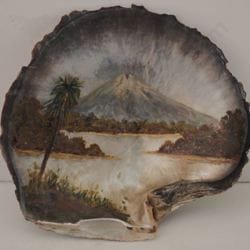
Mount Egmont with Lake
By: John Philemon Backhouse (1845-1908)
Oil on Sea Shell - 13cm x 14cm
Valued $2,000-$3,000
Offers invited over $1,500
Contact: Henry Newrick – (+64 ) 27 471 2242

|
|