
Founded by Max Farndale 1947 - 2018
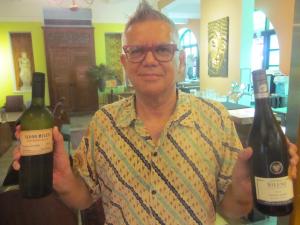
Hawkes Bay & Wairarapa Wines get a special Commendation.
Singapore tastemaker Robin Greatbatch proprietor of the Blue Bali restaurant on the Botanic Gardens has declared himself an ardent promoter of New Zealand wines, especially those from Hawkes Bay and the Wairarapa Valley.
“These wines have the dual advantage of being perceived as premium, yet at the same time are affordable,” enthused Mr Greatbatch.
He is widely credited with introducing to the island city state Indonesian cuisine and presentation. His Blue Bali series of restaurants and bars is definingly positioned in . . .
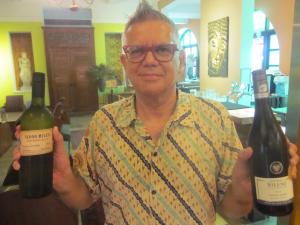
Hawkes Bay & Wairarapa Wines get a special Commendation.
Singapore tastemaker Robin Greatbatch proprietor of the Blue Bali restaurant on the Botanic Gardens has declared himself an ardent promoter of New Zealand wines, especially those from Hawkes Bay and the Wairarapa Valley.
“These wines have the dual advantage of being perceived as premium, yet at the same time are affordable,” enthused Mr Greatbatch.
He is widely credited with introducing to the island city state Indonesian cuisine and presentation. His Blue Bali series of restaurants and bars is definingly positioned in a large colonial era administration building situated at No 1 Cluny Road.
With an East Africa background Mr Greatbatch (seen brandishing Gladstone Vineyard and Sileni Estate) was educated in England, and thence to the United States and the aviation sector.
He was posted to Indonesia and it was here that he encountered his wife, and also his new future as an applied advocate of the Indonesian way of life.
It was now that he saw an opportunity in that while Malay and Chinese restaurants and cooking were well represented in Singapore, there remained the absence of a sustained Indonesian presence in the hospitality realm.
The historic Dutch influence on Indonesia simultaneously gave him considerable latitude in introducing in parallel certain European influences, notably those in wine.
In recent times he has followed through on this theme by developing a northern European style pilsner under his own Pumpkin label.
From the MSCNewsWire reporters' desk Tuesday 2 August 2016
As a trading nation, New Zealand has much it can be proud of. For two small islands of 4.5 million people, thousands of kilometers from distant markets, we produce high quality goods and services wanted by consumers all over the world.We've had a significant influence on world trade policy over the years. New Zealanders have played an influential role at the WTO helping shape the world's trade architecture.Previous New Zealand diplomats and Ministers, from Tim Groser and Phil Goff to Crawford Falconer and David Walker have all stamped New Zealand’s mark, promoting greater trade fairness. They've pushed countries to bring down barriers and lower tariffs and to empower their businesses with opportunities to grow economies, create higher paying jobs and offer better standards of living for their citizens.Our achievements are significant;• The first FTA with China,• achievers of the P4 and a founding member of one of the world's most valuable agreements TPP,• Instrumental in ensuring the ASEAN-Australia-New Zealand FTA (AANZFTA) was ASEAN’s highest quality agreement to date,All of this from a small country who, throughout history, has looked globally to thrive domestically.
As a trading nation, New Zealand has much it can be proud of. For two small islands of 4.5 million people, thousands of kilometers from distant markets, we produce high quality goods and services wanted by consumers all over the world.We've had a significant influence on world trade policy over the years. New Zealanders have played an influential role at the WTO helping shape the world's trade architecture.Previous New Zealand diplomats and Ministers, from Tim Groser and Phil Goff to Crawford Falconer and David Walker have all stamped New Zealand’s mark, promoting greater trade fairness. They've pushed countries to bring down barriers and lower tariffs and to empower their businesses with opportunities to grow economies, create higher paying jobs and offer better standards of living for their citizens.Our achievements are significant;• The first FTA with China,• achievers of the P4 and a founding member of one of the world's most valuable agreements TPP,• Instrumental in ensuring the ASEAN-Australia-New Zealand FTA (AANZFTA) was ASEAN’s highest quality agreement to date,All of this from a small country who, throughout history, has looked globally to thrive domestically.The New Zealand experience is a good one and should be seen as a model worth emulating.Consumers around the world are focused on food safety and their governments are adopting policies in the shadow of food security concerns. We know that it is trade liberalisation that offers the best chance to meet the growing requirements of a modern world.We are 4.5 million people who supply services and produce high-quality, safe food capable of feeding around 40 million people.Attending trade meetings around the globe one could be forgiven for believing we pose a significant threat to almost every world market.We do not.The real threat to meeting the demands of a growing world population is protectionism.According to a joint FOA/OECD study, by 2050 global agricultural productivity will have to increase by around 50 per cent in order to meet the demands of the world’s population.The protection of markets will only increase food security concerns - it will not feed more people.Why trade is important to NZWhilst we are too small to produce everything we need, in some areas we also produce far more than we need.We have to import medicines and medical technology, vehicles and agricultural machinery. We also like enjoy seasonal and tropical foods, the latest smart phones or Netflix episodes.To pay for those imports we need to export.Some of our biggest export sectors produce far more than we can consume – dairy exports 95 per cent of its production; sheep meat about 90 per cent. Wine will earn a record $1.5 billion this year. The people who work in these sectors need secure access to much larger markets than just New Zealand. Tourism depends on foreign visitors. Tourism earns more than $12 billion in export receipts each year and many New Zealand jobs depend on these visitors to our shores.We say it a lot - and it deserves repeating; we will not prosper selling to ourselves. We cannot shut ourselves off from the rest of the world.
NZ Trade StrategyToday I want to outline for you four key shifts that I see in our trade policy strategy.But before I do that, it’s important to consider the context.The world now is not the same as it was in 1993 when New Zealand first defined a trade policy based around a four track framework of unilateral, bilateral, regional and multilateral initiatives.Changes in the global environment, changes in the very way business is conducted, as well as our own successes under that existing trade strategy, have all been significant.That influences where we should now be putting our effort.The WTO has not delivered what we would have hoped it would at the time of that original strategy. The failure of the WTO Ministerial in Seattle was a presage of the difficulties that the Doha Round has experienced.But lack of progress at a multilateral level did not stop the hunger that businesses have for greater market access. Governments, including New Zealand’s, responded by negotiating bilateral and regional agreements.However, multiple trade deals have brought a myriad of rules and regulations which can be confusing and costly for businesses to navigate. This is particularly true for small businesses and businesses that are new to exporting.Take for example one of our close trading partners, Malaysia. Would a New Zealand business in future use the Malaysia/New Zealand FTA, AANZFTA, TPP, or RCEP for their trade access? From a tariff point of view this may be fairly straight forward but when one considers rules of origin, it is anything but.Businesses are now demanding that governments simplify trading arrangements, and rightly so. I believe this can most effectively be done in the WTO.The global financial crisis triggered defensive reactions by governments around the world and started a creeping protectionism that continues today. An OECD report last year showed that of the 1,500 trade-restrictive measures that were imposed by G20 countries since 2008, fewer than 400 have been removed.The WTO is an essential piece of global architecture that ensures all countries can compete fairly and with certainty on the basis of the same set of rules.The WTO is important for all countries, but is absolutely essential for small trading nations such as New Zealand. The WTO must play a vital role in keeping protectionism at bay.To do this, the WTO must also reflect on its decision-making processes.The new norm for WTO ministerial meetings must be achievement not stalemate.It must deal with some of the most contentious and harmful trade-distorting practices in a timely manner – particularly around high tariffs that are coupled with domestic support in key agricultural sectors.The UK vote to leave the EU has introduced new complexity to our relationships with the EU and the UK.From a trade and economic perspective, our continuing objectives are to maintain, and build on, our current trade access into both the EU and the UK markets.We will continue to work towards the opening of FTA negotiations with the EU, and I welcomed EU Trade Commissioner Malmström’s assurance that the UK’s exit will not negatively affect the EU’s forward FTA negotiating agenda.
What have we achieved?The past 12 months have been a remarkable period for New Zealand trade policy.We brought into force an FTA with Korea that restores our competitive position in our sixth largest export market; acceded to the WTO’s Government Procurement Agreement, giving access a market worth US$1.7 trillion, and Ministers at the 10th WTO Ministerial meeting in Nairobi agreed on the elimination of agriculture export subsidies – a decades-old top priority for New Zealand.We also joined with 53 other WTO members to eliminate tariffs on some $1.3 trillion of global trade under an expanded Information Technology Agreement.And then there was TPP – an agreement of enormous significance for New Zealand, covering 40 per cent of the world’s GDP and five new FTA partners for NZ, including two of the top five world economies.Other FTA processes are also continuing. Considerable work remains on the other mega-regional agreement we are involved with – the Regional Comprehensive Economic Partnership (or RCEP), and we are committed to seeking a credible and ambitious outcome.In the Pacific, the PACER Plus agreement with our neighbours is on track to be finalised soon.We remain focused on the China FTA upgrade.At the WTO we are seeking to ensure that disciplines on domestic support for agriculture are part of the outcomes from the next WTO Ministerial meeting.And our negotiators continue to push our interests in two other Geneva-based negotiations – Environmental Goods and the Trade in Services Agreement, or TiSA.
The Trade Policy Strategy refreshI want to talk about the refresh of New Zealand’s Trade Policy Strategy.Why are we doing this?Our existing Trade Policy Strategy – now more than 20 years old - has delivered significant gains for New Zealand and New Zealanders. The four-track framework has proved to be both flexible and robust.But given the global changes I mentioned earlier, it is timely to refresh our strategy.I am looking for evolution, not revolution.What might the Trade Policy Strategy refresh for New Zealand contain?We need a broad strategy that will help us to deliver on some basic objectives.We need to create opportunity and increase international connections, especially for New Zealand businesses – large and small. We need to use strategy to reduce the enduring challenges that New Zealand faces: we’re a long way from some of our key markets, we have a small domestic market, and our major comparative advantage is in products that some of our trading partners want to protect from competition.If our trade policy strategy can address those objectives it will help to make the New Zealand economy more resilient, and in turn help to lift growth and raise living standards for New Zealanders.At the same time, we will negotiate trade agreements that protect the government’s right to pass law and regulate.I expect we might see four broad shifts over time.The first shift is the balance between negotiation of further agreements and making the most of those we have.As I noted earlier, we have achieved a lot already.Under the current strategy we have secured FTAs with markets covering 52 per cent of our exports. This will rise to 72 per cent with TPP, and about 90 per cent if all the current and prospective negotiations I mentioned earlier are successfully completed.Having invested heavily in building what you might call ‘architecture’, the fact that the majority of our exports go to markets that are now covered by FTAs means in future we are likely to spend less effort looking to negotiate new agreements and more effort on implementing and upgrading our existing agreements.That includes things like government working with businesses to maximise the advantage of preferential access, monitoring and enforcing the rights we have secured, and in some cases future negotiations to extend aspects of those agreements.But before we shift the weighting of our effort, we have to complete the existing agenda of negotiations that I mentioned earlier.And throughout this, the WTO will remain important. It’s the only forum where we can achieve disciplines on agricultural subsidies; and with New Zealand companies trading globally, setting trade rules globally through the WTO makes sense for New Zealand companies.We will also use WTO dispute settlement to enforce fulfilment of obligations owed to us – it is imperative we retain and enhance both capability and capacity in this area. When necessary to ensure obligations are honoured, dispute settlement must be seen merely as a tool which is used increasingly around the world. It should not be demonised as anything more than this.While it has had some well-documented difficulties, the WTO can still surprise us.The achievement of the 10th Ministerial Conference in Nairobi was truly historic. I hope that success breathes new life into the negotiating function at the WTO and we do not slip back to the situation where negotiations drift for years. There is too much at stake. Key objectives for New Zealand, such as disciplining agricultural domestic support, can only be achieved in the WTO.New Zealand has had and must retain an important and influential role in shaping these developments at a multilateral level. Our capacity at the WTO must be maintained and, where it makes sense, enhanced.A second shift in our trade policy strategy arises from a combination of what we have achieved to date, and the new challenges faced by business.Our bilateral FTAs have delivered significant benefits for exporters.For example, Korea is a high value market for New Zealand cherry exports that were previously constrained by a high tariff and competition from Australia. The completion of the Korea-New Zealand FTA reduced the tariff from 24 per cent to zero and put us back on a level footing with our competitors. New Zealand export volumes have now trebled, with total exports worth over $5.5 million this season.However, tariffs are still critical impediments for some industries. So we will seek opportunities, including in future negotiations and the WTO, to address these remaining tariff peaks and tariff escalation.Government has heard the concern from business about non-tariff barriers.Addressing NTBs is typically long-term, resource-intensive work.With the progress on tariffs, we should be able to increase our focus over time on the barriers and distortions to our goods exports caused by non-tariff barriers.We’ll do this through our FTAs, through other instruments such as mutual recognition agreements, and through standard international bodies such as ISO and the FAO/WHO ‘Food Code.’Ministers are already taking steps to improve coordination and focus across agencies on NTBs.Our trade agreements need to address NTBs as well as tariffs whenever they can.Let me give you an example of where that has worked well in the past.In 1992, New Zealand exported no rock lobster to China. By 2007, exports were still worth less than $30 thousand per year. Today, New Zealand exports almost $288 million of rock lobsters each year, with much of this trade comprising high-value live lobsters, rather than the lower value frozen product that previously characterised the trade.The key driver of this export growth was a Protocol under the New Zealand-China FTA, which allowed for the direct export of live seafood to Mainland China. This enabled exporters to take advantage of the growing direct air freight services between China and New Zealand, as well as the tariff preferences agreed under the FTA.A third, important shift arises from the changing nature of business. Services and investment are of increased importance. The digital economy is transforming the operating environment for New Zealand.Trade in services – often the classic ‘weightless export’ - is especially important to New Zealand as a way to reduce the enduring challenge of distance from markets.Based on OECD data about 57 per cent of New Zealand’s total exports are services – either in their own right, embodied within or co-sold with products.Services and increasing overseas investment – typically so that businesses can get closer to end customers - are key elements for New Zealand firms to enable them to add value to volume.Over time goods and services trade will increasingly have an equal weighting when it comes to trade policy in New Zealand.E-commerce or digital trade has emerged as a vital channel to market; and with modern communications technology an increased range of ‘digital products’ can now be delivered to customers directly over the internet.This also should be of particular importance to New Zealand, as another means to reduce the enduring challenges of distance from market and small scale. There are opportunities for goods trade as well.The time is here where a small business in Invercargill can export to a consumer market of billions of people through online e-commerce platforms. These platforms can navigate the cultural and linguistic challenges whilst arranging secure payment, freighting and customs procedures all with the click of a button.We often read about NZ consumers buying online from overseas. E-commerce means those very same New Zealanders can now share in the benefits of trade directly - as exporters.The fourth shift that I see is that, over time, as we improve the rules to ensure a level playing field, we will want to put more effort into appropriately assisting New Zealand businesses to compete successfully in market against foreign firms.And to become more integrated in, and play a greater role in, global and regional supply chains.So there are four broad shifts in our Trade Policy Strategy that I believe make sense for New Zealand and will provide a useful guide to the future.
EngagementI have been discussing our Trade Policy Strategy with a wide range of stakeholders and other interested New Zealanders, including from civil society. Other Ministers are also having such discussions.This provides a valuable stream of input.It is important that all New Zealanders are given the opportunity to share in the benefits of trade. We need to continue to find more ways to bring them with us.Trade agreements are not about big companies. They are about levelling the playing field so that the men and women who work for those companies, and who work for their own companies, have greater job security and greater opportunity.For this reason, as part of the process for the refresh of New Zealand’s Trade Policy Strategy, we will hold public meetings in the main centres, open to all New Zealanders, to provide an opportunity to hear their views.To enable New Zealanders that do not live in those centres to participate, these meetings will be webcast and there will be an opportunity for people to send in questions during the meeting. More details will be announced in due course.In addition to that, officials are holding workshops with representatives of New Zealand business to ensure that they have a sufficiently deep understanding of the issues of key concern to business with the trade agenda.I also intend to continue a dialogue with Iwi around the significant benefits to all New Zealanders and in particular Maori businesses that high quality trade agreements can deliver.Taken as a whole, I hope this even greater engagement with New Zealanders will ensure that there is much wider understanding of, and comfort with, our trade policy strategy and the overall direction of New Zealand’s trade policy.Thank you.
Leading provider of online business management solutions, MYOB Group Limited (ASX: MYO) today announced the acquisition of Greentree for a total consideration of NZ$28.5 million.
Headquartered in Auckland, Greentree delivers leading enterprise resource planning (ERP) software to over 850 larger businesses across Australia, New Zealand, UK and US. With over 25 years’ experience, Greentree distributes via a partner channel into the enterprise market, comprising companies with approximately 100 – 1,000 employees. Its product suite has broad, on-premise ERP functionality and licensing is primarily perpetual with annual maintenance.
MYOB helps businesses succeed by providing online business management solutions for its 1.2 million clients across Australia and New Zealand (ANZ). The company’s Enterprise Solutions division is a leader in the ANZ enterprise market, delivering ERP and HRM (human resource management) software to over 7,000 clients with approximately 20 - 500 employees.
Continue here to read full article
Leading provider of online business management solutions, MYOB Group Limited (ASX: MYO) today announced the acquisition of Greentree for a total consideration of NZ$28.5 million.
Headquartered in Auckland, Greentree delivers leading enterprise resource planning (ERP) software to over 850 larger businesses across Australia, New Zealand, UK and US. With over 25 years’ experience, Greentree distributes via a partner channel into the enterprise market, comprising companies with approximately 100 – 1,000 employees. Its product suite has broad, on-premise ERP functionality and licensing is primarily perpetual with annual maintenance.
MYOB helps businesses succeed by providing online business management solutions for its 1.2 million clients across Australia and New Zealand (ANZ). The company’s Enterprise Solutions division is a leader in the ANZ enterprise market, delivering ERP and HRM (human resource management) software to over 7,000 clients with approximately 20 - 500 employees.
Enterprise Solutions is a growing part of the MYOB business, contributing A$41 million of revenue in FY15), up 4 percent year on year, underpinned by the successful integration of PayGlobal, acquired in August 2014, and the launch of online solution MYOB Advanced in early 2015. Since its inception 18 months ago, MYOB Advanced has exceeded market expectation across Australia and New Zealand and is now positioned as the fastest growing cloud ERP solution for the mid-market.
The Greentree acquisition enables MYOB to further extend its mid-market leadership into larger enterprise business offerings and apply its marketing and distribution resources to accelerate growth through the existing Greentree channel. MYOB will leverage Greentree’s considerable large company expertise and provide its leading online capabilities to the current Greentree product range.
MYOB CEO Tim Reed said: “We are delighted to announce the acquisition of Greentree, in line with our stated strategy of targeting value-add acquisitions to complement organic growth. Greentree is a quality business and has a very experienced team who collectively bring a wealth of knowledge and experience in the evolving ERP sector.”
“We’re thrilled with the growing prominence of MYOB in the ERP space. 2015 saw the expansion of our business with the addition of MYOB Advanced to our market leading EXO Business product line. MYOB will be the first to market with and integrated online ERP and Payroll solution for bigger business. The acquisition of Greentree further reinforces our commitment to bigger businesses in Australia and New Zealand and expands our ERP product suite to establish MYOB as a dominant leader in the mid-market.”
Greentree CEO Peter Dickinson said: “This is exciting for our team and a great opportunity to work closely with MYOB to develop and deliver the leading online and on-premise ERP solutions that our clients need to successfully stay ahead in a rapidly changing world. It’s a compelling partnership which allows Greentree to leverage MYOB’s significant scale and resource and tap into new markets.”
The acquisition of Greentree is scheduled to complete on the 1st August this year.
A release from MYOB Monday 1 august 2016
Transport Minister Simon Bridges has welcomed the signing of an air services agreement opening the opportunity for code-sharing between New Zealand and Mauritius airlines.
The agreement was signed today after being negotiated by officials at an international air services conference in Turkey in 2015.
“This agreement opens up opportunities for code-share services linking New Zealand and Mauritius, through Air Mauritius services to and from Perth, Australia. Passenger airlines of each side can now also operate up to 14 services per week,” Mr Bridges says.
“This agreement will further enhance New Zealand’s international air connectivity, bringing both trade and tourism benefits.”
A release from the Beehive Monday 1 August 2016
Transport Minister Simon Bridges has welcomed the signing of an air services agreement opening the opportunity for code-sharing between New Zealand and Mauritius airlines.
The agreement was signed today after being negotiated by officials at an international air services conference in Turkey in 2015.
“This agreement opens up opportunities for code-share services linking New Zealand and Mauritius, through Air Mauritius services to and from Perth, Australia. Passenger airlines of each side can now also operate up to 14 services per week,” Mr Bridges says.
“This agreement will further enhance New Zealand’s international air connectivity, bringing both trade and tourism benefits.”
Mr Bridges says the Government’s liberal International Air Transport Policy is bringing many benefits to New Zealand.
“Since the policy was implemented in 2012 more than 50 new or amended air agreements have been negotiated, bringing the total to 78. Most of the major airlines in the world are now able to operate services to New Zealand without restriction, with 19 new air routes announced in the past year alone.
“We’ll continue our efforts to grow and enhance these connections, making it easier for New Zealanders to travel and trade internationally.”
A release from the Beehive Monday 1 August 2016
Avery Products has unveiled its new range of label stocks named AveryPro, soon after the company revealed it would launch a new print label business WePrint.
The new collection of label sheet stock is slated to suit print businesses which use digital printers for short-run and special project print jobs, Avery Products says they will meet the growing demand for premium grade labels printed just in time to meet an ever growing need for fast turnaround.
The company says that commercial printers can diversify their product range to existing clients by ‘entering the varied and lucrative label market, and also broaden their market reach to new clients’ It says that by using AveryPro premium label stocks, they will enhance . . .
Continue to the full article here
New Zealand First can reveal serious holes in Land Information (LINZ) data that the government claims to show low levels of overseas ownership.
“The government’s data is bumph and only proves its specious honesty box approach to foreigners buying our land,” says New Zealand First Leader and Member of Parliament for Northland Rt Hon Winston Peters.
“A weak Minister in a government denying reality is talking up data that simply does not exist.
“From the horse’s mouth, Inland Revenue, we have this: ‘Inland Revenue does not record information based on tax residency’.
“How do we know that the 63 per cent of purchasers in Auckland claiming to be Kiwi tax residents are that, when Inland Revenue doesn’t even know?
“Is LINZ special? Because when it comes to Kiwi citizenship, the Privacy Act prevents Inland Revenue and Internal Affairs sharing information.
“Then there is the large hole in LINZ data where ‘No statement or tax information is required’. Some hole when it accounts for 39 per cent of sales in the North Island and 38 per cent in the South Island.
“This window dressing data isn’t worth the paper it is printed on, which is why, New Zealand First’s Land Transfer (Foreign Ownership of Land Register) Amendment Bill is before Parliament. We want New Zealanders to properly know who is taking over their country.
“Instead of doing the right thing, National has reinterpreted the 3-Wise Monkeys as ‘see no foreign buyers; hear no foreign buyers; and don’t stop foreign buyers’,” Mr Peters said.
A NZ First press release 1 August 2016
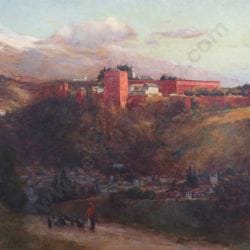
Palace of the Alhambra, Spain
By: Charles Nathaniel Worsley (1862-1923)
From the collection of Sir Heaton Rhodes
Oil on canvas - 118cm x 162cm
Valued $12,000 - $18,000
Offers invited over $9,000
Contact: Henry Newrick – (+64 ) 27 471 2242
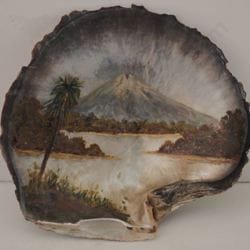
Mount Egmont with Lake
By: John Philemon Backhouse (1845-1908)
Oil on Sea Shell - 13cm x 14cm
Valued $2,000-$3,000
Offers invited over $1,500
Contact: Henry Newrick – (+64 ) 27 471 2242

|
|