
Founded by Max Farndale 1947 - 2018
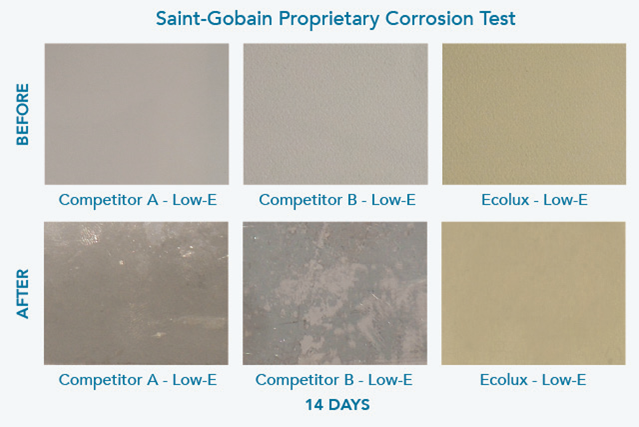
Low E Film Comparative Corrosion Testing
Saint Gobain Solar Gard, 27 June 2016 - Low E, or Low Emissivity films, are able to keep the heat inside a building in winter as well as reject it in summer. In recent years technology in Low E films has advanced significantly and now the latest high performance Low E films can stop nearly half the heat from escaping in winter.
That impressive winter performance has made high performance Low E film the fastest growing market segment in Australia & New Zealand and Solar Gard's Ecolux 70 is a market leader.
As you may know high performance Low E films are more expensive than standard flat glass films and as a result we see most sales going to high end properties where quality is of the utmost consideration. No one wants to see a film fail through corrosion and especially not when installed in high end properties.
As a comparative bench marking exercise Solar Gard Saint-Gobain through its San Diego laboratory tested Ecolux 70 against two competitor's Low E films using a Saint Gobain proprietary corrosion test, see before and after samples illustrated above. As you can see Ecolux 70 performed exceptionally well showing zero corrosion whereas the competitor's samples showed excessive corrosion after only 14 days in the same chamber.
The New Zealand distributor and source of information on the Saint Gorbain products is:
SWF-Distribution Ltd3D / 89 Ellice Road GlenfieldP.O.Box 10-1167 North Shore Mail Centre 0745 Auckland Phone- +64 9 441 0040Fax-+64 9 444 2788Cell- 021 245 5135Email-This email address is being protected from spambots. You need JavaScript enabled to view it.

Wellington, RBNZ, 27 June 2016 - The Reserve Bank today published a consultation paper on its approach to the registration of foreign-owned banks that have a small, non-systemic, locally incorporated presence in New Zealand.
The consultation proposes a way to assess whether these banks may be permitted to ‘dual-register’, simultaneously operating a local branch alongside a subsidiary.
Consultation closes on 24 August 2016. The Bank will review submissions received and expects to communicate further about the issue in late 2016.
More information: Consultation Paper: Dual Registration Policy for Small Foreign Banks
June 27, 2016 - It will enter from the Atlantic Ocean and after few hours exit into the Pacific Ocean.
Following his remarks, Mr. Benitez and the Expansion's project manager Ilya Marotta-who Forbes named as one of the 50 most powerful woman in Central America-answered questions from the assembled worldwide journalists. The amount of steel used could have erected 29 new Eiffel Towers. While others wonder if the new locks are safe.
Neopanamax ships, as their names suggest, are new generation cargo vessels built specifically to pass through the broadened Panama Canal. The expansion project, which began in 2007, is estimated to have cost US$5.5 billion.
Until now, the lock dimensions haven't changed since the Panama Canal first opened in 1914.
The United States and China are the two most frequent canal users.
Panama is also avidly eying the lucrative market of transporting liquefied natural gas between the United States and Asia, principally to Japan.
Currently, the Canal serves more than 144 maritime routes, connecting 160 countries and 1700 ports across the world. "It should be positive for all New Zealand shippers", he said.
This prospect has triggered activity up and down the East Coast.
Annual cargo volumes should double over the next decade, leading Panama to hope to triple the $1 billion in shipping fees it receives each year. If it landed in Los Angeles, it would cost $2,000 to send it across the country by rail.
The Chinese ship won the privilege of making the first transit when it was selected in a drawing among the canal's top customers. With related economic activity, the canal is responsible for about 40 percent of Panama's GDP. The Panama Canal continues to provide the world, global commerce and individual segments with new products and services. Brazil accounted for 54 percent.
The canal is just part of a formidable infrastructure spending program here. "This expansion will reconfigure, permanently, the map of the global shipping industry".
The canal authority will ease in the new locks, allowing only four slots daily for passages. And it is sinking $450 million in urban renewal of poor sections of Colon on the north side of the canal.
The revitalized canal has also spurred vast construction projects at ports on the U.S. East Coast and Gulf of Mexico. "We are the bridge to the world and the heart of the universe", she says, quoting an old promotion campaign and beaming with pride. "When you build a house, you have problems".
Though bigger ships will now fit through the canal, it doesn't mean they'll be filled with more goods, said Greg Miller, a senior editor at IHS Maritime, a publication run by global consultants IHS. Largely because of ship size restrictions, crude oil traffic was significantly smaller, and fairly equal in direction, with 3.0 million long tons going southbound and 2.6 million long tons going northbound (from the Pacific to the Atlantic).
"It's important to remember that the canal does not create demand".
Jorge Luis Quijano, administrator of the Panama Canal, said at a press conference on Saturday that this expansion, which will be inaugurated on Sunday, will open up new opportunities in sectors such as logistics and ship repairs. The Panama Canal expansion has coincided with New Zealand ports either carrying out or preparing to carry out dredging work to increase their own capacity.
The canal builders came up with an elegant, though partial, solution.
He added: "Deep down, we're afraid the locks will fail someday".
SAINT-GOBAIN Purchase of JTT Composites / Deal includes plant, R&D office as well as “RT2i” technologyWithout disclosing the purchasing price, Saint-Gobain (Paris / France; www.saint-gobain.com) in late May announced that it had acquired MIPNET Industries’ (Merignac / France) JTT Composites assets. The business, which operates a production plant near Bordeaux / France, produces composite parts for the aerospace market and also runs an R&D facility. The acquisition will allow Saint-Gobain to access JTT Composites’ proprietary “RT2i” weaving technology, which is said to combine the automated manufacture of 3D dry textile reinforcements in “Kevlar”, carbon or other types of fibre with the impregnation of these reinforcements with thermoplastic matrices or thermosets.
Saint-Gobain Performance Plastics business manager Scott Huth said the purchase “will expand our portfolio of high-performance solutions and value-adding services.” He added that the European aerospace market is booming, and that the company has high hopes for this particular business.
Saint-Gobain said the acquisition is in line with its focus on strengthening its position in growth markets. As part of that goal, the French group in January acquired Brazilian speciality extruded tubing producer SG Plásticos.
Originally published June 1, 2016
Saint Gobain are well represented in New Zealand including This email address is being protected from spambots. You need JavaScript enabled to view it.
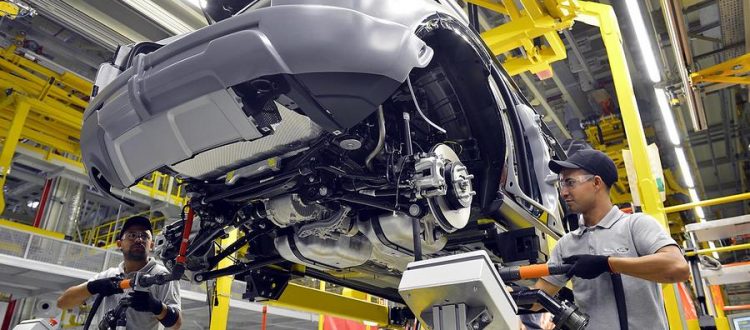
June 15, 2016 - Jaguar Land Rover has officially opened a factory its first fully-owned manufacturing plant outside of the UK, in Brazil.
The new South American plant will construct the Range Rover Discovery Sport and Evoque, which are the two most popular Jaguar Land Rover cars in Brazil.
The opening of the site also marks the first time a UK-based car manufacturing company has opened a manufacturing site in Latin America.
The new Jaguar Land Rover factory will be built in Itatiaia and signifies the next phase in the firm’s global expansion scheme after it opened a Chinese joint venture factory two years.
Speaking at the plant inauguration, the firm’s Executive Director of Manufacturing, Wolfgang Stadler, said that the opening of their new world-class site in Brazil signifies the company’s latest landmark in its global expansion.
He continued that Land Rover already leads the Brazilian market for sales of mid-sized premium SUVs, which account for over 30% of sales in that sector.
Building on their existing popularity in Brazil, the Discovery Sport and Evoque will be made for the first time in South America.
Also included in the plant is Jaguar Land Rover’s first ever overseas ‘Education Business Partnership Centre’, which provides a host of classroom activities for around 12,000 local children every year.
The scheme aims to raise the children’s work awareness, help them to develop key skills and inspire them to pursue a career with Jaguar Land Rover.
The company has also announced that it has sourced major components for its vehicle manufacturing from local suppliers such as IAC and Benteler.
Among the components that will be sourced from these local suppliers are powertrain assembly, chassis, exhaust, cockpit and seats.
Furthermore, Jaguar Land Rover says that it is supporting an increase in the levels of localisation in the future by investing in its technical assistance services.
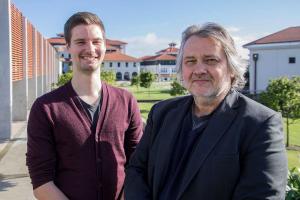
PhD student Lukas Trombach and Distinguished Professor Peter Schwerdtfeger.
Massey University, Monday 27 June 2016 - A world-renowned Massey University researcher in quantum chemistry has opened the doors for a ‘gold rush’ of future research in gold nanostructures.
The paper Hollow Gold Cages and Their Topological Relationship to Dual Fullerenes was co-authored by Distinguished Professor Peter Schwerdtfeger, Lukas Trombach, Sergio Rampino and Lai-Sheng Wang. It featured on the cover of the international publication, Chemistry - A European Journal.
The excitement is around a new class of golden fullerene structures discovered by Professor Schwerdtfeger the acting head of Institute of the New Zealand Institute for Advanced Study and PhD student Lukas Trombach.
Professor Schwerdtfeger explains that gold has sizeable enhancement factors in nanoscience compared to lighter metals like silver and copper and experiences “strong electron donation toward the gold atoms due to its increased electronegativity, which makes them ideal for electronically fine-tuning chemical and physical properties,” he says.
The discovery is significant, as previous research had not considered dual fullerenes when looking at gold clusters. “This new relationship opens the way for a complete new class of hollow gold clusters and the research has applications in synthesising new catalysts with metals inside the gold cage.”
Catalysts (a substance that increases the rate of a reaction without being used up itself) are used in chemistry to increase the rates of chemical reactions, and are important in industrial processes to save energy and reduce costs. Since it was discovered that gold nanoclusters are catalytically active (capable of accelerating or causing a chemical change by the addition of a catalyst) the field of nanoscience has experienced renewed activity, and studying their structure has been the ambition of many scientists over the last 20 years.
“A catalyst is essentially a chemical shortcut that saves time and energy and catalysts with gold nanostructures could potentially speed up these processes compared to other metals,” Professor Schwerdtfeger says.
The study explored the relationship between carbon and golden fullerene cages in detail and found there are as many golden fullerene isomers as there are different fullerene structures, and “the door is now open for other researchers to explore these structures.”
Cover image: the dual golden fullerene Au32 (earlier proposed by Dage Sundholm in Helsinki) above the Auckland skyline. NB: In the full cover image the carbon fullerene C60 can be seen reflected in the water.
 Fullerenes in the skyline
“In the cover photo, we had Auckland’s skyline in mind as most of the research was carried out at Massey University in Auckland. The reflection of the carbon fullerene in the water demonstrates the unique one-to-one correspondence between it and the golden fullerene,” says Professor Schwerdtfeger.
Professor Schwerdtfeger dedicated the paper to Professor Gernot Frenking in recognition of his 70th birthday. Professor Frenking was the one who asked the simple question concerning fullerene structures that led Professor Schwerdtfeger to seek the answer.
“I didn’t have an answer right away. If I see a problem that other people can’t solve I start to get interested in it and want to crack it. From this seemingly small event, I got into the topology of fullerene structures, and have since been delving deep into mathematical graph theory.”
Originally published by Massey University, June 27, 2016
To read the full paper, click here.
ABU DHABI // An industrial strategy that aims to add Dh165 billion to the economy and create thousands of jobs by 2030 has been approved by Sheikh Mohammed bin Rashid, Vice President and Ruler of Dubai.
The strategy sets out priorities for developing aerospace, maritime, aluminium and fabricated metals, pharmaceuticals and medical equipment, food and beverages, and machinery and equipment industries.
The industrial sector is expected to grow by Dh18bn by 2030, creating 27,000 jobs, with exports forecast to rise by Dh16bn. Investment in research and development will increase by Dh700 million by 2030.
“The Dubai Industrial Strategy aims to transform the UAE into a global platform for innovative industries and a destination of choice for international companies seeking an integrated and favourable environment for growth and sustainability," Sheikh Mohammed said.
“With the launch of the strategy we are taking one more step towards the future. We have laid down a strong foundation that blends our strategic location and infrastructure with our ambition, confidence and experience.
“We are one step closer to achieving the goal of making Dubai a home for innovators, a favourite place to live and work, a global economic hub and a preferred destination for visitors."
The sectors were chosen for future growth prospects, export potential and mid-term to long-term economic benefits.
“Sustainable development involves activating all pillars of the economy," said Sheikh Mohammed. “A conducive environment is required to achieve our targets that focus on knowledge, science and research, which form the foundation for the development of industries.
“Nations are recognised for what they produce and the value they add to the global economy."
Sultan bin Sulayem, chairman and chief executive of DP World, said the Dubai Industrial Strategy was in line with the UAE’s vision for sustainable progress in the post-oil era.
Dubai is already regarded as a major international trading centre and is poised to emerge as a global industrial centre, Mr bin Sulayem said.
At the core of the strategy is providing Emiratis with the knowledge and skills through industrial projects, he said, empowering them to take part in the country’s development.
Ibrahim Al Janahi, chief commercial officer of the Jebel Ali Free Zone Authority, said: “The Dubai Industrial Strategy has outlined policies to ensure a steady pace of growth in all sectors and has assigned specific tasks to every economic institution – whether free zones or industrial zones.
“Jebel Ali Free Zone has more than 765 companies from 73 countries, employing nearly 73,000 people over an area of 14 million square metres.
“We intend to increase these numbers in the coming years and contribute to the quantum leap that the national economy will achieve through implementing this strategy."
Originally published in The National UAE June 26, 2016
At the end of last year, Autodesk announced the creation of a new cloud-based platform for developers of cloud-based applications related to design and manufacturing, along with a $100 million investment fund with which Autodesk can support those who sign on to build apps for the program. An all-encompassing ecosystem, Forge features numerous application program interfaces (APIs) and software development kits (SDKs) that allow for a wide variety of applications, from viewing and presenting 3D models to transforming 2D images into 3D models.
Since the initial December 2015 announcement, the Forge Platform has continued to evolve. Among the updates surrounding the platform are the integration of Autodesk’s Spark 3D printing ecosystem into the larger umbrella of Forge and news of the first three companies to receive Forge investments.
While the incorporation of Spark into the Forge Platform may seem minor at first glance, the change represents a new approach that Autodesk is taking in regards to manufacturing. In an interview with ENGINEERING.com, Ulf Lindhe, lead of business development for additive manufacturing with Autodesk, and Mark Forth, industry strategy and business development manager, explained Autodesk’s bird’s-eye view of the future of fabrication technology.Autodesk Spark
The Spark Platform was formed in 2014 as a means of driving innovation around 3D printing. With access to a number of open APIs related to print preparation, printer management and running a 3D printing service bureau, developers could create apps . . . Continue reading
Originally published on Engineering.com June 22, 2016
Tauranga will be the New Zealand port of call for Maersk's new service from North Asia to South America.
June 24, 2016 - New Zealand will be a "bus stop on the route" of a new south-bound weekly shipping service between North Asia and the west coast of Latin and South America. Maersk's Triple Star will arrive from North Asia on July 24, stopping at Japan, Korea, China and Taiwan. It will call at Tauranga, picking up goods from ports around the country and carry on to South America, calling at Peru, Chile, Panama, Colombia and Mexico.
Maersk Line Oceania's trade and marketing director Hennie Van Schoor said the new service would benefit importers of goods from North Asia and exporters to South America. New Zealand importers tended to bring in retail goods such as electronics from North Asia, and New Zealand exporters tended to send wood, dairy and other foodstuffs to South America. Van Schoor said the beauty of the South American leg, called the South Pacific Express, was its speed.
Currently it took about 35 days to send goods to Latin America from New Zealand and now it would only take 13. For New Zealand importers and exporters, their goods would be able to "go along for the ride" on an otherwise expensive service. "The size of the vessels, the space that's on board is not dependent on what New Zealand will fill or can fill. "It really means we can tap into a larger network, meaning that the efficiencies of those networks are passed to New Zealand exporters and importers."

Palace of the Alhambra, Spain
By: Charles Nathaniel Worsley (1862-1923)
From the collection of Sir Heaton Rhodes
Oil on canvas - 118cm x 162cm
Valued $12,000 - $18,000
Offers invited over $9,000
Contact: Henry Newrick – (+64 ) 27 471 2242
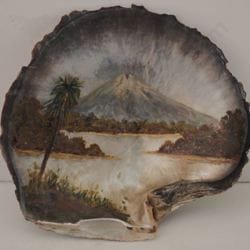
Mount Egmont with Lake
By: John Philemon Backhouse (1845-1908)
Oil on Sea Shell - 13cm x 14cm
Valued $2,000-$3,000
Offers invited over $1,500
Contact: Henry Newrick – (+64 ) 27 471 2242

|
|