
Founded by Max Farndale 1947 - 2018

Australasia’s long-established Customised operator Out-Distances competition with long-range journeys onto the Roads less Travelled
Australasian tour operator Odyssey Traveller anticipated the narrow ultra-specialised consumer requirement so evident today.
Now of course the customised preference drift has become the dominant leisure industry direction echoed so distinctly in outward and inward packaged travel everywhere.
Tailored around the knowledge-seeking experience Odyssey’s expeditionary-style tours are sharply defined around just a few time-frame durations, notably of nine and 30 days.
Focussed on the 50 plus age sector Odyssey’s concentration on the exclusivity of small travelling groups means that the operator can mould its offerings to conform to traveller preference rather than the other way around.
The Sydney-based Odyssey is owned by the Australian and New Zealand universities.
In an academic-dimension lightbulb moment a generation ago these universities conjured forth Odyssey because saw the future in adding an adventure element to what had previously been academic field trips.
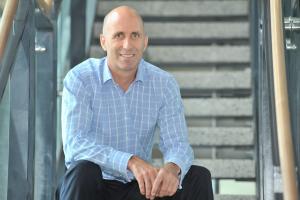
In recent years Odyssey CEO Mark-Banning Taylor (pictured) has tightened up still further on this sharp destination emphasis by sending tours into regions which people have long read about, but who have never encountered anyone who has actually ever been there.
These destinations include nations such as Togo and Benin, Madagascar, and Papua New Guinea.
He has similarly sharpened his profile on inward tours by emphasising subject areas over destinations, basing them for example on studies of Australasian ethnicity, arts, flora and fauna, photography, pioneering, and so on.
In fact he has let expire the organisation’s agency arrangements in order to concentrate on Odyssey’s own inward intellectual tours.
He has similarly enhanced the perspective on Odyssey’s outward tours.
For example, with the resurgent interest in battlefield travel, those of antiquity to those of modern times, Odyssey has expanded its range of tours encompassing the Pacific theatre, North Africa and Europe.Odyssey has also nudged still further to their geographic extremities its standard tours to the Russian/Asian landmass.
Iran is a particular thrust at the moment, with departures guaranteed years ahead for these small groups.
According to Mr Banning-Taylor the objective is to implant tour members directly into the environment and its culture with the minimum of distraction.
This applies across the swathe of the tours including such mainstays as the one that “Island Hops” through Scotland’s Western Isles.
Here members will find themselves lodged in remote crofts and listening to Gaelic as part of everyday life.
A particular strength of Odyssey is considered to be its carefully selected local guides who must be local residents and accredited to a tourism authority.
Similarly the company’s tour “leaders” as they are described are drawn from those who have had a vocational, often academic, association with the region being visited.
The tour planning starting point tends to be at the learning end rather than with the destination itself.
In other words, what are party members going to acquire in a knowledge sense from their experience that they did not know before?
Observes Mr Banning-Taylor: “We ask ourselves, ‘what do people of curiosity really want to discover, see for themselves?’ “
This is a particular characteristic of the Odyssey inward tours which deliberately cater for these special fine-focus interest groups.
Aside from the obvious ones of terrain, settlement and ethnicity, we also find, for example an emphasis devolving onto governance, national character, and how these came about.
One example is a tour for those curious about Australian literature.
Here, the tour takes in visits to the homes in which the authors once lived and takes party members through the institutions and landscapes that determined their output.
This fine-slicing embraces broader gauge interests such as the tours of Australasian distinctive cuisine and wine regions that are sectored into regional specialities, terroirs and marques.
Odyssey according to Mr Banning-Taylor, seeks always to put plenty of distance between what it offers its travellers and the general Australasian tourist concept of looking at the familiar sights.
In its central Europe offering for example is one on the Hapsburgs with reference to their pioneering role in the entertainment industry as we know it today.
It turns out that this is a variant on the usual Danube type of experience insofar as it takes into account the little-understood fact that it was the Hapsburgs who liberated live entertainment and thus gave the world Mozart and Beethoven among other luminaries.Similarly a tour of Provence features this connectivity between past and present with an emphasis on the walled cities of Avignon and Carcassonne which turns out to be where the global heritage and conservation movement as we know it had its beginnings.
Odyssey’s intellectual point of embarkation features a notable sociological emphasis that some may interpret as downright serious.
For example a South American tour is one into Peru centred on the influence of women in regard to the matrilineal nature of the Inca society which was pretty much wiped out by the patriarchal Spanish colonisers.
The tour includes contemporary manifestations of the subsequent resurgence in the status of women especially in textile design and development, thus blindingly indicating the linkage between perceived economic value and civil rights.
Symbolically the expedition is capped by two nights in the middle of Lake Titicaca on Suasi Island owned by a prominent Peruvian womens activist.
In operational terms an enduring shared worry of both providers and their clients is that offered tours will in fact not take place because they are under-subscribed.
It is no consolation to would-be travellers that their deposits will be recovered should there be insufficient bookings to launch it. Time has been allocated, arrangements made.
To this end Odyssey from its long experience categorises certain tours as guaranteed.
Other tours such as the pioneering ones into the paths less travelled are cited as being dependent on a minimum number of takers, usually as low as three people.
A recent tour to see the world’s largest ever dinosaurs in Argentina is just one example “You could say that we are in a joint venture,” noted Mr Banning-Taylor
“A client seeks from us a memorable experience—it is up to us to be candid about the need to find a few others who wish to share in it.”
He summarises the Odyssey endeavour as being quite literally one of an applied taste test.
“Would your Odyssey travellers’ tales stand up at a dinner party; command some attention?
“We like to think that if you have been on an Odyssey tour, then, yes, they would.
“Our objective is taking travel quite some distance beyond sightseeing.”
Similarly Odyssey itself travels just a little bit further also in a community sense
It is known that Odyssey via its board allocates surpluses to university types via a series of cash scholarships for students across New Zealand & Australia of AUD$10,000 who demonstrate financial need and academic performance.
| From the MSCNewsWire REporters desk - travel || Monday 27 September 2017 |||
As a House of Lords Member a Lord Peters can serve in a New Zealand government cabinet
Knowingly or unknowingly New Zealand caretaker prime minister Bill English has it within his gift to put renegade electoral balance of power holder Winston Peters MP on the high road.
The one that leads to the House of Lords.
Former National Party prime minister Jim Bolger signalled that Mr Peters wanted “respect.”
This can now be interpreted beyond the abstract sense in which until now it has been taken.
Neither does it take the form of a knighthood.
Mr Bolger has deliberately stood aside from this diluted form of ennoblement.
Mr Peters will do so, if he has not already done so.
It is within a New Zealand prime minister’s patronage or gift to recommend to Buckingham Palace a candidate for the House of Lords.
The last such candidate was the late Lord Cooke of Thorndon, an eminent jurist.
Mr Peters displays many of the characteristics of this former Wellington law lord.
He is also a lawyer. He is at ease with formality, and protocol.
He is consistently pro monarchist.
He has long been an advocate of Commonwealth trade preference.
Early last year he addressed the House of Lords on this topic in the context of Brexit.
His speech widely publicised in Great Britain was ignored here.
Why then cannot Mr Peters be similarly dispatched to the House of Lords by a coalition friendly Labour government?
The reason is that as a Labour Party initiative such a bold move would be much, much, more difficult if it could be implemented at all.
The action by the last Labour government in eliminating the British honours here was one of string of slaps across the imperial face dating from the Norman Kirk era.
Such an elevation will require also the endorsement of the British prime minister.
Premier Theresa May is likely to have doubts about sponsoring into the House of Lords a new member who is part of a Labour Party. Mrs May would need to be assured that such a candidate was not going to add to the Brexit dissonance.
Neither is it widely understood that as a member of the House of Lords Mr Peters, now Lord Peters, could still serve as a member of a New Zealand government cabinet.
He could not of course continue to sit as a Member of Parliament.
No insoluble problem here to a delicately balanced National-led MMP coalition because the next one on his list would simply slide in at the bottom.
By House of Lords standards Mr Peters at 72 is not very old.
An operational problem is the financing of a member of the House of Lords from New Zealand.
Robin Cooke QC, Lord Cooke of Thorndon, was able to look after the costs of his own membership of the House of Lords.
In the instance of Mr Peters an obvious solution is for his deployment to be part of the operations of New Zealand House.
Mr Peters, now Lord Peters, as a New Zealand cabinet member with an international role would therefore become an official deftly positioned to push the national cause simply by being part of the establishment instead of a mere observer looking in.
Couched in bitter-sweet terms here is part of Mr Peters’ somewhat prescient pre-Brexit appraisal of the position that he delivered to the House of Lords last year……
………The Commonwealth the UK will find in 2016 is quite different to the one it turned its back on in 1973. Infrastructure has come on in leaps and bounds. The days of the Commonwealth having nothing but raw commodities are gone.
It is now a dynamic powerhouse, crossing every time zone and trading session in the world. It covers nearly 30 million square kilometres, almost a quarter of the World’s land area. It’s members can be found in every single inhabited continent. Together, we have a population of over 2.3 billion, nearly a third of the world’s population. In 2014 the Commonwealth produced GDP of $10.45 trillion, a massive 17% of gross world product. Seen that way the Commonwealth could be a colossus.
| From the This email address is being protected from spambots. You need JavaScript enabled to view it. || Sunday 1 October 2017 |||

A tumultuous pair-bonding
The general public remains baffled about the constant and unremitting castigating of the mainstream media by New Zealand First’s Winston Peters MP.
They assume it is a lovers’ tiff.
In a way it is.
The two parties involved possess the essential characteristics of a tumultuous pair bonding.
They cannot live tranquilly together.
Yet they cannot live apart.
Mr Peters understands also that he is both ward and prey.
He helps out by generating news. From time to time he will be fodder himself.
He understands something else too.
It is this.
Journalists would rather be scolded than ignored.
In the current post electoral outcome fractionalisation standoff this press drama which peaks every three years has assumed a stormier than usual proportion and therefore now deserves to be analysed.
Our starting point is the belief held by Mr Peters to the effect that simply because the mainstream media insists that it is impartial, so must it be impartial in its reporting.
Mr Peters contrasts this proclaimed New Zealand impartiality to that which exists in other parts of the Westminster sphere.
In which for example newspapers such as Britain’s Daily Mail, Guardian, Daily Telegraph, Daily Mirror display a known diversity of political preferences.
This means that readers price in this bias when they study the respective newspapers.
What are Mr Peters’ specific gripes? Here are some of them:-
*Whenever Mr Peters advances a policy plank, the media simply goes to other and opposing political side to get comments about it.
*Commentators on reviewing any policy from Mr Peters simply conclude that he is a “populist” which is code for grabbing votes wherever you can.
*Any incursion by Mr Peters and/or his party into the issue of ethnicity in Parliamentary representation is greeted with veiled or direct comments centred on the media trigger-word racism.
*That Mr Peters is primarily a circus entertainer who shoots from the hip, and is an ageing one now to boot.
There are though some solid reasons behind Mr Peters’ reluctance to commit himself to background data on his planks.
For example, had he gone into the historic connection between the Maori Seats and the Ratana sect he could well have found himself accused of being anti-religion, among other things.
His sparseness of supporting background data has much to do with side-stepping angle-journalism, the dominant applied news- shaping technique here.
It devolves on a public figure unwittingly having pinned on them something which, taken out of context, makes them look silly or dastardly, or both.
This process can be lethal to the utterer/author if it is run through the politically correct filter.
This screening process does not so much apply to the visible news people, the ones on the pavement, or in the studio.
But it is a factor for those up the line who must consider things such as licence and public advertising allocations.
| From the MSCNewsWire reporters' desk || Friday 29 september 2017 |||
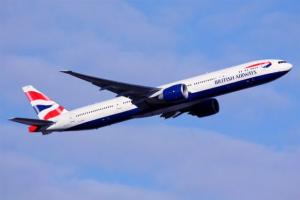
GreenSky London arrived on the scene a few years ago, an ambitious project led by British Airways to produce renewable aviation jet fuel from East London’s garbage.
Now, a group of four companies established a new partnership to prepare the business case for a commercial scale waste-to-renewable-jet-fuel plant in the UK. Subject to the successful completion of all development stages, the aim is to achieve a final investment decision in 2019.
British Airways spokesperson Cathy West said: “The government needs to support innovative aviation biofuels projects such as this if they are to progress. Aviation fuels are not eligible for incentives that road transport fuels receive, making it difficult to build a business case to invest in UK aviation fuels projects. This affects investor confidence.”
This week, the Department for Transport published changes to the Renewable Transport Fuels Obligation (RTFO), and for the first time, sustainable jet fuel is to be included in its incentive scheme. These changes to the RTFO are designed to promote sustainable aviation. Once implemented, they are expected to provide long-term policy support for this market.
Ultimately, BA speculated that the UK policy shift could stimulate as many as a dozen advanced biofuels plants in the UK by 2030.
The technology involved was a gasification system by Solena that would convert municipal solid waste to syngas, and it planned to convert that syngas to liquid transport fuels using Velocys’ micro-channel Fischer-Tropsh technology.
The plant would take hundreds of thousands of tonnes per year of post-recycled waste, destined for landfill or incineration, and convert it into clean-burning, sustainable fuels. The jet fuel produced is expected to deliver over 60% greenhouse gas reduction and 90% reduction in particulate matter emissions compared with conventional jet fuel, thereby contributing to both carbon emissions reductions and local air quality improvements around major airports.
The UK still sends more than 15 million tonnes of waste per year to landfill sites, which not only damages the natural environment but also releases further greenhouse gases affecting climate change.
The planned plant will produce enough fuel to power all British Airways’ 787 Dreamliner operated flights from London to San Jose, California and New Orleans, Louisiana for a whole year. It would be the first plant of this scale.
The jet fuel produced at the plant will deliver more than 60 per cent greenhouse gas reduction, compared with conventional fossil fuel, delivering 60,000 tonnes of CO2 savings every year. This will contribute to both global carbon emissions reductions and local air quality improvements around major airports.
Capacity is not entirely clear, since the business plan is under development, but there are three keys. First, a 60 per cent GHG savings, and 60,000 tonnes of CO2 savings budget. And, conventional jet fuel produces roughly 19 pounds of CO2 per gallon burned.
Back of the envelope math suggests a project of around 11.5 million gallons (42m litres) per year.
| A Biofuel digest release || September 28, 2017 |||
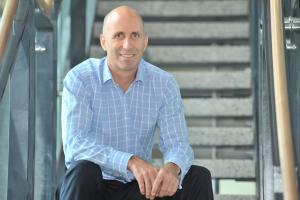
A new national group of New Zealand’s leading tech experts was formed in Auckland today, because the country is facing unprecedented growth and change in tech – which is now the nation’s fastest growing sector.
Tech Leaders has been set up with the support of NZTech and is a group of passionate New Zealand tech, digital and ICT focused-executives from leading organisations that will work together, with the support of NZTech, to use their experience to help address tech related issues of national importance.
NZTech chief executive Graeme Muller says New Zealanders are seeing dramatic tech changes the likes of which have never been seen before.
“Electric car charging stations are popping up all over New Zealand and we are seeing the introduction of driverless cars and buses. A string of artificial intelligence and IoT devices are continually being introduced into our daily lives.
“With the ultimate goal of improving the prosperity of New Zealand underpinned by technology Tech Leaders will define, communicate and promote initiatives around the use of technology from their experience and perspective.
“These tech executive, from organisations such as Auckland Transport, Downer, Fonterra, Fletcher Building and Westpac, are at the coalface, driving the tech change in large New Zealand companies and organisations.“What they can see is new tech out there which will make New Zealand more efficient and businesses will benefit,” Muller says.
David Kennedy, Global Chief Information Officer of Transaction Services Group, is the first chair of Tech Leaders and he says it is up to the leaders to create a platform for the success of New Zealand today and for the future.
“To ensure international and domestic success of Kiwi businesses, it is vital we act now to consider what’s being covered in our education system. Learnings should be designed to develop global leading talent who can cope with all the opportunities and challenges of tomorrow’s world.
“Our education system needs to be producing these type of employees today. We do not have a shortage of skilled people – however, we need to be sure the education being provided is equipping people to succeed in today’s business, as well as tomorrow’s world.
“Tech Leaders is committed to delivering change to the very fabric of New Zealand. Never before has a group of the most senior tech executives got together in this way for the sole purpose of ensuring the prosperity of New Zealand.
“Tech Leaders will work together to answer the toughest questions around the impacts and opportunities of new technologies. Large firms are piloting artificial intelligence tools and fleets of vehicles will soon become driverless, potentially costing thousands of jobs.
“This is just one of the questions we should be asking… What should the government and New Zealand’s largest firms be doing to protect the livelihood of Kiwi families that rely on driving jobs for the food on their table when, not if, autonomous vehicles are widespread on New Zealand roads,” Kennedy says.
| A MakeLemonade release || September 28, 2017 |||
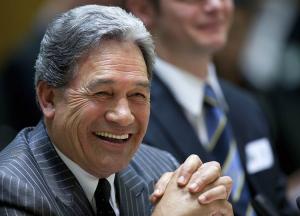
Regal blended with power
New Zealand’s Ministry of Foreign Affairs & Trade stands out as the obvious and logical destination for Winston Peters MP in the country’s pending new Parliament.
It combines for Mr Peters the correct blend of high office and of practical power that he requires in the current Parliamentary re-shuffling.
Under New Zealand’s proportional representation system the mix of seats and percentage vote share that his New Zealand First Party achieved leave him as the make-weight in the practical outcome of the general election..
There are two key factors that make MFAT (pronounced M-Fat) as the ministry is rather clumsily described the obvious choice.
The current minister Gerry Brownlee MP holds is essentially as a caretaker whose trouble shooter role has now been amply discharged.
Mr Brownlee will not complain if he is reassigned.
Then there is there is the sharp end of this ministry – the trade one.
Mr Peters believes that it is over focussed on the East, and notably the Middle East, and to the exclusion of markets in the NATO zone.
It is this trade aspect that dovetails neatly into his recent championing of the New Zealand farmer.
His Farmer First positioning was characteristically aimed at his own base.
New Zealand First votes come from traditional National Party supporters who become exasperated with National’s constant tempering of its policies to accommodate the ideological wing of the Labour Party, and only to a slightly lesser extent, the Greens.
The wisdom of Mr Peter’s pro-farmer stance was based on the confusion National has sown with its stance over water.
The National government allowed the whole vexed picture to become hopelessly muddied between the proven danger of agribusiness effluent intruding into potable water at one end; and on the other the vogueish clamour against the export of water in any form.
Mr Peters will not be an entirely welcome figure at the helm of MFAT.
On its diplomatic side, the department listened to the wrong people in the matter of the outcome of the United States presidential race.
It failed to give guidance correctly over the outcome with some embarrassing results.
Among these in practical terms was the New Zealand temporary contingent on the UN Security Council backing the censuring of Israel, a step that alienated National’s staunch support among urban fundamentalists.
Mr Peters is at home with protocol and is familiar with the Foreign Ministry.
Such a role would allocate him the prestige he seeks along with the exposure to ensure that everyone sees that he has it.
He will not wish to get himself tied down in one of the nuts and bolts ministerial departments of the type that will be required to implement several of his high profile announced policies.
These include the referendum on the existence or otherwise of the Maori seats.
Also the broader-based one on trimming the volume of members of parliament which are often viewed as proliferating.
| From the MSCNewsWire reporters' desk || Sunday 24 September 2017 |||
New Zealand is rapidly becoming a significant digital nation where technology is positively impacting on almost all traditional sectors such as banking, agriculture and tourism, the NZTech annual report says. Technology's momentum is now pulling along organisations from right across the New Zealand economy and tech has become the country’s fastest growing industry. NZTech chief executive Graeme Muller says their membership is rapidly growing to include not only tech firms but also banks, government agencies, universities and large traditional non-tech corporates. “NZTech has developed a national alliance, like a Star Alliance for tech, which now consists of 12 associations that, as of May 2017, collectively represent 423 organisations, who employ almost 100,000 people. This growing not for profit community is committed to creating more prosperity for New Zealand underpinned by technology. “Working with NZ Story, NZTE and MBIE we have also started the development of a New Zealand Tech Story to assist exporters. The international perception that New Zealand produces good food and is a great place to visit can be enhanced through building our reputation as a high-tech nation. “In May, to further develop our international reputation, NZTech produced Techweek’17. The Techweek team coordinated a national network of event hosts, city partners, government agencies and tech organisations, delivering 287 events across 24 towns and cities during the week. In May 2018 Techweek will be run again throughout New Zealand with a focus on attracting hundreds of investors and international delegates to see our best NZ tech. “Another significant project, the LookSee campaign, was designed in partnership with WREDA, Workhere and Immigration NZ to help attract high quality tech talent to New Zealand. Offering 100 senior developer roles and free flights to job interviews attracted 1.8 million people with 48,000 applying for the roles. We now have a database of over 19,000 experienced tech workers ready to shift to New Zealand if the right job opens up. “In terms of local talent, we have been inspiring girls into tech, by partnering with the Ministry of Youth, to expand ShadowTech Day to eight cities. A day where women in tech roles have a year 10 girl shadow them to experience what it is like to work in the tech sector. Work also continues with the Ministry of Education on the introduction of the digital technology curricula into all schools at all ages in 2018. “NZTech will continue to raise the profile of the tech jobs as great places to work, and tech firms has critical for the future growth of the economy ,” Muller says. The new NZTech board is Mitchell Pham (Augen – and chair), Barrie Sheers (Microsoft), Eva Sherwood (Oracle), Mike Smith (IBM), Paul Deavoll (Spark), Leigh Flounders (Latipay), Melissa Firth (Te Papa), Rachel Kelly (SparkTank), Sarah Hindle (Tech Future Lab), Kim Connolly-Stone (MBIE), Tom Chignell (Unitec) and Robett Hollis (Aranui Ventures). For further information contact New Zealand Technology Industry Association chief executive Graeme Muller on 021 02520767 or Make Lemonade media specialist Kip Brook on 0275 030188
| A MakeLemonade release || September 21, 2017 |||
Mysterious background contributes to aura
United States Vice President Mike Pence’s tribute to the passengers who overpowered the crazed psychopaths who sought to commandeer on September 11 2001 United Airlines Flight 93 included reference to a New Zealander who is now all but forgotten in his native land.
Alan Anthony Beaven is increasingly being seen as one of the key passengers on the flight who physically suppressed the gang to the point at which the flight from Newark to San Francisco crashed into a field at Shanksville, Pennsylvania, instead of into its target which is now considered to have been the Capitol, Washington
Mr Beaven, 48, had been seated toward the back of the plane. His distinctive New Zealand accent is clearly audible on cockpit recordings.
Evidence of his remains and personal belongings were found in the cockpit.
A burly fellow, Mr Beaven, is even regarded as a symbol of the determination, especially in regions such as Pennsylvania, of the single-minded determination in the United States to rid itself of lethal fanaticism.
Paradoxically Mr Beaven’s own career as a crusading attorney had devolved into campaigning for exactly the same category of liberal causes that are often associated with apologists for the current Salafist kamikaze plague.
Mr Beaven appears to have hailed from Devonport, Auckland. Along the way he acquired a law degree. It is now that his career becomes uncertain. He left New Zealand at any early stage and found a berth at one of the more venerable English universities. Here he seems to have pursued graduate studies and also to have served in a tutorial capacity.
From there he seems to have shifted to private practice and in this capacity appears to have served as a public prosecutor notably on behalf of Scotland Yard.
He contracted his first marriage, one enriched by his sons.
His move to California now provided this “citizen soldier” as Vice President Mike Pence described him with what gives all the signs of being his true vocation, that of a skilled and audacious public interest environmental protection lawyer.
Much has been made in the United States of the placard in his California legal office
It was of the homily variety so familiar to anyone who does business in the United States.
But in the instance of Mr Beaven it proclaimed, Fear? Who Cares?
The mystery, and thus the curiosity surrounding Mr Beaven has only intensified with the New Zealander becoming the focus of one of the conspiracy plots clinging to 9/11 and those associated with it in any practical way, as Mr Beaven fatefully was.
The theory floats around the notion that Mr Beaven was deliberately programmed to have been on the flight.
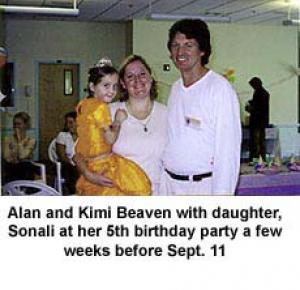
This notion hinges on a seemingly last minute decision to take the flight to sort out a client tactical legal problem, prior to taking an extended tour of Asia with his second wife and their daughter (pictured with Mr Beaven.)
And so it goes on.
Meanwhile, Vice President Pence who spoke of his boss, President Donald Trump’s insistence on the enduring recognition of the valour of the passengers on the flight, spoke of the Tower of Voices memorial planned for the Flight 93 crash site.
The memorial is scheduled to include 40 chimes that each sound its own note, intended to symbolize the memories of the “bravehearts” as those who fought the thugs to a standstill were described.
The acclaim and regard and from so many quarters in the United States gathering around the memory of Mr Beaven indicates an opportunity for a response in the land of his birth.
Indeed Mr Beaven can be viewed in New Zealand as a symbol of how contrived mediatique “heroes” such as those in sports or the finance sector or simply self-proclaimed ones, have utterly overwhelmed the much rarer spontaneous variety who instinctively and without thought of reward put their own neck on the line.
| From the This email address is being protected from spambots. You need JavaScript enabled to view it. reporters' desk || Friday 15 September 2017 |||

Tattoos and piercings are emblems of tribal allegiances
The re-emergence of the North-South divide in the United States supplies further evidence of the way in which the English-speaking zone is being overtaken by tribalism.
This fresh evidence of tribal divergence follows on the heels of the determination of the previous United States presidential dynasties to fight their supplanter, President Donald Trump.
The continuing politicking of the Clinton, Bush and Obama families campaigning seamlessly against the victorious candidate is classic tribal activity in that it cuts across constitutional political transitional processes, writes our roving reporter National Press Club president Peter Isaac.
The advent too of the presidency as a presidential family collective is still further evidence of this tribal drift.
The magnetic pull of tribal resurgence though is most evident now in the United Kingdom..
There the continuing Scottish secession agitation seeking to break away from England remains the most obvious example in the English-speaking zone.
The UK tribal factor became more evident now that any remaining economic underpinning of this breakaway movement has evaporated with Scotland’s bankrupt banks now being controlled from London.
The retribalizing of the English-speaking zone is taking place through stealth, and very largely because the institutions that exist to monitor such a development remaining mute about it.
University socio-political faculties deliberately choose to ignore this increasingly manifest development for fear of upsetting politicians and thus their own funding..
Universities refuse to see such every day and human evidence of tribalisation as the tattooing and other examples of self-adornment and self-mutilation of the entire socio-economic spectrum from show-biz types (pictured) to the industrial and administrative middle class.
This practice once confined to practitioners of virile callings, notably sailors, is now exploding into the elites, notably females whose tattoos are now so much bolder than those once displayed by sea farers, and those in other such danger-prone occupations..
Only Australia according to a covert European evaluation of tribally-inspired fractionalisaton possesses the equivalent of the United States 19th century melting pot, and was thus free of the threat of this resurgence.
New Zealand in contrast has deliberately nurtured tribalism through its parliamentary electoral system, a state of affairs now being actively challenged by the New Zealand First Party and also by Dr Don Brash’s Hobson’s Pledge movement
Official action within New Zealand to curb its tribally-based gangs is deliberately muted in order to appease an elitist political class.
This views and even encourages these anti-social collectives replete with their tribal markings and paraphernalia as evidence of repression inflicted on adherents during and after the imperial era, and thus living emblems of a collective guilt.
Canada is another example.
The largest English-speaking nation geographically must appease its French-speaking minority regions, and must do so with increasing emphasis and intensity.
Tribalisation in this English-speaking zone is now taking the form of a pulling away from a concerted national collective direction and instead reverting to an atavistic romantic blend centred on a notion of an oppression-stoked grandeur of times past.
Another element pointing to the institutionalised pandering to tribalism in the English –speaking zone remains the Westminster Green Paper on broadcasting and its stated need for mass access i.e. customisation to cater to these sectorised and evolving tribal patterns.
In other words Whitehall is accommodating and acknowledging this accelerating tribalisation drift and is accordingly setting about installing the policies needed to appease it.
Universities and other publicly-funded institutions indicate a deliberate and harmonised complicity in ignoring in spite of the evidence this gathering tribal momentum
Indeed, academic institutions supposed to measure the growth of the practical expression of the tribal instinct are often filled with individuals themselves emblematically part of it.
These are their operatives consciously or unconsciously succumbing to the resurgent tribal pull in the form of neck and sleeve arm tattoos and expandable ear lobe insertion devices among the other physical adornments associated with traditional tribal allegiances.
| From the MSCNewsWire reporters' desk || Wednesday 13 September 2017 |||
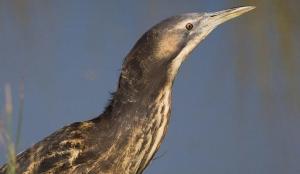
Fonterra’s Maungaturoto manufacturing site in Northland, New Zealand has recently become home to a rare Australasian Bittern.
The Australasian Bittern, or Matuku as they are known, is a large, heron sized bird. They are rarely sighted because of their secretive behaviour and camouflage technique and are usually most active at dawn, dusk and through the night.
Long serving utilities operator at the site Gary Sosich said he had seen the rare bird while doing routine checks on the site’s stormwater diversion system. He then realised that there was two of them, indicating that there may be a breeding pair living in the wetland. Maungaturoto Environmental Manager Steve Gale says, “It’s positive to see our stormwater treatment wetland is supporting biodiversity. It’s a credit to the stormwater management system we have in place.”
“The bittern population in New Zealand used to be abundant, but there is now thought to be less than 1,000 left due to habitat loss. It’s encouraging to see that our constructed wetland is a comfortable home for them and somewhere that they feel safe.” The bird is an indicator of wetland health, due to their dependence on the presence of high quality and ecologically diverse habitats with a rich food supply
| A Fonterra release || September 9, 2017 |||
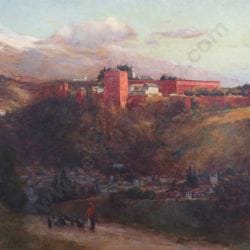
Palace of the Alhambra, Spain
By: Charles Nathaniel Worsley (1862-1923)
From the collection of Sir Heaton Rhodes
Oil on canvas - 118cm x 162cm
Valued $12,000 - $18,000
Offers invited over $9,000
Contact: Henry Newrick – (+64 ) 27 471 2242
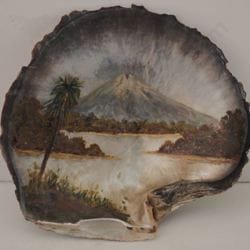
Mount Egmont with Lake
By: John Philemon Backhouse (1845-1908)
Oil on Sea Shell - 13cm x 14cm
Valued $2,000-$3,000
Offers invited over $1,500
Contact: Henry Newrick – (+64 ) 27 471 2242

|
|